Masttro Software Alternatives: Why Each Is Listed and What to Test
Compare ten Masttro alternatives by the family-office job they may serve, then test candidates with the same demo and written scope.

The top alternative to Masttro depends on the job your family office needs the next system to own. For investment analytics, investigate Addepar. For aggregation and reporting, investigate Asora. For accounting-backed records, start with Archway, Asset Vantage or FundCount. For a broader operating workflow, inspect Eton Solutions AtlasFive or MYFO. Aleta, Altoo and Landytech Sesame One address more specific data, family-view or multi-asset reporting requirements. These ten products are investigation candidates. We have neither ranked nor tested them hands-on; some may complement the current Masttro setup.
- Write down the report, record or workflow your current Masttro setup cannot deliver to your standard. Check whether configuration or an integration would solve it before planning a replacement.
- Shortlist by that unmet job. Ask every vendor to process the same dated holdings, entity structure, private-fund correction and role-access request.
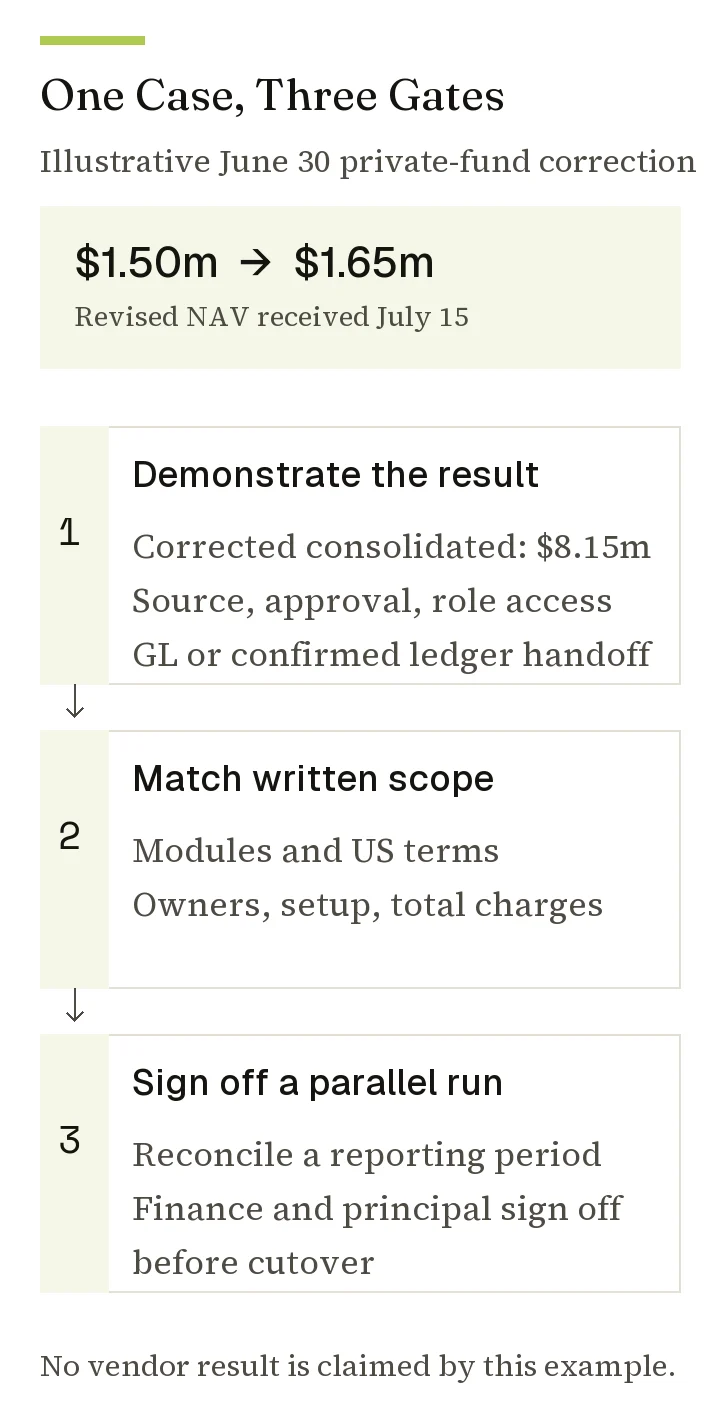
- Advance a demo-passing candidate to contract and migration review. Select it only when written scope matches the test; authorize cutover after a parallel reporting period reconciles and the required people sign off.
01What Masttro Covers and When a Change Makes Sense
Masttro describes a broad family-office platform spanning entity and asset visibility, source feeds, alternative-investment document processing and consolidated reporting. An alternative is worth investigating when the office can name an output, control or responsibility that its present configuration does not meet, and can show why a change would solve that problem.
Masttro's Documented Baseline
Masttro's family-office product page describes an interactive map of entities and assets, direct connections to banks and custodians, extraction of data from alternative-investment documents, and reports that can be shared inside the platform. Those are the baseline claims against which a proposed replacement should be tested. The page also uses broad language about office-wide work; it would be unsound to infer from a missing detail on that page that Masttro lacks a particular accounting, workflow or integration capability.
Document the current implementation alongside the vendor's product catalog. Which custodians feed it today? Which private assets require manual updates? Who validates entity ownership and period-end valuations? Which reports do principals receive, and from which system do the figures originate? An office may need a connected accounting book, a different reporting experience or a better approval process without replacing every part of its stack.
Define the Unmet Job Before Shortlisting Software
Write the requirement as an observable result: “The June consolidated report must tie to approved entity books and show the source and effective date of the revised private-fund net asset value (NAV).” That is more useful than “better reporting.” It identifies what the replacement or complementary system must produce, who must approve it and what would count as failure.
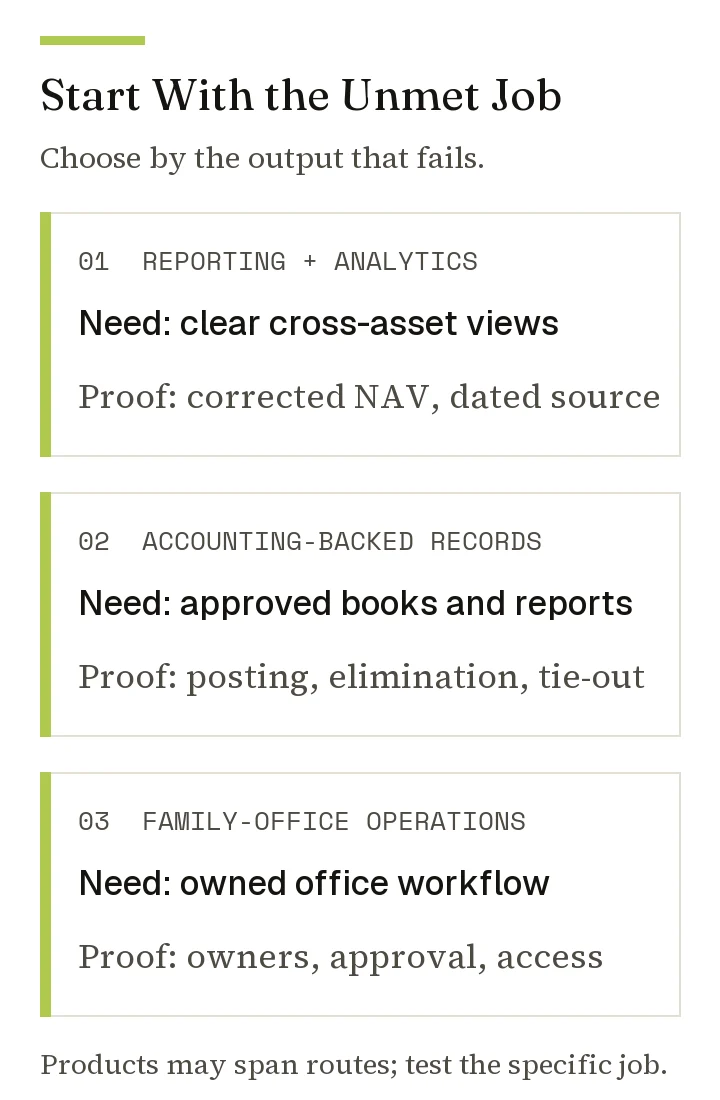
Three routes organize this shortlist. Reporting and analytics addresses data consolidation, exposure analysis and stakeholder views. Accounting-backed records puts posting, reconciliation and report lineage closer to the core. Family-office operations links entities, documents, people and transactions across recurring work. Products may span routes; the group identifies the first buyer job to investigate. A personal portfolio tracker, including an open-source option such as Ghostfolio, can be useful for a narrower owner portfolio. A multi-entity office would need to test its accounting, permissions and service model before treating it as an equivalent operating system.
02How We Chose and Compared the Software
The ten products below have current vendor pages that describe a family-office or closely related complex-wealth workflow and a plausible route to one of the jobs above. Their pages establish vendor-described scope. Independent performance remains untested here. The order follows buyer job and then product name; no overall ranking is implied.
Inclusion Rules for a US Family Office Shortlist
A candidate belongs here when its vendor documents relevant product scope, the office can state why that scope matters, and a decisive demo question can be posed. The list includes different kinds of purchases: software alone, software plus services, and platforms with separate modules. Those differences matter when comparing proposals. Inclusion does not establish that a vendor serves every US structure or that a package includes every advertised module.
Altoo is a conditional cross-border investigation candidate. Its multi-family-office page supports its relevance to family reporting, but the reviewed page does not establish current US delivery and contract scope. A US buyer should obtain that in writing before moving it onto a live procurement shortlist. Likewise, each other vendor must confirm the applicable entity, data, service and implementation scope in its proposal.
What Documented, Connected and Unknown Mean
In this comparison, vendor-documented means the company's current page describes a capability. Connected means the described outcome depends on an interface, partner or separate system. Demo to verify means the public description does not establish the required configuration or result. Unknown means the reviewed evidence cannot answer the question. A blank public claim is not proof that a feature is absent.
These labels prevent a common comparison error. A vendor page that says “accounting” does not by itself show whether the product is the approved general ledger (GL), a portfolio accounting subledger, an accounting integration or a service performed by a team. The buyer must see a transaction posted, corrected, approved and reflected in the report, then confirm which party owns each step. All vendor pages cited here were reviewed on 13 October 2026; product packaging and availability can change.
03Reporting and Analytics Alternatives to Masttro
These five candidates merit attention when the primary unmet job concerns consolidated wealth data, investment analysis or reports for different audiences. Several advertise broader accounting or workflow capabilities. The office should test those separately instead of assuming the category describes the product's full boundary.
Addepar: Investment Analytics and Reporting
Addepar's family-office page describes aggregated investment data, alternative-data extraction, interactive views and permissioned portals. It also describes integration with general ledgers and existing infrastructure. Investigate it when the office needs exposure analysis or investor-quality reporting across complex holdings.
The distinction to test is where the authoritative books live. Addepar's published GL language describes an integration. Ask where the authoritative ledger remains in the proposed setup. In the common demo, trace a corrected private-fund NAV through the analysis view and principal report, then show the ledger interface and exception owner. Request the feed list, integration scope, portal permissions, implementation plan and priced modules. If books remain elsewhere, name the reconciliation owner. For a Masttro-versus-Addepar decision, test Addepar's documented investment analysis and GL connection against the current Masttro configuration; a need for authoritative books also requires a separate posting and reconciliation demonstration.
Aleta: Structured Wealth Data and AI Workflows
Aleta's platform page emphasizes reconciled structured wealth data, extraction from private-market documents, an open API and a Model Context Protocol (MCP) connection for external AI tools. This warrants investigation when the office needs machine-readable fund data or automation around investment committee work.
The public description establishes an architecture claim. A particular AI workflow still needs to demonstrate the office's approval process. In a demo, supply the revised fund statement and require the extracted value, effective date, prior value, confidence or exception state, and a human approval trail before the report changes. Ask which API, AI and ingestion functions are contracted today, how incorrect extraction is reversed, and what complete export looks like if you leave. Price and setup need a proposal scoped to those functions.
Altoo: Family Reporting, With US Delivery to Verify
Altoo's multi-family-office page describes aggregation, consolidated reporting, dashboards and controlled collaboration among family-office staff and stakeholders. Its relevant buyer job is giving different family members an understandable view of the same underlying wealth.
This remains a conditional candidate for a US procurement. The reviewed page references clients in Switzerland and abroad but does not establish US commercial delivery, local implementation terms or the contract entity. Obtain written answers before a purchase shortlist. In the common demo, give a principal restricted access to one entity while finance retains the complete structure. Ask the team to show what each role can see, whether shared documents follow the same boundary, and how a revised NAV appears in historical reporting. Treat a polished dashboard without source and permission evidence as incomplete.
Asora: Aggregation and Reporting for Lean Offices
Asora's site describes automated aggregation, customized reports, ownership structures, private assets and an accounting area. An office seeking to reduce manual reporting should inspect how those functions handle its actual entity map. The reviewed page does not establish the implementation effort or continuing staff time for a lean team.
Ask Asora to import the two custody feeds and the private-fund statement in the common case, then show which records were automated, which needed manual approval and how the final consolidated report was assembled. Its public menu includes accounting, but the office still needs to establish whether its selected package supplies an authoritative GL, an interface or a different accounting workflow. Get the feed coverage, implementation work, module boundaries and support response in the proposal. A fast report matters only if the underlying exception is visible and assigned.
Landytech Sesame One: Multi-Asset Data and Reporting
Landytech's Sesame One product page presents a multi-asset source of data for analytics, reports and accounting. An office explaining exposure across asset classes should inspect its reporting route and test the accounting claim separately. The product page describes a GL, but the reviewed evidence does not establish which functions are included in a particular US contract.
Ask which reporting, general-ledger and entity modules are live and included in the specific US proposal. Run the dated NAV correction through both the analytical report and any accounting record, including approval and export. Request the data-feed coverage and implementation sequence for held-away assets. If a capability is on the roadmap or separately priced, mark it as such in the comparison instead of awarding it a current checkmark.
04Accounting-Backed Alternatives to Masttro
These products deserve a closer look when the office needs the same approved accounting records to support entity statements and consolidated reports. Vendor descriptions of a general ledger are a starting point. The demo must establish posting authority, intercompany elimination, correction control and the trail from journal entry to principal output.
Archway: General-Ledger Accounting and Services
Archway's platform page describes one general ledger supporting investment, entity and financial reporting, alongside cash, expense and administration functions. Archway is the current business name following the 2025 transaction. A controller evaluating a shared record for books and reports, plus possible operated services, has a reason to shortlist it.
The key purchase distinction is platform versus operated service. Ask who posts the private-fund valuation adjustment, who approves it, what the client can change directly and what an Archway team handles. In the common demo, trace the $0.15 million correction and the intercompany elimination to entity and consolidated statements. Archway describes fixed annual pricing based on entities, services and users. It says this model does not use assets under management (AUM); the reviewed page gives no comparable contract amount. Request a scoped quote separating software, implementation and recurring service responsibility.
Asset Vantage: Integrated Ledger and Portfolio Reporting
Asset Vantage describes an integrated general ledger, data aggregation and reconciliation, multi-entity views, performance reporting and documents. It is a direct investigation candidate when a family office wants accounting entries and portfolio reports in one configured environment. That reason deserves prominence: a controller can test both sides of the record instead of relying on a feature matrix's “accounting” checkmark.
Ask Asset Vantage to enter the revised NAV with its source document, show the entity-level posting and elimination, and produce a consolidated principal report that ties to the books. Check how direct investments, held-away balances and custody feeds enter the ledger, and who owns exceptions. Its public page describes the architecture but does not establish the precise US feed set, implementation workload, module entitlement or price for this office. Require those in the written proposal and inspect the audit/export trail before ranking it against Archway or FundCount.
FundCount: Accounting-Led Reporting Across Entities
FundCount's family-office page describes a common GL for trusts, LLCs, partnerships and individual holdings, with alternatives, document intelligence and reporting. It also describes automatic elimination across entities. That makes it a candidate when the office's pain lies in reconciling books, ownership and investment reports across several legal structures.
The claim should be tested with the office's own chart of accounts and ownership rules. In the common case, ask FundCount to show A's receivable, B's payable, the elimination, the revised private-fund value and the final $8.15 million consolidated amount, with the adjustment's approval history. Then inspect whether each report line can be traced to a source and whether the chosen configuration includes required portal or document functions. Request the module, implementation, data-conversion and service scope before comparing cost with another accounting platform.
05Family Office Operations Alternatives to Masttro
These two products are worth examining when the buyer's problem extends across entity records, documents, approvals and recurring office work. They also advertise accounting or reporting functions; the operations route does not diminish those claims. The decision is whether one system can assign and evidence the office's tasks without obscuring financial authority.
Eton Solutions AtlasFive: Integrated Family Office Operations
Eton Solutions' AtlasFive page describes entity and portfolio management, general-ledger and fund accounting, transaction processing, document management and related workflows. Inspect it when the office is considering a major change to its core operating system.
Ask for a workflow demonstration across the entire common case: receipt of the revised fund statement, assignment to an analyst, approval by finance, posting or accounting handoff, report update and restricted principal access. Identify which steps are native, configured, outsourced or separately contracted. A large advertised capability set can create a substantial implementation project; the proposal should identify migration owners, configuration work, training, go-live sequence and recurring support. The office should compare that scope with the benefit of replacing several tools rather than assuming every listed function arrives ready to use.
MYFO: Entity, Document and Planning Workflows
MYFO's product page describes entity mapping, reporting, document storage, integrations and roles and permissions. Its own Masttro comparison also describes forecasting, tasks and operational workflows. Those are vendor claims to verify for an office coordinating entity records, documents and stakeholder access.
The homepage also publishes large savings and onboarding claims; we do not use them as expected results for this office. Ask MYFO to demonstrate its vendor-described planning and task workflow: who receives the revised private-fund statement, who can approve a changed value, how the entity map affects visibility and what the principal report exports. Determine where authoritative accounting takes place and what data returns from that book. The price, integration access, migration effort and implementation schedule should be quoted for the exact roles and entities in scope. A task marked complete is insufficient if the approved number in the report remains stale.
06Compare the Ten Candidates on the Same Requirements
Use the same questions for every vendor, while keeping website descriptions separate from tested results. The tables below identify the vendor-described reason to investigate each candidate and the proof that could change the shortlist. “Verify” identifies an open buyer test; it assigns no negative product rating.
Aggregation, Private Assets and Entity Look-Through
| Candidate | Data and private assets on reviewed page | Entity structure or look-through on reviewed page | Common-case proof still needed |
|---|---|---|---|
| Addepar | Aggregation and alternative-data extraction documented | Complex investment structures described; exact ownership look-through to verify | Revised NAV in exposure and principal report. |
| Aleta | Structured data and private-document extraction documented | Entity ownership rules unknown from reviewed page | Effective date, exception and approved export. |
| Altoo | Aggregation and consolidated reporting documented | Entity ownership or look-through unknown from reviewed page | Entity-limited view, source trail and written US delivery scope. |
| Asora | Custodian aggregation and private assets documented | Ownership structures described | Both feeds and revised NAV in reconciled output. |
| Landytech Sesame One | Multi-asset data and reporting documented | Entity/ownership scope unknown from reviewed page | Live modules and report-to-record trace. |
| Archway | Public/private aggregation described | Look-through reporting described | Journal-to-report trail and service owner. |
| Asset Vantage | Aggregation and reconciliation documented | Multi-entity filtering/reporting documented | NAV posting, elimination and tie-out. |
| FundCount | Feeds and alternative-investment documents described | Trust, LLC and partnership books described; ownership look-through to verify | Entity books and elimination result. |
| Eton Solutions AtlasFive | Portfolio and document functions documented | Entity management described | Full document-to-report workflow. |
| MYFO | Integrations and document ingestion described | Entity mapping documented | Source-to-report trace and accounting handoff. |
The data and entity columns summarize each vendor's cited product page, reviewed 13 October 2026. The common-case proof column is our proposed buyer test; it does not claim any vendor has passed. If the office's entity structures, funds or reporting periods differ, change the inputs once and give the identical revised fixture to every candidate.
Accounting Authority, Reporting and Permissions
The decisive distinction is the approved record of value. An analytics platform may provide a strong consolidated view while posting remains in another system. A GL-centered platform may create the financial statement from journal entries. An operations platform may coordinate the approval and document trail while a separate book remains authoritative. The best fit depends on which responsibility the buyer intends to move.
The reviewed pages establish different levels of accounting and access detail. This compact map shows where the public claim stops; each row still needs the same posting, approval, reporting and unauthorized-access demo.
| Candidate | Accounting authority evidenced by reviewed page | Reporting and permission boundary |
|---|---|---|
| Addepar | Connected: GL integration described; native book authority unestablished | Permissioned portal documented; role behavior to test. |
| Aleta | GL authority unknown from reviewed page | AI/data workflow documented; report approval and roles to test. |
| Altoo | GL authority unknown from reviewed page | Reporting and collaboration documented; entity access to test. |
| Asora | Accounting function documented; GL authority and entitlement to verify | Custom reports documented; correction permissions to test. |
| Landytech Sesame One | GL/accounting documented; availability and package to verify | Reports documented; correction permissions to test. |
| Archway | Common GL documented; software versus service owner to establish | Journal-to-report claim documented; role control to test. |
| Asset Vantage | Integrated GL documented; posting controls to test | Multi-entity reports documented; role control to test. |
| FundCount | Multi-entity GL and elimination documented; rules to test | Reporting documented; approval/access to test. |
| Eton Solutions AtlasFive | GL and fund accounting documented; contracted modules to verify | Workflow documented; role control to test. |
| MYFO | Accounting integrations documented; GL authority to verify | Roles and permissions documented; actual restrictions to test. |
For each candidate, record four observations: where the correction is posted; who approves it; how a principal's report changes; and whether an unauthorized role can alter or view the underlying record. A documented GL is still an untested claim. “Connected” identifies an integration described by the vendor; “unknown” says the reviewed page does not settle the point. Do not put a cross against Masttro or any candidate merely because a public page omits a workflow detail.
Implementation, Pricing and US Delivery Scope
The reviewed product pages do not give comparable US annual prices for these ten configurations. The 13 October 2026 check covered one product page per candidate; other public pricing pages may exist. None of those ten product pages supplied a relevant amount. The separate MYFO vendor comparison and Archway's pricing-model description are disclosed below. All ten require written US contract, delivery and support terms for the actual entities and services. Altoo's US delivery and contracting remain specifically unverified on its reviewed page; obtain written confirmation before a purchase shortlist.
| Candidate | Buyer route | Package and implementation to quote |
|---|---|---|
| Addepar | Analytics/reporting | Feeds, GL interface, portal |
| Aleta | Structured data/AI | Ingestion, API, MCP access |
| Altoo | Family reporting | Roles, data, support; written US eligibility first |
| Asora | Aggregation/reporting | Bank feeds, accounting function |
| Landytech Sesame One | Multi-asset data/reporting | Live GL and reporting modules |
| Archway | Accounting/services | Entities, users, operated services |
| Asset Vantage | Ledger/reporting | Feed coverage, GL configuration, migration |
| FundCount | Multi-entity accounting | GL, document and portal modules |
| Eton Solutions AtlasFive | Office operations | Accounting, workflow modules, migration |
| MYFO | Entity/document workflow | Integrations, roles, workflow functions |
MYFO's own comparison advertises a starting price of $850/month. The displayed dollar sign does not by itself establish currency, US applicability, package inclusions or implementation charges; this office still needs a scoped quote. Archway explains a fixed annual pricing model based on entities, services and users, without a buyer-specific amount. For each supplier, request first-year implementation, license or platform charges, modules, data feeds, API access, document processing, training, outsourced work and ongoing support separately. Specify the number of entities, users, custodians and historical years, and ask what changes fees. Carry any quoted figure's currency, billing period, package, region, source and checked date into the comparison. A US-facing website alone cannot establish eligibility. Product descriptions alone do not establish US tax or regulatory compliance.
07Run One Common Demo and Record the Evidence
A common demo turns ten marketing descriptions into one comparable buying exercise. The case below is illustrative, with invented records and no vendor results. It tests the data, approval and reporting handoffs that a real family office can adapt to its own chart of accounts and entity structure.
The Illustrative US Family Office Case
Parent P owns Subsidiaries A and B at 100%. The office wants a consolidated statement and role-limited principal report for June 30, 2026. It supplies these dated source records to every shortlisted vendor:
| Record | Initial June 30 value | Corrected June 30 value |
|---|---|---|
| A custodian equities | $4.00m | $4.00m |
| B custodian bonds | $2.00m | $2.00m |
| P bank cash | $0.50m | $0.50m |
| B private-fund NAV | $1.50m | $1.65m |
| A receivable from B | $0.10m | $0.10m |
| B payable to A | ($0.10m) | ($0.10m) |
The private-fund manager's revised statement arrives July 15, 2026, but its value is effective June 30. The correction is +$0.15m. Before it, the total is $8.00m. After it, A has $4.10m net assets, B has $3.55m and P has $0.50m. Their sum is $8.15m; the $0.10m intercompany receivable and payable eliminate from gross consolidated balances without changing that net total. There are no minority interests, fees, taxes or other balances in this exercise. The accounting owner approves the correction before the revised report is released.
The difference between July 15 receipt and June 30 effective date matters. A system that only timestamps the upload may leave June reporting stale or restate it without an evident approval. Ask for the prior and corrected views, source document, effective date, user action and versioned report. The exercise tests an observable workflow; it does not establish candidate performance until the buyer runs it.
Required Outputs and Acceptance Checks
Give each vendor the same entity tree, feed sample, private-fund statements, intercompany entries and two user roles. Ask for these artifacts:
- Source and exception view: Show the old $1.50m and revised $1.65m NAV, the July 15 receipt, June 30 effective date, and an exception or approval state before release.
- Entity and consolidated output: Show A $4.10m, B $3.55m, P $0.50m and the corrected $8.15m total, with the intercompany pair identified and eliminated.
- Accounting authority: Show the $0.15m adjustment in the approved GL or a specified export and confirmation from the external ledger. Identify who can post, approve and reverse it.
- Role and export check: A principal receives the authorized consolidated view; finance can inspect source detail. Export both the final report and a usable source/exception log.
An unflagged $8.00m report after the revised statement fails the correction requirement. An $8.15m total with the source, dates and elimination trail passes the numeric part, subject to accounting and role checks. A module that has not been demonstrated is unknown and needs a retest. A required function confirmed excluded from the quoted package fails that package's requirement. A full demo pass advances the candidate to contract and migration review; it does not authorize cutover.
Copy the blank worksheet below for each vendor and quoted package. Replace the bracketed prompts with observed values and links to outputs; record “not shown” when appropriate. Mark each of the four demo requirements pass, fail or unknown. Record vendor identity, US contracting eligibility and written contract match separately; a confirmed unavailable arrangement fails a required purchase condition. No entry in this worksheet represents a vendor result until the buyer runs the test.
| Check | Buyer observation and evidence link | Result to enter |
|---|---|---|
| Vendor, build, modules and US contracting entity | [Enter names; link written confirmation] | [Written confirmed / unavailable / unknown] |
| Feeds and private-asset correction | [Enter feed IDs, old/new NAV, source, receipt/effective dates, exception owner; link output] | [Pass / fail / unknown] |
| Entity and consolidation | [Enter A/B/P totals, eliminated intercompany pair and consolidated total; link output] | [Pass / fail / unknown] |
| GL authority or external handoff | [Enter posting/export, approval and reversal owner; link output] | [Pass / fail / unknown] |
| Principal access and export | [Enter authorized and unauthorized role observations; link report and source files] | [Pass / fail / unknown] |
| Overall demo result | [Enter unresolved requirement and evidence link, if any] | [Pass / fail / unknown] |
| Implementation and written contract | [Enter migration owner/dates, included feeds/modules/services and first-year/ongoing quote; link proposal] | [Matched / gap / unknown] |
| Next action | [Enter issue owner, retest date or contract-review decision] | [Advance / fix / retest] |
The overall demo passes only if all four requirements pass. If any requirement fails, the overall result fails. Otherwise, an untested requirement leaves the overall result unknown. Contract match is a later gate, even after a demo pass. For example, “$8.00m after July 15, revised NAV unflagged” is an illustrative fail, assigned to the data owner for correction and retest. A numerical pass does not settle permission, GL or commercial questions. Keep the result sheet with the exported reports so a later contract or parallel-run check can reproduce the same test.
08Build Your Shortlist and Check the Switch
The right shortlist follows the job and the observed demo result. Start with two or three candidates from the relevant route, including Asset Vantage when integrated books and portfolio reporting are central, then reduce the list using the same pass conditions. A website description is enough to justify an investigation; a replacement decision needs reconciled output, assigned responsibility and a workable transition.
Choose Candidates by Job and Demo Result
| Primary unmet job | Candidates to investigate | What would advance one |
|---|---|---|
| Investment analysis, aggregation and stakeholder reporting | Addepar, Asora; add Aleta for structured private-market data or AI workflow, and Landytech Sesame One for multi-asset reporting with a GL-module test | Corrected holdings, source dates and permitted report views demonstrated with the common fixture. |
| Accounting-backed multi-entity reporting | Archway, Asset Vantage, FundCount | Approved NAV posting or explicit ledger handoff, intercompany elimination and report tie-out. |
| Integrated office workflow | Eton Solutions AtlasFive, MYFO | Named owners for document, approval, accounting and report steps, with purchased modules confirmed. |
| Family-stakeholder view with cross-border provider | Altoo, conditional | The same report and role test plus written US delivery, contract and support scope. |
These routes start the investigation. A candidate can move between them when its demonstrated and contracted scope warrants it. Compare financial software roles across a family office if the office is still deciding which system should own each record; the shortlist above assumes the buyer has identified that responsibility.
Check Data Migration, Contract Scope and Total Cost
Before replacing Masttro, obtain an export of current entities, holdings, transaction history, documents, valuations, ownership links and report definitions. Map each field to the new system and retain the old source identifiers. Reconcile opening balances and ownership at a dated cutover, then run one reporting period in parallel. The principal and finance approvers should sign off both the consolidated output and the permissions. For accounting-heavy offices, the record-to-report tests in our fund reporting software comparison offer related questions for fund-specific outputs; that is a different buying scope from the full family-office platform decision here.
Put the contract beside the demonstrated workflow. Does the quoted package include the feeds, historical conversion, API, document extraction, GL module, user roles and service staff that produced the passing demo? What changes after implementation, and how can the office export its data and reports if it leaves? Compare first-year and ongoing charges only after those scopes match. If an office uses the same software to prepare a client recommendation, the approval and record trail discussed in our investment proposal software guide is a separate downstream handoff.
Take the unmet-job statement and common fixture to two or three candidates in the relevant route. A demo pass advances one to written contract and migration review; matched scope supports selection. Authorize cutover only after a parallel reporting period reproduces the approved figures and permissions, with principal and finance sign-off. Until those gates are met, the office has an investigation or a selected implementation project. It has no completed replacement.
The coming shake-out in family-office software
The category has never been more crowded. Consolidation is coming — and the firms that survive will be… Knowledge & Decision · Analysis
Is a Multi-Family Office Right for Your Family? Compare Fit, Fees and Services
Compare multi-family office fit, services, fees and family responsibilities with an illustrative quote worksheet and provider-check questions. Knowledge & Decision · Analysis