Compare Asora Alternatives by the Records They Maintain and Reports They Deliver
Compare seven Asora alternatives by the records they maintain, reports they deliver and work a US family office would need to move or retain.

Top alternatives to Asora solve different problems for a US family office. Archway, Asset Vantage, Eton Solutions AtlasFive and FundCount describe general-ledger accounting alongside investment reporting. Addepar, Aleta and Masttro merit investigation when investment records, aggregation or family reporting are the main concern. Aleta describes a double-entry investment ledger that connects to specialist accounting systems. Choose a shortlist by naming the record that must change, then test whether each proposed configuration can own it.
- If legal-entity journals and the close must move, start with the four accounting-platform candidates. Verify the exact US package and entity workflow.
- If the books stay, test Addepar, Aleta or Masttro against the missing investment-data or reporting job. Keep the handoff to the existing GL explicit.
- Give every candidate the same capital-call notice. A new accounting core must show the entry; an investment ledger must show the GL handoff; a reporting layer must show the approved source and release. Require the contract and parallel run to confirm the proposed route.
01Asora Alternatives at a Glance: Which Work Could Move?
First check what your Asora deployment already maintains. The seven candidates below address different possible gaps; a reason to investigate one does not establish that Asora lacks the function or that the alternative will perform it in your configuration. Each row identifies the work that could move, the record that must still have an owner, and the first proof to request. “Unverified” means the reviewed material does not establish the point.
| Candidate | Reason to investigate against your current Asora setup | Work to move or retain | First discriminating test |
|---|---|---|---|
| Archway (formerly SEI Archway) | A single GL with partnership reporting and a possible outsourced operating model is the job to evaluate | Test moving entity journals and close; identify whether the office or Archway services would operate them | Trace one posted entry through the report and name its operator |
| Asset Vantage | Integrated investment and entity books may address a split between accounting and performance views | Test moving both books and consolidation; decide which current Asora feeds or reports would stay | Reconcile the investment and accounting views after one correction |
| Eton Solutions AtlasFive | Trust, partnership and approval workflows need to sit with the accounting core | Test moving those ledgers and controls; identify investment records and feeds retained elsewhere | Carry a trust or partnership call through posting and workflow approval |
| FundCount | Portfolio and partnership allocations need a shared GL-to-report trail | Test moving entity books and allocations; decide which Asora data and delivery work stays | Show the allocation, close and recipient report from one call |
| Addepar | Economic-ownership look-through or multi-source investment reporting is the missing job | Retain the posting GL; test whether Asora aggregation or reporting would be replaced and who approves imported balances | Reconcile entity and beneficiary look-through without double counting |
| Aleta | A double-entry investment ledger and accounting-ready handoff could replace a fragmented investment record | Retain the legal-entity GL; test which investment records move and who owns the mapped handoff | Trace investment transaction to mapped GL output and back |
| Masttro | Private-fund document processing, entity visualization or family reporting is the bottleneck | Retain separate accounting books; test which Asora private-asset records or reports move and how approved balances arrive | Review a captured call, payment status and released report |
For the wider software map, see our family-office financial software guide.
02What Does Asora Manage Today—and What Still Needs Proof?
Asora's current pages describe portfolio aggregation, private-asset records, asset-level accounting data and reporting. They establish a meaningful baseline for a replacement search. Whether a particular Asora configuration posts and closes a formal legal-entity general ledger remains unverified in the pages reviewed; ask Asora to demonstrate it before defining the replacement scope.
Portfolio Data, Private Assets and Asset-Level Accounting
Asora says it tracks commitments, invested capital, capital calls, distributions and valuations for private holdings. Its accounting page describes asset-level gains, income, fees, withholding tax and tranche-level book cost. Those are substantive records. A buyer should inventory which are already maintained in Asora, which arrive from a custodian or manager, and who approves a revision before replacing a working flow.
For example, the family office may already use Asora to track an unpaid fund call while its accounting team posts cash and payables in another application. Moving only the reporting layer changes the downstream view. Moving the books changes the posting and close process as well. The actual current setup, rather than the label “Asora user,” determines the migration boundary.
Legal-Entity Books and Report Approval
An asset's book cost is not the same question as a legal entity's complete general ledger. To decide whether a vendor can replace the books, ask for the chart of accounts, dated journals, bank and investment reconciliation, entity balances, intercompany treatment, period locks, approval history and financial statements. Ask Asora to demonstrate any applicable native or connected function before classifying its role in your office.
The report boundary matters too. Who can release a family report after an accountant revises a balance? Can the reader identify its valuation date, source version and approving person? If these steps are performed outside Asora, record those owners before you shortlist alternatives. The article's test below follows one notice through these handoffs.
03How We Compare Record Ownership
We included platforms whose current public material describes a relevant family-office accounting, investment-record or reporting role. The shortlist is conditional and unranked; product pages do not establish US contract scope or performance on your data.
What Counts as Evidence for Each Role
Here, a record owner is the system and accountable party that can approve a source value or posting and resolve an exception. Displaying a number alone does not confer that authority. For aggregation, check source, refresh date and exceptions. For an investment record, trace positions, commitments, cash flows, cost basis and valuations. For legal-entity books, require a journal, balance, close and approval trail. For reporting, trace a figure to its approved as-of record and recipient access.
What the Comparison Cannot Establish Yet
We have not run the products or audited contracts. Public descriptions leave the buyer's entity types, fund rules, permissions, hosting and US module entitlement open. Product-specific unknowns appear beside each candidate; an unmentioned capability remains unknown until demonstrated.
The price check covered current official pages and vendor-domain searches. It did not cover historical quotes, channel packages or negotiations. Displayed starting amounts cannot support a total-cost ranking.
04Alternatives to Investigate When the Books Must Move
These four vendors describe general-ledger accounting alongside other family-office work. Test them if legal-entity posting and close must change; their modules and operating models differ.
Archway (Formerly SEI Archway)
If the office wants one accountable operator for entity books and reporting, investigate Archway's platform. It describes a single general ledger supporting accounting, investment views and reports, plus partnership administration, bill payment and a client portal. SEI's acquisition announcement says its former Family Office Services business began operating as Archway in June 2025, which explains the older “SEI Archway” name buyers may recognize.
The commercial boundary is operating responsibility: software and outsourced services may have different owners, service levels and fees. Have Archway name who posts and approves the call, maintains feeds and controls portal release. Follow a journal-to-report trail with the operator identified at each step. If the trail relies on an unquoted service or manual exchange, establish who owns that step.
Asset Vantage
If Asora's investment view and the office's entity accounts diverge, Asset Vantage is a candidate for a connected investment and accounting record. It describes an integrated general ledger, investment book, partnership accounting and configurable multi-entity reporting. Its GL feature page says the investment and accounting books stay in sync and states support for US GAAP and IFRS.
Correct one partnership transaction and inspect the investment position, entity entry and consolidated report with their as-of dates. The result should be two reconciled book views with an exception owner. The US package must cover the relevant entities, accounting methods, feeds and any bookkeeping services. Our Asset Vantage alternatives comparison explores the replacement-versus-layer distinction in more detail.
Eton Solutions AtlasFive
When the new accounting core must also carry trust, partnership, payment and document workflows, investigate AtlasFive. Its page describes an integrated general ledger, trust and partnership accounting, entity management, investment operations, document handling and workflows. It says the partnership book reconciles with the general ledger and investment book.
That breadth creates a licensing and implementation question. Use the buyer's entity tree to follow a call from extracted notice to trust or partnership posting, payment approval and report. A written module list and staffing plan should show which parts are licensed, configured and operated by the office or a service partner.
FundCount
When partnership allocations and a controlled report release dominate the first close, investigate FundCount's family-office platform. It describes a real-time general ledger with portfolio and partnership accounting, consolidated entity views, reporting and an investor portal. On 15 October 2026, its pricing page displayed a Single Family Office / Asset Owner starting point of $35,899 per year, with digital-transformation and hosting fees in addition.
Follow an allocation-to-close trail: source notice, payment, partner or entity allocation, approved balance and recipient report. Price the full accounting-and-delivery scope, including portal, feeds, hosting and any close assistance. Hold the shortlist decision if allocation logic or release responsibility falls outside the quoted configuration. Our FundCount alternatives article examines a separate first-close correction case.
05Alternatives to Investigate for Investment Records and Reporting
These three candidates describe investment-data, ownership or reporting functions. Test them when the office expects to retain its legal-entity books. Addepar's and Aleta's reviewed pages do not establish a replacement entity close; Masttro explicitly says it is not a replacement general ledger. The accounting owner therefore remains part of each proposed route.
Addepar
If Asora's current view cannot answer who holds an investment across vehicles and beneficiaries, Addepar's family-office page describes a relevant route: multi-source investment data, private-market activity, ownership look-through, tailored reports and connections to general ledgers. The proposed route depends on approved source balances and accurate entity mappings; the buyer must assign ownership of each.
The product-specific test is ownership mapping. Supply one fund interest held through an LLC with two family beneficiaries; ask Addepar to show both the entity position and the individual look-through without double counting, then reconcile the cash movement and approved value to the existing books. The page's GL-integration description does not settle who posts the legal-entity journal, whether the interface is included, or when an accounting correction reaches a report. Record each boundary in the written scope.
Aleta
If the current gap is a controlled investment record feeding an existing GL, Aleta describes a built-in double-entry investment general ledger, transaction-level records across entities and currencies, reconciliation, reporting and specialist-accounting connections. Its investment ledger may prepare the accounting input; the office must still identify who owns each legal entity's financial statements and close.
Ask Aleta to identify the journal or summary sent to the existing accounting system, the mapping from investment transaction to entity account, the reconciliation control and the person who approves it. Then change the source notice and see whether both sides retain a traceable version. Aleta's public description does not prove that it can replace every formal entity book; equally, calling it “reporting only” would understate its described investment record. Include the specialist GL and interface in the cost and ownership discussion.
Masttro
If collecting private-fund notices and statements is the bottleneck, Masttro's family-office page emphasizes an asset-and-entity map, alternative-investment document extraction, capital calls, distributions and consolidated reporting. Its pricing page says its price does not scale with AUM and invites a tailored quote; the page reviewed provides no standard annual amount.
Test the route from a received capital-call notice to its extracted fields, reviewed commitment record and report, then show where the accounting team posts or confirms the cash and payable. Masttro's FAQ explicitly says the platform is not a general ledger or a replacement for accounting software; establish the interface to the office's retained books and who resolves a discrepancy between document data and bank activity. The linked Masttro alternatives guide examines other reasons an office might change its wealth-reporting stack.
06What Happens to a Capital-Call Notice After Asora?
The same notice can be handled by a new accounting core, an investment ledger feeding existing books, or a reporting layer using approved records. The correct choice depends on which system will own each step. This illustrative buyer exercise tests the proposed architecture; no named vendor has been run or scored on it.
Assume an LLC has a $2,000,000 commitment to a private fund. At 30 September 2026, paid-in capital is $600,000 and unfunded commitment is $1,400,000. A manager's $250,000 call notice arrives 1 October, due 15 October. At receipt, track $250,000 as called, unpaid; due 15 October. It is a subset of the $1,400,000 unfunded commitment, so do not add the two amounts. Under this example's convention, paid-in remains $600,000, unfunded remains $1,400,000 and cash has not moved. Once $250,000 is paid on 15 October, paid-in becomes $850,000, unfunded becomes $1,150,000 and bank cash is $250,000 lower. Assume no fees, recycling, FX, other transactions or valuation change caused by payment. The office sets its own recognition, payable, journal and approval policy.
| Event in the illustrative case | Commitment | Paid-in | Unfunded | Called, unpaid | Cash change from 30 September |
|---|---|---|---|---|---|
| Approved position, 30 September | $2,000,000 | $600,000 | $1,400,000 | $0 | $0 |
| Notice recorded, 1 October; no payment | $2,000,000 | $600,000 | $1,400,000 | $250,000 | $0 |
| Payment settled, 15 October | $2,000,000 | $850,000 | $1,150,000 | $0 | −$250,000 |
In this example, retain the separately approved 30 September valuation and as-of date; the cash payment alone does not revalue the fund. A later value enters through the office's approved valuation process. The table follows the chosen paid-in and unfunded convention; an accountant may recognize a payable at notice under the office's policy without treating that as cash paid. Give every vendor the notice, bank confirmation, entity tree, source dates and report recipients. The notice and dates are the common base case; complete each candidate's test with the office's actual ownership shares, trust or entity structure, operator assignments, approval rules and recipient permissions.
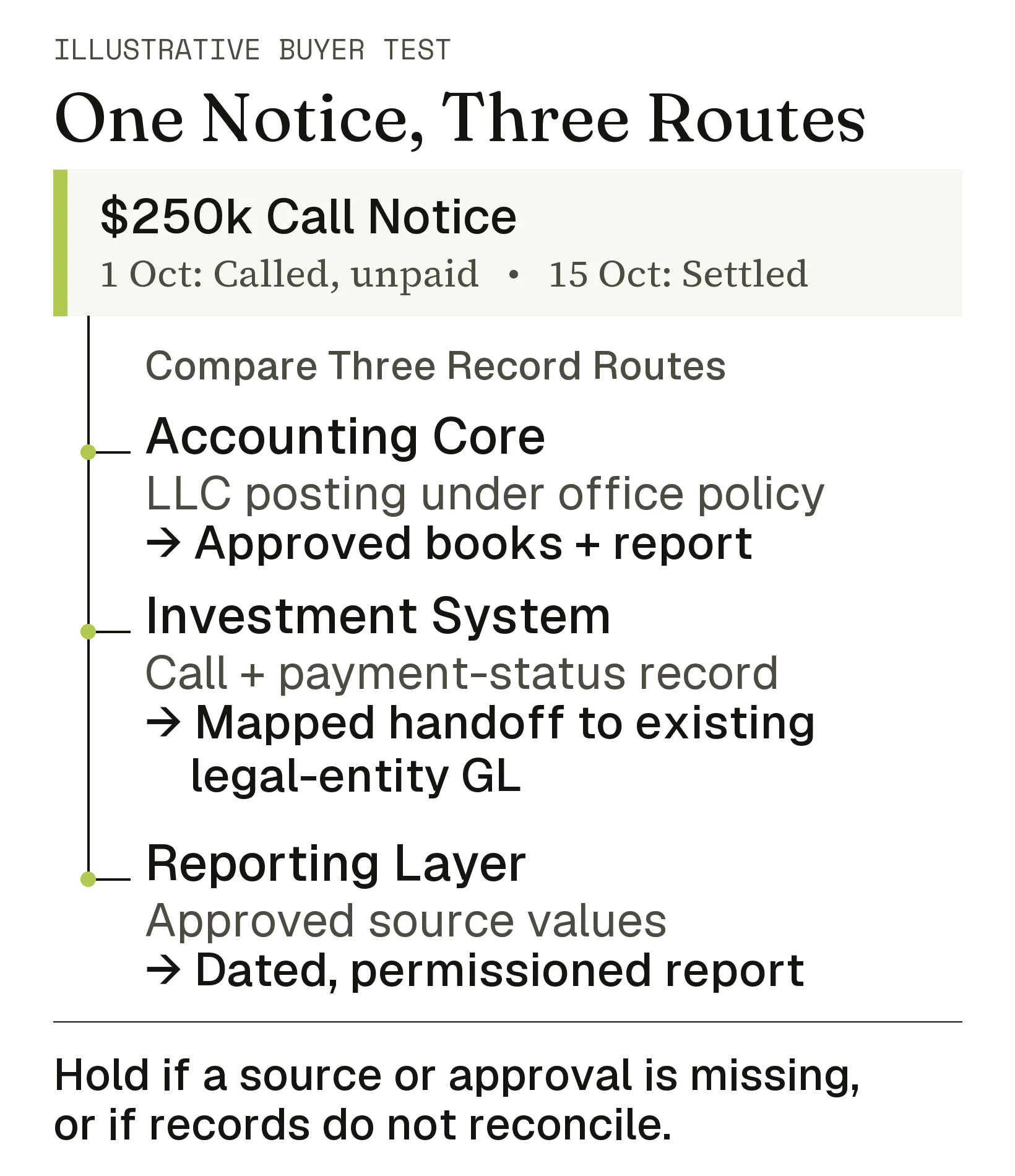
Illustrative ownership routes for the same call notice. The diagram shows buyer tests, not verified product behavior.
Route 1: A New Accounting Core Owns the Books
If the office replaces its GL, the candidate must show the LLC's dated posting under the buyer's recognition policy, payment reconciliation, changed entity balances and a report released from those approved records. The old Asora investment view may be retired, migrated or retained temporarily, but the proposal must name which product owns commitments and values after cutover.
Evidence artifact: journal and account audit trail tied to the notice and bank event, plus the before/after entity and family reports. Handoff owner: controller or outsourced accountant for posting and close; report approver for release. Hold condition: the report does not reconcile to the approved entity balance, or either its source date or required approval is missing. Archway, Asset Vantage, AtlasFive and FundCount describe GL accounting.
Route 2: An Investment System Feeds Existing Books
If the office keeps its GL, the investment system may own commitments, calls, payment status and investment views while an export, API or controlled summary feeds the accounting team. Aleta's described investment ledger makes this route especially relevant; other candidates could propose a connected configuration, but their actual interface must be demonstrated.
Evidence artifact: timestamped notice record, investment-ledger movement, mapped output to the existing GL and a two-sided reconciliation after the bank payment. Handoff owner: investment-operations reviewer for source data and accounting owner for posting. Hold condition: the outbound entry cannot be tied to the legal entity and approved bank event, or the two records disagree after correction. A report should flag that unresolved seam instead of silently presenting one side as final.
Route 3: A Reporting Layer Uses Approved Records
If Asora's reporting is what must change while the books and investment record remain elsewhere, the new layer should consume approved balances, commitment status and dated valuations. Addepar and Masttro are sensible candidates to investigate for this route; the vendor must show how its proposed feeds and access rules work with the office's systems. The journal stays with its accounting owner. The reporting layer must make the origin of each number inspectable.
Evidence artifact: source-to-report trace showing the 1 October call as unpaid, the 15 October settlement after approval, the unchanged valuation date and the recipient-specific released version. Handoff owner: finance owner for approved books and investment data, reporting owner for publication. Hold condition: an unapproved value would reach a recipient, an older valuation would be presented as current without its true as-of date and approval, or the report cannot be reproduced from approved records. An older, correctly dated and approved private-fund value can still appear under the office's reporting policy.
What Would Block the Report or the Switch?
A convincing demo is one gate. The written proposal must name licensed modules, feed responsibilities, service tasks, user roles, data rights and support for the stated US entities. In a parallel run, use one close and report cycle as a minimum illustrative gate; the office should set additional cycles and exception thresholds for its own complexity before cutover. Reconcile migrated history and a correction, then obtain the office's sign-off on the exception log. Hold report release if called-unpaid status, cash settlement or valuation date lacks an attributable source and approval.
07What Should a US Office Price and Confirm Before Switching?
A US office needs quotes for the same entities, feeds, modules and operating responsibilities. On 15 October 2026, Asora's pricing page set to US dollars and the $50 million to $100 million net-worth-under-management bracket displayed $15,600 per year and $3,900 one-time onboarding. That package listed 20 custodian accounts.
The page also displayed annual additions: $3,600 for 20 more investment accounts, $3,600 for up to 20 automated alternative-fund holdings via Canoe, and $4,000 for private cloud. FundCount's different Single Family Office / Asset Owner starting point appears above. These amounts leave eligible scope and comparable total cost open.
On the same date, Asset Vantage's pricing page displayed AV PRO for a US single-family office at US$30,000 a year for 10 entities, US$43,200 for 20, and US$55,200 for 30, billed annually. Its page presents managed services separately. Confirm entity eligibility, onboarding, feeds, hosting, taxes and service charges in a written US quote; the displayed AV PRO tiers are not equivalent to Asora's net-worth bracket or FundCount's starting package.
Subscription, Add-Ons and Services
Ask each vendor to quote the same entity count, assets, users, custodians, feeds, private-fund volume, reports and required service model. Separate annual software, optional modules, data aggregation or document-processing add-ons, implementation, historical conversion, training, hosting and ongoing outsourced accounting. A licence plus an existing GL may cost differently from a new accounting core with migration, even when their published starting figures look similar.
Record the price source, date, currency, bracket and exclusions. Confirm Asora's contractual currency and US applicability. FundCount adds digital-transformation and hosting fees to its published starting amount; AV PRO's entity tiers cover a different scope. Masttro describes a non-AUM price model and requests a tailored quote. The official pages reviewed yielded no standard comparable amount for Archway, AtlasFive, Addepar or Aleta; this limited search leaves other published or negotiated offers possible.
Custodian Feeds, Permissions and Migration
The US proposal should list each actual custodian or bank connection, update frequency, private-asset input, GL interface, legal entity, permission role and report recipient. Ask whether existing Asora data can be exported with source history and whether the candidate can import commitments, ownership, cost basis, valuations and document links without losing provenance. Confirm which party maps and validates those records.
During parallel operation, reconcile an opening balance, one notice and payment, and a corrected report. Agree on the exception owner and stopping rule before cutover. A vendor's security or feed count on a website cannot establish the permissions and connections in the buyer's deployment.
08Which Alternative Should You Test First?
Keep Asora for the investment records and reporting that its current deployment already handles well. Investigate an accounting core when the official entity books, close or operating responsibility must change. Investigate an investment-record or reporting layer when aggregation, private-fund documents, ownership views or report delivery is the gap. The shortlist below turns that distinction into a first demo and written-scope request; it does not award a vendor a pass before testing.
When the Books Must Move
If the office needs a new legal-entity accounting core, use the current arrangement's weakest handoff to choose the first meeting. Archway merits a conversation when operating responsibility may change along with the software; Asset Vantage when investment and accounting views diverge; AtlasFive when trust or partnership workflow is tied to the close; FundCount when allocations and recipient reporting are the pressure points. These are vendor-described selection cues. Bring one entity's chart of accounts and close policy; every candidate must still show a traceable journal, reconciled balance and controlled report reissue.
When Investment Records or Reporting Must Improve
If the legal-entity books remain, Aleta merits the first meeting for an investment transaction-to-GL handoff, Addepar for ownership look-through across vehicles and beneficiaries, and Masttro for a private-fund notice-to-family-report flow. Hold Aleta if the handoff to legal-entity books is unmapped or unreconciled; Addepar if look-through double counts or uses an unapproved source balance; Masttro if the notice or valuation would be misdated or misrepresented in the released report. Any candidate's report must identify approved inputs and the work retained in the incumbent stack.
What the Demo, Contract and Parallel Run Must Prove
| Buyer change | Candidates to test | Blocking demo result | Written scope to obtain | Parallel-run cutover hold |
|---|---|---|---|---|
| Replace legal-entity books | Archway, Asset Vantage, AtlasFive, FundCount | No balanced, dated LLC entry under the buyer's policy, or no trace from payment to revised approved report | Entity types, GL and partnership modules, migration, staffing and report permissions | First parallel close or revised report fails to reconcile |
| Retain GL, change investment record | Aleta | Call or payment status cannot map and reconcile to the retained legal-entity GL | Interface, journal authority, exception owner and historical data import | Investment and legal books diverge without an approved explanation |
| Retain books, change reporting | Addepar, Masttro | Look-through double counts, a notice disagrees with its approved commitment, or the report cannot reproduce approved as-of sources and recipient access | Feeds, refresh cadence, access roles, report formats and data rights | An unapproved value or an older valuation misrepresented as current would reach a released report |
Bring the same LLC, notice, bank event and reporting requirement to each first meeting. Advance a candidate beyond the exploratory shortlist when its demonstrated output addresses the missing job and the written proposal assigns each material handoff. Move to cutover after the parallel records and test report reconcile under the office's agreed exception thresholds.
The coming shake-out in family-office software
The category has never been more crowded. Consolidation is coming — and the firms that survive will be… Knowledge & Decision · Analysis
Is a Multi-Family Office Right for Your Family? Compare Fit, Fees and Services
Compare multi-family office fit, services, fees and family responsibilities with an illustrative quote worksheet and provider-check questions. Knowledge & Decision · Analysis