Seven Landytech Alternatives and the Work Each Could Take On
Compare seven Landytech alternatives by the work each could add or replace, then test records, books and reporting with one controlled correction.

The useful Landytech alternatives depend on which job a US family office needs to change. For custodial data and family reporting, investigate Addepar, Asora or Masttro. For a specific analytics or ownership-view gap, also test Asset Vantage without assuming its ledger must replace the existing books. If the proposed change includes legal-entity accounting, investigate Archway, Asset Vantage, Eton AtlasFive or FundCount. These seven are conditional starting points. No vendor demo or independent ranking informed the shortlist; the detailed comparison below is alphabetical.
- Establish which records your current Sesame One deployment owns and whether the advertised Accounting module is available and contracted for your US office.
- Give each shortlisted vendor the same sample custodian price correction. Ask for the source, investment record, accounting decision and approved family report.
- Decide whether to keep Sesame, add a connected system or replace records only after a demo, written scope and parallel close agree.
Seven alternatives at a glance
These routes identify candidates to test. No vendor has demonstrated a replacement for this article, and the shortlist assigns no award. “Keep the books” means retain the office's existing formal accounting system unless a separately scoped migration passes its own tests.
| Alternative | Work that could be added or replace Sesame work | What stays or needs a separate decision | Decisive question |
|---|---|---|---|
| Addepar | Could replace investment aggregation, analysis and family reporting. | Keep the formal entity books and verify the interface. | Can an approved investment value and its status reach the books and recipient report? |
| Archway | Could replace aggregation, accounting and reporting together; a direct, outsourced or hybrid operator may also take on the books. | Decide who operates and signs off the new GL; retain current books until migration is reconciled. | Who posts, reviews and owns the entity close under the proposed service scope? |
| Asora | Could replace investment aggregation and reporting, including tranche-level book-cost tracking. | Keep the formal legal-entity GL unless a separate book-of-record arrangement is proven. | Can the market value change without changing cost basis, with a controlled handoff to accounting? |
| Asset Vantage | Test its analysis or ownership view as a connected layer, or investigate replacing investment and entity books together. | For a layer-only route, keep the GL and prove its interface; for a full move, verify modules and entity-policy scope. | Does the scoped route reconcile the investment record, accounting decision and family report? |
| Eton AtlasFive | Investigate a broader move of investment, accounting and entity operations. | Decide which workflows and services move; keep the existing close until authority and history are proven. | Can the entity entry be reviewed and traced to reporting? Test trust or partnership work if those entities matter. |
| FundCount | Investigate moving the GL, investment records, allocations and reporting together. | Verify entity structures, feeds and who owns investor delivery; retain old books through parallel close. | Does the scoped ledger carry the entity adjustment into the correct report? Test allocations if a partnership is in scope. |
| Masttro | Could replace consolidated wealth visibility, entity mapping and family-facing reporting. | Keep the formal GL; Masttro says it is not a general ledger. | Can report access remain controlled until the external books decision is approved? |
0101. What Landytech Covers and What Still Needs Verifying
Landytech describes investment, corporate, accounting and reporting work within Sesame One. Its Sesame One 4.0 launch recap brings those functions into one product story. A buyer should test the current contracted Sesame scope before treating any rival's ledger or entity features as an upgrade.
Sesame One 4.0 and the Current Record Boundary
Landytech describes custodian feed setup, mapping and monitoring, alongside portfolio analysis and family reporting. Its 4.0 recap also discusses corporate records and a general ledger generated from investment activity. These are useful questions to take into a demo, but a product announcement does not show that a particular US office has every module, field, permission or accounting workflow in production.
Start with your own boundary. Which system holds the original custodian file? Where does a corrected price become the approved investment value? Which system contains the entity books? What generates the version the family receives? Our guide to mapping a family-office software stack explains the broader record-owner question. If these functions are already controlled in your Sesame deployment and connected accounting system, changing the whole stack may add work without solving the exception.
Sesame's documented baseline goes beyond the price-correction path. First identify which of these capabilities your US office actually uses and values; a replacement must solve a named gap without discarding a useful control or analytic view. These candidates are starting points for investigation. No comparative vendor test was performed for this article.
| Work the office may need to change | Landytech's documented Sesame approach | What to compare before leaving it |
|---|---|---|
| Custodian data and private-fund documents | Data management describes feed mapping and monitoring; its asset-owner page describes Doc AI for alternative-investment documents. | Test Addepar, Asora and Masttro for the required aggregation path. Separately show how a capital-call notice is captured, checked and linked to the correct holding; do not assume each automates that step. |
| Performance, attribution and risk | Portfolio analytics describes contribution, Brinson attribution, scenario analysis and stress testing. | Test Addepar or Asset Vantage if a specific analysis method or ownership view is the gap. Compare calculation definitions, source dates and permissions against the office's accepted Sesame output. |
| Report production and family access | The family-office offer describes scheduled, branded reports and portfolio views. | Test Addepar, Asora and Masttro for the recipient, format and release workflow the family needs. Require a versioned report and a permission check before assigning value to a different dashboard. |
| Entity structure and formal books | Sesame describes corporate management for entities, ownership structures and documents; its newer Accounting story needs the availability check below. | Test Masttro for estate mapping or Archway, Asset Vantage, Eton AtlasFive and FundCount if the formal GL and close may move. Name the posting authority and compare ownership look-through separately from book entries. |
Sesame Accounting: Availability and the Existing Books
The current Sesame Accounting page prominently says “Coming soon.” It describes journal entries and a general ledger generated from Sesame investment activity, while also saying the output can be exported by CSV to the office's existing accounting system. We therefore cannot assume either that Sesame is merely a reporting layer or that it is already a live replacement for a US family's formal books.
Ask Landytech which Accounting functions are generally available to your US entity structure, which are in your agreement, and which system remains authoritative for the close. Request a demonstration of the exact journal or export, review controls, reversals and downstream report lineage. Until then, account for the existing books in every alternative's operating cost and handoff design.
0202. One Custodian Price Correction, Four Records to Check
Use one fixed case to compare different software architectures. This illustrative buyer test uses hypothetical records, and no vendor has completed it for this article. It isolates a corrected custodian-supplied valuation mark for the same reporting date. Units and cash do not change; there is no new trade.
The Fixed US$50,000 Valuation Illustration
Use the same invented input card with every vendor. Before scheduling demos, have the buyer prepare and verify the original and corrected files in a custodian or agreed test-import schema. Keep the economic records and source IDs identical across candidates; document any format mapping separately. All times below are US Eastern; both files value the same June 30, 2026 position in one wholly owned family LLC.
| Fixed input | Illustrative record supplied to each candidate |
|---|---|
| Position identity | Fictional security TEST-SEC-01, USD, held by the same wholly owned family LLC in both files. |
| Original custodian file | CUS-0630-A, received July 1 at 09:00 ET: 10,000 units at the June 30 price of US$50. |
| Corrected custodian file | CUS-0630-B, received July 3 at 09:00 ET: the same 10,000 units at the corrected June 30 price of US$45. |
| Exclusions | No new trade, cash movement or change to the other US$9.50 million of net reported assets. |
| Opening books | The LLC uses fair value and its provisional June 30 books already carry this position at US$500,000 before the corrected file arrives. |
| Earlier report | FAM-0630-D1: an unreleased June 30 family-report draft showing US$10.00 million. Recipient access is blocked. |
| Expected result | Position US$500,000→US$450,000; reviewed US$50,000 downward book adjustment under this fixed policy; FAM-0630-F1 is the approved US$9.95 million first release. |
The position changes by 10,000 × (US$50 − US$45) = US$50,000. The total moves from US$10.00 million to US$9.95 million because the other net reported assets stay fixed. Units and cash do not move. These invented IDs make the sample reproducible; a later market-price movement would be a different event.
The June 30 family report is still a draft when the correction arrives. The controller has not authorized its first release. The office must establish that CUS-0630-B is the accepted source under its valuation policy, then retain the two file IDs, as-of and receipt times, reviewer decision and calculation. The wholly owned assumption matters: a different family ownership interest would change the family's share.
The legal-entity books are a separate decision. For the main sample, assume the LLC uses fair value for this security and its provisional June 30 books already carry the original US$500,000 mark before the corrected file arrives. The controller therefore expects a reviewed US$50,000 downward adjustment to that carrying value before close. Under a different adopted policy or a different prior book balance, the journal amount could differ or there might be no entry; that is a separate case requiring a documented policy decision and reconciliation. Neither outcome follows from a dashboard screenshot or a vendor's generic “accounting” label.
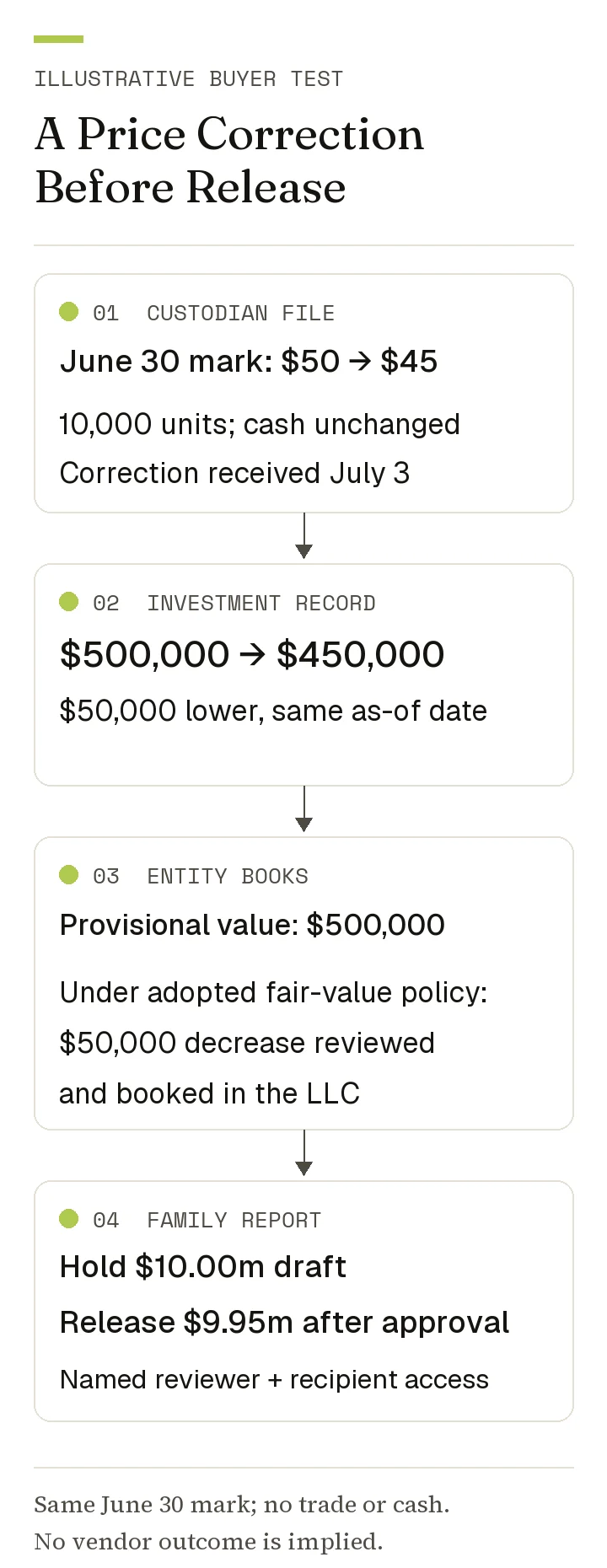
Illustrative buyer test. No vendor has demonstrated this result for this article. It assumes an adopted fair-value policy, a provisional US$500,000 book carrying value and no trade or cash movement; the downward adjustment is reviewed and booked before the US$9.95 million report is released.
What Must Change Before a Family Report Is Released
The correction crosses four evidence boundaries. The first three establish what is right; the fourth establishes whether anyone may see it.
| Record or decision owner | Expected evidence in this sample | Stop condition |
|---|---|---|
| Custodian/source owner | Original and corrected June 30 price files, source IDs, receipt times, 10,000 unchanged units and no associated cash movement. | Source authority or same-date replacement is unproved. |
| Investment-record owner | Old US$500,000 and revised US$450,000 position values, an auditable US$50,000 difference and the effective-date treatment. | The record accepts the new file but the report still uses the old value. |
| Books/controller | In the main sample, provisional book value US$500,000 becomes US$450,000 through a reviewed US$50,000 downward adjustment. A separate policy case may require a documented no-entry reconciliation. | The prior carrying value, adjustment or reconciliation has no named owner or policy basis. |
| Report approver | Draft with US$10.00m is held; corrected draft shows US$9.95m under these assumptions; reviewer signs off the intended recipient, as-of date and first release version. | A stale draft is accessible to intended recipients or released while the exception remains open. |
Use the correction to reject any proposed route that cannot preserve a controlled source-to-report path. A candidate may still merit investigation for another named gap when the current stack passes this test; prove that gap with the corresponding supplemental demonstration in §04. A visible corrected chart alone does not answer whether the source was approved, the books decision was taken or the family received the right version.
0303. Seven Landytech Alternatives and the Work Each Might Own
The early shortlist identifies the work each candidate might take on. The profiles below explain the vendor evidence behind those routes. Public descriptions do not establish that a US buyer has every module, that a named custodian feed works as required, or that any product passes the shared correction. A related Asset Vantage alternatives comparison explores the ledger-versus-reporting-layer choice from another incumbent starting point.
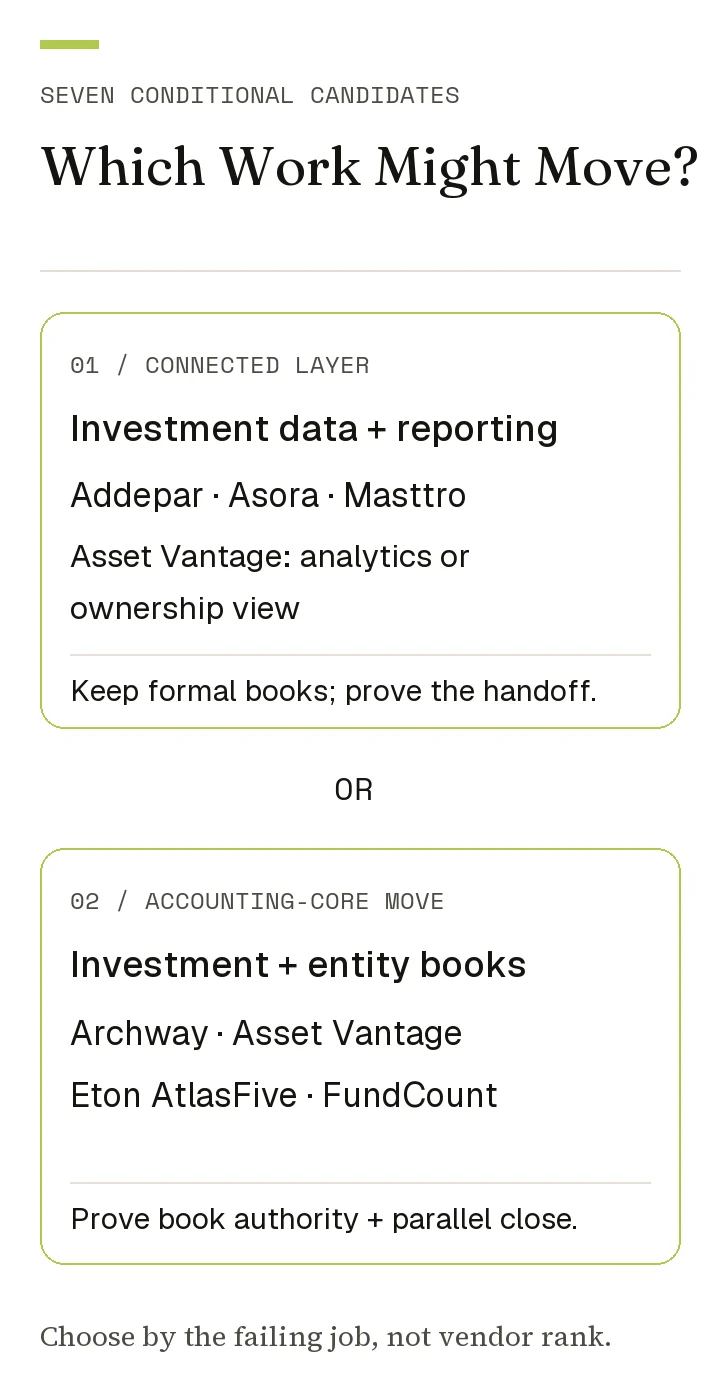
This map covers two ways to investigate alternatives, not a mandate to leave Sesame. Keep the current stack when it passes the required work; no listed vendor has demonstrated either route for this article.
Addepar
Addepar's family-office page describes multi-custodial data, illiquid assets, ownership look-through and integration with general ledgers. Investigate it when the family needs a different investment-data and analysis layer while its entity books may remain elsewhere. A customer quotation about fund accounting does not establish that Addepar is your formal entity GL. The decisive ownership question is how its investment values and approval status reach the office's existing books.
Archway (Formerly SEI Archway)
Archway describes aggregation, accounting and reporting built on one general ledger. SEI's July 2025 announcement says its Family Office Services business became Archway after the acquisition. This is a possible wider record-system replacement if the present pain is the split between investment, entity accounting and reporting. The ownership question is whether the contracted Archway GL would become the LLC's formal book of record and how that migration would be reconciled.
Asora
Asora describes custodial and alternative-asset aggregation, asset views and customized reporting. Its accounting page specifically describes tranche-level book-cost accounting, gains, fees and withholding tax. That is worth testing if investment data and family reporting are the bottleneck; it does not by itself prove a complete legal-entity general ledger. The differentiating question is whether a revised market mark changes the reported fair value while the security's cost basis remains unchanged.
Asset Vantage
Asset Vantage's product page describes an integrated general ledger, investment book, reconciliation and multi-entity reporting. It is a candidate when the office wants to investigate moving accounting and investment records together. The US package and entity structure determine whether its GL, investment book and report permissions cover the same LLC close; the public feature list leaves that entitlement open.
Eton AtlasFive
Eton's AtlasFive page describes an integrated GL, investment book, trust and partnership accounting and reporting. It is worth investigating if the family office's proposed change includes entity accounting and operating workflows. AtlasFive may be proposed with services, so the written scope must name who operates, reviews and signs off each module and source. That assignment determines whether the office is changing software, work ownership or both.
FundCount
FundCount presents a single general ledger beneath family entities, investments and reports. That makes it a candidate when the office is reconsidering the split between Sesame's investment record and its existing accounting system. The buyer-specific question is whether the scoped ledger can take authority for this LLC's valuation policy and history without leaving a parallel reconciliation in the old accounting system.
Masttro
Masttro's family-office page describes aggregation, an interactive entity-and-asset map and reporting. It belongs on the shortlist when the family needs a different consolidated record and delivery experience. Masttro's FAQ explicitly says it is not a general ledger and does not replace accounting software. Evaluate its investment-data and reporting work alongside a retained posting GL. The differentiating question is whether report access can remain blocked until that GL's close decision has an identified owner and signoff.
0404. Run the Same Buyer Test Across Different Architectures
Every candidate must account for the same exception and final report. Identify which part is native, integrated, exported or still manual. A ledger-bearing suite may show more steps inside one platform; an investment/reporting layer can still be viable if the books handoff is controlled and evidenced.
Show Before-and-After Source Records and the Investment Calculation
Give each vendor the buyer-prepared, verified pair of test files from the input card: June 30, TEST-SEC-01, 10,000 units, original USD price 50 and corrected USD price 45 received July 3. Keep the same source IDs and economic values across demos; agree any vendor-specific column mapping in advance. Do not add a new trade. Ask the operator to identify the source IDs, import/replacement time, accepted effective date, old US$500,000 value, new US$450,000 value and why no cash changes. The operator should also show how an exception is assigned and who can override or approve the mark. If the product cannot ingest the sample file, record that as a scoped integration task, not as an unqualified product failure.
Document the Books Decision and Hold the Earlier Report
Set one accounting policy and opening book balance before the demo. For the main path, the LLC uses fair value and its provisional June 30 books already show this security at US$500,000. The corrected US$450,000 mark therefore calls for a reviewed US$50,000 downward carrying-value adjustment before close. Ask the candidate or its connected accounting system to show the entry, its reviewer and the reconciliation to the family report. If your real office uses another policy or starts from another carrying amount, run a separate case and calculate its own journal or no-entry decision; do not silently switch assumptions between vendors.
The prior US$10.00m report is an unreleased draft. Ask the vendor to show who blocks access, how the US$9.95m version is generated, which as-of and version the intended recipient sees, and who authorizes the first release. If a correction instead arrives after a report has already gone out, that is a different test: identify recipients of the old version, notify or recall it under office policy, approve a new version and keep the version history. Do not call the held-draft case a reissue.
Use Pass, Fail or Unknown for each line, with its retained artifact and an owner. A line passes when its expected observation in the table is demonstrated and its evidence retained, whether the step is native, integrated or manual. Fail means an observed numeric mismatch, missing required control or uncontrolled release for that line. Unknown means the step was not observed or was only promised; a scoped import or mapping task stays Unknown until demonstrated. The overall sample passes only when all four lines pass: source replacement, investment recalculation, reviewed books decision and authorized corrected first release with the old draft blocked. A demo pass does not grant contract scope or cutover approval.
| Test line | Expected sample observation | Evidence to retain |
|---|---|---|
| Source | Both June 30 file versions, receipt times, accepted replacement and unchanged units/cash. | File IDs, source record, exception log. |
| Investment record | US$500,000 becomes US$450,000 for the same as-of date. | Position history, calculation and approval. |
| Books | Under the fixed fair-value policy and previously booked US$500,000 value, a reviewed US$50,000 downward adjustment; a separate policy case may instead document no entry. | Prior ledger balance, journal/review or policy decision and reconciliation. |
| Family report | US$10.00m draft blocked; US$9.95m corrected first-release version approved for named recipients. | Draft/version IDs, access log, approver and release record. |
The correction is the common control test. It cannot answer every reason for changing an investment platform. Run only the additional demonstrations tied to the office's approved requirements, using the same holdings, entities and recipient roles for every candidate.
| If the reason to switch is… | Additional demonstration to request | Evidence that changes the decision |
|---|---|---|
| Attribution or portfolio risk | Recreate one accepted period of contribution and attribution, then apply a named stress scenario to the same holdings. | Calculation definitions, benchmark and classification mapping, source dates, risk-method assumptions and explainable differences from the current Sesame output. |
| A new custodian or private-fund document workload | Onboard one additional account and process a sample capital-call notice with an intentionally ambiguous field. | Feed coverage, validation exception, extracted-field review, corrected holding or commitment, and the human approval retained before reporting. |
| Report production or family-facing access | Build the same period report for two recipient roles with different entity access, then change one approved data point. | Builder effort, version history, distribution controls and proof that the wrong recipient cannot see the other view. |
| Ownership look-through or entity operations | Trace one asset through two family entities to the beneficiary view and the posting books. | Ownership percentages, elimination or double-count treatment, book authority and the person who approves each view. |
Record a capability as Unknown if the proposed configuration cannot show it. A candidate can pass the common correction and still lose a required analytic, document or family-access workflow that Sesame already provides in the buyer's deployment.
Separate Demo Evidence, Contract Scope and Parallel-Run Approval
A successful sample is only the first gate. Require written scope for data and records (named custodians, fields, entities, book authority and calculation policy), controls (modules, exception roles, reviewers and report permissions) and delivery (implementation, recurring services and support). A vendor's adjacent module is not included merely because its website describes it. The fund-reporting software comparison develops the distinct reporting outputs and fund-type questions if the family office also acts as a fund GP.
Then run a parallel June 30-style close with your actual source files and accounting policy. The controller should reconcile opening and corrected holdings, the required book entries or no-entry decisions, and the recipient-ready report against the existing process. Approve cutover only after exceptions have owners, prior versions remain retrievable and the written agreement matches what the team observed. A candidate can pass the illustrative demo yet fail commercial scope or migration readiness; keep those decisions separate.
0505. What a US Family Office Must Price Beyond the License
Public list figures can orient a budget, but they do not yield comparable US total costs. The offers differ by currency, asset bracket, entity count, modules and services; the office may also keep Sesame or an existing accounting platform during a transition.
Public Figures and Their Eligibility Limits
| Public display checked 16 October 2026 | What it actually describes | What a US buyer must confirm |
|---|---|---|
| Landytech Sesame One Professional: £20,000/year + £3,000/year per custodial feed | Under-£100m family-office offer on a GBP page; three feeds make £29,000/year in recurring base-and-feed charges. The page separately says a one-time onboarding fee applies in year one without publishing its amount. | US eligibility, currency, feed definition, included modules, Accounting availability and the first-year onboarding quote. |
| FundCount: $35,899/year starting point, plus digital transformation and hosting fees, for the single-family-office solution | Public dollar-denominated starting subscription; the vendor explicitly adds transformation and hosting fees. | Actual US-dollar contract, transformation scope, hosting, implementation, data feeds and services. |
| Asset Vantage: US$30,000 / 43,200 / 55,200 yearly | SFO page selections for 10 / 20 / 30 entities, billed annually; the site also displays separate INR contexts. | US package and module rights, onboarding, data feeds and managed-service scope. |
| Asora: US$15,600/year + US$3,900 one-time onboarding | Selected USD US$50m to US$100m bracket. Other brackets change subscription and onboarding/support depth; extra account or alternatives packs and private cloud cost more. Asora says core features are not gated by tier. | Your bracket, account quantity, added packs, onboarding and support. |
For Addepar, Archway, Eton AtlasFive and Masttro, the primary product pages checked here did not establish a directly comparable public US total. A public price may exist elsewhere. Request written US proposals on the same family profile and leave any unquoted line open.
The Landytech page also lists “full platform access & onboarding” among its included items. Ask what that inclusion covers and how it relates to the separate one-time onboarding charge. Add that unquoted charge before treating £29,000 as a first-year budget.
Quote the Full Stack and the Migration Work
Give every vendor the same entity count, asset mix, custodians, data-feed cadence, report recipients, accounting policy and desired historical cutover. Ask them to separate subscription, custodial feeds, entity/user charges, implementation, historical data cleanup, interfaces, hosting, support and any managed accounting or administration. State which incumbent licenses and external accounting costs remain during parallel running and after cutover. A lower headline license can still leave the expensive handoff in your team's hands; the written responsibility map matters as much as the fee.
0606. Keep Sesame, Add a Specialist or Replace the Record System
The size of the change should follow the failing job. Keep Sesame when its feeds, analytics and reports meet the office's requirements and the remedy is clearer ownership or a module confirmed available and included in the contract. Add or replace an investment/reporting layer when a specific data, analysis or delivery test fails while the entity books remain reliable. Investigate an accounting-core migration when the legal-entity close or investment-to-books seam fails and the required control cannot be repaired within the current stack. Migrate only after the replacement proves the accounting policy, historical conversion, written scope and parallel close. Price each route with retained licenses, interfaces and transition work included.
Route the Decision by the Failed Handoff
| What the current office actually observes | Conditional route | Decisive proof before committing |
|---|---|---|
| Sesame feeds, investment values and reports already pass the sample; the bottleneck is process ownership or an uncontracted module. | Keep Sesame and repair responsibilities or clarify the current contract. | Same-source correction, named exception owner, blocked draft and written availability answer. |
| Investment data, analysis or report delivery fails, but the existing legal-entity books and close work well. | Investigate a connected investment or reporting alternative while retaining the books. Addepar, Asora and Masttro may be relevant; test Asset Vantage if its analytics or ownership view addresses the named gap. | The failed capability improves, the corrected mark and report release remain controlled, and the existing books receive a reconciled handoff without an assumed GL migration. |
| The investment-to-books seam fails and cannot be repaired in the current stack, or the office has chosen to consolidate entity accounting. | Investigate a ledger-bearing replacement such as Archway, Asset Vantage, Eton AtlasFive or FundCount. | Required entity setup, adopted policy, reviewed books entry, historical conversion and report lineage under a signed migration scope and parallel close. |
Use these investigation routes to choose demonstrations. They make no best-for award and do not establish that a named vendor lacks another capability. A buyer can keep Sesame for one function and add a specialist for another when a named team owns the interface and reconciliation.
The Written Acceptance Gate for the First Close
Before a first live close, require three matching records: the demo's retained exception evidence, the signed product-and-service scope, and a parallel-run result on the office's own data. Name the controller who may accept the book treatment and the person who may release the family report. If a source correction is unresolved, the old draft remains blocked. If a vendor cannot yet show or contract the required part of the path, leave that line Unknown; do not cut over, and keep a controlled fallback while repairing any existing process failure.
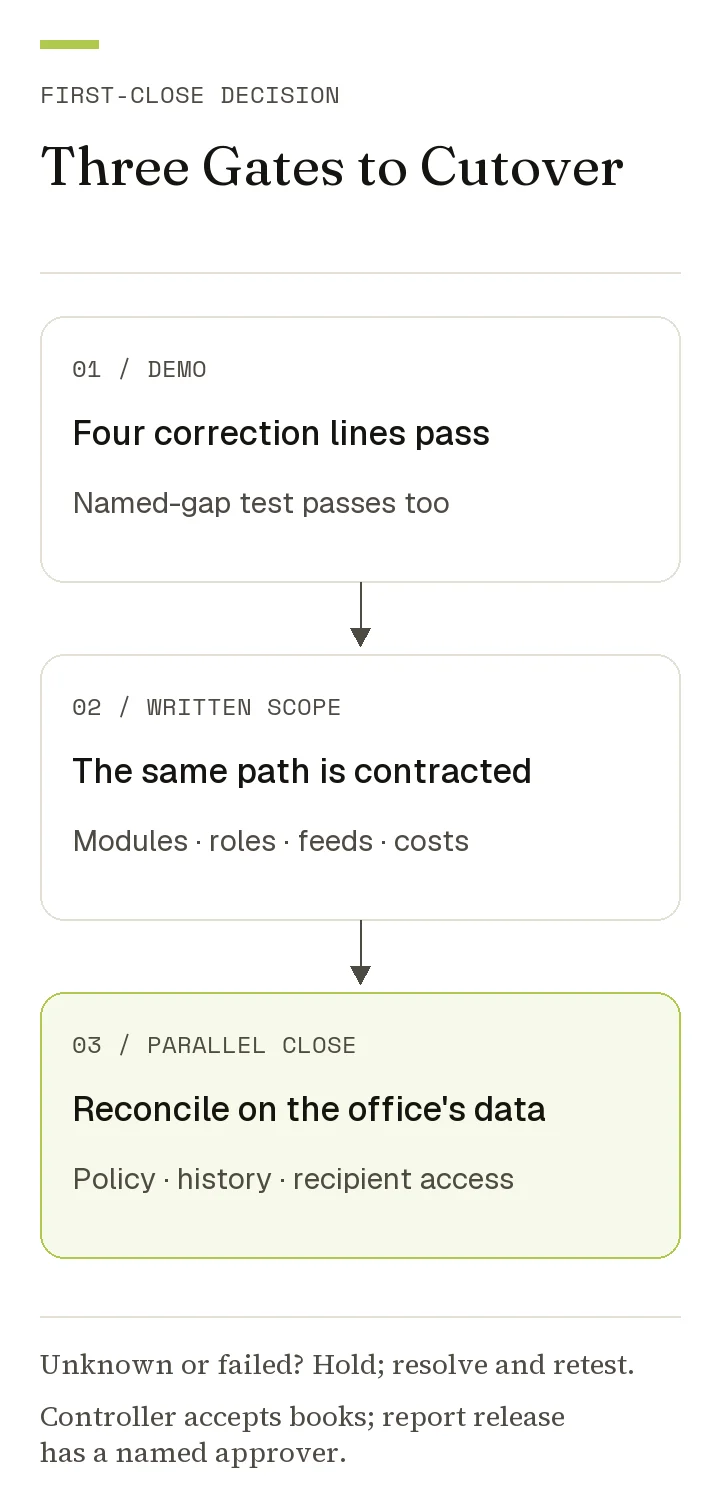
Illustrative decision sequence, not a vendor result. The common correction and every applicable named-gap test must pass; an unknown or failed requirement remains a hold until resolved and retested.
The verified two-file pair establishes a common control baseline; the supplemental tests establish whether the proposed change solves the office's actual reason to leave Sesame. Choose the smallest route that passes both sets of required tests and has a justified full-stack cost. Keep the reliable parts of the stack and move only the work whose owner, evidence or output improves.
The coming shake-out in family-office software
The category has never been more crowded. Consolidation is coming — and the firms that survive will be… Knowledge & Decision · Analysis
Is a Multi-Family Office Right for Your Family? Compare Fit, Fees and Services
Compare multi-family office fit, services, fees and family responsibilities with an illustrative quote worksheet and provider-check questions. Knowledge & Decision · Analysis