Family Office Tax Structure: Guide to Entity Types and Tax Planning
SFO and MFO status can change business expenses, pass through taxation, and audit posture before you choose an LLC, LP, or c corporation.
How should a family office choose its tax structure?
A family office should start by determining whether its facts look like a single-family office or a multifamily office, because that classification shapes expense treatment, records, and separateness before entity choice. Only then should it choose among an LLC, partnership, or corporation based on pass-through logic, tax friction, governance flexibility, liability boundary, and fit with actual operating facts.
01The First Tax Decision for Family Offices Is SFO vs. MFO, Not LLC vs. LP
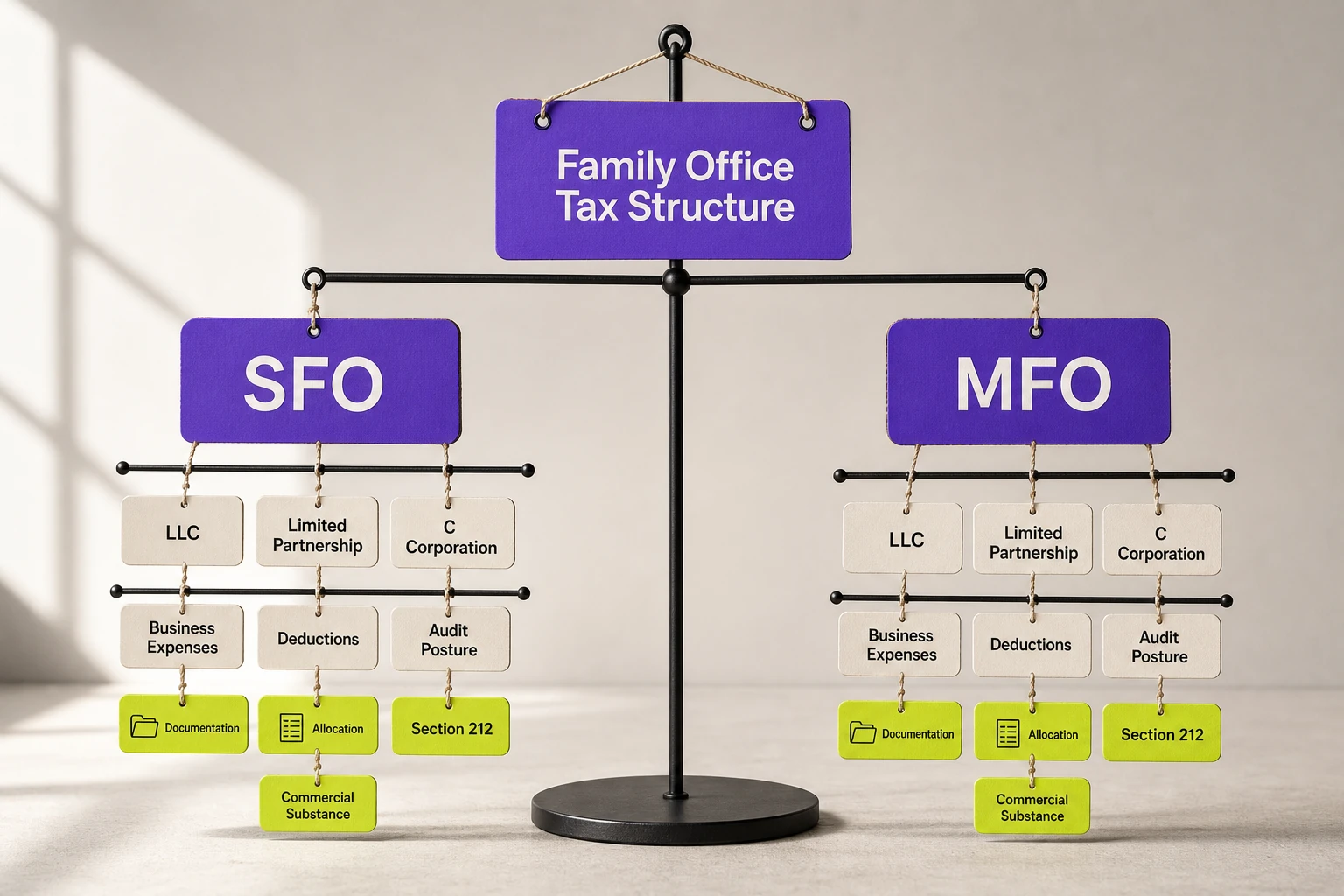
Entity labels come second. For family offices, the opening tax question is whether the operation looks more like a single family office with a private-use profile or more like a revenue-producing model serving clients beyond one wealthy family. That classification lens shapes how spending, records, and separateness will be viewed before an LLC, LP, virtual family office, or alternative investments pool LLC is even worth comparing.
- Start With Operating Facts: Who is served, how charges work, and whether activity looks like a family business or internal administration for family members.
- Then Test Substance Signals: a single family setup with weak separateness and family assets mixed into personal use creates a different posture from multi family offices with real service delivery.
- Only after that should the structure question narrow to which entity best fits the family's objectives.
Why SFO Status Faces a Harder Expense and Audit Posture
The pressure point is not the name on the entity chart. It is whether the office can separate business activity from personal wealth administration. When a single-family operation mainly supports investment strategies and household-level coordination, the tax position becomes harder to defend because the records often do not show a clear charging logic, a distinct operating boundary, or a business purpose behind investment decisions.
- Blurred spending between office costs and personal expenses for family members.
- Investment-only activity with no clear service model or outside-facing revenue logic.
- Weak separateness between the office, the owners, and related entities.
- Thin records that do not show who incurred a cost, why it was incurred, or how it was allocated.
- An internal support model that looks private first and operational second.
Where Multi-Family Office Economics and Client Structure Change the Tax Outcome
Commercial substance changes the analysis. A multifamily office can present a more businesslike posture when the operation earns real revenue, serves actual clients, and runs with visible separateness rather than as an extension of one household. For family offices, that shift does not create an automatic result under the family office rule, but it does change what many family offices can defend when the analysis stays facts-first, then form.
- Real revenue tied to defined services rather than informal cost sharing.
- Actual clients beyond one family group, with a service relationship that is identifiable and recurring.
- Documented service delivery, including administration, reporting, or oversight performed for those clients.
- Operational separateness in records, staffing, billing, and entity boundaries.
That is the threshold the next comparison depends on: once the facts show either a private-use profile or a commercial-use one, entity choice becomes a fitting exercise instead of a rescue attempt.
02How SFO vs. MFO Status Changes the Tax Case for LLCs, Partnerships, and Corporations
Entity choice follows classification because SFO and MFO facts change what each legal entity has to carry. For family offices, an SFO usually needs the legal structure to support a stronger operating case around shared services, family governance, and concentrated assets such as real estate investments, while an MFO can more often pair the same legal entity choices with client-facing economics that better support the structure. That is why structuring family offices starts with the same comparison criteria across forms: pass-through logic, tax friction, governance flexibility, liability boundary, and fit by office facts.
| Entity form | Pass-through logic | Tax friction | Governance flexibility | Liability boundary | Best fit by office facts |
|---|---|---|---|---|---|
| LLC | Usually aligns with pass-through treatment | Low to moderate, depending on classification and elections | High, with flexible allocation and management design | Can provide a limited liability boundary, but not tax support by itself | Works when the office needs adaptable management and the underlying business facts are strong |
| LP or partnership | Usually preserves pass-through treatment | Moderate, with more sensitivity to ownership design and operating discipline | High for tailored control, transfer planning, and economic rights | Often separates control from economic ownership more cleanly than other forms | Works when transfer design, ownership layering, and family control terms matter |
| Corporation | Usually breaks pass-through treatment | Higher because entity-level tax costs and distribution friction can arise | Moderate, with clearer formal governance but less flexibility in economic design | Provides a corporate liability boundary, subject to normal entity formalities | Works when operational simplicity, retained operations, or institutional structure matter more than pass-through efficiency |
When a Limited Liability Company Fits a Family Office
An LLC usually fits when the family office needs flexibility without giving up structural discipline. A limited liability company can adapt management rights, economic arrangements, and tax elections more easily than many rigid forms, which is why it often appeals to family groups with changing service lines or uneven ownership dynamics. Still, limited liability does not cure weak facts. If the office lacks a defensible operating profile, the limited liability company remains only a shell, not a stronger tax position. The real advantage is fit: one legal structure that can support coordination while leaving room to refine governance as the office matures.
Where a Family Limited Partnership Still Has an Edge
A family limited partnership still stands out when the structure must separate control from ownership with more precision. That can matter when senior family members want to centralize decision authority while shifting ownership interests over time, or when preferred interests and other economic distinctions need to be built into the design. In those settings, a family limited partnership can express family governance choices more directly than an LLC built mainly for operating flexibility, and more precisely than a corporation built around standardized classes and formal governance. Its edge is not simplicity. It is the ability to tailor control, distributions, and transfer mechanics around the family's actual operating and succession pattern.
Why C Corporation Structures Trade Simplicity for Different Tax Costs
A C corporation can look cleaner on paper, especially when the office wants familiar governance, formal payroll, and a more standardized operating shell. The tradeoff is that simplicity in administration can create different tax friction than a pass-through model. Instead of asking whether the form is easier to run, the better question is whether the office can justify absorbing corporate-level constraints without weakening the overall tax result.
- Cost: double taxation can change the cost of moving earnings from the entity to owners.
- Trigger: accumulated earnings tax concerns can matter when profits remain inside the entity without a clear operating reason.
- Fit: a C corporation may fit better when the office values formal governance and retained operations more than pass-through flexibility.
03Which Family Office Expenses Survive IRS Scrutiny After TCJA
Structure alone does not carry the tax result. The practical line runs through the Internal Revenue Code distinction between Section 162 business expenses and Section 212 investor-style costs, because only expenses incurred in a real trade or business have the stronger framework for current deductibility. If a family office cannot support that business posture, many investment-oriented costs become far more vulnerable at the individual level, which changes how much taxable income the structure can actually offset.
- Section 162 remains the core path for ordinary and necessary business expenses tied to actual business operations.
- Section 212-style investor expenses are much weaker for many SFO fact patterns because miscellaneous itemized deductions remain disallowed under current law.
- Labels do not control the answer. The same invoice can point in different directions depending on function, beneficiary, and supporting records.
- Some items sit under separate rules, including certain interest items and some rents or royalties, so they should not be lumped into one blanket rule.
What the Section 212 Deduction Loss Changed for Single-Family Offices
TCJA made the fallback position much weaker for many family offices. Before that change, a single-family office that failed to establish a Section 162 trade or business could still look to Section 212 for some investment management and wealth management costs, but TCJA suspended miscellaneous itemized deductions and undercut that route for many taxpayers. Public Law 119-21 removed the old expiration date, so this article should treat that disallowance as continuing under current law rather than ending after 2025. In practice, that means family offices with an SFO fact pattern cannot assume that office-like investment management costs still produce a useful deduction when the activity looks more like private investing than a business. The issue is not entity form alone. It is whether the office can support a real business posture.
Which Costs Still Look Like Business Expenses, and Which Look Personal
The category label is only a starting point. What matters is whether the cost supports defined business operations or mainly delivers investment advice, owner convenience, or personal benefit. This table gives category-level guidance for common business expenses, not a ruling on any specific deduction.
| Expense type | More defensible framing | More vulnerable framing |
|---|---|---|
| Employee compensation | Staff perform defined office operations under a business model | Staff primarily serve family personal or owner-investment needs |
| Office space and systems | Space and systems tie to documented operating functions | Mixed-use or owner-convenience costs have weak allocation support |
| Advisory or investment management fees | Potentially stronger only when tied to a real Section 162 business model | Often looks like investment advice under Section 212 if the office is not a trade or business |
| Custodial or portfolio oversight costs | Rarely strong from the label alone | IRS guidance treats miscellaneous investment expenses as generally nondeductible |
| Interest or rent-royalty related items | May fall under separate rules outside miscellaneous itemized deductions | Still subject to separate limits, so they are not automatically deductible |
The operating test is functional benefit, not vocabulary. A family office strengthens its position when the cost maps to an identifiable office function rather than to private ownership activity.
Why Documentation and Allocation Decide Whether Deductions Hold Up
Mixed-use costs usually rise or fall on proof. Documentation will not ensure compliance or guarantee a deduction, but it gives the office a repeatable way to show what the cost did, who benefited, and why the allocation method matches the claimed business purpose.
- Write down each office function and identify who benefits from it.
- Keep time records or workload support for employees with mixed roles.
- Apply one consistent allocation method to mixed-use costs.
- Match invoices and general ledger coding to the claimed business purpose.
- Maintain separate entity, bank, and approval records that show operational boundaries.
- Retain support for why the cost benefits the office business rather than family ownership or personal consumption.
Those records do not create a safe harbor, but they set up the next question courts ask: whether the facts show a real business function or only private investing dressed in office form.
04How Lender Management and Hellmann Affect a Family Office's Tax Position
Labels do not carry the tax case. Courts look through the family office structure to the operating facts: who is paid for services, how formal the operation is, whether relationships look client-like, and whether the entity functions as a business rather than as an owner extension. That is why Lender Management matters more as a usable favorable example, while Hellmann matters more as a cautionary comparator. The real value of both cases is comparative. They show that business-purpose analysis rises or falls on evidence of separateness, compensation, and actual operations.
What Lender Management Shows About Defending a Family Office Business Purpose
Lender Management is useful because the Tax Court directly addressed whether the entity carried on a trade or business and concluded that it was in the business of providing investment management services. For a family office tax analysis, the case helps reset the standard. The question is not whether the office carries a sophisticated label. The question is whether the facts show a real service business with enough operating separation to resemble the work of investment advisers rather than pure owner self-management.
- Compensation mattered. The court noted service compensation through profits interests, which supported a service-provider narrative.
- Withdrawal rights mattered. Investors in two investment entities had annual withdrawal rights, which made the relationships look more client-like and less like locked-in family capital.
- Staffing mattered. Lender Management employed five employees during each year at issue, which supported ongoing professional operations.
- Relationship framing mattered. The opinion referred to members of the investment LLCs as clients, reinforcing formal separateness and service relationships.
- Operations mattered cumulatively. None of these facts worked alone; together they supported a business-purpose position grounded in structure, records, and actual activity.
What Hellmann Suggests About Family Office Facts That Weaken the Tax Position
Hellmann should be read more narrowly. It involved GF Family Management, a Tax Court order issued on October 1, 2018, and a later settlement, so it did not produce a precedential merits holding comparable to Lender Management. That procedural posture still makes it useful. It shows where a family office can draw scrutiny when separateness is thin, economics track ownership too closely, or the activity looks more like owner-linked self-management than a distinct business operation.
- The case involved Tax Court dockets 8486-17, 8489-17, 8494-17, and 8497-17.
- A Tax Court order was issued, but the matter later settled, so Hellmann should not be treated as a final holding on the merits.
- The caution is factual, not doctrinal. Thin separateness can weaken the business narrative even before any single legal label fails.
- Proportional economics can draw attention when compensation logic looks too closely tied to ownership rather than to services.
- Owner-like self-management can undermine the position when the office appears to manage family wealth for itself rather than operate as a distinct service business.
How to Read Case Law Without Mistaking It for a Safe Harbor
Use these cases as a comparison tool, not as permission. Lender is a fact-pattern example, not a blanket safe harbor for a family office. Hellmann is even narrower because it ended in settlement, and Tax Court orders are not precedent under Rule 50.
- Compare compensation structure line by line against your own facts.
- Check whether client separateness is real or only formal on paper.
- Review staffing, withdrawal features, and operational formality together rather than in isolation.
- Use that comparison to test family office planning before revisiting whether an LLC truly fits the office.
05When a Limited Liability Company Is the Right Family Office Structure
The LLC case turns on fit, not familiarity. A limited liability company often works well as a family office structure when the office needs flexible ownership, relatively simple administration, and a practical way to keep operating activity separate, but the choice only holds if the office can support the business facts behind its tax position and expense profile.
- Choose an LLC when flexibility matters, especially if the office may need to adjust ownership, governance roles, or operating arrangements over time.
- Treat pass-through appeal as conditional. It can carry tax advantages when owners want results to flow through directly, but it can also pass tax liabilities to owners without changing weak underlying facts.
- Give weight to administration. A limited liability company, including a real estate investments LLC, can be easier to run than a more customized structure when the goal is coordinated oversight rather than heavy entity layering.
- Use the liability boundary for operating-risk separation, not as a cure for personal spending, poor records, or weak separateness.
- Move away from the LLC if transfer design points toward partnership terms or if a retained-earnings model points toward a corporate platform.
How Pass-Through Taxation Changes the LLC Case
Pass-through treatment is the main reason many families look hard at an LLC. The appeal is straightforward: the entity can place results at the owner level rather than inside a separate taxpaying corporation, which may simplify the relationship between office activity and owner reporting. That same feature can also narrow the margin for weak design. If the office has uncertain deductions, mixed personal and business spending, or income the owners would rather not absorb directly, pass-through treatment carries those tax liabilities outward instead of containing them. In practice, the pass-through advantage works best when the office already has disciplined facts, clean allocations, and a clear reason for using the structure. The issue is not whether pass-through treatment offers tax benefits. It is whether the underlying operating model is strong enough to support them.
Where Limited Liability Helps, and Where It Does Not
Limited liability draws attention because it sounds like broad protection, but the real boundary is narrower. For affluent families, it can help separate office operations, contracts, employees, and vendor relationships from personal ownership, yet it does not repair a structure that ignores formal separateness or treats private consumption as office expense.
- It helps when the office has genuine operating activity and keeps entity records, approvals, and payments distinct.
- It helps when service arrangements, staffing, and counterparties run through the entity rather than informally through family members.
- It does not turn personal expenses into business deductions simply because the entity pays them.
- It does not overcome weak facts if the office cannot show a real operating purpose or clean boundaries.
- It does not eliminate owner-level exposure to tax consequences that still pass through the structure.
When a Partnership or Corporation May Be Stronger Than an LLC
The better alternative depends on what the structure is trying to control. If the central goal is transfer design, a partnership may offer a better fit. If the goal is to build an operating platform that can retain earnings or separate office economics from owner reporting more cleanly, a corporation may be stronger despite different tax implications.
| Structure may be stronger | Best fit when | Why it may beat an LLC |
|---|---|---|
| Partnership | The office needs tailored ownership economics, transfer planning flexibility, or more customized sharing terms | Partnership design can match family transfer objectives more directly than a standard LLC framework |
| Corporation | The office wants a retained-earnings platform, a more distinct operating entity, or a different relationship between office activity and owners | A corporation can create cleaner separation for operating goals that do not sit comfortably inside pass-through ownership |
| LLC remains stronger | The office wants flexible administration, simpler coordination, and pass-through treatment that matches the facts | The LLC keeps the structure lighter when the family does not need the deeper customization of a partnership or the different cost profile of a corporation |
06How SFO vs. MFO Status Changes the Planning Impact of Investment Income Taxation
Entity choice has limits. For most portfolios, SFO or MFO status affects operating structure, expense posture, and control more than it rewrites the asset-level tax character boundary attached to common investment returns. Capital gains deferral, dividend treatment, and similar results usually follow the asset and the transaction sequence first. The planning work changes when a fact pattern introduces specialized investment-tax friction or when family priorities shift toward transfer, control, and optionality. That is where structure analysis narrows, and broader planning begins.
Why Capital Gains Tax and Qualified Dividends Usually Do Not Change the Best Entity Choice
The main rule is simple: capital gains tax and qualified dividends usually follow the character of the investment, not the label on the family office entity. An LLC, partnership, or corporation can change administration, cash movement, and planning flexibility, but it usually does not change why a gain is a gain or why a dividend is treated as a qualified dividend. That is why entity choice should usually be driven by operating control, deductibility posture, governance, and ownership fit first. The tax character of common portfolio income is a separate layer.
Where Carried Interest and UBIT Create Different Planning Problems
Some investments break the simple pattern. The issue is specialized investment-tax friction that can change timing, reporting, or the character of receipts.
- In a venture capital or private-fund scenario, carried interest can create a planning question that does not resemble ordinary portfolio management. The family office may need to model whether part of the economics looks more like ordinary income than passive investment return.
- If tax-exempt vehicles or charitable structures sit in the ownership chain, UBIT can become a separate constraint. That problem turns on the income source and entity interaction, not just on the family office form.
- If the structure allocates distributable income before cash is available, phantom income can create a cash-planning strain. The tax burden appears before liquidity does.
These are exception cases that need separate modeling because the friction comes from investment facts and cash-flow mechanics, not from a broad assumption that one entity form fixes everything.
How Charitable Giving and Estate Planning Reshape Tax Planning for Family Wealth Structures
Current-year tax planning is only one layer of the decision. For significant wealth, charitable giving and estate planning can outweigh annual tax efficiency because the structure also has to support control, succession, long-term wealth transfer planning, and coordination with estate taxes and gift and estate taxes. That shift moves the question from current-year savings to whether the structure preserves optionality without weakening governance.
- Charitable giving may favor a structure that can separate family control from the assets earmarked for philanthropy while keeping tax planning coordinated.
- Estate planning often puts ownership design, control, and future wealth transfer at the center of the analysis once family wealth priorities extend beyond the current year.
- Family wealth structures may need room for future ownership shifts and transfer flexibility, with annual exclusion limits and valuation discounts treated as secondary to the broader goal of preserving wealth.
Once those priorities enter the analysis, entity choice becomes a control-and-optionality decision as much as a tax decision.
07Why State Tax Domicile Can Change the Outcome for SFO and MFO Structures
Federal analysis does not finish the job. The same SFO or MFO structure can produce different results once a state tax footprint forms around where people work, where revenue is sourced, and where decisions are made. That is why federal tax efficiency can still collide with different state tax considerations in practice.
- People and Decisions in One State: More of the exposure may follow that operating center.
- Services and Revenue Spread Across States: The entity may stay the same, but the filing footprint can widen.
- Declared Domicile in One Place, Real Activity in Another: The federal structure may hold, while the state result becomes harder to defend.
How Residency, Sourcing, and Apportionment Change the Result
Three mechanics usually drive the state tax footprint. Residency asks where key people are located. Sourcing asks where income-producing activity or receipts connect. Apportionment asks how multistate exposure is divided. The entity can stay the same while these facts change the result.
| Factor | What it tests | Likely effect on the outcome |
|---|---|---|
| Residency | Where key individuals or owners are treated as living or based | Can pull more income into a state's taxing reach even if the entity was formed elsewhere |
| Sourcing | Where services, investment activity, or revenue connections arise | Can shift which state claims the income tied to the office's actual work or receipts |
| Apportionment | How people, functions, or receipts are spread across states | Can divide tax exposure across multiple states instead of leaving it in one domicile |
When Domicile Planning Helps, and When It Triggers New Scrutiny
Domicile planning helps when the declared position matches lived and operational facts. It weakens when the paper story and the operating story diverge. That is the core domicile mismatch risk.
- A claimed low-tax base is weaker when investment decisions are still made elsewhere.
- A residence position looks weaker when staff, records, or services remain concentrated in another state.
- A governance narrative is harder to defend when meetings, approvals, and revenue-linked activity point to a different footprint.
Once federal structure, investment friction, and state footprint are aligned, the next question is which controls and counsel-ready records keep that position defensible over time.
08How to Run SFO and MFO Structures With Defensible Tax Compliance and Monitoring
Choosing the structure is only the first tax decision. The position holds only if family offices run that structure with documented controls, repeatable reviews, and a current record of what the office does, who it serves, how costs are allocated, and where the tax footprint sits.
- Maintain entity formalities, separate records, and documented approval workflows.
- Use written expense-allocation rules for mixed personal, investment, and operating-cost allocations.
- Track filing, estimated-tax, and information-reporting obligations by entity and state footprint on a calendar.
- Review classification, charging model, and documentation as facts change.
- Route material legal changes and tax strategies through a financial advisor and counsel before changing structure or reporting positions.
- Keep one current operating file with services, ownership, revenue logic, and state footprint so professional guidance starts from the same facts.
Many family offices lose ground when operations drift away from the facts that supported the original structure. The governing standard is control that can be shown in records, responsibilities, and review habits.
Which Tax Compliance Controls Matter Most When a Family Office Starts Operating
The first operating risk is blur, not complexity. A defensible tax posture depends on keeping business activity, investment activity, and personal activity separated through records, approvals, and assigned responsibility from the start.
- Open separate bank accounts, maintain separate books, and limit signing authority by entity.
- Require an expense-approval process that records the business purpose before costs are paid or reimbursed.
- Apply consistent coding and allocation rules to mixed-use costs so the same type of expense is treated the same way over time.
- Keep invoices, contracts, payroll support, and work records under a defined retention process rather than in advisor email trails.
- Run an annual review of entity formalities, filings, and intercompany arrangements to confirm that operations still match the structure.
- Assign a clear responsibility map for internal staff and outside advisors so each filing, approval, and recordkeeping task has an owner.
For family offices, startup controls matter because later deduction and classification questions are tested against how the office actually operated. The issue is not paperwork volume; it is whether the records show disciplined separation and governance.
How to Monitor the OBBBA 2025 Legislation and Other Tax Law Changes
Tax law monitoring is a process, not a news habit. OBBBA 2025 is enacted federal law, and that is exactly why the next step is implementation review rather than speculation.
- 1. Treat the One Big Beautiful Bill Act as enacted law, not pending legislation.
- 2. Identify it accurately as Public Law 119-21, approved July 4, 2025.
- 3. Monitor IRS, Treasury, and Federal Register guidance for implementation details and follow-on rules.
- 4. Ask advisors which enacted changes affect deduction posture, reporting, entity planning, or family office operating assumptions.
- 5. Recheck prior planning memos and compliance calendars whenever a major tax law change is enacted.
That sequence keeps the office aligned with the law as written while leaving room for agency interpretation to develop. The governing requirement is an enacted-law monitoring process that ties legal change back to filings, memos, and operating assumptions before reporting positions drift.
What to Bring to Tax Counsel Before You Lock in the Structure
Counsel can test the structure only if the facts are complete. A useful tax counsel fact package shows how the office is owned, what services it performs, how money moves, where decisions are made, and which positions still need review by legal and tax professionals.
- A current entity chart and ownership map.
- A description of the services the office actually performs.
- The revenue or fee logic, if any, including who is charged and why.
- The main expense categories and the current allocation methods.
- The state footprint, including where owners live, where staff work, and where decisions are made.
- Existing governing documents, agreements, and prior tax advice.
- Open questions on SFO or MFO posture, deductibility, and restructuring alternatives to review with tax professionals.
Bring that package before finalizing the structure or changing a reporting position. The next action is to test the preferred structure against a complete fact package with tax counsel before implementation or reporting changes.
The coming shake-out in family-office software
The category has never been more crowded. Consolidation is coming — and the firms that survive will be… Knowledge & Decision · Analysis
Is a Multi-Family Office Right for Your Family? Compare Fit, Fees and Services
Compare multi-family office fit, services, fees and family responsibilities with an illustrative quote worksheet and provider-check questions. Knowledge & Decision · Analysis