7 Addepar Alternatives: Compare Fit Before Switching
Compare reporting, accounting and operating fit, then request the same evidence and quote scope before replacing Addepar.

Which Addepar Alternatives Should a Family Office Compare?
For reporting, data and client access, consider Masttro, Landytech Sesame One, Aleta and SS&C Black Diamond. For integrated accounting or broader operations, consider Eton Solutions AtlasFive, FundCount and Asset Vantage. Choose candidates against your unmet requirements, then ask each to demonstrate the same records, reports and corrections before switching.
An Addepar replacement needs to preserve the work your office relies on while improving a defined gap. A principal may want a clearer wealth view; a controller may need journals and partnership accounts; a CIO may need investment analysis. Those requirements can lead to different shortlists.
The seven options were selected because their current public product materials describe relevant reporting, ownership, accounting or operating capabilities. This is a non-exhaustive comparison of vendor-published scope, reviewed on 12 October 2026. We have not tested these products or ranked their performance.
- Define the output your current setup cannot deliver.
- Shortlist products with documented scope relevant to that output.
- Retain demonstrations, scoped quotes and transition evidence before committing.
01Compare Seven Addepar Alternatives by the Job You Need
Start with the capability you need to replace or add. The two groups describe buying priorities; they are not exclusive feature categories. A reporting product may export journals, and an accounting platform may provide investment analytics. Confirm the proposed modules and services for your office.
Reporting, Data and Client Access
Compare these candidates when consolidated wealth visibility, investment reports or stakeholder access lead the brief. The final column identifies evidence to request, rather than asserting that an undocumented function is absent.
| Platform | Documented Scope | What to Verify for Your Office |
|---|---|---|
| Masttro | Wealth aggregation, entity and asset ownership, portfolio analysis, permissioned access and document processing. Its investment subledger complements a separate general ledger. | Named feeds, ownership history, exception handling and the accounting integration included in your proposal. |
| Landytech Sesame One | Investment consolidation, analytics, private markets, reporting and corporate management. Sesame Accounting advertises investment journals for export to existing accounting systems; its page is labeled “Coming soon.” | Which Sesame One modules you receive, journal mappings, reporting conventions and responsibility for unresolved data. |
| Aleta | Multi-custodian and multi-currency consolidation, ownership look-through, private-market reporting, principal access and downstream data connections. | Your custody connections, historical data, permission boundaries, export contents and accounting-system integration. |
| SS&C Black Diamond | Family-office portfolio reporting, alternative-asset servicing and branded client access, with additional functions across the SS&C offering. | Which products, modules and services supply each requirement; do not assume the complete suite is one base subscription. |
Sources: Masttro’s platform, Masttro’s accounting integration announcement, Sesame One, Sesame Accounting, Aleta and Black Diamond for family offices.
Masttro’s announced Truewind workflow produces journal entries for accountant review and posting. Landytech describes Sesame Accounting as a complement to an existing accounting system, but its product page remains labeled “Coming soon” as checked on 12 October 2026. Confirm that the module is available in your proposed deployment and demonstrate its journal-export workflow. Neither description establishes that your operational ledger, payables or local filing work can be retired. Ask the provider to show where the investment records end and accounting responsibility begins.
Integrated Accounting and Operations
Compare these options when you need books, partnership records, payment workflows or operating workflows. Their accounting scope does not establish that every report, feed or local obligation matches your current setup.
| Platform | Documented Scope | What to Verify for Your Office |
|---|---|---|
| Eton Solutions AtlasFive | Integrated entity and portfolio management, general-ledger, trust and partnership records, transaction processing, documents and bill pay. | Included workflows, approval responsibilities, local payment availability, reporting conventions and the transition scope. |
| FundCount | Portfolio and partnership accounting on a unified multi-entity, multi-currency general ledger, with consolidation and reporting. | Capital-account and allocation treatment, intercompany requirements, historical migration and the license, implementation and hosting scope. |
| Asset Vantage AV PRO | Investment and cash records, integrated general ledger, multi-entity consolidation and partnership accounting. | Your accounting policies, feed mappings, cost basis, access controls and reconciliation of investment and financial reports. |
Sources: AtlasFive, FundCount’s general ledger, FundCount partnership accounting, Asset Vantage’s integrated ledger and partnership accounting.
Use your requirement to choose the first demonstrations. If you need to retain a separate accounting system and examine investment-to-ledger exports, investigate Masttro’s proposed integration and Sesame One’s advertised accounting module, subject to availability confirmation. If principal access or branded client reporting leads the brief, investigate Aleta and Black Diamond. If bill pay is part of the change, examine AtlasFive; if partnership books and multi-entity accounting lead it, examine FundCount and Asset Vantage. These starting points reflect published scope. Other candidates may meet the same requirement once their proposed modules are confirmed.
With a reporting platform and a separate ledger, your team or accountant still needs to review mappings, post entries and reconcile the systems. An integrated accounting proposal may bring those records into one platform, but someone must still own approvals and the close. Define those responsibilities before deciding which system you can retire.
If replacing accounting is the main objective, use our family office accounting software comparison to examine that broader selection. If the mandate includes a trading stack, risk-only analysis or personal net-worth tracking, define that separate job before treating those tools as complete Addepar substitutes.
02Check What Addepar Already Covers Before Switching
Addepar’s current family-office offering describes public and private investment aggregation, ownership look-through, configurable permissions, portals, APIs and general-ledger integrations. A replacement case should begin with a requirement your configured service cannot satisfy, or a commercial or operating constraint you need to change.
Write the gap as an observable output. “We need better reporting” leaves room for an attractive demonstration that misses the problem. “We need a dated family report that applies indirect ownership, shows private-fund commitments and traces each valuation to its source” gives the provider something to demonstrate.
Check whether configuration, a contracted service or an integration can close that gap in Addepar. Compare that proposal with replacement. A separate accounting requirement may justify adding an accounting system while retaining the investment-reporting platform. Our accounting setup assessment helps define which part of the current process needs attention.
The table compares published approaches. It does not establish comparative advantages. Several candidates overlap with Addepar; the operating change depends on your current configuration and proposed modules.
| Requirement | Addepar’s Documented Approach | Candidate Approach to Examine | Potential Change to Your Setup |
|---|---|---|---|
| Investment records and entity books together | Investment aggregation with general-ledger integrations. | Asset Vantage AV PRO’s integrated ledger, FundCount’s unified ledger, or AtlasFive’s accounting and operating workflows. | Decide which books move, which systems remain, and who owns posting and the close. |
| Partnership capital accounts and allocations | Ownership look-through; the family-office page does not establish partnership-accounting scope. | FundCount’s partnership accounts and allocations; AV PRO and AtlasFive also describe partnership accounting. | Demonstrate your allocation rules and capital-account reconciliation before replacing partnership records. |
| Ownership views and stakeholder access | Ownership look-through, permissions and portals. | Masttro’s Global Wealth Map, Aleta’s principal access and data connections, or Black Diamond’s branded client reporting and service options. | Test the same ownership structure and user roles; a different interface alone does not establish better reporting. |
| Investment analytics with an accounting handoff | Consolidated public/private investment reporting and ledger integrations. | Sesame One’s analytics and corporate management; Sesame Accounting advertises journal exports but is labeled “Coming soon.” | Compare your required analysis and exception workflow; retain the existing ledger and confirm module availability. |
Sources: the Addepar family-office page and the official product pages linked in the candidate tables above. The Addepar comparison is limited to the scope described on its public family-office page. Ask it to demonstrate the same requirement before treating a candidate as an improvement.
03Turn Your Requirements Into Six Buying Checks
Use these six checks as a suggested evaluation framework. Set mandatory outputs before the demonstrations and apply them to Addepar and every alternative. Public descriptions establish a reason to investigate; observed results and a scoped contract establish different kinds of evidence.
| Evaluation Check | Evidence to Request |
|---|---|
| Data and Exceptions | Your named accounts and feeds, delivery timing, duplicate handling, missing-data alerts and the person responsible for corrections. |
| Ownership and Private Assets | Direct and indirect interests, ownership dates, private valuations, commitments, calls and distributions using your required conventions. |
| Reports and Performance | The principal’s and investment team’s reports, valuation dates, FX policy and agreed performance calculations, traceable to inputs. |
| Accounting and Operations | Journals, ledger mappings, approvals and reconciliation; identify what remains in another system or with a service provider. |
| Access and Security | Role and entity restrictions, authentication, audit records, current security documentation and contractual data arrangements. |
| Service, Cost and Exit | Included modules and services, implementation work, recurring fees, support responsibilities and usable exports. |
For each requirement, keep one record: required output; input and version; expected result; observed result; evidence file; status; exception owner; and resolution date. Mark a requirement demonstrated only when the retained evidence meets its agreed acceptance condition.
Record each mandatory requirement as demonstrated, failed or unresolved. An unresolved requirement needs an owner, evidence request and deadline. Do not convert it into a passing numerical score because another feature looks strong. If you use weighted preferences after mandatory checks, label the weights as your office’s priorities.
04Use the Same Records to Test Every Shortlisted Platform
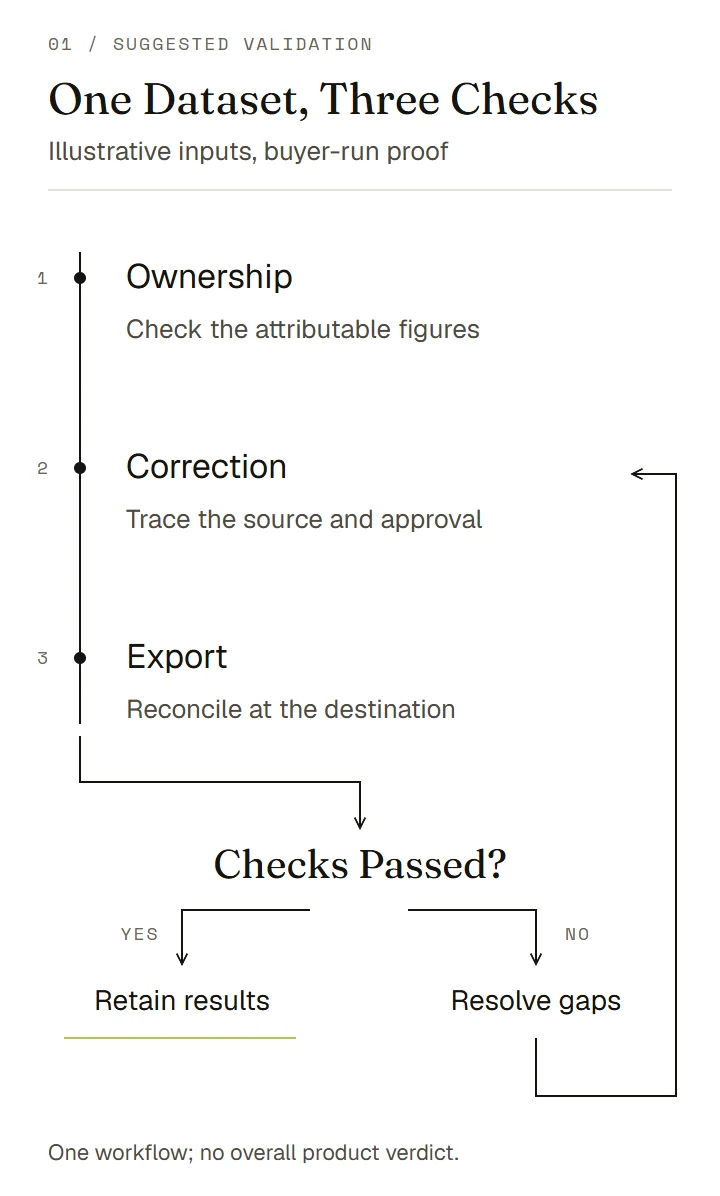
Give each provider the same small, approved dataset and expected outputs. Ask them to demonstrate the path from inputs to a report, a correction and an export. The exercise below is synthetic: it illustrates what to request and is not a test we performed on any product.
Verify Ownership and Private-Fund Reporting
Assume Family A owns 60% of Holding H. Holding H owns 50% of a fund interest whose whole-interest value is 2,000,000 in the reporting currency. All ownership percentages are effective on the report date. For this example, use proportional economic ownership with no special allocation terms.
| Expected Output | Calculation |
|---|---|
| Holding H’s attributable fund value | 50% × 2,000,000 = 1,000,000 |
| Family A’s effective interest | 60% × 50% = 30% |
| Family A’s attributable fund value | 30% × 2,000,000 = 600,000 |
The fund has a whole-interest commitment of 1,000,000 and cumulative calls of 300,000. Assume no recallable distributions, commitment changes or other adjustments. Whole-interest uncalled commitment is 700,000; Holding H’s share is 350,000 and Family A’s look-through share is 210,000.
Request separate displays of whole-interest, entity and family figures. Check that the consolidated family report does not add the holding-company value to the same underlying assets again. These calculations test a stated ownership model; trusts, waterfalls or different economic and legal interests require their own rules.
Introduce a private-fund valuation dated before the report date. The report should preserve the source’s valuation date and explain how that value enters the current view. A current reporting date does not make an older valuation current. Agree how late statements, estimates and FX are labeled before evaluating the output.
Trace a Correction and Export the Evidence
Change cumulative calls in the example from 300,000 to 320,000 while leaving commitment and ownership unchanged. Whole-interest uncalled commitment becomes 680,000, Holding H’s share becomes 340,000 and Family A’s share becomes 204,000. This correction alone does not specify a new NAV or performance return.
Ask the provider to show the original source, corrected amount, approval or change record, and revised report. Determine whether prior reports are retained as issued, restated, or both, and how readers distinguish them. Require an explanation of any difference from the agreed result.
Export the records and check that the output includes identifiers, ownership relationships and effective dates, transaction and valuation dates, amounts, currencies, and source references needed by the receiving system. Demonstrate the destination’s import or reconciliation separately; the presence of a download button does not prove a usable transition.
A passing demonstration proves only the inspected workflow with these inputs and configuration. Repeat the material cases from your own structure, including exceptions, volumes and permissions. Do not infer overall accuracy, statutory accounting fitness or investment-return quality from this miniature exercise.
05Verify Country, Currency and Access Requirements
Global use depends on the actual service and records your office needs. Multi-currency features and international customers do not establish support for a particular custodian, filing, payment rail or data-location obligation.
Before accepting a proposal, request confirmation of:
- Accounts and countries: each bank, custodian and administrator, supported delivery method and timing, manual inputs and exception ownership.
- Currency policy: transaction, valuation and reporting currencies; FX source and dates; treatment of historical rates and restatements.
- Local outputs: financial statements, accounting policies, accountant-approved exports and any country-specific tax or payment requirements.
- Data arrangements: hosting locations, subprocessors, permitted access, contractual restrictions and the security evidence applicable to the purchased service.
- Roles: principal, adviser, accountant and administrator views, including users who must not see another family’s or entity’s records.
For example, FundCount’s pricing page names US forms such as K-1 and 1065 in its multi-family-office offering. Those named outputs do not prove filing support elsewhere. Obtain local professional confirmation for required accounting, tax and data obligations; this comparison is not tax or legal advice.
06Request Quotes for the Same Scope
Compare quotes against a common brief, including work retained by your team and existing systems. Masttro and Aleta publicly describe non-AUM-based pricing, but that does not establish a lower total price or a fee that cannot change. FundCount publishes annual starting prices plus transformation and hosting fees. Starting packages and custom proposals are not equivalent purchasing scopes.
Public prices checked on 12 October 2026 provide starting points for the quote brief:
- Asset Vantage US-dollar SFO offer: US$30,000 per year, billed annually, for 10 entities. Its page separately offers AV Prime managed services through sales and lists one-time onboarding and scope-based implementation fees. Ask which charges apply to your proposal and whether they are included in the annual figure.
- Asset Vantage INR AV PRO offer: ₹6,75,000 per year, billed annually, for up to five entities. INR prices exclude GST and are subject to quarterly revision. Confirm whether this INR offer applies to your deployment. The US-dollar and INR offers have different entity scopes and should not be treated as equivalent packages.
- FundCount SFO/Asset Owner: starts at $35,899 per year, plus digital transformation and hosting fees.
- FundCount MFO: starts at $26,950 per year, plus those fees. FundCount sizes the final proposal by operating scope and deployment. Its family-office prices display “$”; confirm the invoicing currency rather than assuming USD.
Sources: Asset Vantage pricing and FundCount pricing. These published vendor figures do not establish negotiated offers or comparable all-in totals. For Addepar, Masttro, Sesame One, Aleta, Black Diamond and AtlasFive, request a scoped quote; no numerical tariff for them was verified for this comparison.
Use the same quote request for Addepar and each shortlisted alternative:
“Please quote the required reporting, accounting and operating modules for our specified entities, accounts, asset types, currencies, users and custodians. Include the historical years, private-document volumes, ownership structures, report outputs and integrations in the attached brief. Identify configuration, migration, training, reconciliation, support, hosting, data-feed and export fees. State who supplies each input, resolves exceptions and approves outputs. Separate one-time charges from recurring charges, identify pricing currency and taxes, and describe renewal and exit terms.”
Include volumes and named outputs, using redacted information where appropriate. Ask the supplier to list exclusions and separately priced services. A platform quote that leaves reconciliation with your team should be compared with the staff effort and retained systems it requires.
For a chosen comparison period, calculate one-time transition charges + recurring platform, data and service charges + retained-system costs + estimated internal effort + exit costs. Label internal estimates and assumptions. Do not treat a fixed subscription, an AUM-linked offer and a published starting price as comparable until their scope and period match.
07Prove the Transition Before Retiring Addepar
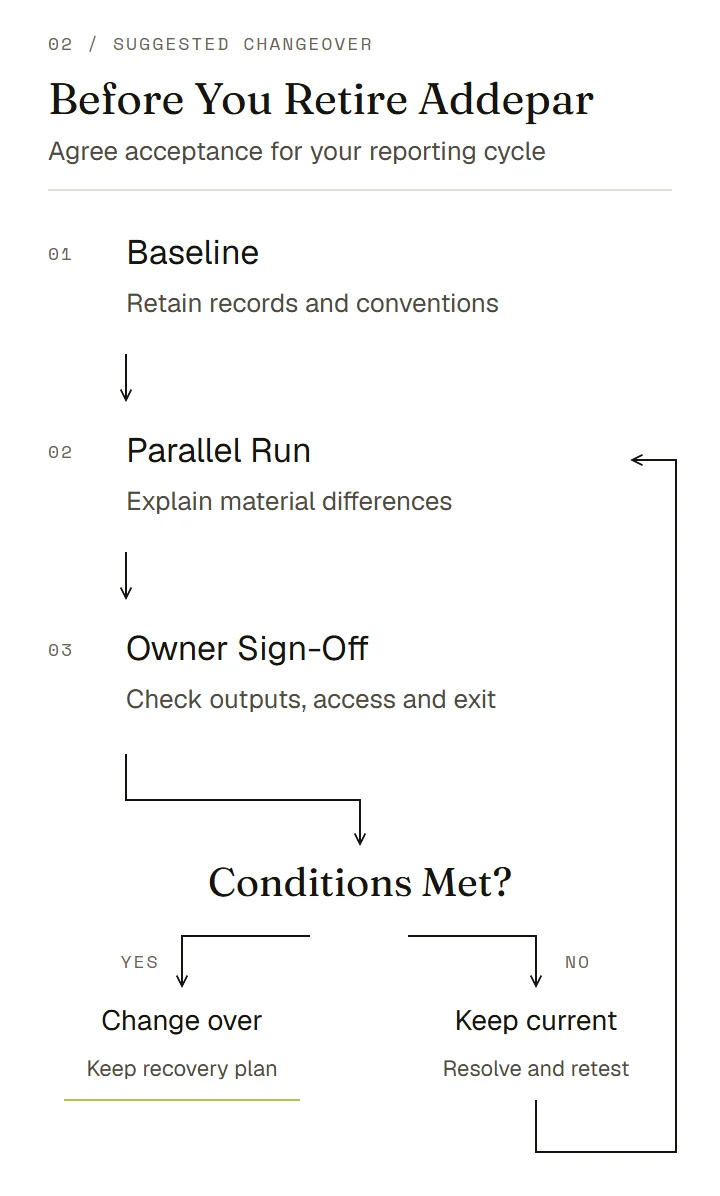
Use a parallel run to establish that the new setup meets your acceptance conditions before you depend on it. Agree its duration and coverage around your reporting cycles, private-asset updates and material workflows; a generic number of weeks cannot establish readiness.
- Agree the baseline. Retain source records, opening positions, entity ownership dates, transactions, valuation history and reports from the current setup. Define the reporting and performance conventions being compared.
- Reconcile the candidate. Compare old and new outputs for agreed dates and workflows. Explain differences caused by changed policies separately from missing or incorrect data. Assign and close material exceptions.
- Approve the changeover. Have the responsible finance, investment and operations owners sign off the required outputs, access, support, history and export checks. Retain a recovery plan before stopping the current service.
Do not promise unchanged since-inception performance merely because transactions were imported. Historical valuations, fees, cash-flow timing, FX and calculation conventions also need agreement. A product can meet your future reporting needs while requiring separate retention of historical evidence; decide whether that arrangement meets your obligations before signing.
08Choose Your Next Step From the Evidence
Choose two or three candidates whose documented scope matches your unmet requirements. Use the reporting and client-access group when those outputs lead the brief; investigate integrated accounting and operations when the ledger or operating process is part of the change.
Record why each candidate remains, which mandatory outputs it demonstrated, unresolved questions, full-scope cost and transition conditions. Keep Addepar in that comparison. Retaining it, extending it with another system, or replacing it are all valid outcomes when supported by your office’s evidence.
For a wider technology mandate, use the family office software comparison. Explore providers in the FOS Atlas for context, then take the same records and quote brief into your next supplier discussion.
The coming shake-out in family-office software
The category has never been more crowded. Consolidation is coming — and the firms that survive will be… Knowledge & Decision · Analysis
Is a Multi-Family Office Right for Your Family? Compare Fit, Fees and Services
Compare multi-family office fit, services, fees and family responsibilities with an illustrative quote worksheet and provider-check questions. Knowledge & Decision · Analysis