Compare Investment Proposal Software Using One Worked Proposal
Compare investment proposal software for a US family office through one dated portfolio case, a stale-value hold and a proof-led shortlist.

Investment proposal software helps turn portfolio data and a proposed change into a reviewable recommendation. Some products calculate and compare portfolios. Others assemble documents, route approvals or collect signatures. A US family office may need an internal decision memo, a client-facing proposal from its advisor, or both. The useful test is whether the configured workflow can carry the same dated inputs through analysis, exception handling, approval and an export that someone can act on.
- Give every supplier the same portfolio, proposed trade, recipient and review policy.
- Require a dated source trail. When an input is too old for the decision, require a release hold built into the software or recorded as a manual gate.
- Record what the supplier publishes separately from what its configured demo produces. Shortlist the setup only after its missing proof, integrations and price scope are clear.
01What Investment Proposal Software Must Produce
For the internal decision in this worked case, the proposal packet must show what would change, why, the data and assumptions used, and the approval record. Software can support that job through portfolio analysis, document production and workflow controls. The buyer must identify which parts are native to a product and which depend on connected systems or human review.
Client Proposal or Internal Investment Decision?
A client proposal usually explains an advisor's recommendation to an investor and may lead into account opening or signature. An internal family-office memo records a decision for a principal or investment committee: alternatives considered, the reason for a change, limits, objections and an approval. These routes can share portfolio calculations while requiring different recipients and final records.
For this article's illustrative case, the recipient is an internal investment committee. Its release condition is a dated, reviewable packet and a recorded approval before an execution instruction. If an advisor uses the same case for a client, the buyer should add the client-specific recommendation, review and disclosure steps that apply to that advisor and relationship. A polished client document does not establish that an internal approval occurred.
Analytical Platform, Document Tool, or Connected Workflow?
Portfolio proposal platforms can model a current portfolio against a proposed one and present risk or allocation views. Document tools can turn approved figures and commentary into a packet, route it and record signatures. A connected workflow uses both, with a defined handoff. These buying categories help structure the comparison; individual products may span them.
The boundary matters when data change. Ask where the portfolio values are calculated, how their dates reach the final document, whether a review hold survives an export, and which system retains the approved version. If a document tool receives a completed analysis from elsewhere, native portfolio calculation may be not applicable to that component. The complete setup still needs to produce a defensible proposal.
02Set Up One Illustrative Proposal for Every Demo
A fair demo starts with a fixed input packet and a written pass condition. The figures below are invented for comparison; they are not a family-office account, a product test or investment advice. Use your own authorized data only after establishing access and confidentiality terms with a supplier.
Fix a Dated Portfolio, Mandate, and Proposed Change
Assume a US family-office investment committee reviews this portfolio as of September 30, 2026:
| Asset bucket | Supplied value | Source date | Indicative share of $10m |
|---|---|---|---|
| Public equities | $6.0m | September 30, 2026 statement | 60% |
| Bonds | $2.5m | September 30, 2026 statement | 25% |
| Private fund | $1.0m NAV | June 30, 2026 manager statement | 10% placeholder |
| Cash | $0.5m | September 30, 2026 statement | 5% |
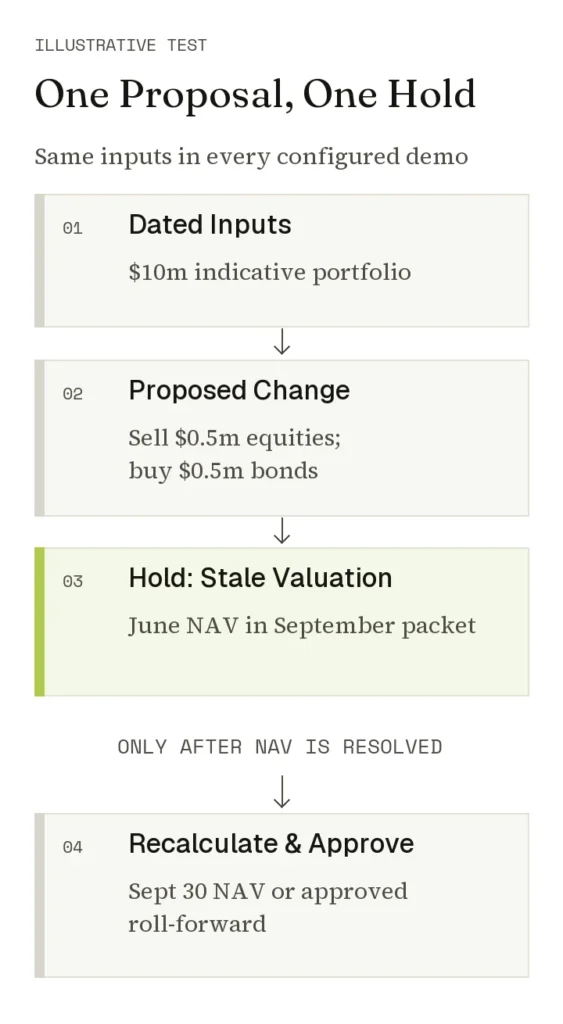
The proposed instruction is to sell $0.5m of public equities and buy $0.5m of bonds. Compare it with the no-trade alternative. The exercise assumes the committee wants to consider lower public-equity exposure within its mandate; it does not assume the trade improves risk or cost. On unchanged indicative values, the mix would be 55% equities, 30% bonds, 10% private fund and 5% cash. No tax, trading cost or market movement is assumed. Those percentages are arithmetic placeholders until the private-fund valuation is resolved; a revised NAV changes the denominator and every weight.
Assume the office's illustrative mandate caps public equities at 60% and requires at least 5% cash. The comparison should show those thresholds and the method used to check them. It should not declare compliance from the placeholder weights. A supplier also needs the portfolio source files or demo equivalents, an agreed asset mapping, the proposed transaction, and the recipient and approval roles.
On the placeholder figures, the current portfolio already sits at both limits. Selling equities would create room below the equity cap, but that room alone does not justify the trade. The memo must explain why bonds serve the family's objectives better than leaving the portfolio unchanged, after the valuation is resolved.
For this transfer, a complete recommendation should address the change in exposure and concentration; relevant equity and bond risks, including duration and credit where applicable; expected-return assumptions and uncertainty; liquidity, settlement and upcoming cash needs; tax lots and potential gains; transaction and ongoing costs; and the mandate check on corrected values. Show which measures come from the software, connected analysis or an accountable human. Mark unsupported calculations as open questions instead of implying that every product computes them.
Set Expected Outputs and One Stale-Value Hold
Give each supplier the same acceptance sheet. Ask for:
- Current and proposed values and weights, with each source's as-of date and the proposed trade visible.
- The mandate checks, the no-trade alternative and an explicit rationale for considering the transfer, plus risk and fee comparisons only where the method, source data and private-asset treatment can be shown.
- A visible warning that the private-fund NAV is three months older than the public-asset values, followed by a review hold under this exercise's policy.
- A versioned proposal or memo with preparer, reviewer, approver, recipient, decision and export/handoff record.
The assumed policy requires a September 30 private-fund value or a documented, approved roll-forward. There is no supplied roll-forward in the initial packet. The expected result is therefore a hold, even if the system can render a finished-looking PDF. The buyer can then supply the corrected value or approved roll-forward during the demo and require the calculations and review to run again. Every supplier should receive the same corrected value or roll-forward method for that retest.
03Test the Proposal From Source Data to Decision
Follow one change through its origin, calculation, exception, review and release. A product demonstration should expose each handoff in the proposed configuration. Attractive sample output alone cannot prove that the buyer's data path and approval control work.
Compare Current and Proposed Holdings, Risk, and Fees
Begin with the four source rows. Ask the presenter to show where each value and date enters the analysis, then where the $0.5m sale and purchase appear. The indicative public-equity share falls by five percentage points and the bond share rises by five; cash dollars are unchanged. If the tool shows only a chart, request the underlying values and the source-to-output mapping.
For risk, ask which measure is calculated, the observation period and data source, and how the private fund enters or is omitted. For fees, separate a quoted advisory fee from fund expenses, trading costs and taxes. This fixture supplies none of those fee schedules or risk inputs, so a numerical improvement claim would be fabricated. A useful demo marks the result not calculated or shows exactly which extra inputs were supplied and by whom.
If the setup works at individual-security level, ask the supplier to trace one holding from the September statement into the comparison. The category totals above do not prove security-level reconciliation. If the product uses model portfolios, inspect how the model maps to actual household holdings and whether a manual override remains visible.
Reconcile the Stale Valuation Before Release
The private-fund row is the deliberate exception. The supplier should display both the June 30 source date and the September 30 proposal date. Under this exercise's policy, the analyst must obtain a September 30 valuation or an approved roll-forward, retain the original June manager statement, and record any derived roll-forward separately with its method, effective date and approval. The team then recalculates the full portfolio and repeats the mandate review. The approver reviews the new version, including any changed recommendation.
A supplier could satisfy this through a native warning, a configured workflow or a documented manual control. The test is whether the assembled route reliably prevents an old value from being presented as current and retains evidence of the resolution. If the presenter cannot show a source date, record unknown, identify the proof needed and keep the output on hold. Do not convert a missing date to zero or assume the product lacks the feature.
Review, Version, and Approve the Output
Have the presenter revise a single assumption after the first draft. The final packet should identify which version was reviewed, who approved it and whether the recipient saw that same version. Ask whether an export can occur while a required exception is open, and whether replacing a source value triggers renewed review. A signature on a document and an investment decision are separate events unless the office's workflow deliberately connects them.
For a US buyer, responsibility depends on the entities involved, who is advising whom and how the proposal is communicated. Software features do not by themselves establish regulatory compliance. The office's legal or compliance advisor should map any applicable advisor, disclosure, recordkeeping and approval requirements to the actual route before the team relies on a template. This workflow test does not provide legal advice.
04Compare Software Categories and Product Scope
The following four products are examples of published approaches, checked on official pages on October 13, 2026. They have not been run through the illustrative case. Their published audiences and functions differ; direct procurement by an internal US family office is unverified for all four. An in-scope demo and written commercial proposal remain necessary.
Portfolio Proposal and Analysis Platforms
| Product and role | Documented proposal output | Published input/analysis description | What remains to prove in this case |
|---|---|---|---|
| Orion Proposals: advisor/client proposal platform | Portfolio recommendation and new-account route | Portfolio customization; planning and risk-intelligence integrations | Internal committee route, exact source feed, private NAV treatment, mandate test and modules in scope. |
| Zephyr Portfolio Proposal: advisor-facing household comparison | Current-versus-proposed household proposal via its presentation center | Risk assessment and model portfolios; current-versus-proposed portfolio comparison | Internal committee route, statement import, private NAV treatment, source-date warning and method for any risk result. |
| Aladdin Wealth proposal generation: wealth-manager/advisor platform | Proposal from household to sleeve with a path toward order-management implementation | Public/private exposure and risk views; policy feedback | Buyer eligibility, source-date control, required configuration and committee route. BlackRock states its US site content is intended for institutional investors. |
These descriptions show what each supplier publishes. They do not prove that all functions are included in one contract, that the functions accept this portfolio, or that an unmentioned control is absent. For the wider software shortlist beyond proposal creation, see our family office software comparison.
Document, Workflow, and Signature Tools
The fourth example takes a different role:
| Product and role | Documented proposal output | Published input/analysis description | What remains to prove in this case |
|---|---|---|---|
| PandaDoc investment proposal software: advisor/wealth-manager document component | Templates, approval routing, document status and e-signature | Content library and integrations are described; the cited page does not establish portfolio-calculation inputs | Connected analysis source, field mapping, revised-value update, stale-date hold and route to approval. Native calculation can be N/A for this component only if the complete route supplies it. |
Provisional investigation order for this internal committee case: Start with Zephyr when current-versus-proposed household analysis is the main need. Investigate Aladdin Wealth when configurable policy feedback and an order-management connection matter, after confirming the office can buy the proposed US configuration. Add Orion when an advisor-led recommendation or client onboarding is part of the route. Consider PandaDoc for document production and approval only alongside a demonstrated analysis source. Each route still needs to show how it produces the committee memo. None of the four cited pages establishes a June-to-September private-NAV release hold or direct family-office procurement. No product has demonstrated a pass or earned a final ranking from this evidence.
Apply the same remaining fields to each proposed configuration:
| Product | Approval/version and module path to prove | Access/security, export rights and scoped cost to prove |
|---|---|---|
| Orion | Committee review/version path; included planning, risk and signing components | Direct office procurement, user roles, retention, data export, first-year and ongoing quote: unknown |
| Zephyr | Review/version path; portfolio inputs and presentation-center scope | Direct office procurement, user roles, retention, data export, first-year and ongoing quote: unknown |
| Aladdin Wealth | Committee approval/version path; entitled analysis and order-management connection | Buyer eligibility, user roles, retention, export, first-year and ongoing quote: unknown |
| PandaDoc-led route | Document approval/version path; connected analysis and field mapping | Direct office procurement, user roles, retention, document/data export, first-year and ongoing quote: unknown |
These are requests for the demo and written proposal. The cited pages do not settle them for this case; unknown does not imply a missing feature.
Check Integrations, Data Access, and Human Review
For every candidate, request one architecture diagram for the proposed setup: custodian or accounting source, private-fund valuation source, analysis engine, document store, approval record and execution system. Name the owner of each transfer. Ask how entitlements, uploads and manual overrides work, because a published integration logo does not establish the fields or permissions available to this office.
The demo should use non-sensitive sample data until the supplier explains access roles, storage location, retention, audit history, export rights and deletion terms for the actual configuration. A family office may give advisors, administrators and principals different access. The product page alone cannot settle those controls. Record the written policy or contract provision that would answer each material question.
05Record Demo Results and Shortlist Candidates
A shortlist should be based on the same observed outputs and the contract that would deliver them. Do not translate a feature page into a pass score. Leave the observation column empty until a buyer runs the case and retains the output.
Separate Published Claims From Observed Outputs
Keep the dated supplier claim beside the configured demo output for each required result. Record the sample input, produced file or screen, user role and time. If a module, integration or manual review fills a gap, name its owner and contract scope.
Use a Same-Case Results Matrix
Illustrative scenario, separate from any vendor result: Suppose a configured route carries the June 30 private-fund NAV into a September 30 proposal without a date warning and produces a recipient-ready file. The buyer must put the case on hold. The configuration has not passed the stale-date control. Its supplier must demonstrate a dated warning and release block, or a documented manual review that catches the exception before any recipient-ready export. The analyst preserves the June source, obtains a September value or approved roll-forward, and retests the revised packet. Capture the input record, warning/review evidence, exported version and approver record. If no workable remedy is shown in the proposed scope, mark that requirement Fail. This hypothetical does not describe Orion, Zephyr, Aladdin Wealth or PandaDoc.
The reusable worksheet begins with every result Unknown. Its claim and observation cells are intentionally blank: copy a relevant dated official claim into the first, then fill the second only after a real demonstration. “Required proof” identifies records to capture; no buyer evidence has been gathered yet.
| Required output for the complete route | Published claim | Buyer-observed result | Required proof to inspect | Pre-demo status; office review owner |
|---|---|---|---|---|
| Source-to-output trace and dates, including the June private NAV | Original statements, input record, field map and proposal output | Unknown; investment analyst | ||
| Mixed-date warning and release hold | Dated warning, blocked export or documented manual gate, audit trail | Unknown; reviewer | ||
| Current/proposed allocation and $0.5m transfer | Input rows, transaction, calculation detail and export | Unknown; investment analyst | ||
| Mandate limits, no-trade alternative and transfer rationale | Policy inputs, threshold result, alternatives and memo explanation | Unknown; investment lead | ||
| Risk and fee method, inputs and private-asset limits | Method notes, source fields, exclusions or explicit “not calculated” | Unknown; investment analyst | ||
| Corrected valuation, rerun and approval version | Original/derived valuation trail, two packet versions, reviewer and approver log | Unknown; approver | ||
| Document connection, access, export and execution handoff | Data mapping, user roles, recipient file, export terms and order instruction | Unknown; operations lead |
For a document-only component, native portfolio analysis may be N/A when a connected system is assigned that role and its output is demonstrated. The complete route's analysis, hold and approval rows remain required. For each Hold, record the office review owner who assesses the proof and the supplier proof/remedy owner who must provide it, along with the remedy, requested evidence and retest date. Leave supplier names blank until assigned by the supplier.
Use Pass only when the required output and its source/condition proof are visible in the agreed configuration for this case. Hold means an identified issue needs a named remedy and successful retest before release. Fail means the required output cannot be delivered in the proposed scope and no credible remedy is offered. Unknown means material evidence has not been shown. N/A applies only to a component outside that function's agreed role. These statuses are per requirement and route; none is a product-wide rating.
Compare Implementation Scope, Export Rights, and Total Cost
Send suppliers one scope sheet: number of entities and portfolios, users and roles, source integrations, private-fund data frequency, proposal templates, analysis and approval modules, implementation services, support period, storage and export requirements. Request an itemized first-year and ongoing quote in the same currency and period, with one-time setup, licenses, data feeds, integration work and recurring services separated. If a public price does not cover this scope, leave the comparable total unknown until quoted.
As checked October 13, 2026, PandaDoc's US pricing page displays its Business plan at $49 USD per seat per month and lists approval workflows; Enterprise requires a quote. The page has monthly and annual options, add-ons and usage-credit conditions. Confirm the applicable billing term and the cost of the proposed configuration. This document-component list price cannot stand in for the complete proposal route, and the cited Orion, Zephyr and Aladdin Wealth pages do not establish comparable totals for this case.
Ask for a sample export and contract language on data ownership, usable file formats, retention and exit assistance. A lower software fee can still involve manual reconciliation or separately charged services; record who performs that work and its cost before comparing totals.
Decide Which Setups Need a Second Demo
Advance a setup to a second demo when the first shows a credible connected path but has not yet produced the required analysis, hold control or approval evidence. Keep those requirements Unknown or Hold, with a supplier owner and proof request. Give every supplier the same corrected valuation or approved roll-forward for the retest. A final shortlist requires observed outputs in the agreed configuration and an established contract scope; a remediable hold becomes Pass only after its retest succeeds. Remove a setup after a documented required output fails with no workable remedy, or its eligibility or commercial scope rules it out.
06Carry the Approved Proposal Into Implementation
The test should trace the approved proposal through an accountable execution instruction. The office should identify who translates the approved change into orders, who checks execution against it, and where any later change is recorded.
Name the Execution Owner and Handoff Record
For the illustrative transfer, the investment committee's approved version should state the $0.5m equity sale and $0.5m bond purchase, the resolved valuation basis and its date, any conditions and the person authorized to instruct execution. An operations or investment lead can then log the order reference, intended amounts and the system that receives it. If the office relies on an external advisor, record where the instruction leaves the office and what confirmation comes back.
Retain the Approved Version and Review the Change
Keep the original manager statement, any separate approved roll-forward, calculation method, resolved valuation exception, approved memo, approval time and recipient copy together. If the private-fund value or trade amount changes after approval, create a new version for the designated reviewer and approver. Record a new approval before execution. Later, compare executed holdings and costs with the approved instruction and explain differences. This is a proposed control for the worked case; the office must adapt it to its own governance and applicable obligations.
The initial investigation order above identifies which demos to request. The final shortlist should reflect observed, in-scope output, a resolved stale-value hold and agreed commercial terms. For the broader question of how this route fits the office's systems, see our family-office financial software guide.
The coming shake-out in family-office software
The category has never been more crowded. Consolidation is coming — and the firms that survive will be… Knowledge & Decision · Analysis
Is a Multi-Family Office Right for Your Family? Compare Fit, Fees and Services
Compare multi-family office fit, services, fees and family responsibilities with an illustrative quote worksheet and provider-check questions. Knowledge & Decision · Analysis