Family Office Software Comparison: Find Your Fit and Build a Shortlist
A family office software comparison for CFOs and operations teams: compare reporting fit, published capabilities, limits and what to verify before buying.


This family office software comparison rates documented fit and explains what your team would need to implement or verify. The ratings are our editorial judgments from official sources checked on October 10, 2026. They are not hands-on performance scores.
Family Office Software Comparison at a Glance
Our comparison assumes an office consolidating public and private investments across custodians and layered entities, with reports for staff and family members. It allows either native investment accounting or a connection to an existing general ledger (GL). Changing that accounting requirement can change the result.
Read the matrix using this key:
- S: Strong documented fit. The source describes the core job directly. Office-specific testing is still required.
- C: Conditional fit. A route is described, but a material dependency, scope choice or unresolved part affects fit. The cell names that condition.
- M: Documented mismatch. An explicit product boundary conflicts with a mandatory requirement.
- U: Insufficient evidence. The reviewed material cannot establish the required route. No product score is assigned.
Cost and security ratings identify commercial or assurance questions still needing answers; neither ranks affordability or safety. Delivery stays conditional until the proposal assigns ongoing operational work; an implementation team or support service alone does not settle that division. There is no overall winner or total: an unresolved mandatory requirement cannot be offset by several strong ratings elsewhere. Scroll the tables horizontally on a narrow screen.
Reporting Foundations
| Platform | Purpose and fit | Data coverage and reliability | Private investments | Ownership and consolidation |
|---|---|---|---|---|
| Addepar | S: Ownership-aware portfolio reporting | C: Feeds; reconciliation process unestablished | S: Calls, distributions, commitments | S: Percentage-ownership allocation |
| Aleta | S: Reporting with open data | S: Reconciliation and data operations | S: Private tracking and documents | C: Look-through; allocation rules unresolved |
| Asset Vantage PRO | S: Integrated investment-entity reporting | S: Feeds and bank/custodian reconciliation | S: Cash flows, valuations, documents | S: Partnerships and ownership changes |
| FundCount | S: Accounting-led investment reporting | C: Feeds; source reconciliation unestablished | S: Documents feed accounting records | C: Entity rollups; branch rules unresolved |
| Landytech Sesame One | S: Reporting, entities and accounting | S: Feeds and reconciled data | S: Fund documents and commitments | C: Look-through; allocation rules unresolved |
| Masttro | S: Wealth reporting alongside accounting | S: Daily custodian reconciliation; document matching | S: GP documents and cash flows | S: Direct/indirect ownership percentages |
| SS&C Black Diamond | S: Portfolio reports and family portal | S: Daily asset-level reconciliation | C: Document workflow adds Accord | U: Layered allocation not established |
Analysis, Access and Accounting
| Platform | Performance and analysis | Reports and family access | Accounting and integrations | Controls and security |
|---|---|---|---|---|
| Addepar | S: Manager analysis and pacing | S: Custom reports; permissioned portals | C: GL APIs; connector unconfirmed | C: Controls described; assurance review |
| Aleta | S: Returns and manager analytics | C: Mobile/BI; branch permissions unresolved | C: API add-on; connector unconfirmed | C: Controls described; assurance review |
| Asset Vantage PRO | S: Returns and benchmarks | S: Configurable views and permissions | S: Native investment-entity GL | C: Tiered controls; assurance review |
| FundCount | S: Returns and exposure analysis | C: Portal; branch access rules unresolved | S: Shared accounting posting engine | C: Deployment-specific controls; assurance review |
| Landytech Sesame One | S: Attribution, stress tests, liquidity | S: Reports and granular permissions | S: Portfolio-generated GL | C: Controls described; assurance review |
| Masttro | S: Private metrics and allocation | S: Role-based web/mobile views | U: External GL interface unspecified | C: Controls described; certificate review |
| SS&C Black Diamond | S: Returns, multiples and exposures | C: Reports/portal; family access rules unresolved | C: API; GL mapping unconfirmed | C: Permissions; assurance scope unverified |
Delivery, Cost and Exit
| Platform | Implementation and ongoing work | Cost and commercial scope | Data ownership and exit |
|---|---|---|---|
| Addepar | C: Implementation team; ongoing scope | U: No reviewed fee basis | C: Exports; licensed-data restrictions |
| Aleta | C: Data operations; scope to agree | C: Scope-based; add-ons and quote | C: Structured output; exit terms unresolved |
| Asset Vantage PRO | C: Data handling separately scoped | C: Entity pricing; regional scope | C: Export before deactivation |
| FundCount | C: Managed/guided; operating work to assign | C: Starting fee; hosting/setup extra | C: Books export; documents/configurations unresolved |
| Landytech Sesame One | C: Timing estimate; service scope | U: No reviewed fee basis | C: CSV/API; full migration unresolved |
| Masttro | C: Support included; operating work to assign | C: Annual scope-based proposal | C: Exports described; full scope unresolved |
| SS&C Black Diamond | C: Service teams; retained work unresolved | U: No reviewed fee basis | C: Bulk API; exit terms unresolved |
No M appears under the flexible accounting assumption above. If a native replacement GL is mandatory, Masttro becomes a documented mismatch. If direct synchronization to a retained GL is mandatory, Asset Vantage’s described Excel route is a mismatch; any different proposed connection remains unresolved. This selection covers seven reporting approaches, rather than the whole market. For a ledger replacement, use the separate family office accounting software comparison.
How to Compare Family Office Software
Each rating answers a defined requirement. The table below states the core job assessed; the profiles explain the supporting capabilities and limitations. A strong documented fit earns a place in an evaluation. It does not establish that your particular accounts, structures or service configuration will pass acceptance testing.
The 11 Criteria Used in This Comparison
| Evaluation criterion | Requirement Behind the Rating |
|---|---|
| Purpose and fit | Consolidated public/private investment reporting for a family office. |
| Data coverage and reliability | Automated inputs plus a described reconciliation or exception-handling process. |
| Private investments | Commitments, calls, distributions and valuations supported by document handling. |
| Ownership and consolidation | Economic-interest allocation through layered entities, with ownership changes tested separately. |
| Performance and analysis | Returns plus contextual analysis such as benchmarks, exposures or liquidity. |
| Reports and family access | Useful reports and appropriately restricted views for staff and family. |
| Accounting and integrations | Native investment-entity accounting or a documented route to an external GL. |
| Controls and security | Permissions and auditability, with current assurance covering the proposed configuration. |
| Implementation and ongoing work | A delivery approach and agreed division of ongoing operational work between vendor and office. |
| Cost and commercial scope | A basis for pricing software, extras and renewals against the office’s scope. |
| Data ownership and exit | Usable history, documents and structures, with exit access and assistance defined. |
Set Your Must-Haves Before Weighing Trade-Offs
Turn your priorities into observable outcomes: “Branch A can see its interests without opening Branch B’s documents,” or “A corrected valuation reaches the retained GL without manual re-entry.” Assign an owner and expected output. Check currencies, ownership-effective dates and reporting cutoffs as part of those outcomes.
Resolve mandatory C and U ratings before comparing preferences such as dashboard presentation. If the underlying operating problem is unclear, first assess your accounting setup. Software selection depends on deciding who owns the records and the work.
Seven Family Office Software Platforms Compared
The profiles explain why a platform might suit an office and what its ratings leave unresolved. Asset Vantage ratings refer to PRO; Landytech ratings refer to Sesame One, with Sesame Data discussed as an alternative configuration. Vendor prices and timelines are scoped statements, and named security assurances have not been independently audited here.
Addepar
Addepar is worth evaluating when the investment team needs to explain wealth through a complicated ownership structure. Its documented percentage-ownership calculations apply performance and exposure to people, entities and the family. That is the basis for our strong ownership rating: a family branch needs its economic share of a holding, which can differ substantially from the holding entity’s gross assets.
Daily custodian feeds and alternative-data ingestion bring liquid and illiquid investments into the reporting environment. Capital calls, distributions and commitment balances sit alongside manager analysis and private-equity pacing. Customized reports and permissioned portals then serve different audiences from that investment picture. The data rating remains conditional because the reviewed description establishes ingestion without explaining the required source-reconciliation or discrepancy-resolution process.
Addepar describes APIs connecting general ledgers, but the office must specify the supported connector, mappings and correction workflow. This makes it a candidate for an investment-reporting layer around existing systems. Its family-office page describes role-based access, encryption and SOC 2 Type II compliance; our security rating remains conditional pending review of the current assurance scope.
- Cost: No numerical fee appears on the reviewed family-office page. Include data services and integration maintenance in the quote.
- Delivery: A dedicated implementation team covers aggregation, entity mapping and reports; timing depends on feeds, legacy records and history.
- Exit limitation: Third-party data terms restrict some licensed information. Confirm which client records and licensed datasets can be exported.
Aleta
Aleta suits an evaluation where principals want accessible wealth reporting and analysts want to work with the underlying data. Its distinctive choice is between native dashboards and the Data Cube, which feeds Excel or Power BI. An investment committee report can therefore use the consolidated data outside Aleta’s own presentation tools, provided the office assigns ownership of that external report.
The vendor describes a data-operations service for reconciliation and quality control, private-market tracking for valuations, commitments, calls and distributions, and time-weighted returns, IRR and investment multiples. These support strong ratings for the documented data and investment-analysis jobs. Multi-entity look-through is described, but the sources reviewed do not settle economic-interest allocation to family branches, leaving ownership conditional.
The API offering provides structured data for accounting and other systems. It is an integration option with implementation work to define: access alone does not supply a maintained GL connector. Permission-controlled access and SOC 2 Type II assurance are described; permissions must also be checked in any external reporting destination. Structured output supports portability, while post-termination access and complete document/history exports remain unresolved.
- Cost: Scope- and service-based pricing is independent of AUM. API access and connections for AI tools through MCP are described as add-ons.
- Delivery: Aleta says most single-family offices onboard within weeks; obtain a schedule for your feeds, entities and reporting requirements.
- Main trade-off: Using Excel or BI tools adds flexibility and leaves responsibility for those reports and interfaces with an identified team or partner.
Asset Vantage
The Asset Vantage rating applies to PRO, the integrated accounting and reporting offering. Its pricing page separately positions Aspire for performance reporting. PRO merits evaluation when the office wants investment-entity books and portfolio oversight to use connected transaction records; applying the same rating to the cheaper Aspire plan would conceal a material product difference.
The product documentation connects partnership accounting, multilevel structures and ownership changes with investment records. This matters when a private-fund cash flow must be reflected in both entity books and the family’s economic-interest report. Commitments and valuations support return and benchmark analysis. Bank and custodian reconciliation are described. Feed interruptions pause synchronization and alert staff; manual uploads provide another input route. In the demonstration, follow one corrected private-fund record through its allocation, performance report and permitted mobile view; establish who resolves the interruption before reporting resumes.
The important boundary is accounting scope. The FAQ excludes operating-business accounting and direct synchronization with external accounting systems, offering Excel outputs instead. PRO has strong documented fit for native investment-entity accounting; a requirement to retain an external GL with direct synchronization changes the assessment. Role permissions, activity logs and document controls are described, with standard and enhanced audit trails distinguished by tier. Current independent assurance scope still needs review.
- Cost: The reviewed regional INR offer lists PRO at ₹675,000/year for up to five entities and Aspire at ₹250,000/year, excluding GST. Onboarding is extra.
- Delivery: Training differs from handling client data. Managed posting and reconciliation are optional services to price separately.
- Exit limitation: The pricing FAQ permits export before deactivation and assigns backup responsibility to the client, with a paid backup service available. Confirm the export package and restoration arrangements.
FundCount
FundCount is an accounting-led route to consolidated investment information. Portfolio accounting, partnership accounting and the GL share a posting engine. Our strong accounting rating reflects that documented architecture: investment transactions, partner allocations and financial statements can draw on the same accounting record. Choosing it involves deciding whether to adopt that record as authoritative.
The platform describes custodian, bank and alternative-manager feeds, multi-book accounting, currency revaluation and drill-down to source transactions. Extracted private-investment document data can be reviewed, approved and posted into the books. Entity hierarchies and partnership accounting support consolidation, although the reviewed descriptions do not establish economic-interest allocation through the family’s layered branch structure. Synchronized books also do not establish reconciliation against incoming source records; demonstrate that process and classification-error handling.
Returns, exposures, NAV and partner statements are documented, supporting our strong analysis rating. The investor portal draws capital-account information and documents from the books, which may suit an office communicating around investment entities. The reviewed portal description does not establish branch-specific access rules. Demonstrate one branch’s consolidated report and documents while denying it access to another branch; that unresolved access outcome keeps the report rating conditional. Portal encryption, multifactor authentication and private-cloud or on-premises options are described; confirm controls across the full proposed deployment.
- Cost: The dedicated SFO page lists from $35,899/year, with digital-transformation and hosting fees applying. Confirm currency and included scope.
- Delivery: Managed implementation includes a project manager and specialists; guided implementation gives more work to your team. Requirements analysis precedes the implementation estimate.
- Exit limitation: Exportable accounting records are described. Demonstrate the migration of documents and configurations as well as balances and transactions.
Landytech Sesame
Sesame One combines reporting, entity management and accounting generated from portfolio activity. Sesame Data offers a separate API-based route. That distinction matters when comparing proposals: buying a data service can leave the office building and maintaining reports that an application proposal supplies within the product.
Custodian feeds, open banking, document processing and assisted entry for non-custodied assets feed a data layer described as validated and reconciled. This supports the strong data rating; the office must still scope its particular feeds and assisted-entry work. The family-office offering covers private-fund commitments, distributions and valuations. Multi-entity look-through is described; percentage allocations, ownership changes and the intended consolidation perimeter remain demonstration questions. The portfolio-generated GL meets our documented investment-entity accounting baseline. Any broader accounting requirement needs its own scope assessment.
The analytics offering is a useful reason to evaluate Sesame: performance attribution addresses the sources of returns, while stress tests and cash-flow projections address risk and future liquidity. Confirm the analytics modules in the proposal. Reports, granular permissions, isolated client databases and audit trails are described, alongside ISO 27001 and SOC 2 assurance. These support an evaluation, with security acceptance still dependent on the current reports and contracted configuration.
- Cost: No numerical subscription is stated on the reviewed product and family-office pages. Separate application, data-service, accounting and implementation charges.
- Delivery: The vendor says most clients onboard in around three months; define feed setup, assisted entry, training and ongoing support in the schedule.
- Exit limitation: CSV/API exports are described. Full ownership history, documents, report configurations and post-termination access remain to be established.
Masttro
Masttro is a reporting candidate for an office keeping its accounting system. Its Global Wealth Map describes direct and indirect ownership percentages through trusts and holding companies to ultimate owners. This supports a strong documented ownership rating for tracing a family member’s economic interest across layered structures, subject to testing changes over time.
Direct custodian feeds include named institutions such as UBS and J.P. Morgan. Alternatives AI processes GP documents, emails and PDFs for calls, distributions and valuations, with private-fund multiples and cash-flow-based returns feeding analysis. Dashboards, reports and mobile access use role permissions for different audiences. Its investment-tracking page describes daily reconciliation to custodian records and reconciliation of private documents against commitments and bank accounts. That supports strong documented data fit; account eligibility, historical coverage and exception ownership still need testing.
The accounting boundary is unusually explicit: Masttro does not replace QuickBooks, NetSuite or Sage. It can therefore fit the reporting side of a retained-GL design, but the sources reviewed do not establish the required accounting interface. We leave that criterion unrated for this requirement. The FAQ describes client-held encryption keys, single-tenant Azure hosting in Switzerland and ISO/IEC 27001:2022 certification; request the current certificate and configuration details.
- Cost: Annual pricing depends on estates, entities, custodial relationships and alternative feeds, independently of AUM; a personalized proposal supplies the amount.
- Delivery: The stated estimate is 12 to 14 weeks depending on data and entity scope, with an implementation specialist and project manager. Ongoing support and training are described as included.
- Exit limitation: Client ownership and data exports are stated; complete history, usable document links and exit assistance need specifying.
SS&C Black Diamond
Black Diamond merits evaluation when portfolio reports, family communication and investment-data services are central. Its brochure describes daily asset-level reconciliation, portfolio metrics, tailored reporting and a branded portal with a document vault. These support strong data fit. Family-portal access rules remain unresolved, leaving the reports/access rating conditional.
Its alternatives offering covers returns, multiples, income and exposures. Integrating SS&C Accord adds document aggregation, processing and service-team support. The private-investment rating is conditional because that combined workflow requires explicit service scope. An office seeking help with private-fund documents should compare who collects, processes and follows up on them, alongside the reports produced.
The integration offering includes real-time and bulk financial-data APIs. Those provide a route to investigate, without establishing a maintained GL connection. Layered family-ownership calculations remain unrated because the reviewed pages do not settle the required allocation behavior. Staff business-intelligence permissions are described; family-portal permissions and current product-specific assurance scope remain unverified. Bulk API access also leaves document portability and post-termination rights to resolve.
- Cost: No numerical subscription appears in the reviewed pages or brochure. Identify platform, Accord and other SS&C charges separately.
- Delivery: Dedicated implementation and service teams are described; a standard elapsed timeline and the office’s retained work are not established here.
- Main limitation: The wider SS&C suite cannot be treated as automatically included in Black Diamond. Require the proposal to name each product and service supporting the required workflow.
“Changing the requirement changes the shortlist.”
Compare the Full Cost and Implementation Work
Compare proposals against one scope: entities, accounts, private investments, users, history, reports and required services. A subscription price alone cannot establish the cost of operating the system. Published prices above refer to different currencies and configurations, so they do not support a cheapest-platform ranking.
Subscription, Modules, Services and Setup Costs
Separate recurring software, feeds and managed services from onboarding, custom reports and integration development. Estimate costs for additional entities, accounts or users and renewal increases, then estimate internal exception-handling and reconciliation work. Your choice of in-house or outsourced accounting responsibilities belongs in that estimate.
Migration, Ongoing Responsibilities and Data Exports
Assign owners for mapping, historical cleanup, feed authorization and report sign-off. Define a parallel reporting period and which unresolved differences prevent go-live. Before signing, obtain an export sample with transactions, ownership history, valuations and document references; confirm formats, deadlines and assistance charges.
What to Test Before Choosing a Platform
Give every finalist the same sanitized records and expected outputs. A useful demonstration traces a source record through its correction, ownership allocation, report and accounting handoff. Record what the software performs, what requires configuration and what depends on staff or an additional service.
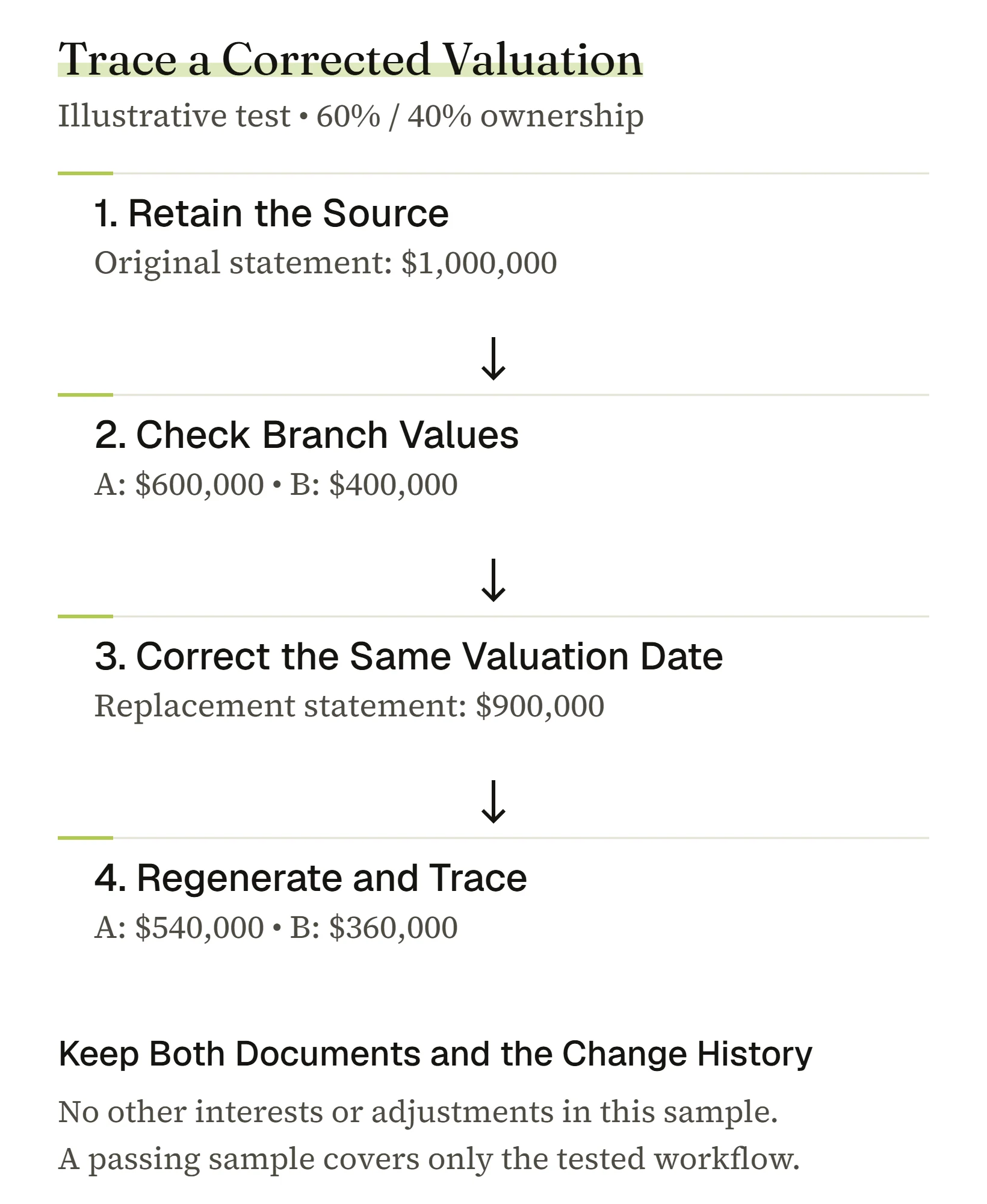
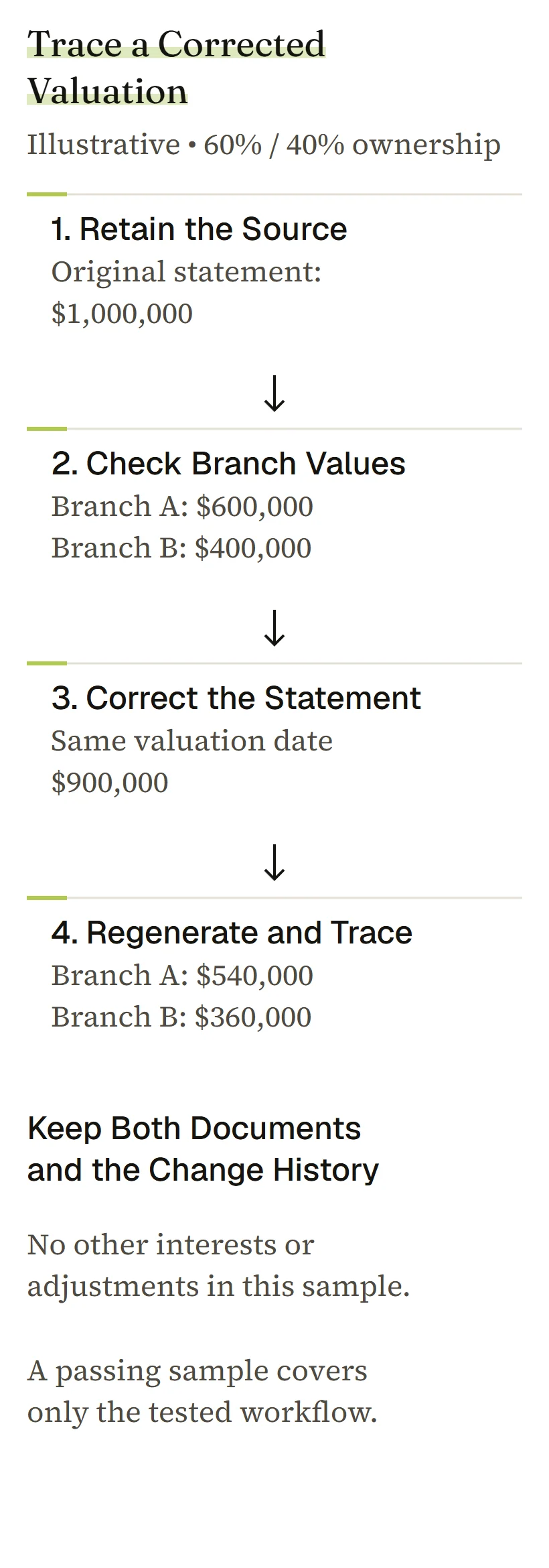
Trace a Private Investment Through Ownership, Reporting and Accounting
Use this illustrative test with your controller:
- A holding entity owns a private-fund interest; branches A and B own 60% and 40% of the entity, with no other adjustments.
- Load a $100,000 capital call and a later $1 million valuation as distinct cash-flow and valuation records.
- The valuation allocates $600,000 to A and $400,000 to B. The family total must avoid counting the entity’s holding again.
- Replace the valuation with $900,000 for the same date. Expect $540,000 and $360,000, retaining the original document and change history.
Trace the correction into the accounting output specified in advance by your controller, including whether and how it should affect the retained GL. This checks the stated sample; it does not establish support for every ownership or fund-allocation arrangement.
Test Corrections, Permissions and Performance Calculations
Introduce a duplicate, a missing price and a restricted user. Observe exceptions, resolution ownership and access to the corrected report and source document.
Include a private-fund valuation from an earlier quarter alongside current listed prices. Require the report to show each valuation date, flag the older mark and explain how subsequent cash flows affect the displayed value; agree the expected treatment before the demonstration. For performance, specify return method, fees, currency and dates, then compare against an independently calculated expected return. Record each result as passed, failed or unresolved, retaining the output.
A Worked Example: Build a Shortlist Around Your Requirements
A shortlist should explain why each platform advances and what could change that decision. This illustrative office retains its accounting system and needs reporting across private investments and family branches. The decisions below use published evidence; no vendor has run this scenario for us.
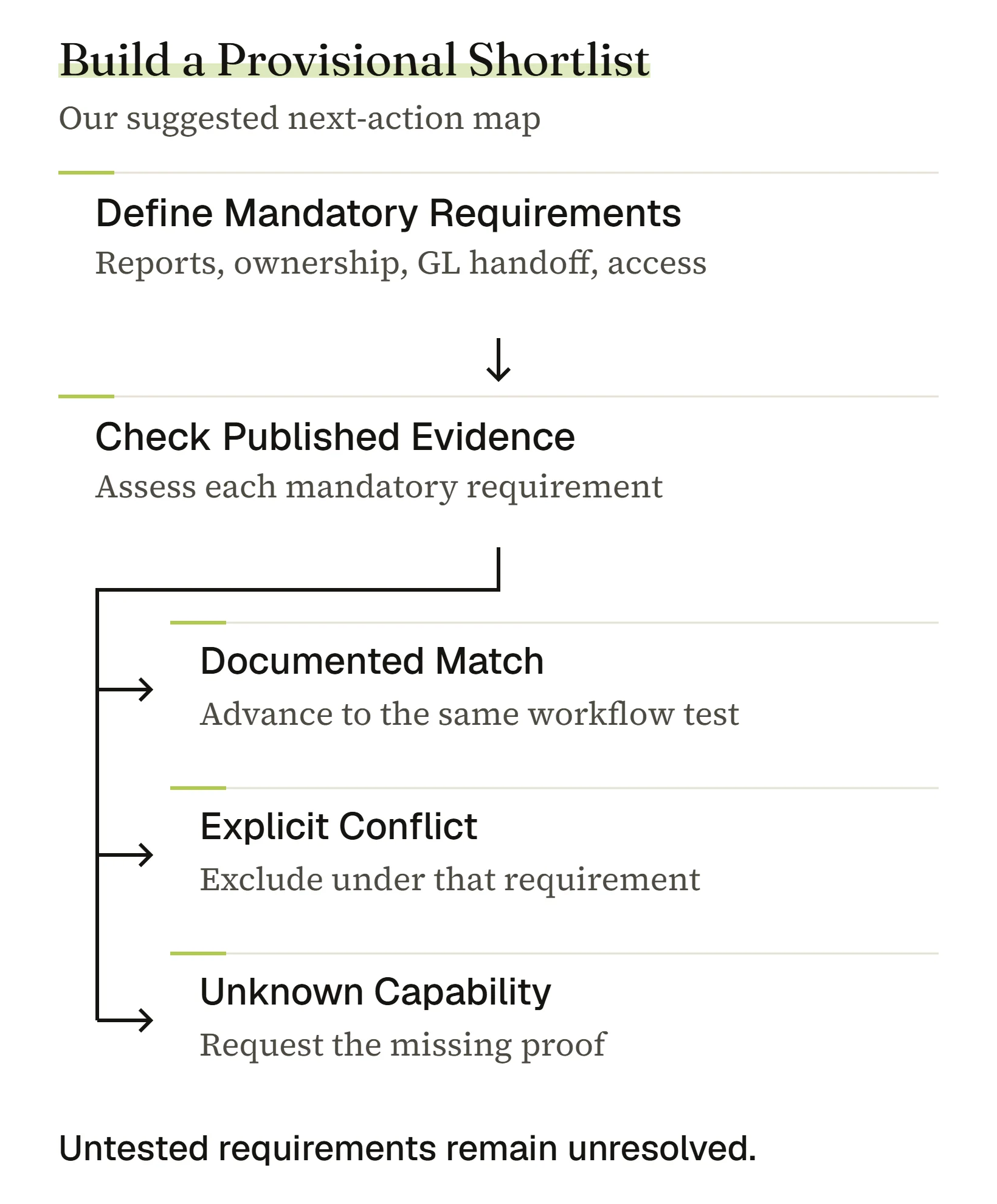
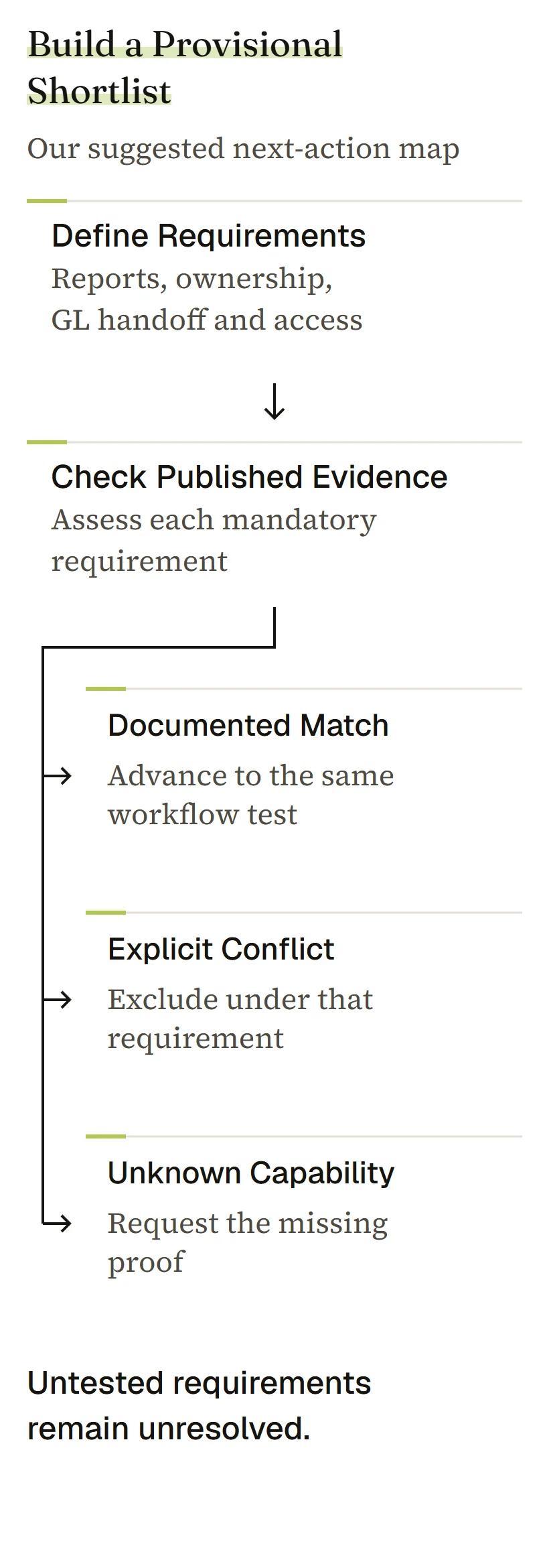
Define the Office’s Requirements
Assume UBS and J.P. Morgan accounts, private funds in holding entities and quarterly reports for two family branches. Mandatory requirements are percentage-ownership reporting, restricted branch access, source traceability and a maintained connection to the existing GL. Manual Excel transfers are unacceptable. The controller owns accounting acceptance; the investment lead owns the report specification.
Advance, Exclude or Keep a Platform Under Review
First, ask every vendor to confirm in writing its account coverage and proposed maintained connection to the office’s GL. Advance to the full technical demonstration after those routes are confirmed; keep unconfirmed routes under review. An API description starts that investigation. It does not satisfy the requirement. On this public evidence alone, none of the seven has yet passed every mandatory check.
| Requirement | Platform Evidence or Unknown | Shortlist Decision | Proof That Would Change the Decision |
|---|---|---|---|
| Ownership plus retained GL | Addepar: percentage ownership and GL APIs described. Aleta: look-through and accounting APIs described; economic-interest allocation unresolved. | Confirm the proposed GL connection, then demonstrate ownership and accounting together. All mandatory requirements still need testing. | Actual connector, corrected branch report, permissions and reconciliation. |
| Maintained GL connection | Asset Vantage: FAQ excludes direct accounting sync; its pricing page separately lists APIs. | Exclude the described Excel-based route; keep any proposed alternative unresolved. | Written, tier-specific confirmation and demonstration of a supported GL connection. |
| Retain existing accounting | FundCount: integrated posting model. Sesame: application and data-service routes. | Confirm a retained-GL design, then demonstrate the reporting and accounting workflow. | Data ownership, exchange fields and correction workflow for the proposed configuration. |
| Ownership plus GL connection | Masttro: ownership mapping and retained-accounting boundary documented; exact GL connection unresolved. | Confirm the proposed GL connection, then demonstrate ownership and accounting together. | Supported accounting exchange and account-level feed coverage. |
| Branch allocation plus GL connection | Black Diamond: APIs described; required ownership calculation and GL mapping unresolved. | Confirm the proposed GL connection, then demonstrate the required branch allocation. | Correct branch allocation, restricted access and the maintained accounting handoff. |
Any candidate that resolves its unknowns and passes the mandatory checks can advance. If the office instead requires a replacement GL, Masttro’s stated boundary excludes it from that procurement, while FundCount and Asset Vantage PRO merit evaluation of their accounting scope. Changing the requirement changes the shortlist.
Choose Your Next Software Evaluations
Select the next conversations from documented matches to your mandatory requirements. Send each vendor your entity map, account list, sample records and expected outputs, asking it to identify the included product, services and unresolved work. Compare demonstrated results, complete costs and retained staff responsibilities before choosing.
Marcus Dossler, CPA, with 20 years’ experience managing family offices in the US, Germany, Dubai and India.
The coming shake-out in family-office software
The category has never been more crowded. Consolidation is coming — and the firms that survive will be… Knowledge & Decision · Analysis
Is a Multi-Family Office Right for Your Family? Compare Fit, Fees and Services
Compare multi-family office fit, services, fees and family responsibilities with an illustrative quote worksheet and provider-check questions. Knowledge & Decision · Analysis