13 Family Office Accounting Software Platforms Compared by Need
Compare 13 family office accounting platforms by consolidation, partnerships, investment records, currencies, pricing and operating requirements.

The best family office accounting software depends on entity books, consolidation rules, partnership allocations, investment records and who runs the close. Begin with the accounting output you cannot produce reliably today. Then compare the platforms that document that work, the systems they must connect to and the result they must demonstrate. Assets under management alone do not determine fit.
- Match accounting requirements to documented capabilities before comparing prices.
- Separate native functions, additional modules, integrations and manual work.
- Use the same records and expected outputs in finalist demonstrations; include the first accounting close in implementation acceptance.
01Compare the 13 Platforms by Your Accounting Needs
These 13 platforms have documented accounting or general-ledger functions. This is an unranked editorial comparison of vendor documentation reviewed in October 2026, without hands-on testing. The shortlist suggestions identify candidates to investigate, not proven winners.
Start With the Work Your Office Must Complete
| Main requirement | Platforms to evaluate | Deciding test |
|---|---|---|
| Entity books and controlled payments | QuickBooks Online Advanced, AgilLink | Approve an invoice, release payment and reconcile the ledger |
| Multi-entity consolidation | SoftLedger, SumIt, Asseta | Post reciprocal entries and inspect consolidation and eliminations |
| Partnership and investment records | Asset Vantage, FundCount, AtlasFive, Archway | Carry an allocation through books and partner statements |
| Enterprise and cross-border books | OneWorld, Sage Intacct, Business Central | Demonstrate local books, currency treatment and consolidation |
| Separate client families | AtlasFive, Archway, LemonEdge | Attempt unauthorized access to books, documents and exports |
These groups overlap. A candidate remains conditional where the required method, country, edition or access boundary is unresolved. For portfolio-led selection, use the broader family office software comparison.
If QuickBooks no longer meets your consolidation requirements, investigate SoftLedger or SumIt; for partnership books with investment records, consider FundCount or Asset Vantage. Multiple entity ledgers can coexist when book ownership, account mappings, intercompany treatment and reconciliation responsibilities are explicit.
Compare Accounting Capabilities Across All 13 Platforms
The general ledger (GL) holds entity transactions and financial balances. Investment records track positions, costs and cash flows; reporting presents those records to an audience.
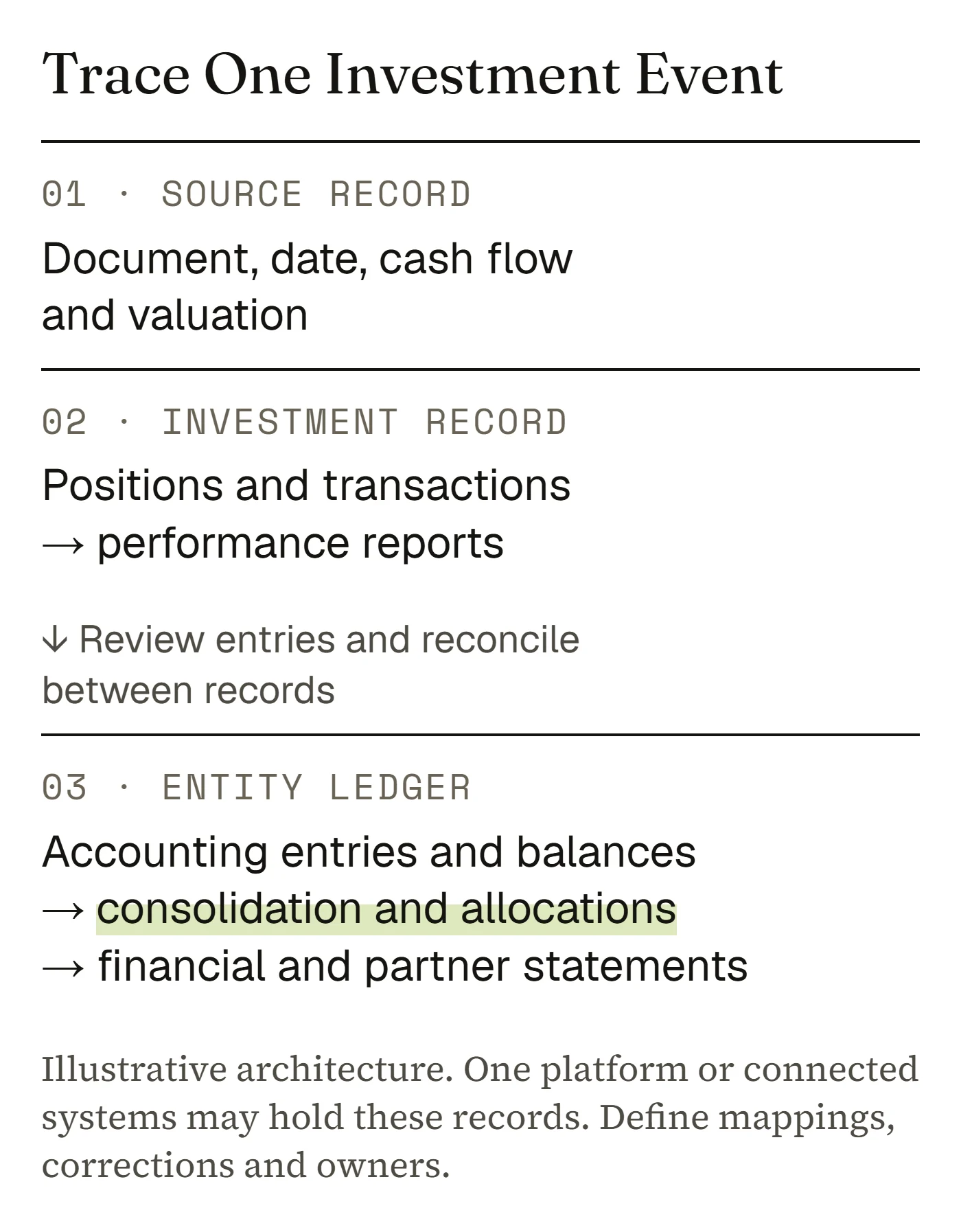
Illustrative record flow. Define mappings, corrections and owners for the agreed architecture.
All rows describe vendor documentation, not tested results. Unverified means not publicly established in the reviewed evidence; it does not mean absent. Native means within the product, with license/module inclusion still to be scoped. Non-controlling interest (NCI) is shown separately from partnership allocation rules.
Ledger and consolidation
| Platform | GL | Consolidation | Eliminations |
|---|---|---|---|
| QuickBooks Online Advanced | Native | Spreadsheet Sync reports | Unverified |
| AgilLink | Native | Consolidated reports | Unverified |
| SoftLedger | Native | Native multi-entity | Automatic, per vendor |
| Sage Intacct | Native dimensional | Ownership by period | Automatic entries |
| Microsoft Dynamics 365 Business Central | Native | Full/percentage | Standard manual |
| Oracle NetSuite OneWorld | Native | Subsidiary/parent | Configured automatic journals |
| SumIt | Native | Full, percentage, equity pickup | Automatic, per vendor |
| Asseta | Native | Global multi-entity | Unverified |
| Asset Vantage | Native | Multi-level ownership | Dynamic, per vendor |
| FundCount | Native | Nested ownership | Automatic, per vendor |
| Archway Platform | Native | Ledger-based look-through | Scheduled, per vendor |
| Eton Solutions AtlasFive | Native | Accounting/investment consolidation | Automation unverified |
| LemonEdge | Native engine | Hierarchy; financial method unverified | Automation unverified |
Partnership, investment and currency
| Platform | Partnership | Investment records | Currency accounting |
|---|---|---|---|
| QuickBooks Online Advanced | Unverified | Specialist records unverified | Home-currency revaluation; translation unverified |
| AgilLink | Allocation mechanics unverified | InvestLink connection | Revaluation/translation unverified |
| SoftLedger | Unverified | Specialist records unverified | Remeasurement and consolidation rates |
| Sage Intacct | Ownership/NCI; partnership rules unverified | Portfolio connections | Revaluation and translation adjustments |
| Microsoft Dynamics 365 Business Central | Specialist rules unverified | Specialist records unverified | FX adjustments and consolidation rates |
| Oracle NetSuite OneWorld | Specialist rules unverified | Specialist records unverified | Revaluation and group translation |
| SumIt | Ownership; capital/waterfalls unverified | Addepar data to reviewed journals | Revaluation/translation unverified |
| Asseta | Capital, percentage allocations, ownership history | Calls/distributions; tax lots unverified | Automatic unrealized FX gain/loss booking claimed; translation unverified |
| Asset Vantage | Ownership history and allocations | Tax-lot reconciliation, gains, GL posting | Local/group views; revaluation/translation unverified |
| FundCount | Capital, P&L, fees, statements | Portfolio and fund-document accounting | Multi-currency; revaluation/translation unverified |
| Archway Platform | Allocations/waterfalls in services; software scope unresolved | Fund records into ledger; lots unverified | Revaluation/translation unverified |
| Eton Solutions AtlasFive | Pro-rata to waterfall; trust accounting | Commitments, distributions, NAV; lots unverified | Portfolio views; revaluation/translation unverified |
| LemonEdge | Event-based; exact rules unresolved | Lot-level; attribution may need another system | Lot-level multi-currency; revaluation/translation unverified |
Additional technical sources: Intuit revaluation, AgilLink consolidated reporting, SoftLedger remeasurement and consolidation rates, Sage consolidation, Microsoft FX adjustments, Oracle eliminations and Asseta partnership accounting.
Capital accounts do not establish waterfalls or book-versus-tax capital. Investment records do not establish every cost-basis method. Multi-currency views do not establish revaluation or translation. These remain separate demonstration requirements where the matrix leaves them unresolved.
Compare Operating Scope and Published Pricing
Prices checked 12 October 2026 are subscription snapshots, not complete first-year costs. US prices and India packages are labeled separately. SoftLedger and FundCount display dollar amounts without an explicit currency code in the reviewed pages; establish contract currency. SFO means single-family office; MFO means multi-family office. Custodian coverage and accounting services marked unverified remain unresolved. Control descriptions do not verify current assurance-report scope.
| Platform | Published price / scope | Connections and controls | Implementation / services / limitations |
|---|---|---|---|
| QuickBooks Online Advanced | US $340/month; $170 promotional first three months; 25 users; company scope unresolved | Custodians: unverified; controls: custom access/approvals | Migration separate; optional bookkeeping separately scoped; payment eligibility applies |
| AgilLink | Quote required | Custodians: unverified; InvestLink; controls: approvals; City National Bank required for payments | Vendor average 2 to 6 months; external-bank visibility extra; accounting services unverified |
| SoftLedger | Annual-billed monthly: $300 Starter: 3 entities, 1 user; $750 Standard: 10 entities, 3 users; $1,125 Plus: unlimited entities, 5 users | Custodians: unverified; API from Standard; controls: Enterprise single sign-on/user provisioning | Implementation unpriced; Enterprise custom; accounting services unverified |
| Sage Intacct | Quote required; modules scoped | Custodians: unverified; portfolio connections; access/audit controls: unverified | Partner work/timing unresolved; accounting services unverified |
| Microsoft Dynamics 365 Business Central | US $80 Essentials/$110 Premium per user/month, paid yearly; limited Team Members $8 | Custodians: unverified; access/audit controls: unverified | Partner work/extensions additional; accounting services unverified |
| Oracle NetSuite OneWorld | Annual core + modules + users; amount unpublished here | Custodians: unverified; access/audit controls: unverified | One-time implementation fee; migration/timing unresolved; accounting services unverified |
| SumIt | Custom; SFO entity-based; MFO license/entity/integration fees | Custodians: unverified; Addepar; controls: pre-posting approval | Vendor estimate 8 to 12 weeks; integrations excluded; accounting services unverified |
| Asseta | Complexity tiers; amount/cadence unverified | Custodians: Schwab/Fidelity named; controls: immutable trail claimed | Vendor average 8 to 12 weeks; accounting services unverified |
| Asset Vantage | US SFO/year: $30,000 for 10 entities; $43,200 for 20 entities; $55,200 for 30 entities; larger/MFO custom | Custodians: feeds/reconciliation; controls: audit trail/locked periods | Onboarding/surcharges extra; optional AV Prime posting/reconciliation; US user cap unstated |
| FundCount | SFO from $35,899/year; MFO from $26,950/year; entity/users scoped | Custodians: automated feeds; controls: permissions; SOC 2 Type II claimed, period unverified | Transformation/hosting extra; ongoing accounting services unverified |
| Archway Platform | Fixed annual scope/entity/service price; amount unverified | Custodians: direct feeds; controls: ledger traceability | Internal/outsourced/hybrid accounting; timing depends on history, feeds and services |
| Eton Solutions AtlasFive | Eton describes a six-figure annual starting band; no exact tariff/currency established | Custodians: direct/aggregator feeds; controls: role/entity access | Statement-processing/migration services; inclusion/timing unresolved; ongoing close scope unverified |
| LemonEdge | Amount and billing unit unverified | Custodians: unverified; controls: client isolation/audits | Deployment/support scoped; accounting services unverified; specialist attribution may be external |
AV's separate India Pro accounting-and-reporting panel lists INR675,000/year for up to five entities and unlimited users, excluding GST; INR prices are subject to quarterly revision. Do not transfer those allowances to US plans or substitute the reporting-only Aspire price. Managed hosting and outsourced accounting are different services.
02Accounting Differences That Change the Shortlist
Compare the accounting output and the workflow that produces it. These vendor-documented differences change the required demonstration.
Asset Vantage, FundCount, Archway and AtlasFive
Asset Vantage describes ownership tracking and investment reporting alongside its ledger. FundCount explicitly names capital accounts, profit-and-loss allocations, fees and partner statements. AtlasFive documents trust principal-and-income tracking and allocation methods extending to waterfalls. Archway adds an explicit choice between internal, outsourced and hybrid accounting operations.
This changes the demonstration: an ownership change, partnership allocation, trust treatment and outsourced close require different proof. Book capital and tax capital must be separately specified where required; a capital-account feature does not establish both. Specify the agreement's allocation sequence, hurdles and exceptions for a waterfall demonstration.
AV's documented lack of direct synchronization with third-party accounting tools also matters if operating-business books stay elsewhere. Excel exports create a transfer and reconciliation obligation.
SumIt, Asseta and SoftLedger
SumIt identifies equity pickup, full consolidation and ownership-percentage consolidation, plus automatic eliminations. SoftLedger describes eliminations calculated and booked automatically. Asseta describes global consolidation, inter-entity automation and period-close views; the exact elimination and ownership-change mechanics require a demonstration.
Full consolidation and ownership-based views answer different questions. Specify the reporting basis, effective ownership dates and treatment of changes before comparing results. Equal aggregate balances can conceal different allocation logic.
SumIt's documented Addepar connection turns investment data into proposed journals reviewed before posting. That introduces mapping, rejected-import and correction responsibilities. Choose this architecture when those handoffs are acceptable; it does not establish that either product alone supplies the complete workflow.
NetSuite OneWorld, Sage Intacct and Business Central
OneWorld documents global subsidiaries, multi-book accounting and country configurations. Sage Intacct emphasizes dimensional accounting, consolidation and connections to portfolio applications. Business Central documents consolidation across charts, fiscal years and currencies, but its standard consolidation eliminations are manual.
A requirement for automated eliminations without extensions therefore rules out that documented standard Business Central route. Accepting an extension changes both the candidate's eligibility and its support obligations. Local books, group consolidation and specialist investment workflows need separate demonstrations across all three.
Transaction currency, an entity's functional currency and group presentation currency are distinct. Revaluation of a foreign-currency balance and translation of subsidiary statements must also be distinguished. The IFRS Foundation's IAS 21 overview explains these different currency jobs; the office's accountant must define the applicable treatment. Currency support alone does not prove local reporting compliance.
0313 Family Office Accounting Software Profiles
Put module inclusion, migration and ongoing responsibilities in the proposal alongside the published subscription.
QuickBooks Online Advanced
Accounting role. Business books, bills and financial reports suit entity bookkeeping with investments maintained elsewhere. The US Advanced page lists 25 users. Intuit Advanced
Distinction. Spreadsheet Sync combines specified financial reports across Advanced company files; this does not establish automatic eliminations. Combined-report instructions
Before selection. Run the real charts of accounts through the combined report. Matching accounts must have the specified name, type and hierarchy; unexplained aggregation fails acceptance.
Operating scope. Establish company subscriptions and payment eligibility. Investment records and consolidation adjustments need an assigned home and owner.
AgilLink
Accounting role. Multiple client books and controlled bill payment serve offices whose payment operation drives selection. AgilLink overview
Distinction. Configurable approvals and City National Bank treasury integration make banking eligibility a material condition, alongside stated investment-data integration.
Before selection. Demonstrate invoice approval, authorized release and the resulting entry through the intended bank and payment method. An unavailable route leaves the payment requirement unmet.
Operating scope. Separate software, banking charges, migration and connections. Each failed payment or feed needs an identified support owner; multiple client books alone do not prove every access boundary.
SoftLedger
Accounting role. Consolidated entity books and intercompany accounting make this a candidate for repeated cross-entity activity. Family-office offering
Distinction. The vendor explicitly describes offsetting intercompany lines and automatically calculated and booked eliminations.
Before selection. Use the $10,000 reciprocal-balance test below, then add your actual ownership and transaction exceptions. Inspect both the elimination entry and consolidated total.
Operating scope. The published Standard scope is ten entities and three users, billed annually. Migration, allocation requirements and investment reporting need separate scope.
Sage Intacct
Accounting role. A dimensional ledger and multi-entity consolidation support offices needing financial views across entities and reporting dimensions. Sage family-office offering
Distinction. Sage documents ownership percentages by period, automatic consolidation entries and non-controlling interests. These make ownership changes a specific demonstration requirement; portfolio connections retain a separate-system dependency.
Before selection. Post one investment event through the intended connection and trace dimensions, allocations and consolidated output. The result must reconcile to the originating record.
Operating scope. Identify licensed consolidation and allocation modules. The team must own account mappings, failed imports and corrections after implementation; dimensional reporting does not prove specialist partnership or tax-lot coverage.
Microsoft Dynamics 365 Business Central
Accounting role. General-ledger consolidation supports differing company charts, fiscal years and currencies. Microsoft consolidation documentation
Distinction. Microsoft identifies standard consolidation eliminations as manual. Intercompany transaction handling is a separate function.
Before selection. Demonstrate the exact elimination method. Label any extension and manual journal; neither should be presented as standard automatic capability.
Operating scope. Price licenses, partner work and extensions separately. An extension adds configuration, upgrade testing and support ownership. Specialist investment and partnership requirements need their own evidence.
Oracle NetSuite OneWorld
Accounting role. Subsidiaries, consolidated statements and global accounting make OneWorld a candidate for operating-company and international structures. OneWorld capabilities
Distinction. Multi-book accounting addresses different local, regional and headquarters reporting requirements.
Before selection. Produce the required local and group outputs from the same transactions. Identify every jurisdiction-specific configuration and external process.
Operating scope. Scope users, subsidiaries, modules and partner services. Currency conversion cannot establish local tax-return or banking support; investment performance and family-partnership allocations require separate proof.
SumIt
Accounting role. A family-office multi-entity ledger with documented consolidation methods serves ownership-structured books. SumIt overview
Distinction. Its Addepar connection produces proposed journals for review before posting. Integration description
Before selection. Apply an effective-dated ownership change under the chosen consolidation method. Reconcile imported investment events and rejected entries through correction and reposting.
Operating scope. Identify entity history and mapping owners. The published eight-to-twelve-week implementation estimate is vendor guidance, not a project commitment. Other investment-system connections remain separate compatibility questions.
Asseta
Accounting role. A family-office GL with multi-entity accounting, dimensions and global consolidation serves entity posting and close management. Asseta GL
Distinction. Its partnership product documents capital accounts, percentage allocations and ownership transfers/admissions/redemptions with retained history. Two-sided inter-entity booking is described; elimination automation remains unverified. Asseta partnership accounting
Before selection. Follow a reciprocal transaction through posting, elimination and close review. Show the ownership method and exact allocation rules; broad automation language does not establish them.
Operating scope. Define included products, connections and conversion work. Name the person reconciling imports and signing off the first close. Unproved partnership or investment details remain open requirements.
Asset Vantage
Accounting role. GL, partnership accounting and performance reporting combine entity books with investment records. Asset Vantage overview
Distinction. The site describes ownership tracking, tax-lot and cash reconciliation, bank/custodian feeds and consolidated eliminations.
Before selection. Trace an ownership change and investment correction into allocations, books and performance reports. Verify cost basis and lot selection where required.
Operating scope. AV's FAQ excludes operating-business accounting and direct third-party accounting synchronization; Excel exports are available. Retained operating-company books therefore require a defined transfer, reconciliation and correction process. Feeds and bill-payment connections are different integration jobs.
FundCount
Accounting role. Portfolio, partnership and GL accounting support offices combining investment records and partner allocations. Family-office capabilities
Distinction. The vendor explicitly describes capital accounts, profit-and-loss allocations, fees, partner statements and nested ownership, plus PDF processing for fund documents.
Before selection. Apply a representative agreement and corrected source document through the allocation and statement. Identify where extracted figures are approved and how corrections propagate.
Operating scope. Include required modules, feeds, custom reports, digital transformation and hosting in the quote. Integrated records still require reconciliation to external statements and control over source-document changes.
Archway Platform
Accounting role. General-ledger and investment accounting, inter-entity eliminations and wealth-structure reporting serve books across entities and families. Archway platform and services
Distinction. Internal, outsourced and hybrid operation are explicitly offered. Platform capability and the people performing the close are separate decisions.
Before selection. Produce the allocation and close outputs with the proposed service split. Test client access and the escalation path for disputed adjustments.
Operating scope. Annual pricing depends on scope, entities, service model and included capabilities. Custodians, asset classes, history and team availability affect implementation. Specify who posts, reviews, reconciles and approves each close.
Eton Solutions AtlasFive
Accounting role. GL, trust, partnership and tax-ledger functions address offices with those accounting responsibilities. AtlasFive details
Distinction. Published principal-and-income tracking and allocation methods extending to waterfalls provide specific trust and partnership evaluation routes.
Before selection. Process the relevant agreement or trust event into books and statements, then test role-based and entity-level access. A tax ledger does not establish filing support in every jurisdiction.
Operating scope. Define configuration, migration and service responsibilities. Allocation rules and access changes need ongoing governance.
LemonEdge
Accounting role. Event-based partnership accounting, lot-level multi-currency records and multiple ledger charts support complex structures. Family-office offering
Distinction. The stated safes model addresses client-family isolation; local-server and private-cloud deployment options add an environment decision.
Before selection. Test family access across ledgers, documents, reports and exports. Validate configured calculations against the governing rules.
Operating scope. Price deployment, calculations and support separately. LemonEdge states that sophisticated attribution-level performance reporting would likely need a specialist system. That connection adds data ownership and reconciliation obligations.
04Test the Fit From Simple to Complex Setups
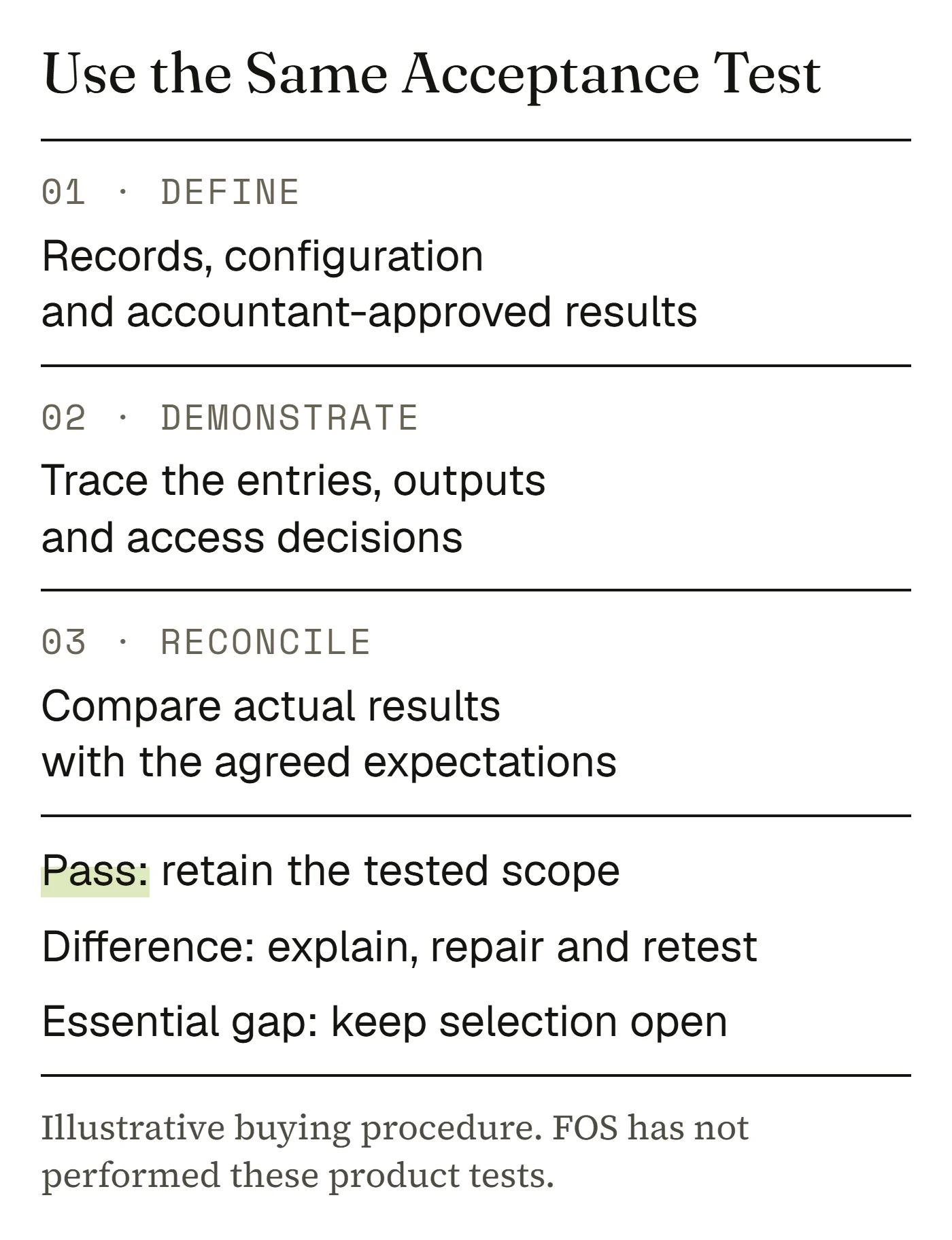
Illustrative buying procedure. FOS has not performed these product tests.
Use accountant-approved records/results and record the edition, configuration and adjustments. Passing establishes only demonstrated scope; unexplained differences leave requirements unresolved.
Simple Books and Bill Pay, With Investments Tracked Separately
Input: one $1,000 entity expense invoice, an approver and a payment releaser. Under the agreed test policy, record expense and payable, then settle the payable through the intended bank route.
Expected output: expense $1,000, payable zero after payment, bank movement $1,000 and the approval trail. An unauthorized user must not release payment. Reconcile the bank record to the ledger; an investment system must not create a second expense.
Decision: QuickBooks and AgilLink serve different starting requirements. An unsupported bank route or unexplained duplicate fails this workflow. The operational consequence is an outstanding payment or overstated expense, even if the dashboard looks correct.
Multiple Entities Requiring Consolidation and Intercompany Accounting
Input: two fully consolidated entities, one currency and matching $10,000 intercompany receivable/payable at the same date, with no other adjustments.
Expected output: each entity retains its own balance; the consolidated output eliminates both to zero. Retain the elimination entry and report.
Decision: if automatic elimination without extensions is mandatory, a manual adjustment fails that condition. Advance SoftLedger or SumIt for the scoped demonstration; Microsoft's documented standard manual Business Central route does not meet the unchanged requirement. Asseta's exact method remains to be demonstrated. Unexplained residuals leave group balances unreliable; an acceptable extension changes eligibility and support scope.
Investment-Heavy Structures With Partnerships and Ownership Allocations
Partnership input: opening book capital A $60,000/B $40,000; A contributes $10,000; agreed income $10,000 allocated 60/40; distributions A $2,000/B $1,000. Assume fixed allocation percentages for these events, no fees or other adjustments.
Expected output: closing book capital A $74,000/B $43,000, total $117,000, tied to ledger and partner statements. A subsequent 50/50 change must take effect on the specified date without silently rewriting prior allocations. Tax capital and waterfalls need separate approved rules and results.
Investment input: start with zero opening investment carrying value in one currency. Pay and capitalize a $10,000 call, then receive a $2,000 distribution classified as return of capital. Assume no other transactions, fees or FX movements. At a later valuation date, set fair value to $9,000. Under the agreed fair-value basis, carrying value before revaluation is $8,000; the valuation entry adds $1,000. Books and performance reports must retain the same dated flows and valuation; this is not a calculated return.
Decision: test AV, FundCount, Archway or AtlasFive against the required allocation and record detail. Wrong classifications or retroactive allocations fail; they distort capital or performance. For securities, add actual tax lots, cost basis and realized-gain rules rather than assuming a private-fund test proves them.
Multiple Families Requiring Separate Books, Permissions and Reporting
Input: unrelated Families A and B, with a user authorized only for A. Attempt direct access to B's ledger, documents, reports and exports; test administrator oversight separately.
Expected output: A's authorized work succeeds; every unauthorized B route is denied and relevant activity is logged according to the agreed audit requirement.
Decision: AtlasFive, LemonEdge and Archway provide different documented starting points, not proof of identical controls. A hidden dashboard with an accessible export fails isolation. The consequence is client-data exposure. If services are outsourced, test the provider's roles and approval responsibilities as well.
Cross-Border Structures With Multiple Currencies and Local Accounting Requirements
Input: a EUR1,000 unpaid invoice in USD-functional books. Set illustrative accountant-approved rates of USD1.10 per EUR on posting and USD1.15 per EUR at close, with no hedging or other adjustments.
Expected output: initial payable $1,100, closing payable $1,150 and a $50 exchange loss under the agreed test treatment.
Translation input: for a separate EUR-functional subsidiary, supply a balanced trial balance, accountant-approved closing, average and historical rates, and an approved USD group-output schedule. Expected output/pass condition: translated assets, liabilities, income, equity and the translation adjustment match that schedule and reconcile to consolidation. Unexplained differences fail this leg and leave group reporting unresolved.
Decision: evaluate OneWorld, Sage Intacct and Business Central on the actual edition and country configurations. Passing revaluation alone does not pass translation or local reporting. Wrong rates distort balances; missing local outputs leave an external accounting obligation. Give each provider the jurisdiction, accounting basis, bank and required export list.
05Compare the Full First-Year Cost
Use identical entities, users, history, outputs and service scope in proposals. Different pricing units and exclusions prevent a cheapest-platform ranking; missing component prices leave totals unknown.
Price the Same Software, Services and Retained Systems
An integrated suite can still need external payment, data or specialist reporting services. A connected architecture can require additional subscriptions and internal reconciliation work. Price both routes through the first accepted close. Separate one-time implementation from recurring support and accounting services, and include internal work where the office can estimate it reliably.
Use One Quote Worksheet for Every Finalist
| Quote field | Record for each finalist |
|---|---|
| License | Edition, currency, billing period, users, entities, modules and renewal basis |
| Implementation | Configuration, reports, allocation rules, training and acceptance scope |
| History migration | Years, transaction detail, opening balances, lots and capital accounts |
| Connections | Setup and recurring bank, custodian, investment, payment and extension fees |
| Operating services | Supplier charges for hosting, support, managed close and retained systems |
| Internal effort | Estimated hours and internal-resource cost, stated separately from supplier expenditure |
| Year-one supplier expenditure | Twelve months of supplier/third-party commitments plus one-time costs; list taxes, exclusions and unknowns |
Do not annualize a temporary promotion as the renewal cost or double-count services already included. If a required connection has no price, show the total as incomplete. Compare vendor delivery estimates only after the same history, configuration and acceptance work has been priced.
06Accept the Migration and First Accounting Close
Define acceptance before migration: reconciled history, documented corrections, access boundaries and the first close with its assigned owners.
Reconcile History, Balances and Access Before Cutover
Reconcile entity trial balances, intercompany balances, investment quantities and cost basis, capital accounts and currency balances for agreed dates. Trace opening balances to source records and check that imported transactions are not duplicated. Resolve exceptions, preserve correction history and test restricted users. Decide which older records remain accessible outside the new system. The accounting-platform guide covers related setup decisions.
Record Demonstrated Scope and Remaining Responsibilities
Attach the demonstrated edition, configuration, outputs and limitations to the proposal. Assign the first close, failed-feed recovery, mapping changes, allocation updates and access reviews. A finalist is ready for selection when required outputs reconcile and the office accepts the remaining obligations. Unresolved essential requirements stay open; a sales description cannot close them.
Explore the FOS provider directory for wider provider context. The accounting requirements above remain the selection criteria.
Choose the accounting workflow you can prove and operate, with its costs and handoffs visible.
The coming shake-out in family-office software
The category has never been more crowded. Consolidation is coming — and the firms that survive will be… Knowledge & Decision · Analysis
Is a Multi-Family Office Right for Your Family? Compare Fit, Fees and Services
Compare multi-family office fit, services, fees and family responsibilities with an illustrative quote worksheet and provider-check questions. Knowledge & Decision · Analysis