Is a Multi-Family Office Right for Your Family? Compare Fit, Fees and Services
Compare multi-family office fit, services, fees and family responsibilities with an illustrative quote worksheet and provider-check questions.

A multi-family office (MFO) coordinates wealth-related work for several families using shared people and infrastructure. Whether one fits your family depends on the work you need coordinated, the control you want to retain, the provider's eligibility terms and the full cost of the agreed service. Compare written proposals against the same family profile before treating their fees as comparable.
- Identify the reports, decisions and handoffs your present team cannot reliably deliver.
- Ask each provider who performs, approves, supervises and records the work in its proposed scope.
- Send each provider the same one-page family scope. Reconcile first-year and ongoing charges, leaving missing prices and responsibilities open until answered in writing.
01What Is a Multi-Family Office?
A multi-family office serves multiple families through a shared operating platform. It may coordinate investments, reporting, estate and tax advisers, administration and family governance. The agreement specifies proposed services and authority; applicable law, regulated activity and jurisdiction also shape legal duties. The name alone does not tell you who has investment discretion, holds assets or approves a payment. J.P. Morgan Private Bank's model comparison and Creative Planning's MFO guide describe the broad model from provider perspectives.
What Is Shared Across Families?
Staff, systems, investment research or operational processes may be shared. A provider can spread the cost of that capacity across clients, while each family still needs its own service agreement, authority limits and records. Shared capacity does not establish that two families receive the same team, reporting frequency or access to specialists.
Which Services Depend on Your Agreement?
Use the service schedule to separate work the MFO performs from work it coordinates through another firm. For example, “tax coordination” could mean collecting information for an external tax adviser, arranging a meeting or providing tax advice through an appropriately qualified professional. Ask which meaning applies, who pays the outside adviser and who signs off on the final advice. Repeat that distinction for legal work, custody, investment execution and consolidated reporting.
| Service named in a proposal | Scope to establish in writing |
|---|---|
| Investment oversight | Advice or discretionary decisions; implementation authority; reporting benchmark. |
| Tax and legal coordination | Named adviser, deliverables, review owner and separately billed work. |
| Accounting and reporting | Source records, entities covered, reconciliation owner and delivery cadence. |
| Administration | Payment initiation, independent approval, evidence retention and exception route. |
| Trust and estate administration | Named trustee or administrator, legal adviser, signing authority and charges for each entity or trust. |
| Family governance and succession | Meetings, decisions, succession documents, facilitator and final-record owner. |
| Philanthropy and next-generation education | Agreed planning or education output, specialist provider and any separately billed work. |
| Risk and insurance coordination | Review and referral scope, decision owner and whether placement or specialist advice sits outside the agreement. |
02Decide Whether an MFO Fits Your Family
An MFO is worth investigating when your current arrangement leaves important work uncoordinated and the proposed service would solve that problem at an acceptable cost and level of control. Complexity or wealth alone does not decide the answer. A family may obtain the needed outcome through a bank, adviser team or specialist providers.
Ask five questions before contacting providers:
- Which output is missing or unreliable, such as a consolidated report across entities or a clear payment approval record?
- How many entities, custodians, advisers and jurisdictions must that output cover?
- Which decisions will the family keep, and how much internal coordination can it still perform?
- Can a prospective provider serve the family's actual asset base and service scope under its current terms?
- Does a same-scope proposal justify the cost compared with fixing the current team or hiring a narrower service?
Use the answers to choose a route. Seek an MFO proposal when recurring work across providers lacks an owner and a candidate can take that work under a clear scope. Compare a narrower specialist team when the gap is bounded. Explore a single-family office when the family prioritizes dedicated staff and accepts the operating burden. Check provider eligibility and same-scope cost before choosing any route. The site's family-office structures guide develops that broader structural choice.
| Possible model | Who coordinates across services? | Who controls staff and systems? | Family work to check |
|---|---|---|---|
| Multi-family office | Provider, to the extent contracted. | Provider sets its shared platform; agreement sets family access. | Approvals, oversight and any excluded tasks. |
| Single-family office | Family's dedicated team. | Family, subject to its chosen governance. | Hiring, supervision, systems and full operating cost. |
| Private bank | Bank for its agreed services; cross-provider work may sit elsewhere. | Bank controls its service platform. | Outside advisers, consolidated records and decisions beyond bank scope. |
| Coordinated specialists | Named lead adviser or family team, if appointed. | Each firm controls its own work. | Integration, handoffs and dispute resolution. |
Privacy, cost and access depend on each arrangement and its documents; no model wins those questions by name alone.
For the same family profile, compare the MFO's full quoted cost with the specialist team's separate fees, the family's internal coordination time and the work still left without an owner. An MFO may justify an added fee when it takes responsibility for recurring cross-provider work and delivers an output the existing team cannot reliably produce. If the family already coordinates that work well, or needs only one bounded service, the narrower arrangement may be enough. Test the claimed improvement with the same report or handoff example under both models.
Compare an MFO With a Single-Family Office
A single-family office is organized for one family. Its dedicated team can give that family more direct control over staffing, priorities and systems, while the family takes on the cost and management of that operation. An MFO offers access to shared capacity under a provider agreement, so customization and oversight depend on the contract. Neither label proves better privacy or service quality. J.P. Morgan's comparison describes the model distinction; test actual arrangements through access rights, staffing and records.
Compare an MFO With a Private Bank or Adviser Team
A private bank may combine banking, lending and investment services. A coordinated adviser team can retain separate specialists chosen by the family. Either may solve the defined problem, but someone must still reconcile work across providers. Ask who owns the combined report, who follows up on missing records and who resolves conflicting advice. Compare those obligations with the MFO proposal; a broader service list alone does not create a working handoff.
Ask About Provider-Specific Minimums
There is no useful global net-worth cutoff for MFO fit. Providers may assess investable assets, total net worth, expected fees, entity complexity and the requested services differently. Published figures illustrate that variation, but they answer different questions:
| Published source, checked 12 October 2026 | Figure and its limit |
|---|---|
| Creative Planning's MFO guide | Describes roughly US$10 million–US$25 million or more in net worth as a possible model fit. The guide does not state Creative Planning's own admission minimum. |
| Cresset's MFO guide | Says MFO clients typically exceed US$25 million in net worth. The guide does not state Cresset's own eligibility rule. |
| Corporate & Trust Mauritius's MFO service page | Advertises a recommended US$5 million across Mauritius structures; its stated requirements include Mauritius-based or Mauritius-connected structures. This is one provider's geographically limited offer, subject to assessment. |
These amounts cannot establish eligibility for another firm or country. Ask each prospective provider what asset measure it uses, what is excluded, whether a minimum fee applies and whether your requested service is available in your jurisdictions.
03Map the Work, Decisions and Records
A service list becomes useful when every important action has a named performer, decision-maker, supervisor and record owner. Build this map from each provider's proposed agreement. An empty cell reveals a handoff to resolve before engagement; it does not prove the provider cannot perform the work.
Name the Adviser, Executor, Custodian and Approver
Use this request template to establish each provider's actual division of duties for the entities and accounts in scope. For every row, record who holds the source and final record and who resolves a missing one.
| Work or decision | Performer to name | Approval or supervision to name | Record owner, source and final evidence to name |
|---|---|---|---|
| Investment advice | Adviser and any external manager | Person or body with decision authority | Recommendation and decision record. |
| Trade execution | Authorized executor | Discretion limit and oversight owner | Order and confirmation. |
| Tax and legal coordination | Named MFO contact and outside professional | Reviewer of advice and filing/signing authority | Advice, source documents and approval. |
| Custody | Legal custodian for each account | Access and instruction authority | Custody statement and access log. |
| Payment | Initiator | Independent approver, if used; otherwise control and exception owner | Instruction, control evidence and confirmation. |
| Consolidated report | Data collector and preparer | Reconciliation reviewer | Source extract, exceptions and final version. |
The escalation route must cover an unavailable person or conflicting records. “The team handles it” leaves that decision and its evidence undefined. The agreement should state which external professionals the provider supervises, if any, and which remain directly engaged by the family.
Test a Payment and a Reporting Correction
For a proposed payment, use a sample instruction without real account details. The walkthrough should identify the initiator, authority document, whether a second person independently approves it, and what control applies if nobody does. It should show any threshold that changes the route and where approval and confirmation are retained. A changed beneficiary detail tests who pauses the payment and informs the family. A satisfactory answer names each role and an observable record.
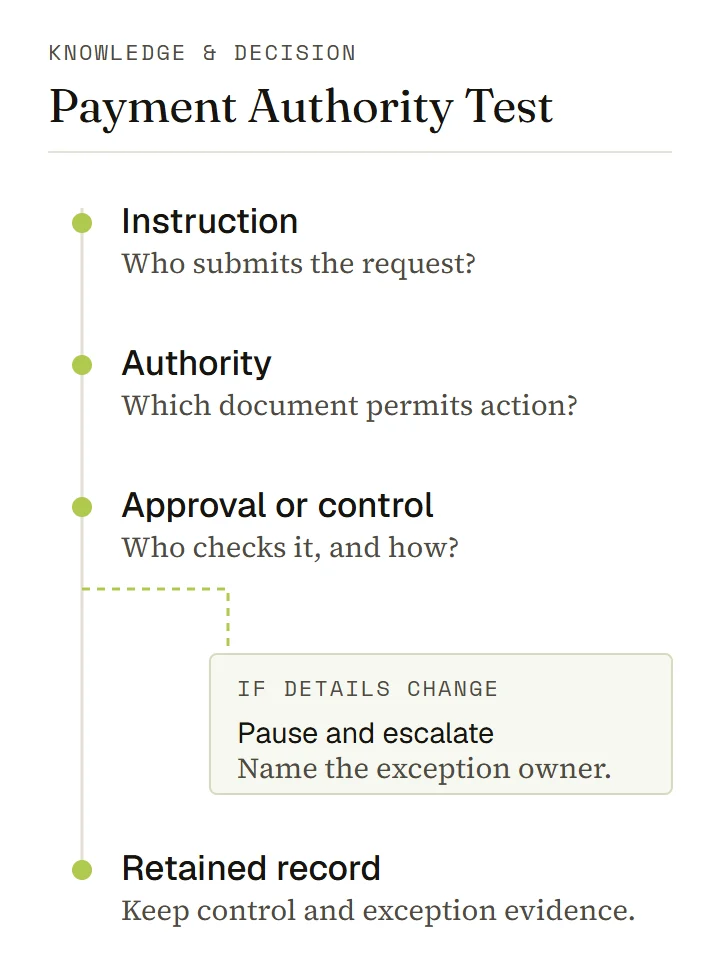
Illustrative payment handoff: ask who owns each step and what happens when the instruction changes.
For a reporting correction, suppose one custodian's statement does not match a consolidated report. The walkthrough should show who obtains the source statement, reconciles the difference, authorizes a corrected figure, issues a revised report and records the change. If the provider only collects files while your internal team owns reconciliation, place that responsibility and its cost in the comparison. Use the same test on both proposals:
| Handoff to test | Proposal A: named party and record | Proposal B: named party and record |
|---|---|---|
| Payment initiation, authority and approval or control | Enter family, provider or external owner; cite authority and approval evidence. | Enter family, provider or external owner; cite authority and approval evidence. |
| Changed payment or other exception | Enter pause/escalation owner and record. | Enter pause/escalation owner and record. |
| Source-data reconciliation and corrected report | Enter source holder, reconciler, correction approver and final-record owner. | Enter source holder, reconciler, correction approver and final-record owner. |
Leave a role open if the proposal cannot name its owner or evidence. If your central need is software selection, use the site's family-office accounting software guide.
04Compare the Full Cost on One Scope
An MFO's headline percentage or retainer does not establish the total cost of a usable service. Compare the charge base, included work, separately billed work, outside costs and exit charges for one agreed family profile. Public guides describe several fee forms, including asset-based rates, fixed retainers and service-based charges, but a provider's actual quote controls its package and eligibility. See Creative Planning's fee overview and Aleta's MFO guide for examples of fee categories.
Published numbers give context, with different scopes. In PwC Italy's Family Office Survey 2026, based on 2025 data from seven Italy-based MFOs, about half reported a fixed fee of 0.30% of assets under management (AUM), one reported 0.50% and one 1%. PwC warns that services and fee structures vary. This small Italian sample does not establish a global market rate or a complete family bill.
For a provider-published offer, Corporate & Trust Mauritius advertises an indicative US$12,000–US$35,000 annual MFO administration retainer per family, plus US$5,000–US$15,000 per underlying trust and US$2,500–US$6,000 per company for those services. Its page says consolidated reporting is included in the retainer and investment management is outside its service. The offer concerns Mauritius-connected structures and a detailed proposal follows assessment. These service components cannot establish the full cost of another MFO package. Figures and scope were checked on 12 October 2026.
Define the Fee Base and Included Services
For an assets-under-management (AUM) charge, record which assets enter the base, their valuation date, the rate and any minimum. A stated rate applied to custody assets differs from one applied only to assets the provider manages. For a retainer, record the period, included hours or deliverables and repricing terms. For a per-service or project fee, record the priced deliverable, unit or project period, what triggers additional billing and whether outside advisers are billed separately. Ask whether performance, incentive or transaction fees apply alongside the base charge. Record each variable fee's calculation, trigger, measurement period and payer; if its future amount cannot be priced, mark the total provisional. For every model, attach the service schedule. A low headline fee can accompany a narrower scope; a higher quote may include work billed separately elsewhere. Neither conclusion follows without the schedules.
Add Onboarding, Third-Party and Exit Costs
Ask for the first-year setup fee, recurring provider charge, product and custody costs, external tax and legal fees, applicable tax treatment and any data extraction or termination fee. The provider may control some charges and merely estimate others. Mark each line as included, separately priced, estimated or unknown. An unknown is not zero. Tax treatment, provider eligibility and disclosure rules depend on the relevant jurisdiction and arrangement; obtain local professional advice where needed.
05Work Through an Illustrative Quote Comparison
The following figures are invented solely to demonstrate the calculation; they do not represent market prices or quotes from the cited sources. They show how two fee structures compare when the family holds scope constant. The calculation answers a cost question only; it cannot establish service quality, suitability or future fees.
Hold the Family Inputs Constant
Assume a family has $20 million of investable assets, three entities and two custodians. Both proposals cover investment advice, coordination, source-data reconciliation, a consolidated annual report and a quarterly review, with no discretionary investment authority. Assume a full year with the AUM base unchanged at the $20 million opening valuation; a real quote must specify its valuation and adjustment method. Neither invented proposal includes a performance, incentive or transaction fee. Both comparisons use an invented $18,000 annual third-party-cost allowance. It is an invented shared allowance. Actual custody, product, tax and legal charges remain unknown and outside the illustrated total.
Calculate First-Year and Ongoing Totals
| Illustrative line | Proposal A | Proposal B |
|---|---|---|
| Annual provider fee | 0.5% × $20m = $100,000 AUM fee, plus $30,000 service retainer | $140,000 retainer |
| One-time setup | $12,000 | $10,000 |
| Invented third-party allowance used in both examples | $18,000 | $18,000 |
| Illustrative first year, including allowance | $160,000 | $168,000 |
| Illustrative ongoing year, including allowance | $148,000 | $158,000 |
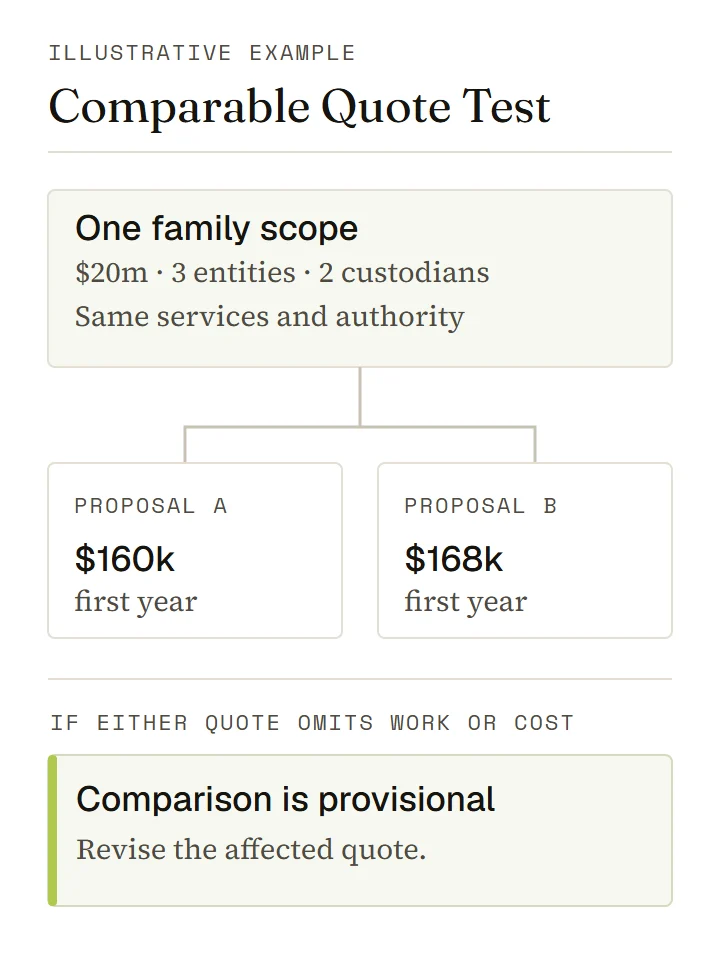
Invented first-year figures include a shared $18,000 allowance. For real quotes, confirm identical work and resolve material excluded charges before comparing totals.
On these fixed inputs A is $8,000 lower in the first year and $10,000 lower in an unchanged ongoing year. The gap can change if assets move, the AUM base changes or the retainer resets. Unknown actual tax, product, custody, legal and exit charges are excluded from both displayed totals; the $18,000 line is solely an invented shared allowance.
Under the invented ongoing fee formulas, the provider charges meet at $22 million of AUM: 0.5% × $22 million + $30,000 equals B's $140,000 retainer. This sensitivity check cannot establish a real price or total-cost break-even. The first-year setup fees differ, and actual excluded charges and repricing terms remain unknown.
Resolve Missing Charges Before Comparing Totals
Send both providers the same family-scope sheet, then copy their written answers into this worksheet. In each proposal cell, enter the amount or deliverable; status (included, priced separately, estimated or unknown); source document and line; and named owner where work or approval is involved. “Unknown” remains unknown in totals. Keep the example above separate from real quotes.
| Same-scope field or deliverable | Family requirement to send both providers | Proposal A: amount/status/source/owner | Proposal B: amount/status/source/owner |
|---|---|---|---|
| Entities, accounts and custodians | List each entity and account; identify two custodians if applicable. | Enter coverage and quote line. | Enter coverage and quote line. |
| Advice and investment authority | State advice needed and whether discretion is granted. | Enter included scope and decision owner. | Enter included scope and decision owner. |
| Reporting and reconciliation | State report fields, annual delivery, quarterly review and source-data reconciliation. | Enter deliverables, status and source. | Enter deliverables, status and source. |
| Provider fee | State fee base/date, period and any minimum or retainer; for service/project fees, state unit and extra-billing trigger. Ask about variable, performance, incentive and transaction fees, including their calculation and trigger. | Enter formula, amount or provisional status, repricing and quote line for each charge. | Enter formula, amount or provisional status, repricing and quote line for each charge. |
| Onboarding and separately billed work | State setup and additional-service triggers. | Enter one-time or recurring amount/status/source. | Enter one-time or recurring amount/status/source. |
| Product, custody and other third-party charges | Name actual custodians and identify each known outside cost. | Enter one-time or recurring amount or unknown, payer and source. | Enter one-time or recurring amount or unknown, payer and source. |
| Tax and legal professionals; applicable tax | State required outside work and jurisdiction. | Enter included/estimated/unknown and source. | Enter included/estimated/unknown and source. |
| Exit and data return | State export format, timing and assistance needed. | Enter charge, duty owner and source. | Enter charge, duty owner and source. |
| First-year and ongoing total | Sum only priced or expressly assumed items; label assumptions. | Enter both totals or “provisional”. | Enter both totals or “provisional”. |
In a real quote comparison, either provider might exclude reconciliation or leave custody costs unpriced. The resulting totals would not be comparable prices for the same outcome. Mark that line and the responsible provider as open. Request revised written quotes that price the missing work or identify the charge basis. Do not select the lower illustrated total while a material cost or responsibility remains unknown.
06Check the Provider and the Exit Terms
Provider due diligence should connect each document to a decision. A service schedule tests what is delivered, a fee schedule tests total cost, authority documents test who may act, and a sample report tests the output the family will receive. Ask for the actual contracting entity and any external firms involved; a brand name alone does not establish permissions or the scope of responsibility.
Request the Service Schedule and a Sample Report
Request these items for the proposed engagement:
| Evidence | Decision it supports |
|---|---|
| Service schedule and named team | Which entities, outputs, specialists and response obligations are included? |
| Fee schedule and scoped quote | What is the fee base, what triggers extra billing and what remains estimated? |
| Sample report and source list | Can the provider deliver the required consolidated view, and who reconciles it? |
| Authority, custody and approval map | Who can instruct, approve, execute and observe transactions? |
| Conflicts disclosure and outside-provider list | Which incentives and subcontracted roles affect the advice or work? |
| Termination and data-return terms | What records, formats, access and help will the family receive on exit? |
The sample report need not contain a real client's confidential data. Ask the provider to demonstrate the fields, reconciliations and exception handling using a safe example.
Check Permissions and Conflicts in Each Jurisdiction
Check the entity and activity that would serve your family. In the United States, for a relevant investment adviser, the SEC's Form ADV investor bulletin explains the brochure and disclosures investors can examine. In the United Kingdom, the FCA Firm Checker helps check a firm's authorization and permissions for the activity. These tools do not confirm every service in an MFO proposal, and neither applies globally. Elsewhere, use the relevant local regulator and qualified counsel. Use this route for due diligence; obtain local legal, tax or investment advice where needed.
Agree on Data Return and Handover
Ask which entity owns each record, the export format, the time allowed to retrieve it, continuing access after notice, transfer assistance and any exit charge. Confirm who tells external advisers and custodians about changed authority. A family that cannot obtain source records or a clear handover may face operational disruption even if it can terminate the agreement.
07Record the Decision and Unresolved Questions
The invented case supports continued MFO conversations, with no provider selected. A's illustrated first-year total is $8,000 lower, yet real costs remain provisional. Before deciding, the family would need each provider's written custody charges and a named reporting reconciler. It would compare those answers with the same output and ownership offered by a coordinated specialist team.
An MFO is worth serious consideration when your family needs recurring coordination across investments, entities, advisers and administration, and a provider will take responsibility for defined work at an acceptable full cost. If the main gap is one service or your existing team can reliably own the handoffs, compare a narrower arrangement. In either case, proceed only when the quoted scope, retained family decisions, total charges and unresolved conditions are clear.
The coming shake-out in family-office software
The category has never been more crowded. Consolidation is coming — and the firms that survive will be… Knowledge & Decision · Analysis
Family Offices in the United States: About 3,000 and Rising
Recent estimates put family offices in the United States near 3,000, but the total shifts by year, source,… Knowledge & Decision · Analysis