Top 10 fund reporting software platforms compared by fund type
Explore the top 10 fund reporting software options for US fund teams. Understand fund management, reporting and accounting, then compare features and costs.

Which Fund Reporting Platforms Should You Compare?
Start with the fund you operate and the reports you must produce. Private equity teams need partnership allocations and investor statements; hedge-fund teams may need class-level net asset value (NAV) and complex investment accounting. Compare the documented outputs, calculation controls, delivery modules and operating responsibilities before selecting demonstrations.
This comparison helps US private and alternative-fund teams evaluate ten accounting-backed reporting platforms. Confirm fund-specific and US reporting requirements in the proposed configuration. The intended buyers are fund managers, finance teams and administrators producing fund reports. A family office receiving reports as a limited partner may instead need document collection, commitment tracking and consolidated portfolio reporting; those needs fall outside this comparison.
01What Is Fund Reporting Software?
Fund reporting software assembles, calculates, formats or distributes information about a fund's finances, investments and investors. It may be part of the accounting system that produces those numbers, or a connected application that receives them. Its usefulness depends on the underlying data, calculation rules and review process.
Fund Reporting, Fund Accounting and Fund Management: The Differences
Fund accounting records transactions, assets, liabilities and investor allocations. A general ledger holds the accounting entries; partnership accounting assigns activity to investors under the fund's agreed rules.
Fund reporting communicates the results through statements, performance reports, notices and dashboards. A portal distributes information and controls access; portal access alone does not establish who calculated the balances.
Fund management software is a broader category that can include fundraising, deal tracking, portfolio monitoring and investor relationships alongside accounting. Ask which application owns each task. For example, portfolio-company revenue may come from a monitoring system, while an investor's capital balance comes from the fund ledger.
Who Uses Fund Reporting Software?
Controllers and finance teams prepare and reconcile reports. Fund administrators may maintain the books and produce the package. Investor-relations teams distribute approved information, while investors, including limited partners (LPs), receive statements and notices.
Family offices buying visibility across externally managed investments have a different job from general partners maintaining a fund's accounts. Our Revere provider profile illustrates the document-collection side of that distinction. This comparison focuses on accounting-backed reporting for private and alternative investment funds, rather than nonprofit fund accounting or retail mutual-fund procurement.
02What Does Fund Reporting Software Do?
Fund reporting software connects financial records and investment data to reports people can review and use. Depending on the product and purchased modules, it can calculate balances, generate statements, organize approvals and deliver investor documents. Each step needs a defined source and an accountable owner.
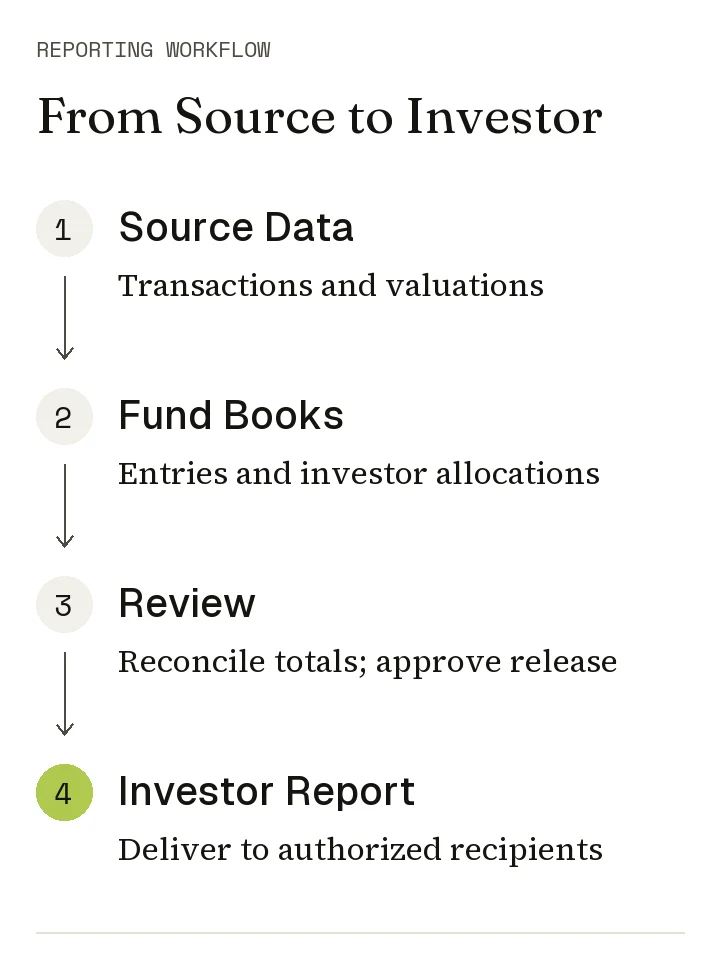
A reporting workflow needs an identified source, accounting owner, reviewer and authorized recipient.
Fund Financial Statements, NAV and Investor Capital Accounts
A reporting package may include the balance sheet, income statement, cash-flow statement and investment schedule. Net asset value, or NAV, measures assets less liabilities. Investor capital accounts show each investor's allocated interest and activity; their calculation depends on the fund's structure and allocation rules.
Reconcile fund totals to the ledger and investor totals to the relevant fund balances before release. A polished statement does not resolve an incorrect valuation or expense allocation.
Performance Reports, Capital Calls and Distributions
Performance reporting can include internal rate of return (IRR) and investment multiples. Gross and net results answer different questions, so require the calculation basis, cash-flow dates and treatment of fees to accompany the output.
Capital-call notices request contributions; distribution notices explain amounts returned to investors. Check whether issuing a notice also creates the required accounting entries and whether amended notices remain traceable.
Portfolio Data, Investor Portals and Approval Workflows
Portfolio dashboards may combine valuations with company operating metrics. Those metrics require their own collection and validation process. Investor portals provide the delivery channel, while approval workflows determine who can prepare, review and release information.
Have the vendor trace one number from its source through the accounting entry, report and investor view. That reveals where a spreadsheet, integration or human approval remains necessary.
03Top 10 Fund Reporting Software at a Glance
Which Platforms Fit Your Fund?
These are suggested starting groups based on documented scope, not exclusive categories or ranked winners. Choose two or three whose reporting emphasis matches your problem; then apply the acceptance test. Other listed products may also qualify.
| Buyer and Requirement | Candidates to Investigate | Reason and Decisive Test |
|---|---|---|
| Private equity or venture capital general partner | Allvue, Dynamo, eFront, FIS, Fundwave | Partnership accounting and investor activity. Test your allocation rules, capital statements and separate delivery modules. |
| Hedge-fund controller | FundCount, SS&C Geneva; Mfact for NAV-centered requirements | FundCount specifies class/series NAV; Geneva emphasizes instrument complexity; Mfact emphasizes multi-class NAV. Test subscriptions, fees and reconciled investor balances. |
| Independent fund administrator | PAXUS, FundCount, Allvue | PAXUS integrates administration; FundCount has administrator packages; Allvue documents administrator workflows. Test multiple clients, permissions and release ownership. |
| Team checking an external administrator | FundCount, SS&C Geneva | Both document shadow-accounting scope. Test independent inputs, balance breaks and responsibility for resolving discrepancies. |
| Private-credit instruments or entity structures | SS&C Geneva/Mfact for instruments; LemonEdge for structures | Geneva addresses complex instruments; Mfact names private debt. LemonEdge targets accounting through entities. Test loan events separately from entity allocations and investor statements. |
For example, a private equity team requiring Excel-integrated reporting could start with Dynamo. For waterfall comparison, add Allvue with its optional module and FundCount with its advertised calculation flexibility. FundCount’s wording does not establish Excel integration: verify spreadsheet use and formula ownership. Give all three the same allocation and approval case; other platforms may also qualify.
For a different private equity starting group, compare FIS for replacing the accounting environment, Fundwave for connecting investor activity to journals, and eFront for coordinating accounting and portal applications. Choose demonstrations around the workflow you need to change.
How We Selected and Compared the Platforms
Selection required public evidence of fund or investment accounting plus reporting relevant to alternative funds. Standalone dashboards, portal-only products and administration-service-only offerings were excluded. “Top 10” identifies this editorial selection; the profiles are alphabetical, with no performance ranking. We reviewed public documentation on October 12, 2026, without hands-on product testing.
The two matrices use the same dimensions across all ten platforms. Documented means stated in the linked vendor material, not independently tested. Confirm identifies detail the reviewed material does not settle; it does not establish an absent feature. Package inclusion requires a proposal even where a capability is documented.
Accounting, Investor Outputs and Performance
| Platform | Financial Statements and NAV | Investor Activity and Allocations | Performance Reporting |
|---|---|---|---|
| Allvue | General-ledger financial statements; confirm class/series NAV | Partnership allocations, calls/distributions; waterfall optional | Confirm required gross/net metrics and calculation basis |
| Dynamo | Net assets, operations, cash flows and partners' capital | Capital accounts, calls/distributions; Excel-integrated waterfalls | Investor/portfolio gross and net IRR documented |
| eFront | General ledger and custom reporting through Invest GP | Transactions, calls/drawdowns and investor reports | Performance analytics described across products; confirm application and metrics |
| FIS | Fund/partnership accounting and reports; confirm statement formats | Commitments, calls/distributions; confirm allocation configuration | Performance measurement described; confirm formulas and outputs |
| FundCount | Consolidated financials; Hedge Fund package specifies fund/class/series NAV | Partnership accounting; Private Equity package specifies unit/series/equalization and waterfalls | Confirm required return metrics and benchmark outputs |
| Fundwave | Trial balance, balance sheet, income statement and NAV statements | Investor closes, capital notices, fee/carry calculations | Confirm gross/net metrics and calculation basis |
| LemonEdge | Multi-ledger financial reporting through fund structures | Allocation engine; confirm investor statement/notice formats | Scenario planning documented; confirm historical return reports |
| Linedata Mfact | Multi-class NAV; configurable financial reports | Confirm partnership capital statements, notices and waterfalls | Analytics documented; confirm investor-return measures |
| PAXUS | Integrated fund accounting; confirm required statement/NAV formats | Open/closed-ended administration; confirm allocation and notice formats | Confirm required metrics and calculation basis |
| SS&C Geneva | Multi-currency investment accounting and reporting | Investor accounting; confirm your partnership allocation/report package | Confirm required investor returns and benchmark basis |
Delivery, Templates and Operating Model
| Platform | Investor Delivery Arrangement | Operator and Commercial Boundary |
|---|---|---|
| Allvue | Connected investor-portal module; inclusion to confirm | Managers/administrators; Capital Activity Workflow labeled live for administrators |
| Dynamo | Connected Dynamo investor portal | Software and separately offered administration services; distinguish responsibilities |
| eFront | Investment Café linked as portal; Invest GP for accounting/reporting | Identify licensed applications and manager versus administrator permissions |
| FIS | Digital Data Exchange separately described | Define accounting-suite and portal scope, including interfaces |
| FundCount | Client/self-service reporting in administrator package; confirm portal requirements | Distinct administration, hedge, shadow and private equity packages |
| Fundwave | Investor notices and reports documented; confirm delivery package | Define software operation versus work performed by your administrator |
| LemonEdge | White-label portal described; Eleven partnership also documented | Establish proposed portal, connection and implementation owner |
| Linedata Mfact | Web reporting described; investor-portal scope unverified | Managers/administrators; distinguish data connectivity and services |
| PAXUS | PAXUS-CONNECT described as built into the core | Administrator-centered operation; confirm your access and US configuration |
| SS&C Geneva | Investor reporting documented; portal arrangement unverified | Investment/investor accounting, shadowing and managed-service scope to separate |
Template support: Dynamo explicitly advertises Institutional Limited Partners Association (ILPA) reporting. The reviewed material does not establish exact current ILPA template versions and export-field coverage for any of these ten configurations. Require a completed version-specific export; generic reporting, custom-report capability or a portal is insufficient evidence.
Price evidence: FundCount publishes package starting figures, detailed below. No software figure appeared on the other nine reviewed product pages. That is a page-specific finding, not a claim that those vendors never publish prices.
04Fund Accounting and Reporting Software Reviews
For private equity partnership workflows, Dynamo's Excel-integrated calculations make formula ownership a central evaluation question; Allvue's optional waterfall makes licensed allocation scope explicit; eFront and FIS require attention to named accounting and delivery applications. Fundwave connects investor activity to journals and reports. These differences determine what to demonstrate, without proving another platform lacks the capability.
For investment accounting and administrator workflows, compare FundCount's package-specific class/series NAV, Mfact's multi-class NAV production, Geneva's instrument and reconciliation scope, and PAXUS's integrated administration. LemonEdge adds a structure-centered evaluation route where changes must flow across entities. Begin with your hardest calculation and the people responsible for it.
Allvue
Allvue Fund Accounting combines private equity partnership accounting, financial statements, a multi-currency general ledger and cash management. It documents funds of funds, co-investment vehicles and multi-fund environments.
- Useful capabilities: A financial-report library, custom report writer and configurable allocations; connections to management-company accounting and investor-portal modules.
- Limits and dependencies: Carry calculations use an optional waterfall module. Capital Activity Workflow is labeled live for fund administrators; establish availability in a manager-operated configuration.
- Cost and adoption: Price the waterfall and connected modules separately in the proposal, and assign allocation setup and report acceptance.
Investigate Allvue when partnership books and financial statements are the center of the project. The deciding demonstration is your allocation agreement in the licensed configuration, including the optional waterfall where required.
Dynamo
Dynamo Accounting serves private equity, venture capital, real estate and funds of funds. Its Excel-integrated calculation and reporting approach gives finance teams a specific way to inspect formulas.
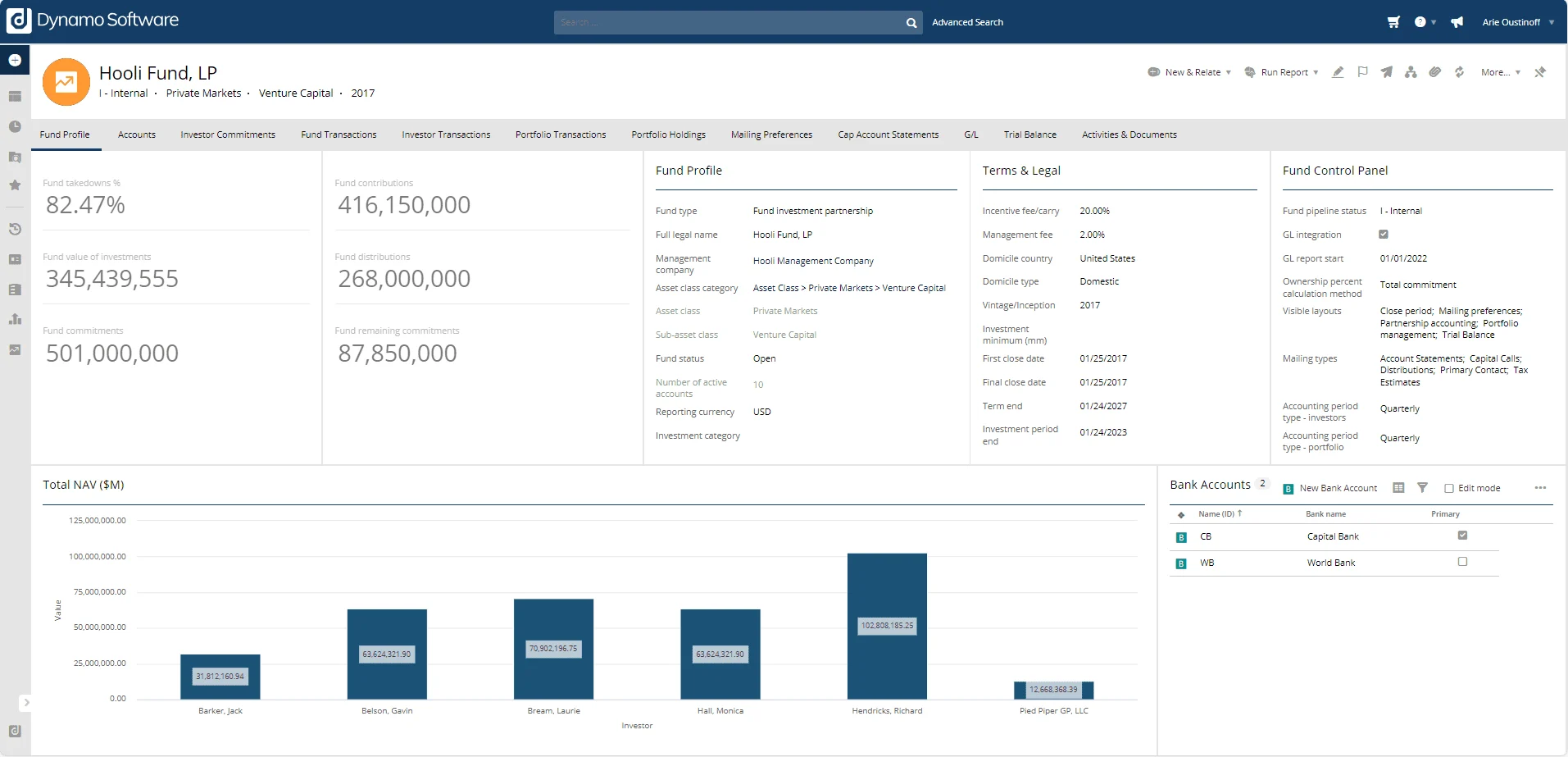
Public demonstration image: a fund profile, accounting tabs and NAV chart.
- Useful capabilities: General-ledger statements, capital accounts, calls/distributions, waterfall allocations and investor/portfolio gross and net internal rate of return (IRR).
- Limits and dependencies: Establish who may change formulas and who approves them. The advertised ILPA reporting does not establish your required template version. Separate portal access from administration services.
- Cost and adoption: Scope report conversion, formula maintenance and any outsourced accounting work.
Dynamo warrants investigation when controlled spreadsheet-based calculations are an operating preference. Ask the team that would maintain them to demonstrate a changed allocation and its approval history.
eFront
eFront's private equity offering spans modular products. Its accounting and investor-reporting capability blocks link to Invest GP; its investor-relations portal block links to Investment Café.
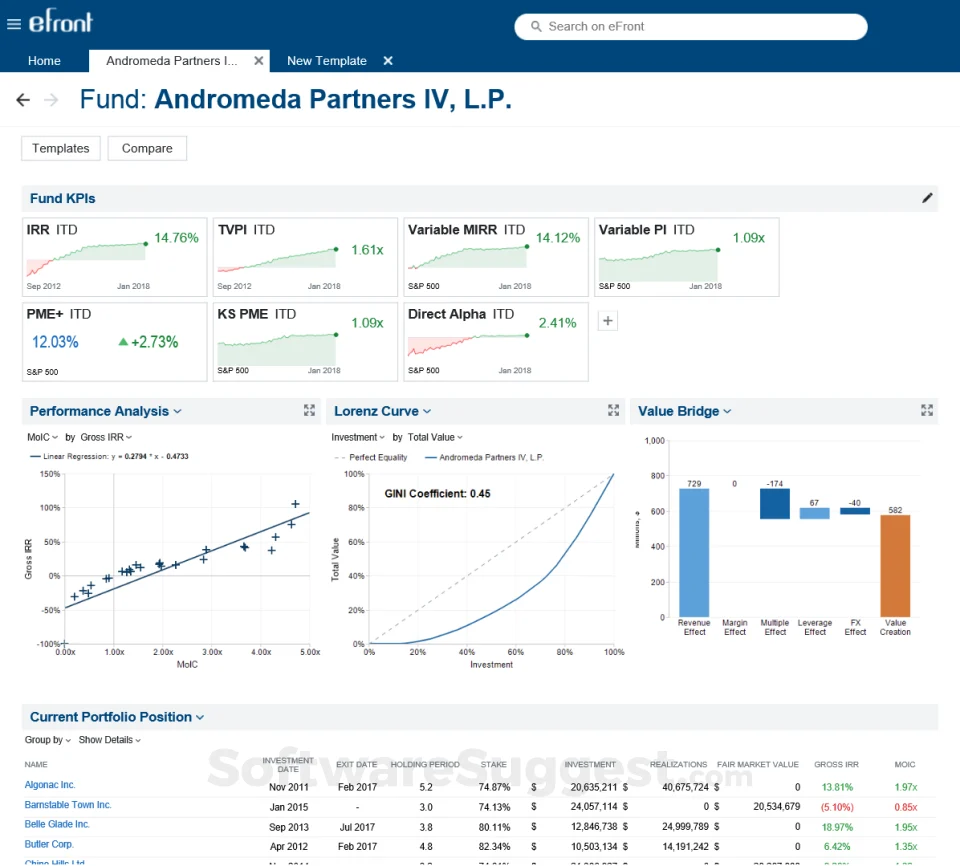
Public demonstration image: fund performance analytics. The image does not establish the licensed Invest GP or Investment Café configuration.
- Useful capabilities: General-ledger transaction recording, capital calls, industry-standard/custom reporting, plus portal data rooms and dashboards in the relevant application.
- Limits and dependencies: Those links do not establish a bundled license. An administrator's deployment does not establish your access to report design, exports or calculations.
- Cost and adoption: Identify each application, interface and historical-data migration task in the proposal.
Investigate eFront when accounting, portfolio information and investor communication need coordinated applications. The deciding question is whether the proposed application combination supports your transaction-to-report workflow and gives your team the required control.
FIS Private Capital Suite
FIS Private Capital Suite, formerly Investran, combines fund and partnership accounting, reporting and investor management for private capital operations. FIS separately describes the Digital Data Exchange investor portal.
FIS product-page image; this is marketing material, not an application screen.
- Useful capabilities: Accounting automation, investor reporting, portfolio visibility and connected investor management.
- Limits and dependencies: Establish the portal's inclusion and which calculations, report formats and interfaces the implementation covers.
- Cost and adoption: Separate software from implementation, including transaction history, investor records and reconciliation of opening balances.
FIS merits investigation when replacing the underlying private-capital accounting environment is part of the project. Acceptance should cover migrated capital balances and their investor reports, since a successful data import alone cannot establish reconciliation.
FundCount
FundCount combines investment, partnership and general-ledger accounting. Its package distinctions make it relevant both for maintaining books and for checking an administrator's output.
- Useful capabilities: Consolidated multi-entity/multi-currency financials. The Hedge Fund package specifies NAV by fund, class, side pocket, partner or series; the Private Equity package lists unit/series/equalization allocation and describes its waterfall calculations as having the flexibility of Excel.
- Limits and dependencies: Match the administrator, hedge, shadow or private equity package to the work required. Do not assume every package includes every listed function.
- Cost and adoption: Annual starting figures are $38,389 Private Equity, $26,950 Fund Administration and $35,899 Hedge Fund, plus digital-transformation and hosting fees. These are the dollar figures displayed October 12, 2026; confirm billing currency. Configuration, migration, training and applicable hosting require separate scoping.
Investigate FundCount when package-specific NAV or independent shadow accounting is decisive. Entities, users, funds, assets under management/administration and deployment affect the quote. Our FundCount provider profile supplies broader context.
Fundwave
Fundwave's fund-administration software connects private equity and venture capital activity with journals, financial statements and investor reports. It describes associated journal entries when issuing capital-call notices.
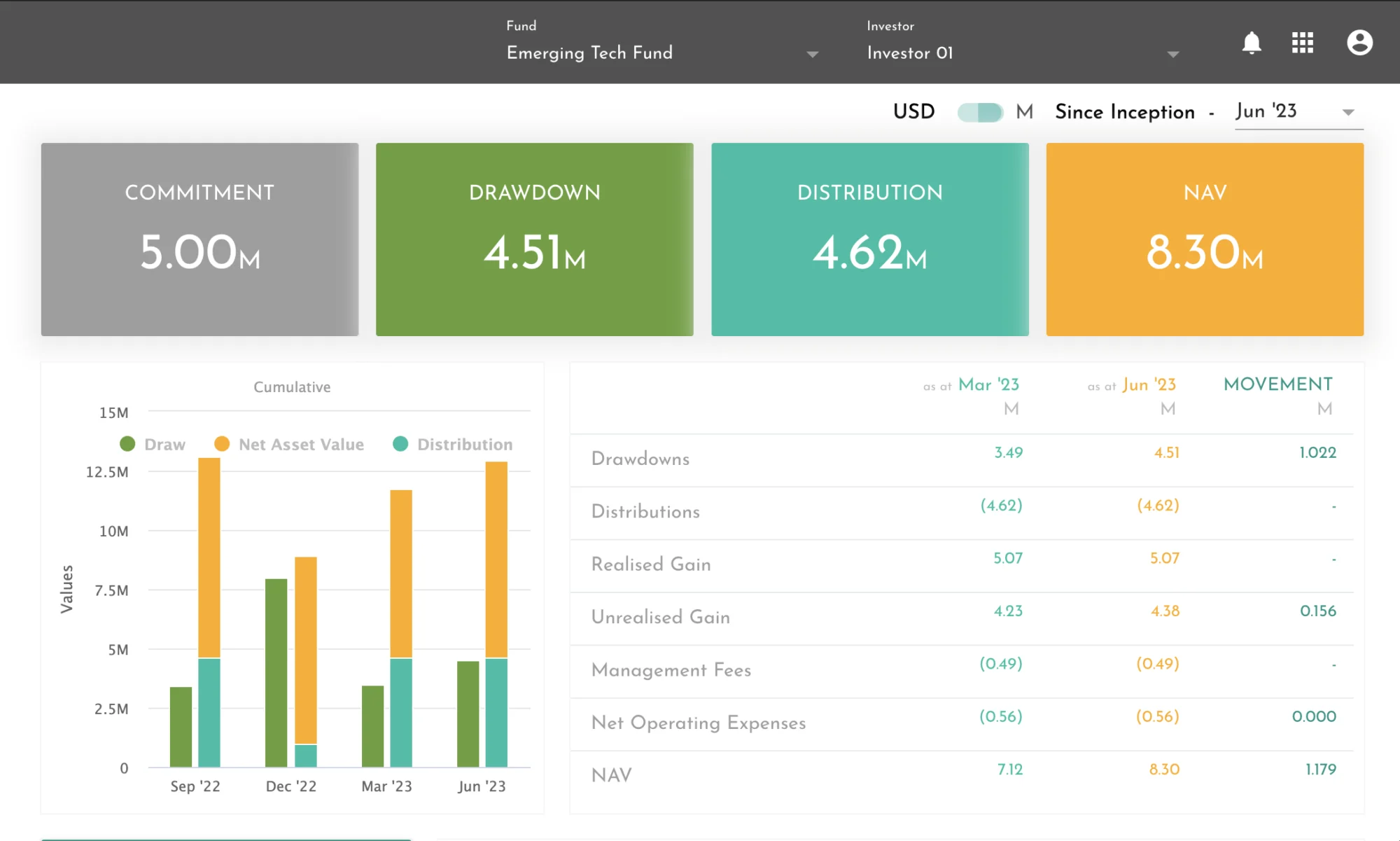
Public demonstration image: investor balances and a period-movement breakdown.
- Useful capabilities: Trial balance, balance sheet, income statement, NAV statements, investor closes and fee/carry calculations. A four-eyes workflow involves a second person in reviewing transactions, notices and reports.
- Limits and dependencies: Demonstrate when notices create entries under your accounting policy. Historical material mentions external accounting integrations; current connections and versions require confirmation.
- Cost and adoption: Scope investor histories, opening balances, templates and integration ownership.
Investigate Fundwave when the problem is moving investor activity into the books and reporting package. A capital call followed by an amendment is a useful deciding case: the notices, journals and statements should follow the agreed recognition policy.
LemonEdge
LemonEdge emphasizes event-driven accounting, multi-ledger management and an allocation engine that carries activity through fund structures. It also describes data interfaces, scenario planning and calculation audit history.
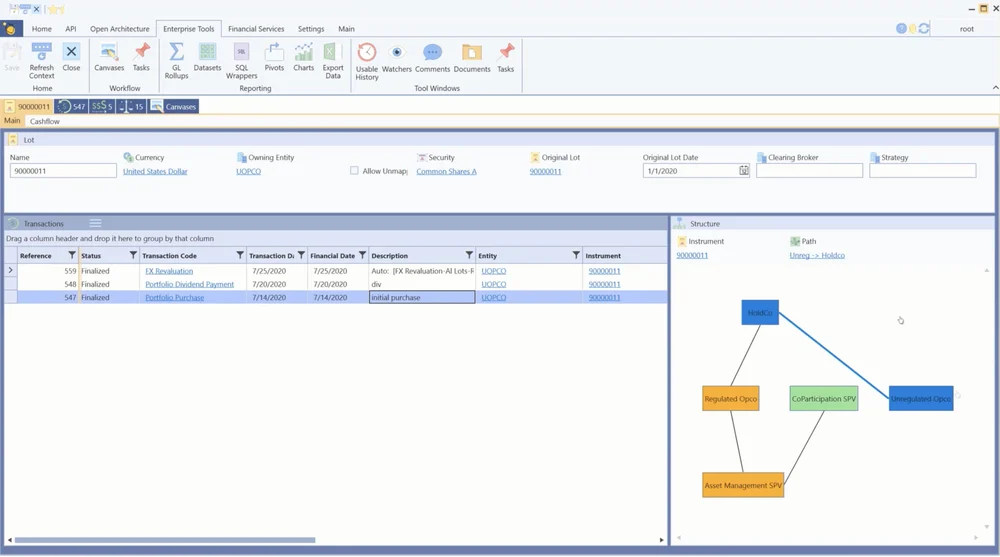
Public demonstration image: transaction records alongside an entity structure.
- Useful capabilities: Allocation, consolidation, financial reporting and tracked calculation changes across entities.
- Limits and dependencies: The site describes a white-label investor portal and an Eleven partnership. Identify the proposed delivery arrangement, license and connection owner.
- Cost and adoption: Implementation may involve LemonEdge's own specialists or consulting partners; name the configuration and acceptance owners.
Investigate LemonEdge when entity-level calculations drive the reporting problem. Demonstrate one corrected input through every affected entity and allocation, then into the required investor statement; accounting-engine depth alone does not establish the statement format.
Linedata Mfact
Linedata Mfact supports traditional and alternative structures with multi-class accounting, NAV production, an integrated general ledger and multi-currency workflows.
- Useful capabilities: A report designer, more than 150 configurable reports, web reporting and asset coverage including private debt and derivatives.
- Limits and dependencies: Its positioning prominently includes mutual funds. Alternative-fund partnership allocations, investor statements and waterfalls need their own demonstration.
- Cost and adoption: Separate core software, data connectivity and optional services.
Investigate Mfact when NAV production and class-level investment accounting are central. A private-credit buyer should separately test instrument accounting and investor allocations: documented private-debt coverage does not settle partnership-reporting suitability.
PAXUS
PAXUS combines accounting and administration for open-ended and closed-ended traditional and alternative funds, including hedge funds, partnerships and private equity. Its operator emphasis is fund administration.
- Useful capabilities: Integrated accounting/administration and PAXUS-CONNECT, described as core web access for authorized managers and investors to retrieve reports and submit transactions.
- Limits and dependencies: Global scope does not establish your US reporting configuration, support hours or commercial terms. Require representative report formats and allocation cases.
- Cost and adoption: Establish deployment, migration and investor-record ownership.
Investigate PAXUS when an administrator needs a connected operating environment. A manager receiving its output should evaluate recipient access, correction turnaround and release responsibilities; those are different needs from operating the accounting system.
SS&C Geneva
SS&C Geneva addresses complex instruments, strategies, fund structures and multi-currency portfolios. It documents investment/investor accounting, reporting, shadow accounting and reconciliation.
- Useful capabilities: Portfolio and investor reporting, reconciliation and exception-management workflows.
- Limits and dependencies: Identify investor-accounting configuration and data/managed services. Instrument-accounting depth does not demonstrate your particular partnership waterfall or statement package.
- Cost and adoption: Scope instrument setup, transaction histories, reconciliation rules and service responsibilities separately.
Investigate Geneva when difficult instruments or administrator reconciliation drive the decision. For private credit, demonstrate representative loan events and their accounting consequences before testing the resulting investor allocation and report.
05How to Choose Fund Reporting Software
Choose software against a defined reporting package and operating model. Specify the fund structures, outputs, data sources and responsible people before comparing proposals. This makes module dependencies and implementation work visible, and helps prevent a lower software quote from concealing work your team will still have to perform.
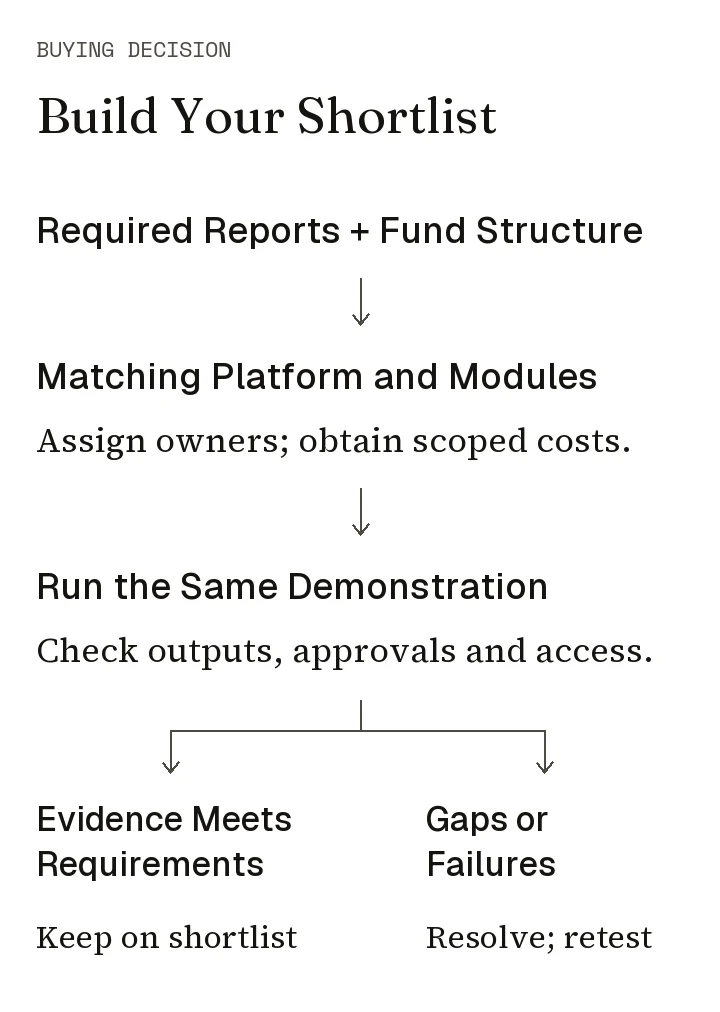
Compare the same reporting requirements and test inputs; keep unresolved questions visible.
Match the Platform to Your Fund Structure and Reporting Needs
List fund and feeder entities, currencies, investor classes, fee arrangements and required reporting frequency. Identify whether you need to replace the ledger, check an administrator's books, or improve delivery from an existing accounting system.
For each must-have report, supply a redacted example and acceptance criteria. A private equity capital statement, a hedge-fund NAV report and a portfolio-company dashboard should not share an undifferentiated “reporting supported” checkbox.
Check US Reporting Requirements and Template Support
Have the fund's accountant and legal advisers identify applicable obligations and accounting basis; this comparison is not legal or tax advice. Separate fund financial statements, contractual investor reporting, tax-supporting schedules and regulatory filings. A report generator does not establish compliance or replace the responsible preparer.
Dynamo advertises a financial-report library for US generally accepted accounting principles (GAAP). If that is your fund’s agreed accounting basis, have the accountant verify a completed statement package, adjustments and disclosures; the vendor’s claim does not establish compliance.
ILPA's updated templates include reporting and performance templates released in 2025, with use subject to fund agreements and jurisdictional considerations. Obtain a completed export for the required version and fields. The refreshed portfolio-company template scheduled for January 2027 is not an already-final requirement.
Confirm Modules, Integrations and Who Does the Work
Use this suggested acceptance sheet. Owners must be assigned for your operating arrangement, including work prepared outside the software.
| Report Type | Source and Suggested Owner | Acceptance Evidence |
|---|---|---|
| Fund financial statements | Ledger/valuations; accountant and final reviewer | Mapped accounts, reconciled statements and agreed accounting basis |
| Capital statements and partnership allocations | Ledger, investor register and agreement; preparer/approver | Investor balances reconcile; allocation follows documented terms |
| Contractual investor reports and notices | Approved fund data and investor agreement; finance/investor relations | Required fields, dates, recipient access and corrected versions |
| ILPA reporting/performance template | Agreed fee, expense and performance data; reporting owner | Named version, field mapping, calculation basis and completed export |
| Tax-supporting schedules | Book/tax records; fund tax preparer | Reconciled inputs, required adjustments and usable external handoff |
| Applicable regulatory reporting | Applicable rules and relevant fund data; compliance/legal owner | Confirm obligation, preparer, field mapping and submission responsibility |
Add the licensed module, integration and export format to each row. Where family-office entity accounting is also required, our Eton Solutions profile covers that adjacent scope; keep it separate from the fund's investor package.
Compare Software, Implementation and Ongoing Costs
Compare five priced scopes: fund accounting, investor reporting, investor portal, implementation and administration services. Separate an annual software license from recurring work performed by an administrator. Managed hosting also does not establish that someone prepares your books.
Request first-year and recurring totals using the same entities, users, history and deliverables. Include modules, hosting, data feeds, migration, configuration, training and your team's maintenance work. Record currency, contract term and exclusions. FundCount's published figures are package starting points; obtain written proposals before comparing all-in costs across vendors.
06Test a Reporting Correction Before You Buy
Give shortlisted vendors the same small correction exercise and ask them to show the complete result. The useful evidence includes the accounting change, investor balances, approval record and replacement report. This illustrative exercise checks a defined workflow; it does not validate the software against every fund agreement or instrument.
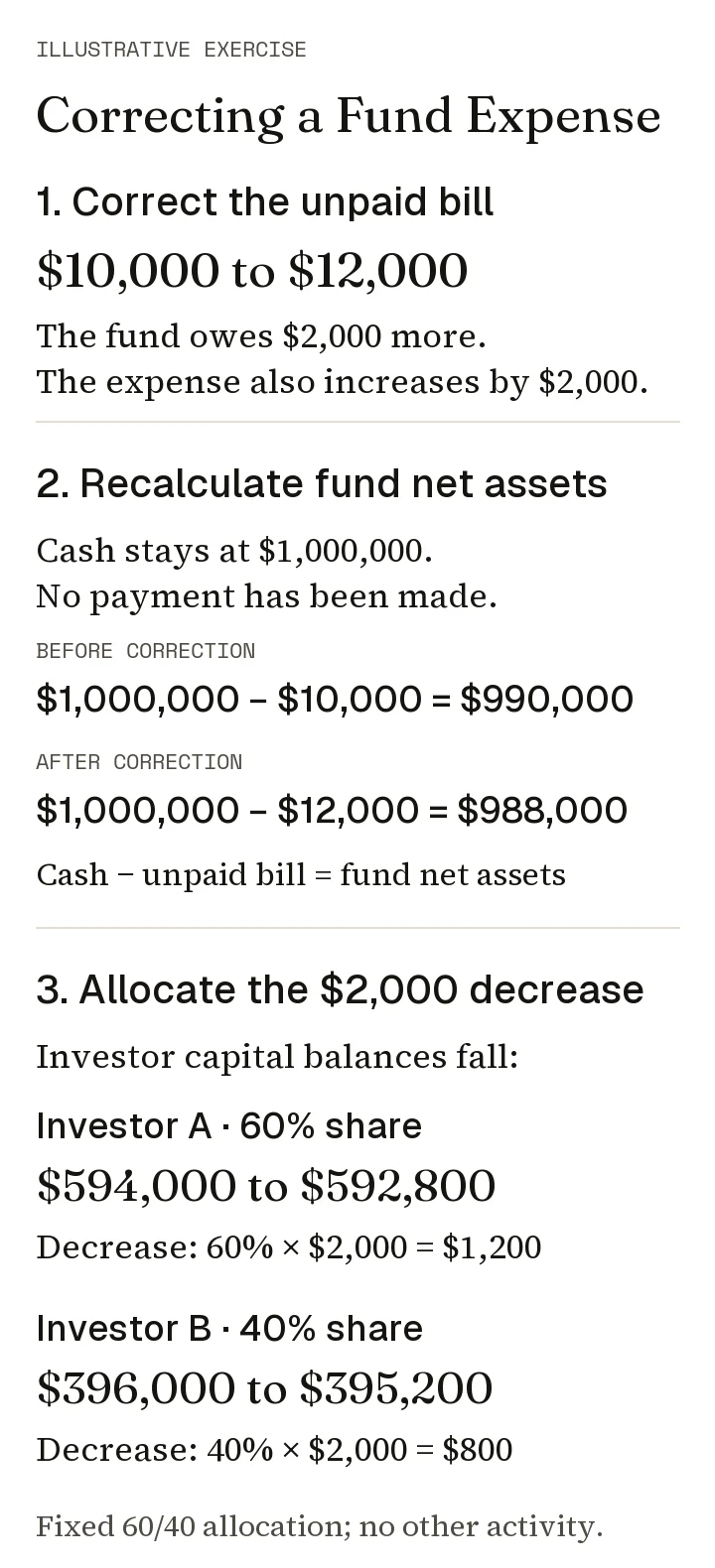
Illustrative fixed-allocation example. The full test below follows these balances through approval and report reissue.
Worked Example: Correcting a Fund Expense
Assume a fund has $1 million in cash contributed by two investors: Investor A owns 60%, and Investor B owns 40%. Its agreed expense allocation follows those percentages. There are no investments, gains, other fees, taxes, currency movements, subscriptions or distributions during the exercise.
An unpaid expense was accrued at $10,000. The corrected invoice is $12,000. The original entry debits expense and credits accounts payable by $10,000; the correcting entry adds a $2,000 debit to expense and $2,000 credit to accounts payable. Cash does not change because nothing has been paid.
Trace the Change Through the Ledger and Investor Statements
Ask the vendor to produce both statement versions and explain these expected results:
| Measure | Original | Corrected | Change |
|---|---|---|---|
| Cash | $1,000,000 | $1,000,000 | $0 |
| Expense payable | $10,000 | $12,000 | +$2,000 |
| Fund net assets | $990,000 | $988,000 | -$2,000 |
| Investor A capital | $594,000 | $592,800 | -$1,200 |
| Investor B capital | $396,000 | $395,200 | -$800 |
The investor reductions must total the $2,000 increase in expense. Both corrected capital accounts must sum to $988,000. Require a trace from the amended invoice through the adjusting journal and allocation to each statement, using the fund's applicable correction policy.
Check Approval History, Access and Report Reissue
Ask who can enter and approve the adjustment, whether an approved period must be reopened, and how that action is recorded. Have the demonstrator show the retained preparer and approver identities and timestamps for this correction and the revised release. Require the earlier statement to remain available for authorized audit review while its superseded status is clear. Demonstrate the revised release and confirm Investor A cannot access Investor B's statement.
Use the observations to make a decision:
- Correct totals, missing source trace: Request the missing lineage before accepting the workflow.
- Correct accounting, wrong recipient access: Withhold approval until access is corrected and retested.
- A spreadsheet or extra module is required: Identify its owner, controls and cost in the proposal.
- A step is not demonstrated: Record it as unverified, with an agreed follow-up demonstration.
This example uses fixed allocations. Carry waterfalls, equalization, tax allocations and actual fund agreements require their own acceptance cases. No vendor has been tested by this article.
07Build Your Fund Reporting Software Shortlist
Shortlist two or three platforms that match your fund structures, required outputs and operating model. Give each vendor the same report samples, correction exercise and quote assumptions so the comparison addresses the work you need done.
Before choosing, resolve who owns the ledger, approves allocations, maintains integrations and releases statements. Keep unverified requirements visible until the vendor supplies evidence. The next step is to take one redacted reporting package into those demonstrations and document what each proposed configuration can deliver.
The coming shake-out in family-office software
The category has never been more crowded. Consolidation is coming — and the firms that survive will be… Knowledge & Decision · Analysis
Is a Multi-Family Office Right for Your Family? Compare Fit, Fees and Services
Compare multi-family office fit, services, fees and family responsibilities with an illustrative quote worksheet and provider-check questions. Knowledge & Decision · Analysis