Advanced Tax Planning for UHNW Families: What to Decide Before a Sale
Advanced tax planning for UHNW families starts before a business sale. Compare share gifts, charity and a personal sale through one decision file.

When a US ultra-high-net-worth family faces a business sale, the first tax question is what must be decided before the transaction happens? A sale, a gift of shares and a charitable contribution may involve the same asset, but they require different owners, documents and timing. A family cannot transfer stock and only later ask an adviser to reconstruct the intended tax result.
This guide compares advanced tax planning strategies through one hypothetical liquidity event. It shows where each approach might help, what it gives up and what evidence an adviser needs before anyone acts. No strategy here guarantees a tax saving or substitutes for advice on a family's facts.
- Start with the tax exposure and the event date: potential gain on sale, a gift or estate transfer, a charitable objective, and future portfolio income are different jobs.
- Compare each tactic with its cost in control, liquidity, basis, complexity and flexibility. A gift or charitable transfer cannot be evaluated from the possible deduction alone.
- Put the facts, adviser conclusion, family authority and execution deadline in one decision file. If a material fact is unknown, hold that action open.
01What Makes UHNW Tax Planning a Sequence of Decisions?
“Advanced” planning does not mean using the most complicated trust. It means coordinating decisions across assets, taxpayers and time. The owner of a company interest may differ from the owner of a diversified portfolio. A trust's tax filings, when required, a founder's gain and an estate-transfer calculation also follow different rules.
An impending sale makes the order especially important. A family may want liquidity, support for heirs and a charitable gift. Yet a transfer of appreciated shares before a transaction can have different income-tax, gift-tax, control and documentation consequences from giving cash after closing. Counsel must examine the actual transaction status and any binding obligations; a calendar label saying “pre-sale” is not enough.
The planning file should begin with five facts: legal owner, tax basis, estimated value, transaction stage and authority to approve a transfer. Add the relevant tax year and state jurisdictions. If those facts cannot be reconciled, comparing projected tax savings is premature.
“UHNW” describes the audience, not an IRS eligibility category. Fidelity uses $30 million or more in investable assets as one industry marker. The $20 million company holding in the example below, plus an unspecified portfolio, does not establish whether that family meets this marker. A family below or above it may face the same planning questions; each tax rule has its own taxpayer, asset and transaction conditions.
Start with the event, then select a strategy to investigate:
| Family trigger | First route to evaluate | A reason to hold it |
|---|---|---|
| Business liquidity event | Personal-sale control case, then qualified small business stock (QSBS), charitable and heir-transfer alternatives. | Ownership, stock history or deal status is unconfirmed. |
| Estate exposure without a sale | Lifetime transfer and trust terms alongside a retain-and-inherit comparison. | Value, basis, prior gifts or intended control is unclear. |
| Philanthropy | Outright gift, donor-advised fund or charitable remainder trust, selected for the family's income and control objective. | Recipient cannot accept the asset or deduction conditions are unresolved. |
| Tax drag after liquidity | Lot-aware realization and asset-location review within the investment mandate. | Losses, replacement trades or account constraints are unknown. |
The rest of this article follows the first route in depth. The other triggers belong in the same decision discipline, but they do not require a founder to have a sale pending.
For the broader map of who owns a tax workstream and its deadline, see Family Office Tax Planning. The decision here is narrower: which strategy belongs in the transaction at all?
02Which Strategy Addresses Which Exposure?
The same family may need several strategies, but each has a distinct job. “Potential fit” below is a question to investigate, not an instruction to implement. Selling personally is the control case against which to compare transfers; loss harvesting and asset location are portfolio overlays, not alternatives for who owns the company shares.
| Potential strategy | Exposure it may address | What must be tested before action | Main trade-off |
|---|---|---|---|
| Sell and retain proceeds (control case) | Liquidity and known transaction execution | Owner, basis, purchase terms, estimated tax and reinvestment plan | Realized gain may be taxable; family retains control of proceeds. |
| Lifetime gift or trust transfer | Future estate exposure and intended heir ownership | Available gift/estate exclusion, valuation, transfer restrictions, trust terms, gift return and basis consequences | Donor gives up some control; recipients may carry a different basis from inherited property. |
| Donate appreciated property | Philanthropy alongside a potential gain | Qualified recipient, property and holding period, transaction status, valuation, deduction limits and substantiation | Asset and its future upside leave the family; deduction may be limited or unavailable. |
| Test qualified small business stock (QSBS), Section 1202 | Possible exclusion on qualifying stock sale | Issuance, original ownership, entity, gross assets, active-business, acquisition date, holding period and sale records | A favorable result cannot be assumed from “founder stock”; rules vary by stock vintage and transaction. |
| Realize portfolio losses | Offset eligible capital gains where tax rules permit | Account-level lots, holding periods, related accounts, replacement trades and wash-sale rules | Portfolio exposure can change; disallowed losses or mismatched replacements can defeat the plan. |
| Change asset location or realization schedule | Ongoing tax drag after liquidity | Account type, investment mandate, liquidity, expected distributions and tax character | Tax efficiency may conflict with diversification, access or investment policy. |
Section 1202 is a stock-specific test, not a label for every founder's gain. Public Law 119-21, Section 70431 changed its treatment for stock acquired after the law's applicable date, making the acquisition date and stock history material. Advisers should identify the rule applicable to the actual holding before modeling any exclusion. The IRS Schedule D instructions describe reporting a qualifying Section 1202 exclusion; neither source establishes that this hypothetical holding qualifies.
For a US citizen or US-domiciled donor, the IRS gift-tax FAQ lists a $15 million basic exclusion for 2026 and a $19,000 annual exclusion per recipient for qualifying present-interest gifts. The available basic exclusion depends on prior taxable gifts and applicable rules. Cross-border donor status and a trust beneficiary's rights need separate review.
Neither figure is an income-tax deduction. A $6 million transfer cannot be treated as a collection of annual-exclusion gifts by changing its label.
The IRS basis guidance also makes the asset choice consequential: basis rules for gifted and inherited property differ. A family comparing “gift now” with “hold until death” should model both transfer-tax exposure and the recipient's potential gain, with the actual valuation and ownership facts. It should not assume either route is universally better.
For appreciated-property giving, the IRS charitable-contribution guidance sets conditions and limitations; fair-market-value language does not make every contributed asset fully deductible. IRS Form 1040-ES for 2026 says an itemizer can deduct charitable contributions only to the extent they exceed 0.5% of adjusted gross income, beginning in 2026. Property-specific limits and substantiation still govern the modeled private-share gift.
A tax adviser must also evaluate whether a proposed gift occurs before a sale is effectively fixed. Publication 505 informs estimated-payment planning once the facts and tax treatment are established.
Choose the Transfer Vehicle, Not Just the Tax Label
An outright gift, a trust for descendants, a donor-advised fund and a charitable remainder trust are different arrangements. A trust for descendants must specify who benefits, who controls distributions and what the donor can retain under applicable law. It is not simply a way to move a large number out of an estate while the founder keeps every power.
An outright charitable gift gives the property away. In a donor-advised fund, the sponsoring charity owns and controls contributed assets; the donor may advise on grants, subject to the arrangement's rules. Consider those routes when the family is prepared to give up economic access; the donor-advised fund adds grant-advisory privileges, not retained ownership.
A charitable remainder trust may fit a different objective: payments to a noncharitable beneficiary before the remainder passes to charity, if the terms and property qualify. Those payments have their own tax treatment and the trust adds design and administration work. In the hypothetical case below, the proposed $2 million charitable block has not been assigned to any of these vehicles.
None should be chosen solely because a model displays a larger deduction. The family's desired cash access and the recipient's ability to accept private shares may rule out a candidate.
03Test the Choices Against One Business Sale
Imagine a US family whose founder owns shares in a private company. For illustration only, an independent working valuation places the entire holding at $20 million, and the founder's documented adjusted basis in that holding is $2 million. A buyer has sent a nonbinding indication of interest, but no definitive agreement has been signed.
At that preliminary aggregate value, the founder wants to consider blocks of shares tentatively worth $2 million for charity and $6 million for descendants, while keeping enough liquidity after a possible sale. Those blocks require their own defensible valuation before any transfer. The office also holds a diversified taxable portfolio.
The figures make the choices visible; they do not establish a sale price, capital gain, gift value, deduction or tax bill. The company shares may be restricted, and a later deal could change or fail.
Before placing any numbers in a tax model, the team must confirm what the founder owns, what the buyer has offered, whether a transfer is permitted and who can approve it.
Keep the personal sale as the control case: advisers confirm the cap table, basis, terms, state facts, payments and possible QSBS treatment; the founder decides on deal terms and a liquidity reserve. The two proposed share transfers need separate block entries in the same decision record. Portfolio losses are a later investment overlay, supported by custodian lots and approved within the investment mandate.
If the proposed recipient is a grandchild or a trust that could be a generation-skipping transfer, counsel must test the separate GST consequences and reporting. IRS Form 709 covers gift and generation-skipping transfer tax; the word “descendants” alone does not tell us whether the hypothetical block triggers that review.
These entries are alternatives to assess, not automatic steps. A sale without prior transfer leaves later cash gifts possible, with different tax consequences. A proposed share gift requires counsel to confirm transaction status and transferability before execution; a later sale does not retroactively create an earlier valid gift.
Provisional decision in this case: the personal sale is the comparison baseline, not a recommendation to sign. Both the proposed $2 million charitable share gift and $6 million descendant share transfer remain on hold until counsel confirms transfer authority and deal status, advisers establish block-specific value and basis, and the family approves the liquidity it would surrender.
Proposed-transfer decision card
Use one entry per block: legal owner and asset; recipient; status; open fact and proof; named adviser and family approver; counsel-set cutoff; next permitted action; cash/control effect; evidence version. The named people and cutoff must be filled from the actual transaction, not invented by this illustration.
- Charity block — under review; no transfer executed. Owner: founder. Recipient: charity to confirm acceptance. Open proof: share restrictions, dated buyer status, block value and basis, substantiation and adviser conclusion. Responsible roles: transaction counsel and tax adviser; founder approves any gift. Cutoff: counsel to set. Next action: keep the shares while these checks and the family cash comparison are completed. A valid gift would remove that block's possible sale proceeds and control from the founder. Evidence: preliminary whole-holding valuation only; block record not yet approved.
- Descendant block — under review; no transfer executed. Owner: founder. Recipient or trust: terms and acceptance to confirm. Open proof: transfer authority, prior gifts, possible GST applicability, block value and basis, buyer status and liquidity reserve. Responsible roles: transaction counsel and tax adviser; donor and authorized fiduciaries approve the final transfer. Cutoff: counsel to set. Next action: keep the shares and resolve these facts before any instruction. A valid transfer would reduce the founder's shareholding and possible proceeds. Evidence: preliminary whole-holding valuation only; trust and block records remain open.
If a charity cannot accept private shares, a later cash gift is a different route to model. If buyer negotiations become binding, counsel must revisit any claimed pre-sale treatment before a transfer occurs.
The $20 million working value minus $2 million basis equals an illustrative $18 million built-in difference for the entire original holding before selling costs, adjustments, transaction structure and tax rules; it is not a final taxable gain.
If any shares leave the founder, advisers must identify the basis and value of that specific block and analyze each owner's later transaction separately. The proposed $2 million charitable amount is not automatically a $2 million deduction. The $6 million intended for descendants cannot be treated as if the recipients inherit a new basis.
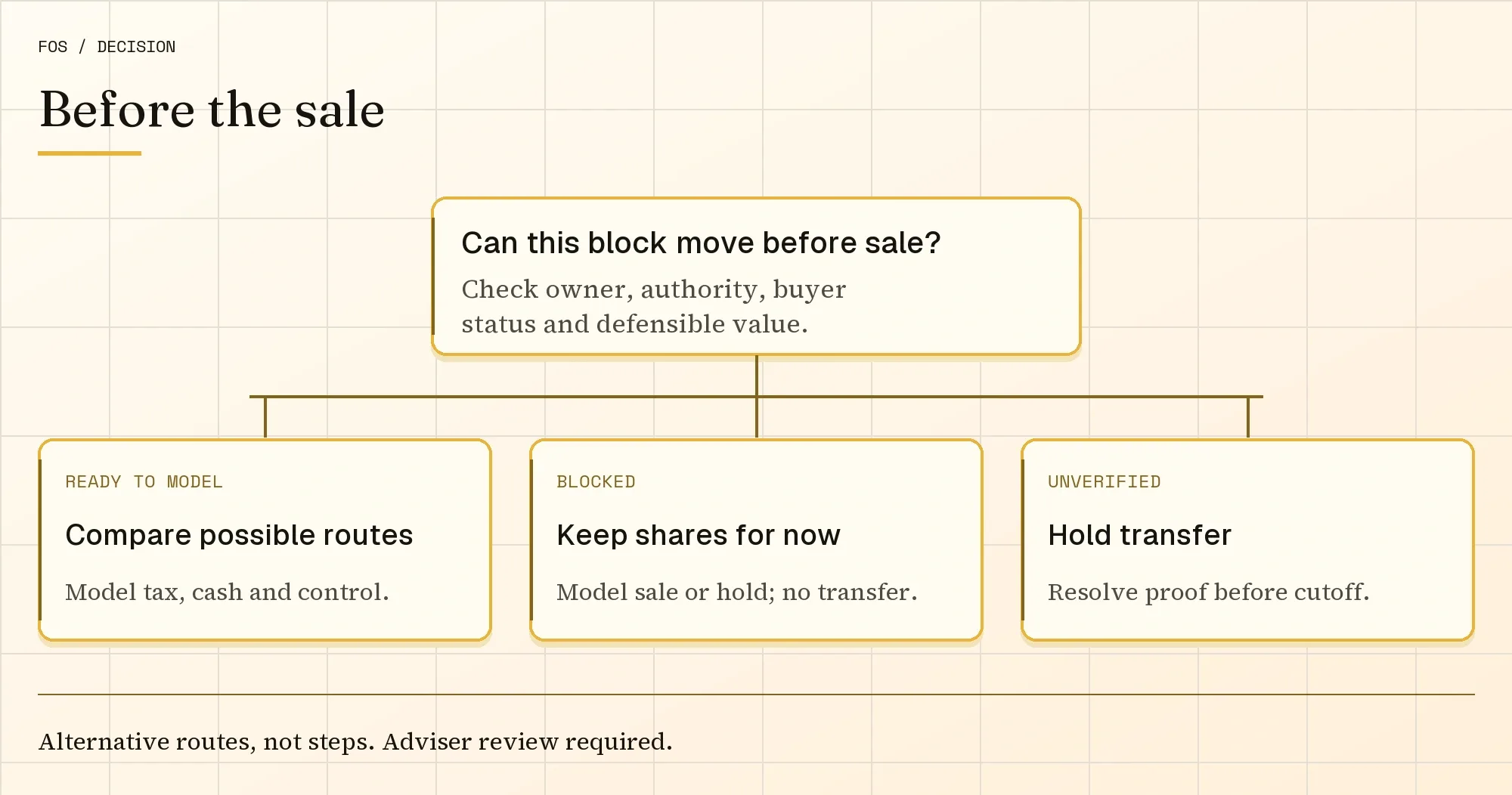
Illustrative alternative routes. “Ready to model” is not approval to transfer. Apply the gate separately to the charitable and descendant blocks. View the full-width desktop diagram. No branch claims a tax result without documented adviser review.
04Compare the Main Trade-offs Before Choosing
A strategy is useful only if its benefit survives the costs it creates. Compare the routes on the same assumptions: ownership record, estimated transaction value, tax year, state facts and likely closing date. Mark an unknown result unknown, not zero.
For the same $20 million holding, with tentative $2 million and $6 million blocks separately valued, the family should compare:
- Sell all shares personally: the founder may receive proceeds from the full holding at closing and retains decisions over those proceeds. Advisers calculate gain from the actual consideration and allocable basis, then model any tax and liquidity reserve. No charitable or descendant transfer has occurred.
- Transfer the $2 million charity block: the founder gives up that block and its possible sale proceeds. The recipient's acceptance, the block's basis and valuation, timing and deduction rules determine the treatment. Compare the family's remaining cash with the personal-sale case; do not enter $2 million as a guaranteed deduction.
- Transfer the $6 million descendant block: the founder gives up the transferred economic interest, subject to valid trust terms if a trust is used. Advisers model gift and possible estate consequences, any GST issue, the recipient's basis and the founder's reduced sale liquidity. Do not enter $6 million as a tax saving.
These are alternative outcomes for the specified blocks, not three whole-holding sale prices. If both proposed transfers are valid, the founder would retain a smaller shareholding; if either fails its conditions, model that block with the founder instead. The team's model needs block-specific values and basis before it can quantify the differences.
The choice is between cash and control for the founder, future ownership for heirs, and a genuine charitable gift. Keeping the shares while planning preserves control but adds no sale proceeds and leaves business and timing risk with the founder.
The memo should not rank the options solely by projected tax saved. A family might reject a large trust transfer because it needs the sale proceeds for operating reserves, or prefer a smaller charitable gift because the recipient cannot accept restricted shares. Those are decisions about family goals and transaction feasibility, not failures to optimize a spreadsheet.
This compares ownership routes for the same company shares. The business-stock exclusion check affects a sale route if these shares qualify. Portfolio loss harvesting and later asset location belong in a separate investment worksheet; they do not change who owned the company block at closing.
The office should also separate execution risk from tax risk. A valid, well-documented transfer may still be a poor liquidity choice. A desired economic outcome may be impossible under an existing shareholder agreement.
The family's counsel and tax advisers must resolve the governing documents and law; the family office coordinates evidence and records the decision.
05What Must Be Decided Before the Transaction Becomes Hard to Reverse?
The priority is the next event that changes what the family can still choose. A signed binding agreement, a completed gift, a trade or a payment all narrow the available path.
The precise legal and tax effect is fact-specific, so the team should set deadlines from the transaction timetable and adviser's analysis—not from a generic “year-end tax tips” calendar.
For this hypothetical sale, keep a stage-aware decision sequence:
- Nonbinding indication: the founder and advisers verify ownership, basis, transfer restrictions and the family's minimum cash need. Counsel records whether proposed share transfers remain legally and commercially possible.
- Negotiations and approvals: counsel watches buyer terms, board or shareholder approvals and any event that could make the transaction effectively fixed. The tax and valuation advisers document their conclusions for each proposed block; the family decides whether to authorize a transfer while that choice is still available.
- Binding terms and closing: counsel reassesses any incomplete proposal against the actual documents. The controller records only executed transfers and prepares sale, payment and filing work from final evidence.
This is a management sequence, not a legal safe-harbor timeline. Counsel sets the actual cutoff for each proposed action from the facts; a nonbinding label or unsigned draft does not by itself guarantee favorable treatment.
Before a proposed share transfer, require a short written package:
- Ownership and authority: current cap table, governing restrictions, signer and recipient acceptance.
- Tax facts: adjusted basis, stock history, prior taxable gifts, relevant returns and state jurisdictions.
- Transaction status: dated buyer communications, drafts, approvals and expected closing events.
- Adviser conclusion: treatment of each proposed route, conditions, estimated-payment implications and unresolved issues.
- Family decision: asset and amount, liquidity reserve, charitable or heir objective, approval date and execution owner.
Counsel should also mark the no-go conditions: if ownership, transfer authority, transaction status, recipient acceptance or required valuation remains unresolved at the decision cutoff, do not execute that proposed transfer. The family can still evaluate the personal-sale control case; a missed pre-sale route is not a reason to manufacture an earlier gift date.
This is an internal decision control, not a list of documents the IRS requires for every strategy. Specific filings, appraisals and substantiation depend on the action. For a noncash gift of private shares, advisers test the Form 8283 instructions, qualified-appraisal rules and acknowledgment requirements, rather than treating the working valuation as filing proof.
Separately, the IRS explains that wash-sale rules can disallow a loss when substantially identical securities are acquired in the surrounding 30-day window. The investment team needs visibility into the taxpayer's relevant accounts, including spouse or IRA transactions where the rules may apply; an adviser identifies the actual attribution and replacement-trade consequences. The Tax Lot Method guide covers the operational lot decision in more detail.
06How Should the Family Approve and Revisit the Plan?
The family needs a decision record that survives a change of adviser, a delayed transaction and the next filing season. For each chosen action, identify the asset, taxpayer, purpose, conditions, approval authority, adviser who signed off and evidence version. Give the controller or chief of staff an open-item register, not authority to determine the tax answer by themselves.
After closing or after a transfer is abandoned, reconcile what actually happened with the planning memo: final proceeds, transferred shares, recipient acknowledgments, custodian trades and required tax documents. Update estimated payments and return workpapers from executed records. If the sale price or structure changes, reopen affected calculations rather than carrying forward the illustrative $20 million value.
If the family's question instead concerns which entity should own the assets or pay for the office's services, use the Family Office Tax Structure guide; that legal and service-design question is separate from selecting a pre-sale tax route.
After liquidity, the investment team can revisit portfolio losses and asset location against the mandate. The tax file should then reflect the transaction that actually occurred, including any abandoned gift proposal; it should not carry a forecast forward as a completed transfer.
For a US UHNW family, a defensible tax plan is not the longest list of trusts and deductions. It is a choice among feasible routes, made while the choice still exists, with the trade-off and evidence visible to the people who must approve it.
 Tax & compliance · Analysis
Family Office Tax Planning: Map the Owner, Event and Deadline
Family office tax planning is the work of making a decision while it can still affect a transaction—not… Tax & compliance · Analysis
Tax Lot Method: Which Shares Did You Actually Sell?
A practical guide to choosing, instructing and confirming tax lots for a partial stock sale, with one worked… Tax & compliance · Analysis