Family Office Tax Planning: Map the Owner, Event and Deadline
Family office tax planning is the work of making a decision while it can still affect a transaction—not discovering its tax consequences after…

Family office tax planning is the work of making a decision while it can still affect a transaction—not discovering its tax consequences after the trade, distribution or transfer has occurred. For each event, the office needs the legal owner, the relevant tax facts, an adviser’s analysis, an authorized decision, an execution date and a record of what actually happened. A family-wide tax estimate that mixes owners or treats unknown basis as zero is not a plan.
- Map each proposed event to its legal owner and possible taxpayer before calculating a family total.
- Give the tax adviser dated facts and unresolved questions while the decision is still open.
- After execution, replace assumptions with actual records and revisit estimated payments, reporting and the next decision.
01What Family Office Tax Planning Actually Coordinates
A family office may see the whole balance sheet, but it does not file one “family return.” An individual, trust, partnership, corporation and foundation can have different ownership, tax treatment, reporting periods and advisers. A consolidated wealth report is useful for oversight; it cannot decide which person or entity recognizes a particular item.
Planning connects four jobs that often sit with different people:
- Investment or transaction owner: proposes the sale, distribution, gift or restructuring and states the non-tax reason and deadline.
- Records owner: supplies legal title, acquisition documents, adjusted basis, holding period and prior tax elections or reports.
- Tax and legal advisers: determine which rules apply, model alternatives and document the treatment that needs approval.
- Authorized decision-maker: accepts the trade-offs and instructs execution; the office then preserves the executed record.
This is different from choosing the family office’s legal structure. It is also different from an annual compliance checklist that tracks forms and filing dates after facts are fixed. The planning question is: what must be decided or verified before the event, and who owns that answer?
A useful plan therefore begins with an event register, not a list of deductions. It records proposed and actual dates, the legal owner, the potential taxpayer, adviser responsible for analysis, authorized decision-maker, open facts, decision status and evidence location. The family office coordinates the register; it should not present its own assumptions as a tax opinion.
02Start With the Owner and the Event
A proposed sale is not yet a realized gain. Its tax consequences depend on the owner, the property, its adjusted basis, the holding period, the execution price and other facts. The IRS basis guidance explains why accurate records of basis and its adjustments are needed to figure gain or loss on disposition.
Before an adviser models the result, the office should put the owner and event on one row. “Family shares” is not specific enough. Record the title on the account, beneficial ownership questions that counsel must resolve, the security or asset, quantity, proposed action and decision deadline. Link the row to source records rather than copying an unverified number from a consolidated dashboard.
The event register should distinguish three states:
| State | Meaning | Next action |
|---|---|---|
| Known from documents | A named owner and dated source establish the fact | Adviser can use it, subject to normal review |
| Provisional assumption | A figure or treatment is plausible but not yet confirmed | Label its owner and deadline; model it separately |
| Unknown | Required evidence or a legal determination is missing | Do not turn it into zero or silently use another owner's answer |
That discipline matters across tax work. A fund distribution is cash received, but a partnership’s taxable income may not equal the cash distributed. The IRS instructions for a partnership Schedule K-1 explain that a partner’s share of income may be taxable whether or not distributed. The office needs both the cash record and the K-1 or reliable estimate; one does not substitute for the other.
03One Share Sale, Two Owners and One Missing Number
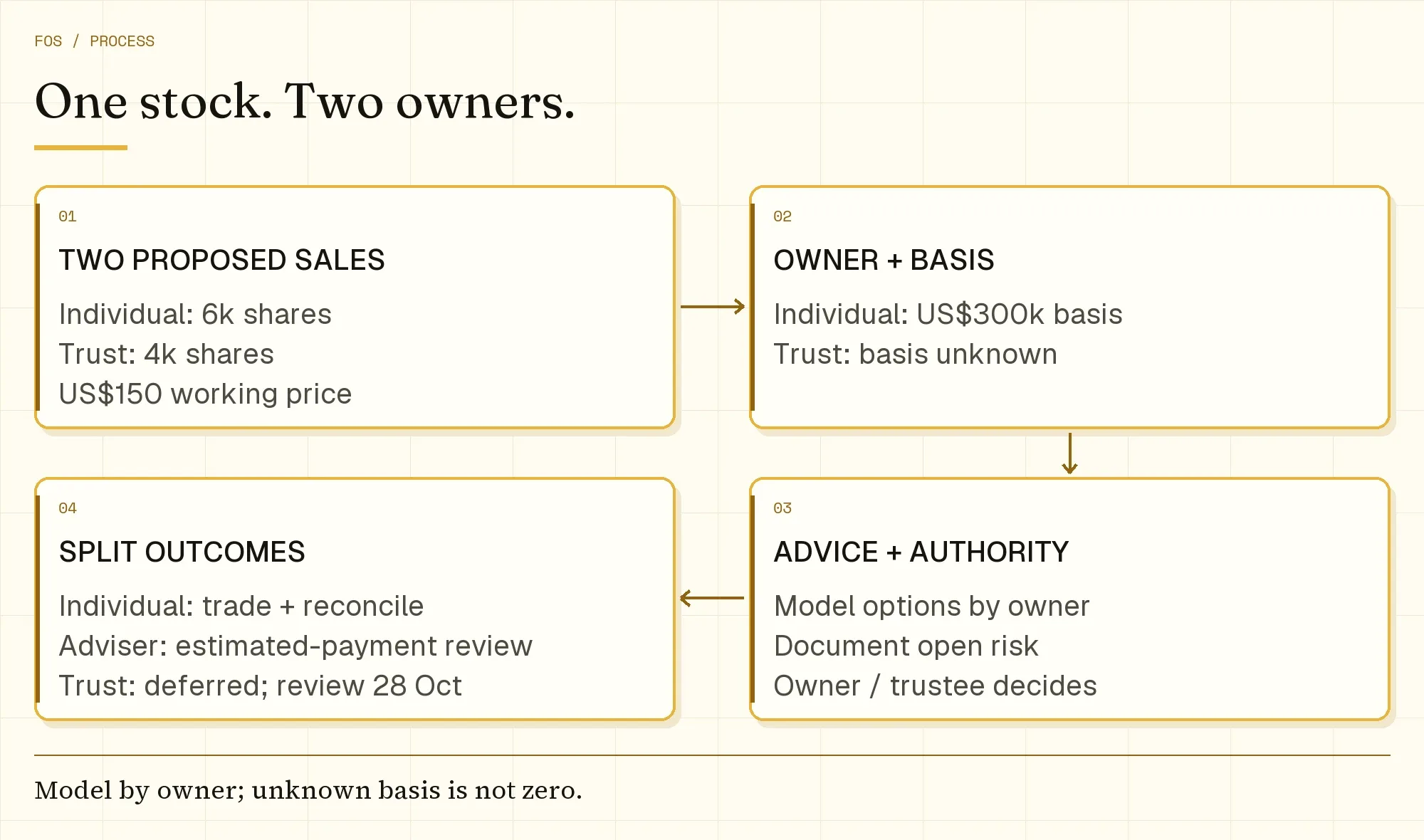
Consider a fictional US family considering an October sale of the same public-company stock from two accounts. The individual holds 6,000 shares and a family trust holds 4,000. The working price is US$150 a share. These are planning assumptions, not executed trades or tax returns.
| Account and legal owner | Proposed shares × price | Adjusted-basis evidence | Provisional gain before selling costs |
|---|---|---|---|
| Individual account | 6,000 × US$150 = US$900,000 | US$300,000, supported by acquisition and adjustment records for the identified shares | US$600,000 |
| Family trust account | 4,000 × US$150 = US$600,000 | Not yet reconciled to the trust’s acquisition and transfer records | Unknown |
| Family-wide view | US$1,500,000 proposed gross proceeds | Owner-specific basis cannot be pooled | Unknown total gain |
The individual’s US$600,000 is only a provisional gain: actual execution price, costs, identified shares and holding period still need confirmation. The trust’s proposed proceeds are not its gain. Its missing basis does not become zero because a spreadsheet cell is blank. Counsel and the trust’s tax adviser must also confirm its tax status and who reports the transaction; legal title alone does not resolve that question.
A strong decision record shows both the calculation and its limit. The family might proceed with both sales, change the size or timing, or decide that the investment and liquidity reasons outweigh an unresolved estimate. This article does not choose for them. The decision-maker needs the uncertainty, the responsible adviser and the latest date for a useful answer before trade instructions become binding.
For this proposed sale, the adviser and authorized owner have three concrete choices to examine. Each depends on evidence, and none guarantees a lower tax bill:
| Choice to analyze before instruction | Fact that unlocks analysis | Who decides or acts |
|---|---|---|
| Identify which individual shares would be sold | Acquisition and adjusted-basis records for the actual shares, plus custodian instructions and holding-period review | Tax adviser models the result; authorized owner approves any trade instruction |
| Change the size or timing of either proposed sale | Liquidity need, concentration risk, investment policy, trust authority and transaction deadline | Authorized owner or trustee weighs tax advice with non-tax constraints |
| Assign the owner-specific estimated-payment review and possible post-trade response | Pre-trade full-year forecast and prior withholding; revise with actual execution data afterward, and resolve trust status and basis separately | Tax adviser recommends; the responsible taxpayer or fiduciary authorizes any payment |
The IRS basis publication explains why maintaining adjusted-basis records matters to a stock-sale gain calculation. Which shares can be identified for the proposed order is a separate question for the adviser and custodian; this article does not assume that every family can select any lot after execution.
Here is one fictional decision outcome, with dates added to show how the register closes a choice. On 14 October, the office sets 16 October as the latest useful date for the individual’s adviser to confirm the US$300,000 basis and holding period for the identified 6,000 shares. The adviser confirms those facts on 16 October. The individual, as authorized decision-maker, approves a 20 October order identifying those same shares. The trustee defers the separate 4,000-share order while counsel and the trust adviser reconcile basis and tax status, with a 28 October review date. That deferral is this family’s choice given its assumed liquidity position, not a tax-law requirement.
Assume the custodian confirms that the identified 6,000 shares execute at US$151 per share on 20 October, with selling costs omitted solely to keep the example arithmetic clear. Gross proceeds are US$906,000 and the gain before those costs is US$606,000 against the confirmed US$300,000 basis for those shares. The office replaces the US$900,000/US$600,000 working figures, sends the actual confirmation to the tax adviser and records an owner-specific estimated-payment review. The trust sale remains proposed; its gain and reporting treatment remain unknown. The office has made one trade and kept the other decision visible, without pretending the family-wide gain is US$606,000.
The diagram shows where the handoffs occur.
04Decide Before the Trade, Then Recheck After Settlement
The proposed price is a scenario, not tax evidence. Before a trade, the office should confirm the security and share identification, owner, basis records, liquidity requirement, investment-policy constraints and who can approve the order. It should send the adviser the same dated fact pack that the investment team uses. If a basis or trust-status answer arrives late, the office records whether the decision was deferred, made conditionally or made with acknowledged uncertainty.
After execution, the custodian confirmation replaces the planning price and share count. The office reconciles actual proceeds, selling costs and the shares sold to the basis record. It sends the final data and any remaining unknowns back to the adviser. A pre-trade estimate should not drift into the tax file as if it were the executed result.
The payment question is separate. The IRS’s 2026 estimated-tax guidance explains that capital gains can create estimated-tax considerations when withholding is insufficient. The adviser should review the owner’s full-year facts, prior payments and applicable rules; the office should not calculate a universal percentage from the executed example’s US$606,000 gain before selling costs and call it due.
A useful sequence has clear evidence at each step:
- Proposal: dated trade or transaction request, owner, purpose and deadline.
- Fact check: source records for title, basis and holding period; unresolved items named.
- Adviser analysis and authorized decision: assumptions, alternatives, responsible professional, documented decision and required approvals.
- Execution: authorized instruction and actual confirmation.
- Closeout: reconciled basis and proceeds, updated estimate, payment decision and record for return preparation.
Each step can change the next. If the trust turns out to have different basis or tax treatment than assumed, the office should revise the model and decision record, not overwrite the original assumption without a trace.
05Keep Income, Investments and Transfers on Separate Lanes
A family office plan is wider than one stock sale. It should have separate workstreams with a shared calendar and owner map, because a “tax-efficient” action in one lane can change another.
| Lane | Typical planning trigger | Evidence and adviser question |
|---|---|---|
| Investments and liquidity | Proposed sale, rebalance or private-fund cash event | Which owner holds the asset? What are adjusted basis, holding period and actual proceeds? |
| Pass-through income | Partnership or fund activity before final K-1s arrive | What is the partner’s estimated allocation, and what remains provisional despite cash received or not received? |
| Trust and family transfers | Proposed gift, distribution or change in beneficiary arrangements | Which instrument and parties govern it? What are the legal, valuation and reporting implications? |
| Entity and operating income | Sale, financing, compensation or change in business ownership | Which entity recognizes each item, and what elections or contracts need counsel’s review? |
| State or cross-border exposure | Residence, asset location or entity activity changes | Which jurisdictions and advisers must evaluate the facts before a position is adopted? |
These rows are prompts for professional analysis, not a menu of tax-saving moves. For instance, a trust distribution may have legal and income-tax consequences that cannot be inferred from the cash transfer alone. A charitable transfer or estate-planning change should be separately reviewed before anyone treats it as a deduction or assumes it can be reversed.
The calendar should track decision dates as well as filing dates. A filing deadline may be months away while the opportunity to change a transaction closes tomorrow. Conversely, a proposed tax step should not override liquidity needs, investment policy, legal obligations or the family’s governance process without an explicit decision.
06Build a Decision Record the Tax Adviser Can Use
A planning meeting produces value only if its output can be carried into execution and return preparation. For the share sale, the record should identify the two owners separately and state what was approved, executed, deferred and still unknown. This table updates the pre-trade snapshot with the fictional 20 October outcome.
| Field | Individual-sale entry | Trust-sale entry |
|---|---|---|
| Event and status | 6,000 shares executed on 20 October at US$151; gross proceeds US$906,000 | 4,000-share proposal deferred by trustee; working US$150 price is not an execution price |
| Evidence ready | Adviser confirmed US$300,000 adjusted basis and holding period on 16 October; execution confirmation retained | Account title and proposal retained; basis and tax-status review still open |
| Tax question | Reconcile actual shares and selling costs; adviser reviews US$606,000 gain before omitted costs and any estimated-payment response | Confirm basis, trust tax status and reporting owner before using a gain estimate |
| Decision owner | Individual authorized the trade after adviser analysis | Trustee deferred the trade pending trust counsel and tax-adviser work |
| Closeout evidence and open work | Confirmation matching the identified 6,000 shares and basis reconciliation; adviser’s updated full-year estimate remains due | Dated deferral, named owner of open basis/status questions and 28 October review date; no executed-trade proof yet |
The office can use “approved to trade” and “tax treatment confirmed” as separate fields. One does not imply the other. In another case, a trust sale might be authorized for investment reasons while its tax estimate remains open; that is a visible risk to manage, not a completed tax plan. Here, the trustee deferred the trade and the open questions have named owners.
Keep the dated version of the decision pack, the source documents, the adviser’s written conclusion or unresolved question, the instruction and the final confirmation together. Access should follow the family’s confidentiality and approval rules. The record should let a successor or outside preparer answer: what did we know before the event, who decided, what happened, and what changed afterward?
07Test the Plan Against the Next Event
Before calling the process reliable, run one proposed event through it and mark each control pass, fail or unknown from observed evidence. The fictional sale is a useful fixture, but an office should test its own records and roles.
| Test | Pass condition |
|---|---|
| Owner map | Individual and trust accounts remain separate from proposal through return-preparation handoff |
| Basis and status control | Individual basis is sourced; trust basis and tax status are visibly open with named advisers and a revisit date, never silently estimated as zero. A control pass does not mean the trust tax facts are verified |
| Adviser input | Adviser receives the dated assumptions and can identify the open questions before the decision deadline |
| Authority | The person who approves the trade is named; tax advice and trade authority are not conflated |
| Executed facts | Final share count, proceeds, costs and basis are reconciled to confirmations |
| Payment and reporting | Adviser documents whether estimated payments or other reporting actions are needed for each relevant taxpayer |
| Evidence handoff | A successor can retrieve the proposal, source records, advice, approval, execution and revised estimate |
The acceptance record also needs separate event-readiness statuses. In this fictional outcome, the individual trade is executed; its actual shares, proceeds and basis can be reconciled. The payment-and-reporting control remains unknown until the adviser completes the updated full-year estimate and documents the response. The trust sale is deferred, not cleared: basis and taxpayer status are still unknown, counsel and the trust adviser own those questions, and the trustee reviews the decision on 28 October. A passing control for recording that deferral is not permission to execute the trust order.
An affirmative process result is not “the family paid less tax.” It is that the office surfaced the material choices early, kept each owner’s facts distinct, obtained the appropriate advice and preserved a reproducible decision record. If a necessary answer remains unknown, name who will obtain it and when the decision must be revisited.
Family office tax planning succeeds when the next event is not the first time anyone asks who owns the income, which assumptions were used or whether the payment and return work were ever updated.
 Tax & compliance · Analysis
Advanced Tax Planning for UHNW Families: What to Decide Before a Sale
Advanced tax planning for UHNW families starts before a business sale. Compare share gifts, charity and a personal… Tax & compliance · Analysis
Tax Lot Method: Which Shares Did You Actually Sell?
A practical guide to choosing, instructing and confirming tax lots for a partial stock sale, with one worked… Tax & compliance · Analysis