10 Wealth Management Software Options for Financial Advisors
Compare reporting, planning and CRM tools by the work your advisory firm needs, the modules included and the checks to complete before buying.

What Is the Best Wealth Management Software for Financial Advisors?
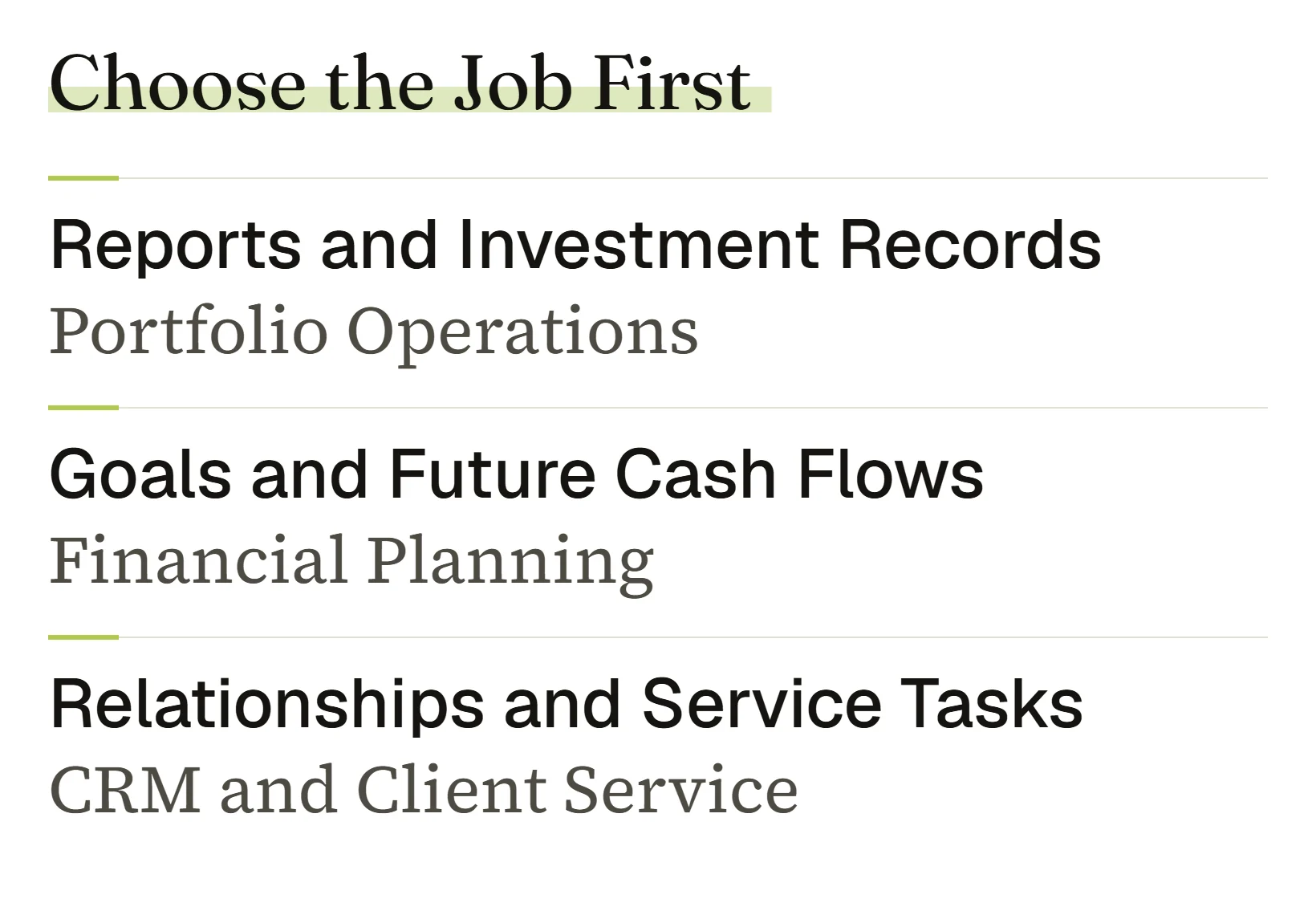
The best fit depends on the job your firm needs to improve: portfolio operations and reporting, financial planning, or CRM and client service. Start with that job, compare products within it, and confirm the modules, integrations and support included in the proposal before choosing a wider suite.
An advisory firm can have good planning software and still struggle to produce an accurate quarterly report. Another can have reliable portfolio records but lose track of who promised a client an answer. Both need better software, but they need to solve different problems.
This comparison covers ten professional tools across those jobs. It explains their published capabilities, where each may fit, and what a buyer should establish before committing. Product information and public prices were checked on 12 October 2026. Fit judgments are our editorial view, based on public sources; this is not a hands-on product test.
- Choose the operating job before the brand. A CRM, a planner and a portfolio system can complement one another.
- Treat a suite as a proposed configuration. The product name alone does not establish which functions or services you are buying.
- Give finalists the same household example, required outputs and acceptance conditions. Compare the work that remains with your team as well as the license price.
01Which Type of Wealth Management Software Do You Need?
Wealth management software is an umbrella term for tools that support investment operations, financial advice and client service. Some products combine several functions; others specialize. For an advisory firm, the useful first distinction is between the investment records, the financial plan and the service record.
Portfolio Operations and Reporting
A portfolio system supports records of accounts, holdings and transactions, then uses those records for performance reports and other investment work. Depending on the product and modules, that can include fee billing, trading or rebalancing, and client reporting.
The important question is how the records become reliable. A custodian connection may bring in data, but your proposal should also identify who reconciles it and resolves missing transactions. A holdings dashboard alone does not establish that responsibility.
Financial Planning
A planner models how a client's goals, resources and assumptions interact over time. Goals-based planning and detailed cash-flow planning are different approaches; product tiers may separate them. Account aggregation helps populate a plan, but it does not by itself establish a reconciled investment book.
For a global readership, check jurisdiction before comparing outputs. A tool's tax, retirement or benefit assumptions need to match the client being modeled. An integration list or broad “tax planning” label is insufficient evidence of support for a particular country.
CRM and Client Service
A CRM records relationships, communications, tasks and service workflows. It helps a team answer who owns the next action, what the client was told and whether a review is complete. It may display account information through integrations without replacing the portfolio system that maintains it.
Keep a working specialist tool when it still serves its job. Consolidation needs a demonstrated improvement in the firm's workflow and an acceptable migration burden. More functions from one supplier alone do not justify it.
02How We Selected and Compared These Ten Options
We selected ten distinct professional products with current official material relevant to portfolio operations, planning or advisory CRM. This practical selection is not an exhaustive market inventory. Consumer wealth apps, robo-advisory services and private-bank core systems serve different buying decisions and are outside this comparison.
Products are grouped by their main role. Their order does not represent a ranking. Black Diamond appears once. Envestnet Tamarac is evaluated as a named advisory suite, rather than counting its parent company as another equivalent product. Current MoneyGuide and Practifi Naya scope is used instead of merging older names or other product lines into their profiles.
The criteria follow the decisions a buyer needs to make:
- Purpose and fit: which job the product handles and whether it suits the proposed firm workflow.
- Data coverage and reliability: account coverage, data arrival, reconciliation and exception responsibility.
- Investment operations and analysis: reporting, performance, billing or trading where relevant; planning methods for planning tools.
- Households and client access: how related accounts, relationships, reports and permissions are represented.
- Accounting and integrations: the distinction between portfolio accounting, an entity general ledger, native functions and connected systems.
- Controls and security: evidence for permissions, approval history, retention and the proposed security configuration.
- Implementation and ongoing work: migration scope, training, support and work that remains with the firm.
- Cost and commercial scope: license basis, modules, services, renewal and add-ons.
- Data ownership and exit: usable exports of records, history and documents, plus transition assistance.
We use published capability, separate or connected scope, and verify in the proposal as evidence distinctions. An unanswered question is not proof that a capability is absent. We do not turn marketing descriptions into numerical product-quality scores, security certifications or promised go-live times.
03Compare the Ten Options at a Glance
The fit column is our view. Use it to narrow the category, then read the relevant profiles and ask for the exact configuration. These products are not ten interchangeable replacements for one system.
| Option | Main Role | Consider It When… | Establish Before Buying |
|---|---|---|---|
| Addepar | Investment data, analysis and reporting | Client portfolios span public and private assets | Asset coverage, historic records and connected operating tools |
| Advyzon | Integrated advisor operations | Reporting, billing and CRM need to work together | Current planning scope and any separate services |
| Orion Portfolio Accounting | Portfolio records, reporting and billing | Investment operations need a defined data and accounting process | Stack/modules, reconciliation service and exception ownership |
| SS&C Black Diamond Wealth Solutions | Portfolio reporting and broader wealth suite | Reporting and client delivery are central to the selection | Included products, back-office services and correction workflow |
| Envestnet Tamarac | RIA investment-management suite | Reporting and trading/rebalancing need coordinated workflows | Licensed modules, custody connections and approval controls |
| eMoney Advisor | Goals and cash-flow planning | The advice process requires the appropriate planning method | Product tier, source inputs and service scope |
| MoneyGuide | Goals-based planning, with a separate advanced suite | Goals planning is the immediate job | Core license versus Wealth Studios, aggregation and other add-ons |
| RightCapital | Financial planning | The team wants defined planning tiers and client collaboration | Tier features, annual commitment and jurisdiction fit |
| Practifi Naya | Configurable wealth CRM | Service roles and workflows need coordination | Configuration, add-ons and implementation cost |
| Wealthbox | Advisor CRM | Relationship records and review tasks need a dedicated tool | Workflow tier and the exact fields transferred by integrations |
04Portfolio and Reporting Platforms
Addepar
Addepar's financial-advisor page describes analysis of public and private investments, portfolio performance and exposure. It also describes capturing and standardizing fund document data. Its integration material distinguishes partner connections and API access.
Our view: consider it when the advisory book needs a consolidated investment picture across asset types. Define the reporting requirements first, then identify how planning, CRM, trading or entity accounting will connect. An API route does not mean those jobs are included in the reporting subscription.
Use the demonstration to resolve three practical questions:
- Can a representative household's accounts and private investment records be brought in with the required history?
- When a fund supplies a revised valuation, who reviews it, what date is used and which reports change?
- Which records move to the firm's other tools, through which connection, and who maintains it?
The retrieved pages did not establish a numerical price or a fixed go-live time. Request a quote covering the assets, history, connections and document work in the proposed deployment. Include the ongoing review of private-asset records in the operating scope.
Advyzon
Advyzon's RIA offering brings portfolio reporting, billing, CRM and client access into its advisor platform. Its published CRM functions include tasks, opportunities and workflows, while billing supports fee structures, statements and exports.
This makes it a candidate for a firm trying to connect several everyday operating jobs. The planning boundary matters: Goals-Based Investing is described as live, while full Financial Planning is labeled “coming soon.” Do not treat the future capability as a current comprehensive cash-flow planner.
Ask the team to demonstrate the present configuration:
- Move one household from account data to a performance report, fee bill and client view.
- Run a client-service task through the CRM and show what updates automatically.
- Identify which goal-planning functions are available now, which need another tool, and which are future releases.
No numerical price or fixed migration duration was established on the retrieved pages. The proposal should separate the platform from named offerings such as AIM investment services or Auria, and state the migration and training work included.
Orion Portfolio Accounting
Orion Portfolio Accounting describes performance reporting, AUM-based fee billing, household data and direct-custodian reconciliation. Orion says brokerage data is reconciled overnight, ordinarily before US markets open; that statement should not become a guarantee for every account or asset.
Our view: consider it when the firm needs a defined investment-record and reporting process, with related operating functions available through Orion's configuration. Products and services may be bought separately or through Stacks. The chosen tier determines scope.
Ask for evidence using the firm's required outputs:
- Reproduce a household's performance report and fee bill, explaining the source balances and rules used.
- Introduce a missing or incorrect record and show who receives and resolves the exception.
- Identify how alternative assets are handled, including any professional service or AltExchange connection.
Orion describes tailored pricing and an implementation scope that can cover migration, custody connections, billing rules and templates. Obtain that scope in writing, including which services are ongoing. A broader product ecosystem does not settle the cost or responsibility of the configuration you need.
SS&C Black Diamond Wealth Solutions
SS&C Black Diamond now presents a broader Wealth Solutions suite. Its portfolio-management and reporting material describes performance, allocation and activity views, branded reports, batch reporting and portfolio appraisal.
Consider it when the selection centers on producing and delivering investment reports, with an opportunity to use related wealth tools. The suite also describes CRM, trading, billing and other services. Ask which products are in the proposal; a suite-level list is not a statement that every function is included in one portfolio license.
The reporting demonstration should answer:
- Can the team reproduce the required report and batch it to the right clients?
- Who audits the data, corrects a missing transaction and republishes an affected report?
- Which statement-batching, portal-posting or other back-office services are included, and which remain with the firm?
The retrieved material did not establish a public numerical price or a universal transition time. Compare the quoted software and service package, rather than treating back-office support as an automatic inclusion.
Envestnet Tamarac
Envestnet Tamarac describes trading and rebalancing, reporting, a client portal and CRM. Its reporting scope includes performance, holdings and transactions; the site distinguishes named tools such as Reporting, Trading, Client Portal and Proposal Tool.
Our view: consider Tamarac when coordinated investment operations are the priority. A useful evaluation follows one household through the proposed reporting and trading workflow, rather than scoring each function from a product menu. Establish the modules, custody connection and supervision arrangements in that configuration.
Ask the demonstration to cover:
- A rebalance with client restrictions and the firm's chosen tax assumptions.
- The approval and exception path before an instruction proceeds to execution.
- The resulting account records and performance report, including how discrepancies are handled.
No numerical price or universally applicable go-live time was established on the retrieved page. Request an itemized proposal for the modules and support required. Evaluate planning integrations on the information they exchange. Do not assume they replace a separate planning license.
05Financial Planning Software
eMoney Advisor
eMoney's products distinguish Plus for goals-based planning, Pro for cash-flow planning and Premier for both. The site also describes client access, account aggregation, budgeting, file sharing and business analytics.
Consider it when the firm's advice process needs one or both planning approaches. Select the method before the tier: an attractive client portal does not establish that the model covers the scenario the advisor needs. Planning aggregation also serves a different purpose from maintaining portfolio-accounting records.
Use a representative plan to inspect:
- The source and review of income, assets, spending and other inputs.
- How a change in an assumption affects the scenario and what the client sees.
- Which partner connection or enterprise API is involved, and which values still need manual updates.
The product page did not establish a numerical price. eMoney describes onboarding, training and migration support, with additional professional services such as data entry or plan development. Clarify which work is part of the quote and which needs a separate service engagement.
MoneyGuide
MoneyGuide's current product page presents core goals-based planning with stress testing and interactive variables. Wealth Studios is a separate offering for detailed cash flow, estate, trust, gifting and entity planning. The wider Platform combines named products.
Our view: shortlist core MoneyGuide when the immediate job is goals-based advice. If the required case needs the advanced cash-flow or trust work described for Wealth Studios, evaluate and price that configuration. Do not infer it from the core product name.
Make the scope differences visible:
- Build the client's goals plan and explain the stress test and assumptions.
- Demonstrate an advanced case in the product that supports it.
- Identify any aggregation or risk-profiling add-on and the license needed for each advisor.
The page displays core MoneyGuide at $2,000 per advisor annually, or $175 per month under an annual subscription. Those payment choices have different annual totals. It lists Yodlee and MX aggregation separately at $400 per user annually each; taxes are excluded. Confirm the selected package, currency and renewal terms in the quote. No fixed full-firm migration time was established.
RightCapital
RightCapital's pricing page distinguishes Basic, Premium and Platinum. Basic lists multiple planning areas, client-facing views and a vault; Premium adds account aggregation, budgeting and Tax Analyzer. Platinum adds team collaboration, configurable assumptions and other firm-level tools.
Consider it when the team wants to compare planning requirements against explicit tiers. Jurisdiction and assumptions still need testing. A named tax or retirement feature does not establish that it handles a particular international client's circumstances.
Before selecting a tier:
- Reproduce the planning scenario and inspect assumptions rather than judging the presentation alone.
- Show how account data is populated and refreshed in the proposed tier.
- Test who can collaborate, what assistants can do and whether enterprise API access is needed.
Displayed prices are $149.95 Basic, $209.95 Premium and $254.95 Platinum per advisor per month. The first year requires an annual commitment; assistant access is listed at $40 per assistant monthly. Enterprise pricing requires contact. Verify currency, taxes and renewal terms. A trial is useful for evaluation but does not establish a migration completion date.
06CRM and Client-Service Software
Practifi Naya
Practifi Naya describes a configurable wealth CRM with client, household and entity relationships, role-specific experiences, service workflows, pipeline tracking and analytics. Practifi now distinguishes Naya from Sentir; capabilities announced for the latter should not be imported into a Naya comparison.
Our view: consider Naya when a growing team needs to coordinate advisors, operations and oversight around a shared service record. The purchasing question is how much configuration and migration the firm's workflows require. The page identifies Protect, Promote, Portals and Sandbox as add-ons.
Use a service case to confirm:
- How household relationships and existing interaction history will be represented.
- Who owns each review or account-opening task, and how overdue work is escalated.
- Which integrations, configuration work and add-ons are required for the proposed workflow.
Practifi's comparison page says pricing starts at $120 per user monthly. It also mentions included guided implementation and a typical implementation cost below $15,000. Those statements do not resolve the scope of your project: obtain an itemized quote rather than assuming all implementation is free. A quick workflow deployment is not proof of a completed firm migration.
Wealthbox
Wealthbox focuses on advisor relationship records, household information, notes, activities, tasks and opportunities. Its pricing page separates Basic, Pro, Premier and Enterprise. Workflows and two-way email sync are listed in Pro; higher tiers add other capabilities.
Consider it when the immediate problem is the client-service record and task coordination. Listed integrations with portfolio and planning products can help connect the stack, but the existence of a connection does not establish complete two-way synchronization of every field.
Inspect the actual service handoff:
- Import a household with notes and history, then assign and complete a review workflow.
- Show which fields transfer to the firm's existing planning or reporting tool, in which direction.
- Export the records and confirm how documents and history can be retrieved on exit.
Displayed prices are $59 Basic, $75 Pro and $99 Premier per user per month, with Enterprise quoted separately. Confirm currency, billing commitment, add-ons and migration scope. Basic should not be treated as including the Pro workflow features because both are sold under the Wealthbox name.
07Which Tools Fit Your Advisory Firm?
A Small Firm That Needs Reliable Reporting
Keep the decision narrow when the CRM and planner already work. Compare the portfolio/reporting candidates on the custodian accounts, report, fee calculation and exception process the firm uses.
Choose demonstrations by the work required:
- Advyzon when reporting, billing and CRM should share a workflow.
- Orion Portfolio Accounting when account records and reconciliation are central.
- Black Diamond when report production and client delivery drive the choice.
- Tamarac when trading and rebalancing matter.
- Addepar when public/private asset consolidation is essential.
Use these routes to choose demonstrations; they do not establish a ranking or exclude other capable products. Ask what ongoing help is included; a small team may have limited capacity to maintain custom connections or resolve data problems.
For illustration, a two-advisor firm already has a satisfactory CRM and planner but rebuilds quarterly reports in spreadsheets. Its first shortlist should address account records and reporting. Buying another CRM because it is bundled does not by itself solve the missing report or justify migrating a working service history.
A Growing Team With Service Handoffs
When clients repeat instructions because tasks are lost between advisors and operations, inspect the CRM workflow first. Practifi Naya and Wealthbox are dedicated candidates; Advyzon and broader suites may also supply relevant functions in their configurations.
Use the same review request in each demonstration. The output should identify an owner, a due date, required inputs and a completed client response. If account data must pass between tools, show that transfer as part of the case. A more extensive dashboard is useful only if the underlying handoff works.
A Firm With Complex Client Portfolios
Complex public/private portfolios raise questions about document data, valuation dates and reporting, which make Addepar relevant to the shortlist. Other portfolio providers may offer modules or services for parts of that work. Test the actual assets and exception responsibilities rather than assuming complexity requires one brand.
If the requirement extends to layered family ownership, entity books and consolidated family-office records, use our family-office software comparison. This advisor shortlist does not establish that a portfolio-accounting or planning product can replace a family office's general ledger.
08What Will the Software Cost?
License prices are only part of the commercial decision. A product priced per advisor or user can still require assistants, add-ons or implementation work. A portfolio platform may be quoted by firm configuration or asset volume. Compare the same required output and responsibilities across proposals.
The dollar amounts above reproduce the vendors' displayed $ prices on the research date. The retrieved pages do not consistently state the currency code. Confirm currency, taxes, billing commitment and renewal terms before making a budget or an international comparison. “No numerical price established” means it was not found in the retrieved official material. The product may still have a defined pricing model.
One published example shows why the payment terms matter: core MoneyGuide's $175 monthly option under an annual subscription totals $2,100 for twelve payments, versus the displayed $2,000 annual payment option. Neither comparison includes a separately required add-on or taxes. The arithmetic compares payment options for that product; it does not show which planner is better value.
Have each quote answer the same questions:
- License: named products, tiers, advisors, other users, accounts or assets covered.
- Connections: custodians, planning/CRM links, APIs and any separately maintained integration.
- Transition: history to migrate, configuration, validation, training and parallel operating period.
- Ongoing work: data exceptions, report maintenance and service charges. Specify support hours and time zone, who handles an urgent reporting or billing failure, escalation contacts, and any contracted response commitments.
- Renewal and exit: price changes, minimum commitments, usable exports and transition assistance.
When proposals differ, identify the missing scope before comparing totals. A low base fee with an unpriced essential connection is an incomplete proposal. Ask the supplier to complete it, then decide whether its price and operating burden fit the firm.
09What Should You Verify Before Signing?
Give finalists a de-identified household example and a written list of required outputs. Test the purchased configuration, including the partner tools involved. Each category has a different job, so judge the product on its assigned portion of the workflow.
| Test | Observable Output | Firm Owner | Acceptance Condition |
|---|---|---|---|
| Portfolio records | Holdings/transactions tied to source statements, with an exception list | Operations | Required accounts and history represented; discrepancy owner and resolution route identified |
| Report and fee bill | The firm's required report and independently checked billing calculation | Operations and advisor | Calculation rules, source dates and any remaining manual work explained |
| Plan | Required scenario with reviewed inputs and documented assumptions | Advisor | Chosen tier supports the case; jurisdiction and model limits understood |
| Service handoff | Assigned review task, due date, status and retained client response | Service lead | Team roles and completion evidence visible; required transfers between tools demonstrated |
| Controls | Role-permission test, approval/change history and security evidence for the configuration | Firm oversight lead | Access and record requirements met; unanswered security questions resolved before contracting |
| Exit | Sample export of records/history and a documented route for documents | Operations | Team can read and use exported material; scope and charges are written down |
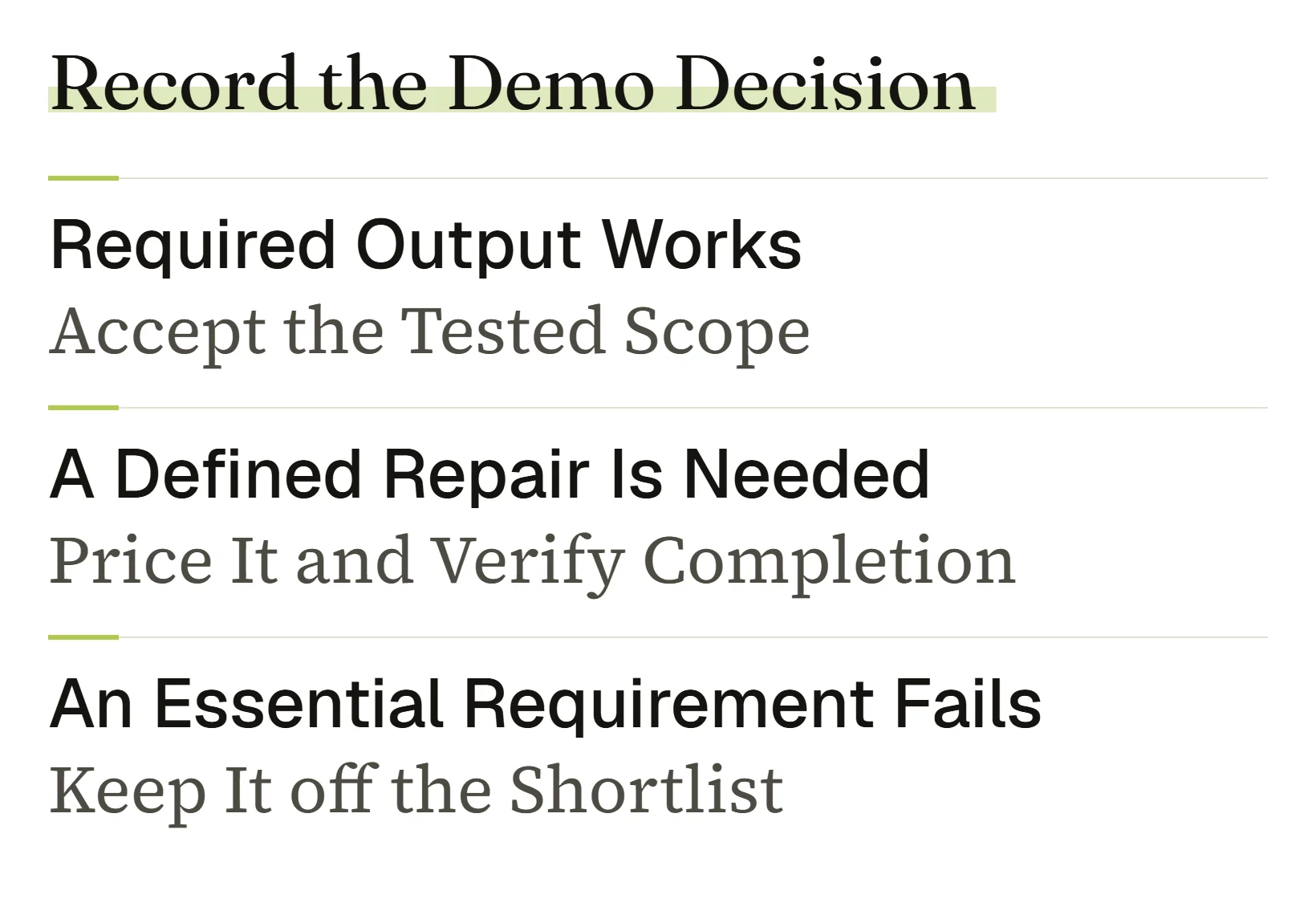
Agree these conditions before the demonstration. Record the result as accepted, requires a priced repair, or fails an essential requirement. A necessary function that has only been promised for a future release remains unresolved. Identify who will deliver a repair and how it will be checked before treating it as complete.
For migration, define which history moves, who validates it and what must be reconciled before cutover. Set the transition date from the agreed work. An advertised workflow-setup time does not establish when the migration will be complete. For controls, request security evidence covering the relevant service and configuration; a permission demonstration alone does not establish an independent security certification or satisfy the firm's obligations.
Choose the configuration your team can demonstrate, price and operate.
Leave the evaluation with a short list of products matched to jobs, a complete proposal for each finalist and named owners for unresolved work. Advisors and operations should agree that the required outputs work before the firm commits. That is a more useful decision than a single score awarded to tools that do different things.
Browse the Atlas and the Register for provider context.
The coming shake-out in family-office software
The category has never been more crowded. Consolidation is coming — and the firms that survive will be… Knowledge & Decision · Analysis
Is a Multi-Family Office Right for Your Family? Compare Fit, Fees and Services
Compare multi-family office fit, services, fees and family responsibilities with an illustrative quote worksheet and provider-check questions. Knowledge & Decision · Analysis