How a Restated NAV Changes Family Office Private Fund Monitoring
A restated private-fund NAV changes the source record, but an already-issued family report needs its own documented correction decision.

On 31 July, a family office sends a report as of 30 June using a US$2.40 million net asset value (NAV) from its fund manager. On 15 August, the manager corrects that same 30 June NAV to US$2.28 million. The family also received a distribution on 10 July. Which record changes, and who decides whether the family needs a revised report?
Private fund monitoring starts with those dates and sources. The team preserves the first statement, verifies what the correction covers and keeps the July cash movement in its own period.
Then it decides how the revised June value affects each report already issued. A new fund file opens a verification step before any record is replaced.
The figures below are fictional. The family's agreements and reporting policy determine its actual rights, deadlines, valuation basis and release decision.
- Keep the governing fund terms, original and revised manager statements, cash record and family-report versions linked to the same investor and fund. Record each source's as-of or effective date and its receipt or release date, as applicable.
- Treat an unexplained value or missing document as an exception with an owner, next proof and due date. A missing item does not establish that the fund manager breached a term.
- Reconcile the corrected value before changing an internal record. Then decide whether to correct, qualify or hold each affected output under the office's policy. Preserve what the family previously received.
01What Private Fund Monitoring Must Keep Current
The family office is a limited partner (LP), or an investor through a feeder, in a private fund. After the commitment, it receives capital-call and distribution notices, periodic capital-account or financial statements, valuation information, and sometimes investor-specific information. It must also track its own cash and entity records. The manager's reporting and the office's duties depend on the limited partnership agreement (LPA), other governing documents and any applicable side letter.
The Cooley primer on private-fund reporting and information rights describes quarterly financial reporting, annual information and event-driven notices as different categories. It also notes that investor-specific side-letter terms can change the information one LP receives. That practitioner discussion helps organize the work; it cannot establish what this family's manager owes it.
The LP Record and Its Limits
An LP monitoring record needs to answer four questions: what the family committed, what the fund's general partner (GP) reported for a specified date, what cash actually moved, and what remains disputed. A dashboard may combine those figures, but it needs traceable source dates and fund/entity identity before a principal should rely on it.
Keep the office's entity books separate from the LP's capital-account statement reported by the GP. That statement describes the investor's fund position under the fund's accounting and documents. The family entity's ledger also records its own payments, receipts and accounting decisions. A mismatch is a reconciliation item until the records and their bases are understood.
Rights Come From Documents, Not a Template
The ILPA Reporting Template promotes more uniform disclosure of fees, expenses and carried interest. Its updated version has a staged go-forward adoption intention. ILPA guidance does not automatically amend a fund's LPA or give an LP a new contractual delivery right. The office should ask which template, if any, this GP uses and check what its own signed terms require.
For each fund, preserve the LPA, subscription, effective amendments, applicable side letter and notices that require a term review. A notice alone need not amend a signed right. Record the investor entity and class. A family may hold interests through multiple vehicles, so a right or fee break for one investor cannot simply be copied to another.
02Set the Fund Record Before a New Statement Arrives
Create one dated fund master record before the next quarter closes. It should hold the investor and fund legal names, commitment, any GP-reported unfunded commitment, currency, contact and portal route, source documents, reporting/notice rights, internal reviewer and family-report owner. Identify which terms are confirmed, which need counsel or GP clarification, and which are merely office expectations. A computed commitment balance is not a substitute for checking the GP's own treatment of recycling, recallable distributions or other terms.
| Record | Source and date to retain | What the office checks | State if unresolved |
|---|---|---|---|
| Contract right | LPA or applicable side letter, version and effective date | Exact investor, promised item, condition and delivery route | Unverified right; ask counsel or GP to identify governing text |
| GP-reported value | Original statement and any revision, valuation date and receipt date | Fund, investor class, NAV, paid-in, GP-reported unfunded commitment, distributions, fees and version | Provisional GP figure; do not silently replace |
| Office cash | Bank confirmation and entity ledger, settlement date | Amount, currency, payer/recipient and link to GP notice | Unreconciled cash; payment or receipt evidence pending |
| Family output | Issued report and approval record, as-of and release dates | Which GP version and office adjustment the family saw | Affected-output decision open |
Terms, Sources and Due Dates
Turn each obligation in the governing documents or accepted side letter into a calendar row: document clause, item, investor, trigger or due date, expected delivery method, responsible office reviewer and escalation route. If the agreement says only that a report will be supplied after a process, do not invent a fixed number of days. Distinguish a negotiated delivery deadline from the office's own follow-up date.
The ILPA Capital Call & Distribution Template aims to standardize transaction details useful for fund monitoring. Its transition timing varies by fund adoption and extends into 2027. It is a reference for questions about a notice, not proof that this fund has adopted the updated form. The actual notice and governing documents control the family's review.
Which Date Does Each Number Represent?
Label four dates when they differ: transaction date, valuation or statement date, GP delivery date, and family-report release date. A 30 June NAV delivered in July describes a 30 June measurement. A cash distribution settled on 10 July belongs to a later cash period. A 31 July delivery of a family report as of 30 June does not turn the June NAV into a July valuation.
If the family report combines as-of dates, state that basis next to the affected figure. The office can then show a principal what is current, what is dated and what remains estimated without implying that all positions were valued on one day.
03A Restated NAV Arrives After the Family Report
Consider one fictional LP interest. The family's commitment is US$5 million, and paid-in capital at 30 June is US$2 million. The GP delivers a statement on 20 July showing a 30 June NAV of US$2.40 million.
The office issues a family report on 31 July, expressly as of 30 June, using that GP value as its stated source basis.
On 15 August the GP sends a corrected statement for the same investor, fund and 30 June valuation date. NAV is now US$2.28 million, a US$120,000 decrease.
Separately, the fund distributed US$200,000 on 10 July. The distribution is a later cash event; this example does not say whether the GP had accrued or anticipated it at 30 June. Ask the GP for that treatment before attempting any roll-forward.
| Item | Date it describes | Receipt or release date | Amount | Immediate record action |
|---|---|---|---|---|
| Original GP NAV | 30 June | 20 July | US$2.40m | Retain as the source used for the issued report. |
| Family report using original NAV | As of 30 June | Released 31 July | GP NAV basis shown as US$2.40m | Preserve the exact issued version and recipients. |
| Distribution cash | Settled 10 July | Confirmed 10 July in this example | US$200,000 | Record as July cash; reconcile it to the GP distribution notice and entity ledger. |
| Corrected GP NAV | 30 June | 15 August | US$2.28m | Validate the revision and open a US$120,000 same-date variance. |
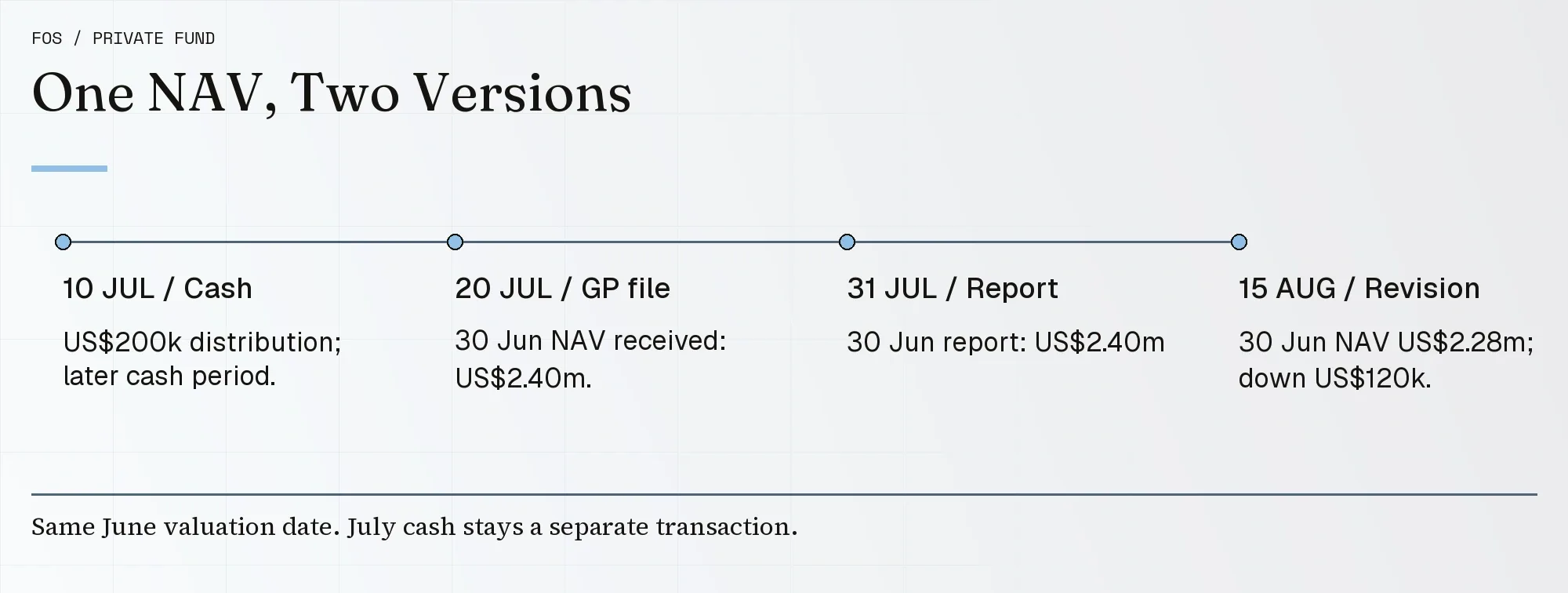
View the full-width desktop diagram. The July distribution is a separate cash event; the August revision changes the same 30 June NAV.
Reconcile the June and July Records
First verify that the corrected file belongs to the same LP interest, currency, class and valuation date. Compare the original and revised capital-account statements line by line: NAV, contributions, distributions, fees, expenses and any manager note explaining the change. Request a change bridge if the GP provided only a new total. Check whether the revision affects unfunded commitment, fee calculations or a tax document; mark those effects unknown until supported.
The arithmetic in this case is simple: US$2.28 million minus US$2.40 million equals negative US$120,000 for the same 30 June GP NAV. It is not a performance return, a loss recognized by the family entity, or a new cash movement by itself. The office's accounting treatment requires its policy and appropriate advice.
Do not subtract the 10 July distribution from the 30 June NAV just because it arrived before the restatement. To prepare a later-date view, the team needs the GP's treatment and any other intervening contributions, distributions, fees and value movements. The family-office capital-call management article covers the payment-side control; this monitoring record tracks what the fund subsequently reports and what the office confirms.
Decide What to Correct, Qualify or Hold
The office's report owner determines which outputs used the original NAV: the 31 July family pack, any internal exposure view, loan or liquidity schedule, and any external statement. Put the exact version and recipients in the exception row. Then apply the office's documented correction/materiality policy and any applicable reporting obligation. A US$120,000 variance has no universal publication threshold.
The possible outcomes are distinct. The office may issue a revised family report, send a correction note while retaining the original pack, qualify a pending output, or hold a decision that depends on the figure. A named approver decides and records the reason. If an external filing or legal communication is implicated, the responsible adviser determines the required treatment. No GP restatement automatically dictates one of these actions.
For the return, benchmark and full report-release methodology, use the investment performance reporting article. Record the source change and exception here so that the reporting team can apply its separate calculation and approval rules.
04Keep Notices, Cash and Investor Rights on Separate Tracks
Every incoming item enters one of three review tracks. A capital-call or distribution notice is checked against fund/investor identity and the office's transaction register; bank settlement is checked separately.
A periodic statement is checked against prior GP versions and the family's position record. A consent, key-person, conflict or information-rights notice is checked against the governing term and the office's decision authority.
The tracks meet in one exception queue but do not collapse into one status. A notice may be valid while its related cash has not settled. Cash may agree with the bank while a fee classification remains open. A GP valuation may be the latest received value while the office has not approved it for a family output.
A Missing Item Is an Exception, Not an Assumed Breach
Suppose this fictional fund's executed side letter calls for an investor-specific holdings schedule after each quarter, subject to a stated condition. The office has not received the schedule by its internal follow-up date. The row should show the exact clause and condition, due date if one exists, portal and email checks, GP contact, and requested response. Until the term and facts are verified, its status is missing or unverified, not “breach.”
The McDermott family-office fund discussion notes that side letters can address reporting, fees, co-investments, conflicts and other investor-specific issues. That breadth is a reason to maintain a rights calendar for each actual LP interest, not to assume the same package applies to every fund.
05Use One Exception Register to Assign the Next Decision
A register is useful only if a reviewer can act on it. Record the source, discrepancy, affected output, amount or term, state, owner, next proof, deadline and decision. The table below shows one row for each kind of open work in the fictional case. Dates and responsibilities are illustrative office choices, not obligations imposed on a real GP.
| Exception | Observed evidence and state | Next proof and owner | Decision effect |
|---|---|---|---|
| June NAV revision | Original US$2.40m and corrected US$2.28m, same valuation date; reason unknown | Fund analyst requests GP bridge; controller compares capital account and fee lines by 19 August | Keep future uses of the position provisional until reconciled; preserve any already-issued view and ask its owner to decide the correction route. |
| July distribution | US$200,000 bank receipt; GP notice classification not yet matched in this example | Treasury matches notice, bank and entity posting by 18 August | Cash receipt confirmed, fund-record classification still open. |
| Investor-specific schedule | Side-letter clause identified, delivery condition and due status unverified | Legal/operations reviewer checks executed clause and GP portal by 20 August | Do not assert breach; seek document or explanation. |
| Prior family pack | 31 July pack as of 30 June used original NAV; recipients and version retained | Report owner applies materiality/reissue policy after GP bridge | Preserve prior pack; revised notice, qualification or no reissue requires an explicit approval. |
An “unknown” is different from a failed check. If the GP supplies the bridge but the office cannot verify the fee line, close the bridge request and keep the fee question open. If the correction is approved for the position record but the family-report decision is pending, keep those two statuses separate.
Illustrative decision record, 16 August
- Current status: Preserve the original 31 July family pack, its 30 June basis and recipient list. The US$120,000 NAV difference remains open pending the GP bridge, so the decision whether to reissue or correct the June family pack is on hold. The issued pack remains preserved.
- Next proof: The fund analyst requests the bridge by 19 August. The controller compares the original and corrected GP statement versions and reconciles the family's position record.
- Decision owner: The family-report owner decides by 20 August whether the office's policy and verified facts call for a revised pack, a recipient note, a qualification or a continued hold. If proof remains missing, the owner records that limit and a next review date.
These are proposed office deadlines for this example, not the GP's contractual deadlines.
Illustrative closure, 20 August, if the requested proof arrives
Assume the GP supplies a dated bridge on 19 August. It ties the US$120,000 change to a corrected 30 June valuation line for this LP interest and shows no additional June cash movement. The fund analyst checks the investor, class, currency and date against both GP statement versions; the controller verifies the bridge. This is a fictional completion condition, not a claim about any real GP or a rule for recognizing an entity-book loss.
- Fund-position record: On 20 August, the controller approves the corrected GP-reported 30 June NAV of US$2.28 million in the office's source-linked monitoring record. The original US$2.40 million source, the bridge and the approval stay attached. Any entry in the family entity's official books receives its own accounting review and approval; the GP source correction alone does not post one.
- Already-issued family pack: The report owner confirms that the 31 July pack as of 30 June went to the principal and investment committee using US$2.40 million. Under this fictional office's documented correction policy, the owner approves a dated correction note and revised NAV table to those same recipients on 20 August, with the US$120,000 change explained. The original pack is retained; its issued version is not overwritten. The fictional issue record reads: approved by the family-report owner on 20 August; sent that day through the approved channel to the principal and investment committee; delivery logged as CORR-01. The reason is the verified US$120,000 same-date NAV revision. If delivery confirmation is absent, status remains approved but not confirmed sent.
- July cash exception: As of 20 August, the US$200,000 bank receipt is confirmed, but Treasury has not matched the GP notice classification to the entity posting. Its illustrative 18 August office target is overdue; Treasury records the reason, escalates to the fund analyst and sets 21 August for the next review. The June NAV bridge does not close this July cash row.
- Other outputs: No external statement is assumed in this example. If one used the old figure, its separate owner must assess its own correction obligation. A later liquidity or exposure view uses the reconciled source but retains any qualification required by the office's reporting policy.
That disposition is one possible outcome after proof and policy review. Another office could approve a full pack reissue or no recipient correction with a documented reason; the size of this fictional variance does not impose a universal threshold.
06Escalate a Fee, Valuation or Terms Question With Evidence
Send the GP a bounded request: identify the fund and LP interest, cite the two statement versions and valuation date, quantify the US$120,000 delta, and ask which line items and methodology changed. Attach the applicable clause only for a term-right question. Request a response date that supports the office's next decision. Avoid sending a generic “please clarify NAV” email that forces the GP to reconstruct the problem.
The SEC's June 2020 examination Risk Alert recorded historical deficiencies concerning private-fund adviser conflicts and fees/expenses, sometimes leading investors to pay more or miss material information. It does not establish that this GP made an error or that the family's US$120,000 delta is a fee issue. The alert supports checking the fee and conflict lines when the GP revises a statement, with the actual conclusion based on this fund's records.
If a term appears inconsistent with the GP's response, involve the office's legal adviser before calling it a contractual violation or accepting a waiver. If the value remains disputed near a report deadline, the report owner records the evidence, the unresolved amount, a provisional label or hold, and the next review date. The family can then see which decision is waiting on proof.
07Carry Open Items Into the Next Monitoring Cycle
Preserve the Prior Report and Restated Source
Keep the original GP file, corrected file, change bridge, correspondence, approved position entry and every family-report version. Record who received each issued version and what explanation accompanied a correction. A later statement should create a new dated record, not erase the earlier basis for a family decision.
Review the Rights Calendar and Exception Deadlines
At each monitoring cycle, compare expected and received GP items under the actual LPA and side letter: notices, periodic statements, annual audit or tax material, investor-specific data and event-driven communications where the documents provide them.
Mark each item received, not yet due, missing, disputed, or conditionally inapplicable. Record any claimed waiver separately and verify its authority against the governing documents with counsel as needed. Assign one reviewer, one next action and a dated follow-up for every open row.
Before the next output is released, the reviewer should be able to identify the source date, open variance, approver and affected report version. The GP's latest 30 June NAV in this case is US$2.28 million; July cash remains a separate transaction. If the bridge or revision decision is open, the output says so and names who will close it.
 Investment & Portfolio · Analysis
What Is Family Office Private Fund Commitment Pacing, and Why Does It Matter?
Private fund commitment pacing sets the size and timing of new promises while older funds can still call… Investment & Portfolio · Analysis
Family Office Private Asset Valuation Policy: Which Mark Belongs in the Report?
A December family report can contain a fund value dated September and a direct-company mark proposed from a… Investment & Portfolio · Analysis