Family Office Private Asset Valuation Policy: Which Mark Belongs in the Report?
A December family report can contain a fund value dated September and a direct-company mark proposed from a new financing headline.

A December family report can contain a fund value dated September and a direct-company mark proposed from a new financing headline. One source is old; the other may price a different security. Neither becomes an approved December value simply because it appears in the December report.
A family office private asset valuation policy should decide what each number represents, when an old source needs challenge, who can authorize a new estimate and what the reader sees while the value remains unresolved. The job is to control the claim made by the report, not to make every private asset look equally current.
- Record the asset, ownership interest, valuation basis, source and as-of date before importing a mark into the family report.
- Challenge a mark when a new event, elapsed time or conflicting source could change the value; a cash-flow roll-forward is not, by itself, a fresh fair-value conclusion.
- Separate the preparer, challenger and approver. Release an approved value with its date and limits, or label the number as a prior mark while the current estimate remains unresolved.
01What Must the Valuation Policy Decide?
The policy begins by naming the purpose of the report. An internal family wealth view, an entity's financial statements, a lender certificate and an estate or tax filing may require different valuation bases, measurement dates and professional work. This article designs an internal management-reporting policy. The office's accountant, auditor, lender documents and legal or tax advisers must determine any separate formal requirements. A number approved for the family dashboard is not automatically suitable for those other uses.
For each holding, decide five things:
- Unit of account: Which LP interest, share class, property interest or security is being valued? A company's headline transaction price may not price the family's instrument.
- Basis and date: What does “value” mean in this report, and on what measurement date? If the office uses fair value, it must choose methods consistent with the applicable reporting framework.
- Source and method: Is the starting point a GP statement, independent appraisal, recent transaction, or supported model? Which inputs and judgments bridge to the report date?
- Challenge and approval: Which events require a new analysis, who prepares it, who reviews it independently, and who can sign an override?
- Release treatment: If current value is unresolved at the reporting cutoff, does the report show a clearly dated prior mark, a range or no current estimate? The label must match the evidence.
The December 2025 IPEV Guidelines recommend a written policy, documented methods and inputs, and independent internal or external review for private-capital investments. They distinguish the valuation basis from the technique and its inputs. They are guidance for private-capital valuation, not a rule that every family office must use one universal process.
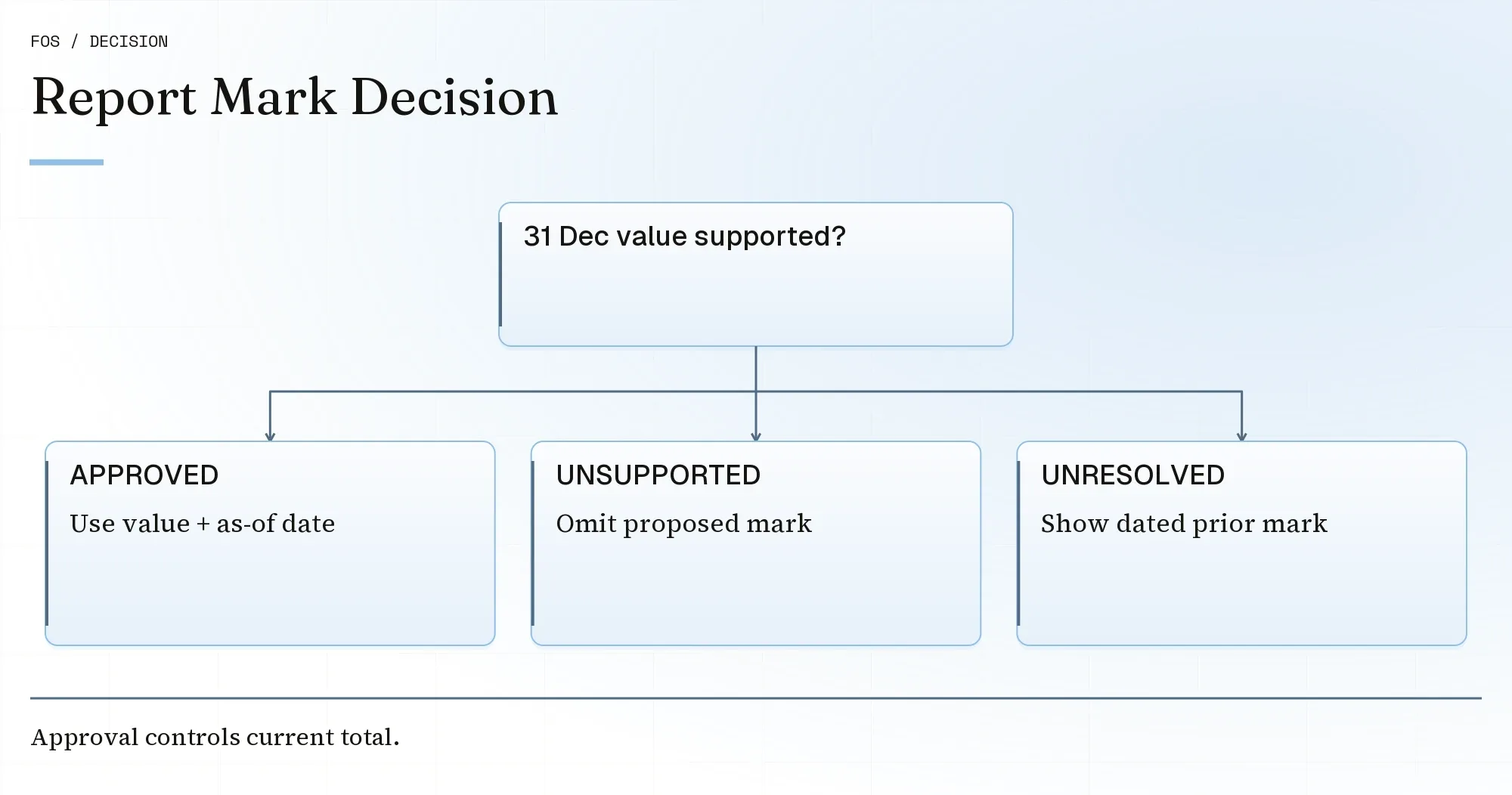
Open the full-width desktop diagram. The three routes depend on the valuation approver’s recorded decision; a report release does not itself approve a mark.
02Choose Sources by Interest, Basis and Date
An LP interest and a directly owned asset need different source paths. A private-fund GP has access to its underlying portfolio and reports a NAV for a stated date. The family is an investor in the fund interest; the GP's NAV is evidence, not an automatically current December mark. A direct holding may require the office to gather operating results, transaction terms and market inputs itself or commission a specialist.
When sources conflict, prefer the evidence that values the correct ownership interest, on the required basis and measurement date, after testing its reliability and later events. A newer company financing headline does not automatically outrank an older instrument-specific model; an old GP NAV does not become current just because no new statement has arrived. Record why the chosen source and any adjustment are fit for this report.
Use a source register rather than a single “value” cell:
| Holding | Starting evidence | Date and scope to preserve | Challenge before release |
|---|---|---|---|
| LP fund interest | GP capital-account statement or NAV report | Valuation date, LP class, currency, cash movements and any known later events | Is the statement for the reporting date? If not, are changes to that date significant and supportable? |
| Direct private company interest | Approved model, financing documents and company results | Exact security rights, model date, projections, market inputs and transaction terms | Does a financing price apply to this instrument, after preferences and dilution? |
| Direct property interest | Appraisal and updated property evidence | Property right valued, appraisal date, lease roll, occupancy, related debt and material later events | Has tenancy, rent, condition or comparable pricing changed enough to require a new estimate? Is the appraisal gross asset value or equity value? |
The IPEV guidance allows a fund interest's attributable share of the last reported NAV to be a starting point when the underlying investments are valued appropriately and significant known or knowable changes to the measurement date are assessed. It explicitly calls for attention to a difference between the NAV date and the measurement date. It does not license the office to rename an old GP number as a new-date value.
For direct holdings, the appropriate technique depends on the instrument and facts. Valuation Research's family-office discussion describes how preferences, options, return thresholds and incentive awards complicate direct private-company marks. Its examples include income, market and other approaches. A new financing headline can be a valuable input without being the value of a different share class.
03Work a December Close Across a Fund and a Direct Company
Consider a fictional family office preparing an internal report as of 31 December 2026. Its chosen policy says that a material post-source event or a source one quarter old or older triggers documented review. That is an illustrative internal threshold, not an accounting or legal requirement.
LP interest. The GP's latest statement gives a US$8.0 million NAV as of 30 September. The LP contributes US$0.6 million in November and receives a US$0.2 million distribution in December. Adding the contribution and subtracting the distribution yields US$8.4 million as a mechanical capital-movement bridge if those flows belong to this interest and match the GP capital account. It does not prove the fund interest's 31 December fair value: portfolio performance, fees, carry, foreign exchange or another significant event may also matter.
The family's cash falls by a net US$0.4m from those two fund movements (−US$0.6m + US$0.2m). If a fund carrying proxy rose by US$0.4m solely because of those transfers, the family's combined wealth would not rise US$0.4m from the transfers alone. Reconcile notices, the GP capital account and bank evidence before using even the mechanical bridge.
The controller preserves the September statement and bank evidence for both cash flows. The investment lead asks the GP for a December estimate or subsequent-events information and checks whether the policy permits an internally supported adjustment. Until that work is complete, the family report may show “last GP NAV: US$8.0m as of 30 September; subsequent LP cash flows: +US$0.6m and −US$0.2m; 31 December value unresolved.” It should not put “US$8.4m December NAV” into the total without an approved valuation conclusion.
Direct company interest. The office's last approved, instrument-specific model values its preferred shares at US$5.0m as of 30 September. In December, the company raises capital in a new preferred class and circulates a headline valuation. An internal preparer proposes US$6.2m for the family's older class by applying that headline price per share. The numbers are fictional. The challenger recommends rejecting that shortcut pending the financing documents, updated cap table, dilution and preference waterfall: a price for new shares does not automatically price the family's different rights. The valuation approver has not approved the US$6.2m proposal.
The investment lead requests the signed financing terms and an updated analysis of the actual preferred interest. Until then, the separate schedule can say “last approved model: US$5.0m as of 30 September; new financing and proposed US$6.2m mark under challenge; 31 December value unresolved.” The family report must not silently insert either US$5.0m or US$6.2m as a verified December value.
The CFO, acting under this fictional office's written reporting mandate, sends a confirmed liquid-assets subtotal only. Both private interests remain outside any purported current-value total. A separate dated schedule shows their last source values and open challenges. The report label reads “partial current-value view; private-asset current values unresolved”, with a next status date.
Exclusion does not erase either asset or imply zero value. The subtotal is not whole-family net worth. If the office instead needs a formally complete financial statement, its accounting owner must determine the applicable measurement and release requirements before issuing it.
04Route the Exception Before Anyone Changes the Mark
The policy should define what triggers a challenge, rather than waiting for someone to dislike a result. Triggers can include a source-date limit, a new financing or property event, a material operating variance, a proposed sale, a conflicting appraisal, a change in security rights or an observed model error. Thresholds may vary by asset and report purpose; a 5% movement is not a universal materiality rule.
Use separate roles even in a small office. One person may hold more than one title, but a consequential override should receive a review by someone who did not prepare the new number. The office designates a valuation approver in its mandate; a conflicted preparer cannot approve their own change. Escalate a material unresolved exception to the designated committee or an independent specialist. The authorized report releaser separately decides whether the family receives a qualified, partial or delayed report.
| Step | Evidence and action | Decision owner |
|---|---|---|
| Prepare | Retain the prior source, cash/activity bridge, new event, model version and proposed basis | Asset owner or controller |
| Challenge | Test dates, instrument rights, assumptions, alternate evidence and impact on the report | Investment lead or independent reviewer |
| Approve or reject | Record the concluded amount or range, method, reason, limitations and effective date; recuse conflicted participants | Named valuation approver or committee under the office mandate |
| Release | Choose the report label, as-of date, provisional treatment and recipients; preserve the previous version | Authorized report releaser |
A reviewer should not substitute a preferred round number for analysis. The IPEV guidance treats a recent transaction as a possible starting point and calls for updated market and company facts at each measurement date. Under US GAAP, FASB's 2011 update to Topic 820 describes fair value as a market-based measure using market-participant assumptions, including risk. The office should apply the framework that actually governs the specific report; these sources do not make an internal family estimate an audited fair-value measurement.
An override record needs the prior amount and date, proposed amount and date, reason for the difference, source and model version, review challenge, conflict declaration, approval and the reports affected. If the old source later changes, preserve both versions and the release decision. The separate private fund monitoring guide works through that subsequent restatement workflow; this policy controls how a mark is chosen and labeled before release.
05Put the Policy Into a Copyable Approval Register
Start with one row per asset, ownership interest and reporting date. A controller can implement the first version in a controlled workbook; a system may later enforce permissions and lineage.
Keep the full register in four grouped sections, with one record per asset, ownership interest and reporting date:
- Identity and date: holding ID; legal owner; instrument/right; report purpose; measurement date; valuation basis.
- Evidence and analysis: source and source date; last approved value and its as-of date; material event since source; proposed technique and inputs; proposed value or range; challenger and finding; conflict; evidence link.
- Valuation decision: valuation approver; valuation status; valuation approved at.
- Release and follow-up: report releaser; release treatment; report label; report released at; exception owner; next evidence/action; due date.
Keep valuation status and report release treatment in different fields. For valuation status, use distinct meanings:
- Source received: The document is stored and dated; no conclusion about its suitability for the report has been made.
- Challenge open: An event, stale source or conflict needs analysis. Preserve the last approved mark and do not silently roll it forward.
- Approved for this report: The named approver accepts the amount, date, basis and limitations for the stated reporting purpose.
- Superseded: A later source or decision replaces a prior version for a specified report date. Keep the old record and the reason for change.
The releaser chooses one treatment that the evidence supports:
- Include a current value: The valuation approver has accepted its amount, basis, date and limitations for this report.
- Show a dated prior mark separately: The current value is unresolved; identify the earlier source and keep it outside the current-value total.
- Publish a current range: A valuation approver has accepted the range for this report's basis and date. Label an unapproved indicative range separately, outside the current-value total.
- Exclude or delay: Reconcile the omission, explain the incomplete total, or hold the report if a qualified release would mislead its readers.
A qualified release does not close an open valuation challenge. The releaser names the recipients and the next evidence date.
The fictional close yields two selected-field decision records. The CFO's shared release label is “partial current-value view; private-asset current values unresolved.” The liquid-assets subtotal excludes both private positions.
LP fund interest
- Evidence: GP NAV US$8.0m at 30 September; an illustrative US$8.4m cash-movement bridge, subject to GP capital-account matching.
- Finding and status: December fair-value changes remain unverified. Challenge open; no December value approved.
- Report treatment: The CFO releases the dated GP NAV and cash movements in a separate schedule, outside the current-value total, under the shared partial-report label.
- Next step: The investment lead seeks a GP update and significant-events evidence. A status update is due 15 January 2027; valuation completion is not promised by that date.
Direct preferred shares
- Evidence: Last approved instrument-specific model US$5.0m at 30 September; US$6.2m proposal derived from the price of a different share class.
- Finding and status: Rights, dilution and the preference waterfall remain untested. Challenger recommendation: reject the shortcut. Approver decision: no December value approved or formally rejected; challenge remains open.
- Report treatment: The CFO shows the dated prior model and financing event in the separate schedule, outside the current-value total, under the shared partial-report label.
- Next step: The direct-investment lead obtains signed financing terms and a class-specific analysis. A status update is due 15 January 2027.
One complete LP approval-register entry to copy
- Identity and date: Holding ID LP-01 (fictional); legal owner to be recorded; instrument the family’s LP interest; purpose internal family wealth report; measurement date 31 December 2026; basis current-value management view, subject to the office’s written policy.
- Evidence and analysis: Source GP capital-account/NAV statement, dated 30 September 2026; last approved value to be recorded; GP source NAV US$8.0m as of 30 September; later events US$0.6m contribution and US$0.2m distribution; technique/inputs cash-movement bridge only, subject to GP-account matching, not an approved December valuation; proposed current value/range none; challenger investment lead; finding December fair-value changes unverified; conflict declaration to be recorded; evidence link statement, notices and bank records to be attached.
- Valuation decision: Approver named approver under the office mandate; name to be recorded; status challenge open, no December value approved or formally rejected; valuation approved at none.
- Release and follow-up: Releaser CFO; treatment dated prior mark and cash movements in a separate schedule, excluded from current-value subtotal; report label “partial current-value view; private-asset current values unresolved”; report released at timestamp to be recorded at issuance; exception owner investment lead; next action seek GP update and significant-events evidence; status due 15 January 2027.
The CFO signs the partial-report release and preserves the challenge records; the valuation approver has not signed a new December value for either position. The report must state that its liquid-assets subtotal is incomplete as a net-worth measure. These are illustrative office choices, not a default treatment for formal financial statements.
The release check is not “every cell has a number.” It is: what can the report truthfully say about each position on its date? If a material holding is unresolved, the family may need a qualified total, a range, a delayed release or an explicit exclusion. The policy should state who can choose among those treatments and when a formal-reporting specialist must decide instead.
06Frequently Asked Questions
How Often Should a Family Office Value Private Assets?
Set the measurement dates required by each report and review material events between formal valuations. A GP may issue quarterly NAVs; a direct holding may have a different valuation cycle. Neither cadence removes the need to challenge a significant later event. The office should document its chosen schedule and reporting framework rather than borrow an interval as a universal rule.
Can a Capital-Call and Distribution Bridge Update a Fund NAV?
It can reconcile cash movements from a prior GP statement, subject to the fund's accounting and dates. It is not necessarily the LP interest's current fair value. Fees, portfolio changes, carry, foreign exchange and later GP information may change the conclusion.
Does a New Financing Set the Value of Every Share Class?
No. Compare the transaction date, rights, preferences, dilution, conditions and market-participant assumptions with the family's actual interest. A financing is evidence to analyze, not a universal repricing instruction.
Can One Valuation Serve the Family Report, Financial Statements and Tax Filing?
Only if the relevant purpose, basis, date and professional requirements coincide. The policy should identify those uses separately and route formal accounting, lender, tax and estate work to the people responsible for them.
 Investment & Portfolio · Analysis
What Is Family Office Private Fund Commitment Pacing, and Why Does It Matter?
Private fund commitment pacing sets the size and timing of new promises while older funds can still call… Investment & Portfolio · Analysis
Family Office Liquidity Stress Testing: When Does the Paying Entity Breach Its Cash Floor?
A fictional entity-level stress test shows when coupled liquidity shocks first breach a cash floor, which remedy could… Investment & Portfolio · Analysis