A Family Office Next Generation Education Plan From Observation to Recommendation
A practical learning plan that tests judgment through a first memo, coached feedback and a different unprompted case—without confusing education with decision rights.

A family member can finish a wealth course, attend two investment meetings and still be unsure what to do when a decision is incomplete. The office needs to know whether the learner can recognize a missing document, challenge an assumption and identify who is authorized to decide. Attendance alone cannot answer those questions.
Family office next generation education needs a sequence of learning, supervised participation and observed judgment. It can prepare someone for a later role. Education alone grants no trustee power, committee vote, bank-signing right or management position; each requires its applicable formal authorization process.
This article builds an illustrative learning plan around a fictional investment proposal. The family must adapt topics and access to its own members, ages, interests, governing documents and privacy rules. The example does not measure the effectiveness of a real program.
- Set a learner-specific goal: what should the person be able to explain, test or recommend, and what may they observe without acting?
- Move from explanation to a bounded exercise. Record what the learner did with evidence, uncertainty, conflicts and authority—not only whether they chose the answer an adult expected.
- Give feedback and test the skill on a different case. Record what the learner demonstrated, who reviewed it and the next assignment; handle any formal appointment separately.
01Define the Education Job Before Choosing a Course
The goal is not to make every family member an investor or an office employee. One learner may want to understand distributions from a trust; another may join family meetings but never manage an asset. A third may be preparing for a professional role. Start with the responsibilities the family actually expects each person to understand or eventually undertake.
Write a small number of outcomes as things the learner can do. For example: explain the difference between a commitment and a cash call; read a family report and identify the date of each number; describe how a proposal reaches an authorized decision; or say when a conflict should be disclosed. An outcome such as “appreciates the family legacy” may matter, but it needs a different conversation and cannot be graded like reconciliation arithmetic.
The National Endowment for Financial Education (NEFE) evaluation toolkit recommends identifying the knowledge, skills and actions a program is meant to develop before choosing how to evaluate it. That is general financial-education guidance, not a validated family-office promotion test. The office can apply its logic without claiming a course causes better investment decisions.
Education Is Not Delegated Authority
An observer can ask a useful question without holding a vote. A learner can write an investment memo without instructing a bank. Mark the person's actual role at the start of each exercise.
The office's investment-committee authority and governing documents control real decisions. A teaching plan may recommend that someone be considered for a role later; the appointment and permissions require their own process.
02Establish a Baseline and a Learning Agreement
Ask the learner what they want to understand and what they already know. Use one short initial exercise instead of assuming competence from age, degree, occupation or surname. Someone who has run a business may understand cash flow but not the family's trust structure; a younger member may be fluent with a dashboard but unfamiliar with its valuation dates.
Agree on five practical boundaries before sharing materials:
- Purpose: the specific learning outcomes and the next occasion on which the learner will practice them.
- Access: which documents can be used, whether the case is fictional or sanitized, and what remains confidential.
- Participation: observer, discussion participant or supervised memo writer; distinguish each from approval and execution rights.
- Support: the family or office contact who answers questions, the specialist who teaches a technical subject, and the person who gives feedback.
- Evidence: what work the learner will submit, when it will be reviewed and what a further exercise must show.
If the family has minors, sensitive beneficiary information or competing family branches, tailor access and consent with the responsible advisers. Do not use a real account, private medical detail or live payment instruction merely to make an exercise feel authentic. A fictional case can test reasoning without opening production permissions.
03Move From Explanation to a Supervised Recommendation
No universal age ladder decides readiness. The stages below describe types of participation, not titles or promotion guarantees. Learners can move at different speeds or choose to stay informed without seeking a governing role.
Understand. The learner explains source dates, basic terms and the family's decision route using a glossary and fictional records. The education lead records the explanation and questions. Move to observation when the learner can distinguish a number's source from a decision right, without the coach supplying the answer.
Observe. The learner attends an approved meeting or reads a sanitized packet, then writes what was decided, by whom and what remained open. A meeting owner reviews the summary for accuracy and confidentiality. If it confuses a proposal with an approval, repeat the observation with a different packet before assigning analysis.
Analyze. The learner writes a short memo with evidence, alternatives, missing information and consequences. A technical coach annotates the first attempt. Move toward supervised recommendation only after the learner can apply the method to a new case without prompting; a corrected first memo alone shows learning with guidance.
Recommend under supervision. The learner presents a dated recommendation, uncertainty, next proof and the actual decision owner. The reviewer records how much help was given and selects the next exercise. Formal role changes use a separate process.
Parkview's published next-generation education program describes needs assessment, curriculum design, application and ongoing development. That is a provider's own program design, not independent proof that its sequence fits every family. Wharton's family-office program illustrates how structured teaching can cover family, governance and financial topics. A course can add vocabulary and outside perspectives; the office still has to test application to its own decision rules.
A Small First Cycle
An illustrative first cycle might use one baseline conversation, one approved observation, one fictional case memo and one different follow-up case after feedback. The schedule should fit the learner and the office, not a fixed birthday. A learner who wants understanding but no governing role can stop at informed participation; the education lead still records what was learned.
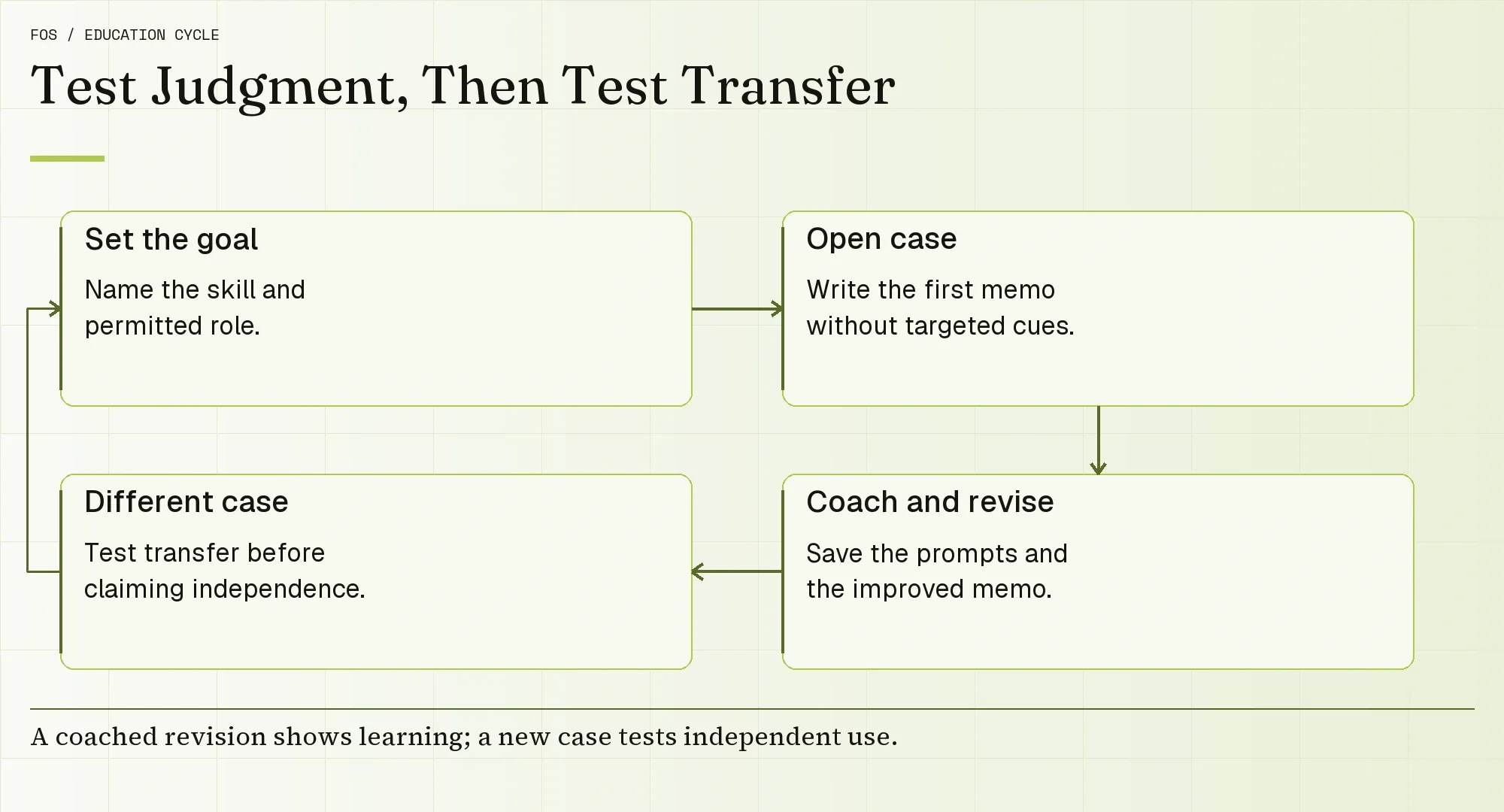
See the full-width desktop diagram. The second case tests whether the learner applies the method without targeted coaching.
04Test Judgment With a Fictional Investment Proposal
Suppose a 26-year-old adult family member wants to contribute to investment discussions. The office gives them a fictional proposal for a US$500,000 private-fund commitment. The sponsor asks for an answer by Friday and describes a ten-year term. The family's current investment mandate requires a liquidity review before a new long-duration commitment.
The exercise packet has three short pieces: a sponsor summary calling for US$100,000 initially with up to US$400,000 more subject to the eventual fund terms; the mandate's liquidity condition; and a disclosure that a family member holds a minority interest in the sponsor's management company. It does not include the full fund agreement or complete fee schedule. The figures and relationship are teaching assumptions, not a real transaction.
The learner's first, open-ended prompt asks: “What should the office do next, and why? Identify the evidence and approvals you would need.” They may not contact the sponsor as the family, approve the commitment or instruct a payment. The task is to identify what the office needs to decide, not whether private funds are generally good or bad.
First submission: “The team should commit before Friday because the strategy sounds attractive. We need to pay the US$500,000 now.” It notices the deadline but treats the entire commitment as immediate cash, misses the required liquidity review, leaves the absent agreement and fee detail unexamined, and ignores the disclosed relationship and decision owner. A reviewer names those omissions precisely rather than judging the learner's interest in wealth.
After feedback: The coach asks the learner to distinguish the commitment from the first call, find the mandate's liquidity condition, account for the disclosed relationship and name the approver. The learner then writes that the proposal should not receive a binding approval on this packet. It requests US$100,000 initially, while up to US$400,000 could be called later under terms not yet reviewed; that is a potential exposure, not cash due today. The learner requests the full agreement and fee schedule, routes the liquidity and relationship questions to office processes, and identifies the authorized committee or delegate as decision owner. If proof cannot arrive by Friday, the office may seek more time or decline under its policy; the learner does not make that choice for it.
The second memo shows improvement with guidance. It is not proof of independent readiness or a real investment verdict. Give a different fictional case later to see whether the learner transfers the same habits without the answer being supplied.
Score What Was Observed, Not the Person
For each criterion, use not yet shown, shown with prompting or shown without prompting in this exercise. These are descriptive observations, not a universal pass score. A filled record for this fictional learner could read:
- Cash and source use: First memo: not yet shown; it equated a US$500,000 commitment with cash due now. Revised memo: shown with prompting; it separated the US$100,000 initial request from up to US$400,000 of possible later calls and named the missing agreement.
- Mandate and conflict: First memo: not yet shown; it missed the required liquidity review and disclosed sponsor relationship. Revised memo: shown with prompting; it routed both questions to the right office processes without alleging wrongdoing.
- Decision boundary: First memo: not yet shown; “the team should commit” named no authorized approver. Revised memo: shown with prompting; it gave the authorized committee or delegate the choice, with next proof and deadline.
- Uncertainty and communication: First memo: not yet shown; it gave a confident conclusion despite missing terms. Revised memo: shown with prompting; it stated what was unknown, which documents were needed and how Friday's deadline affected the next step.
The education lead saves both memos, the coach's specific prompts, the packet version and the observation record. The next assignment is a different fictional proposal with a different cash profile and no disclosed family connection. Its prompt is only “What should the office do next, and why?” The reviewer gives no targeted coaching before assessing whether the learner independently asks about sources, liquidity, potential conflicts and authority without inventing a connection. A polished memo ghostwritten by an adviser would not demonstrate the learner's own judgment.
One Learning Record the Office Could Use
Keep the record short enough for the learner and reviewer to use, while preserving the difference between coached work and independent work. For this fictional exercise, it might read:
- Goal and permitted role: explain a commitment's cash timing and identify missing decision evidence; supervised memo writer with a fictional packet, no approval or payment access.
- Packet and first observation: version 1, dated for the exercise; first memo said US$500,000 was payable now and missed the liquidity gate, disclosed relationship and approver. Status: not yet shown on those criteria.
- Coach input and revised observation: coach pointed to the commitment-versus-call distinction, mandate condition, relationship and decision owner. Revised memo addressed them. Status: shown with prompting.
- Independent follow-up: different fictional proposal, open-ended prompt, no targeted coaching. Observation: not yet assessed; do not prefill a pass.
- Reviewer and next step: education lead names the reviewer and review date when the second case is assigned. If a material source, authority or conflict miss recurs unaided, repeat that skill with different evidence. If the learner shows the method unaided, offer a bounded next exercise or supervised participation under the existing access rules.
- Formal appointment: none proposed by this learning record; any later role decision follows the separate authorization process.
An independently strong second memo would be evidence for that task, not a universal readiness certificate. Keep both the learner's work and the amount of help visible when deciding what to teach next.
The same method can serve a trust beneficiary who wants to understand a distribution statement but no office role. Their bounded exercise is to identify the statement period, explain what is known versus pending, and draft questions for the trustee. The reviewer records source-date and question quality; no trustee power or investment memo is implied. A family-governance learner could instead summarize which forum owns a fictional policy question. The goal, practice and evidence stay aligned to the person's chosen path.
05Choose Teaching Roles and Protect Family Information
Different people should teach different subjects. A principal may explain values and why the family uses particular decision forums. The office CFO can teach how cash, commitments and reports connect. Counsel can explain the limits of actual trust, entity or committee authority. An external educator may bring curriculum structure or neutral facilitation. None should be asked to present an uncertain family policy as a settled legal right.
Give teachers a brief that states the learner's goal and permitted material. Keep a record of what was shared, especially if an outsider receives family information. For a real meeting, decide beforehand whether the learner can ask questions during the session or only in a debrief; do not surprise other participants with a new audience for confidential material.
The CFA Institute discussion of next-generation family-office engagement describes families adapting governance and involvement as younger members' priorities evolve. Its professional accounts support taking those interests seriously. They do not establish that every family member wants a leadership role, or that participation alone creates one.
06Review Progress, Then Set the Next Assignment
NEFE's toolkit distinguishes evaluation before, immediately after and later than a learning activity. For a family office, that suggests three questions: What could the learner do at baseline? What changed after teaching and feedback? Can they apply the skill to a new case later without prompting? The office can keep the record short, but it should preserve the work, the feedback and the conditions under which the behavior was observed.
End a cycle with one of four next steps: repeat a skill with different evidence; deepen a subject; invite supervised participation in a bounded setting; or pause if the learner chooses a different path. State the next reviewer and date. Do not label someone “ready for the board” because they passed a quiz or attended a conference.
If the family wants to change a real role, use its separate governance and legal process to decide appointment, voting, signing, conflict rules and revocation. The education record informs that discussion. It does not replace it. A useful program leaves both the learner and the office clearer about what the person can explain, what they can recommend, and what remains someone else's decision.
 Knowledge & Decision · Analysis
How to Set Up a Family Office in India, From Mandate to First Report
Choose an India family-office model, map authority and asset owners, budget year one, and test the first report… Knowledge & Decision · Analysis
How Much Net Worth Do You Need for a Family Office, and When Should You Start?
What family office wealth figures mean, how location-specific rules differ, and how to test costs, cash and service… Knowledge & Decision · Analysis