How to Set Up a Family Office in India, From Mandate to First Report
Choose an India family-office model, map authority and asset owners, budget year one, and test the first report before relying on the setup.

An Indian family office is an arrangement for coordinating the family's investments, entities, records and decisions. Setting one up starts with the work the family needs done and who may authorize it. Incorporating a company, hiring a chief investment officer or opening a GIFT City fund comes later, if that work calls for it.
This guide takes the family from its first mandate to its first approved report. It covers operating models, the legal and authority map, cost, and the separate choice of a Family Investment Fund in GIFT City, India's international financial services centre (IFSC). Indian rules cited here were checked on 30 October 2026.
- Name the jobs first. Decide who coordinates advisers, owns records, approves investments and payments, and resolves a disputed number.
- Separate the layers. An office that employs people, an entity that owns assets, and an optional GIFT City fund serve different purposes.
- Choose the smallest workable model. A named coordinator with outside specialists may solve the immediate problem; a dedicated SFO has a recurring cost and control burden.
- Test the first cycle. Do not call the office live until it can trace one investment, one payment and one family report from source record to approval.
01What Is the Family Actually Setting Up?
The term family office describes a mandate and operating arrangement, not one prescribed Indian legal form. A family may employ staff in a company, coordinate established advisers through a lead person, or buy shared services from a multi-family office. Assets can remain with individuals, trusts, companies or partnerships while the office coordinates their work. Our family-office definition explains the broader service model.
Before choosing an entity, decide which work it will deliver:
- Investments: monitor managers, exposure and liquidity; reserve allocation and manager appointments to the authorized family or investment body.
- Finance: reconcile entity books and prepare cash and family reports; name who approves release of each.
- Tax, legal and succession: gather records and coordinate qualified advisers; let the authorized person instruct them and approve the resulting act.
- Operations and family services: manage contracts, payments, property, travel or concierge work only when explicitly included, with separate privacy and approval limits.
A family office can coordinate tax and legal advice without pretending its generalist staff are the tax adviser or counsel. Likewise, a private bank may manage investments well while entity accounting and family governance remain elsewhere. See the site's family office versus wealth management comparison for that service boundary.
Three layers that must be drawn separately
| Layer | What it does | What to document before launch |
|---|---|---|
| Operating office | Employs people, contracts for services, receives information and runs controls | Employer/contracting entity, service scope, privacy and system access, who reviews its work |
| Asset-owning structure | Holds bank accounts, businesses, investments or property | Legal owners, beneficial interests, signatories, restrictions, tax and accounting records |
| Investment vehicle, if chosen | Pools or holds investment capital under its own rules | Contributors, vehicle documents, applicable regulator, investment powers, funding route and reporting |
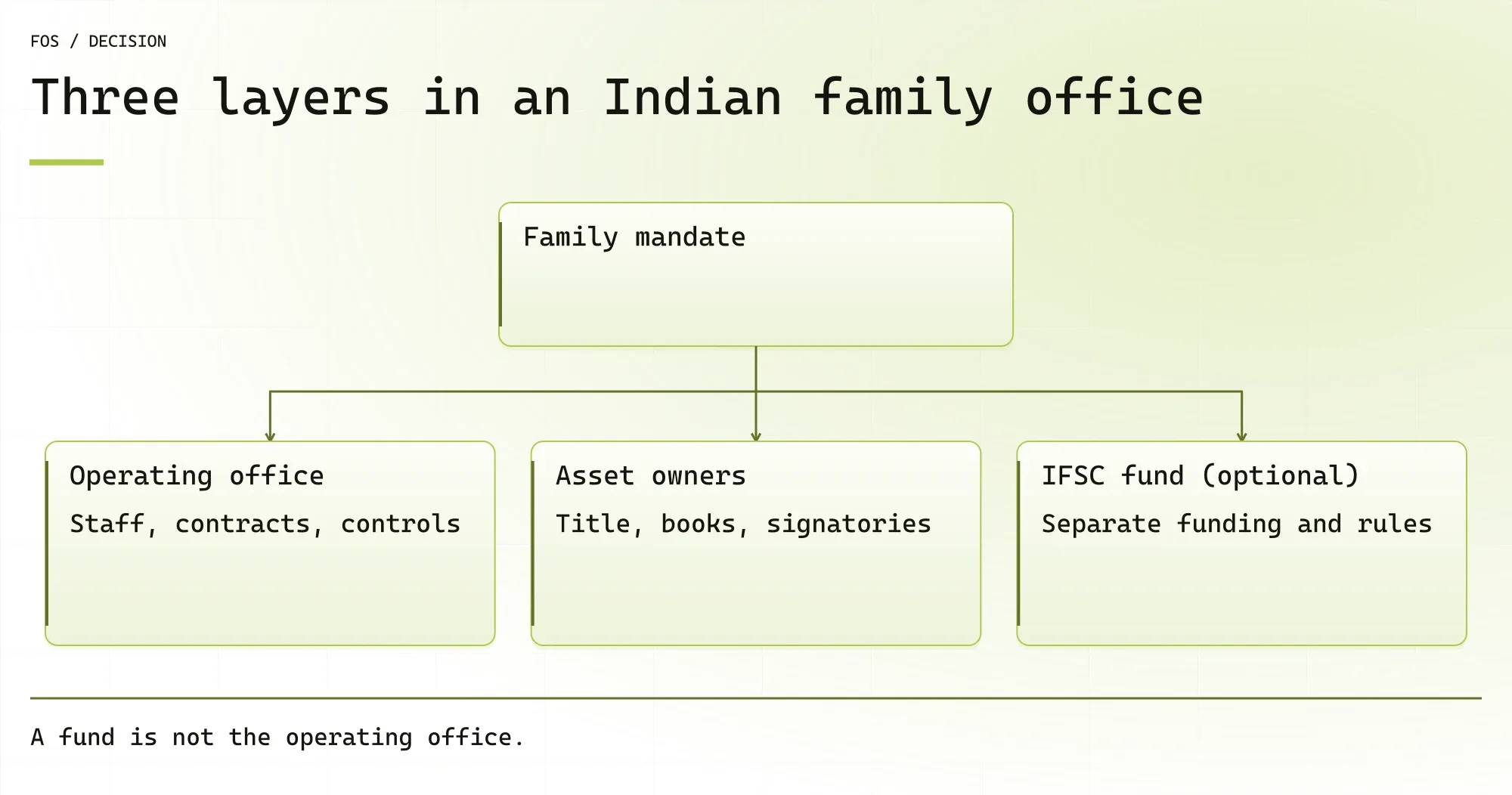
The family mandate links these layers; it does not merge their ownership or permissions. Open the full-width diagram to inspect the detail.
Changing the operating office does not, by itself, transfer title to the family's assets. Forming an asset-holding trust does not, by itself, create an investment-management licence or a tax exemption. The entities, their actual activities and the people who control them need separate review.
02Why Base the Office in India?
India may be where the family's operating businesses, approvers, staff and source records already are. Proximity can shorten an accounting handoff or a disputed-payment decision. It does not determine where every asset vehicle should sit.
Reasons to test an India base:
- Recurring work: The office must obtain records and approvals from Indian entities every month, rather than occasionally.
- Local oversight: Family members want direct oversight of hiring, advisers, property or operating-business interests.
- Source access: A qualified local team can work with the family's banks, chartered accountants and company secretaries on the actual records.
Constraints to price and assign:
- Cross-border funding: Indian-resident investments and remittances require a contributor- and transaction-specific FEMA/RBI route; a GIFT address does not remove that work.
- Separate obligations: Entities and family members can have different tax years, residences, filing duties and decision rights.
- Fixed operations: A staffed office adds payroll, continuity and information-security obligations even when outside managers still handle investments.
Ask where the recurring work and lawful decision makers sit and which cross-border tasks require a separate adviser or vehicle. If existing advisers already produce dependable reports, a named coordinator may solve the problem.
03Which Operating Model Fits the First-Year Mandate?
There is no universal net-worth figure at which India requires a family to form an SFO. Providers may set commercial minimums; a specific regulated investment vehicle can have its own conditions. The minimum-net-worth guide explains why investable assets, accessible cash, complexity and recurring cost differ from headline wealth.
| Model | When to test it first |
|---|---|
| Named coordinator plus existing advisers | A small number of entities or one urgent reporting, succession or control gap. |
| Outsourced or virtual arrangement | Work recurs, but a full internal team would be premature. |
| Multi-family office | The family needs a broader shared team and regular administration. |
| Dedicated single-family office | Cross-entity work persists and the family will fund and supervise its own staff. |
The family retains its mandate and final approvals under every route. Test the specific failure before buying: who owns the consolidated answer under a coordinator model; who checks a virtual provider's output; whether a shared office covers unusual entities; and whether a dedicated team's fixed cost buys the control promised. Get these answers in the service scope, not a sales label.
The labels are not a ladder. A family with a large operating company but limited liquid cash may need urgent coordination and no permanent investment team. Another family with fewer assets but several trusts, cross-border holdings and recurrent decisions may need a substantial service even if it does not build an SFO. The SFO versus MFO guide goes deeper on that choice.
04Build the Mandate Before the Entity
Write a one-page mandate with the family principal and the people who will use the work. State the first-year decisions, monthly outputs and matters outside scope. Avoid a promise to 'manage everything' that cannot be staffed or priced.
Start with evidence of work, not assets alone:
- Map entities and accounts: Identify the owner, purpose, bank or custodian, record keeper and reporting frequency for each.
- List recurring decisions: Investments, private-fund capital calls (requests to pay part of a committed amount), distributions, tax instructions, property spending, philanthropy and household matters may involve different approvers.
- Name current failure points: Missing consolidated cash, late private-market statements, repeated document requests, unclear signing authority or unreviewed related-party transactions.
- Prioritize the first year: Select a limited number of outputs, such as a monthly liquidity view and a reconciled quarterly family report.
- Set escalation rules: Specify what goes to the principal, board, trustee, investment committee or external professional.
The family should be able to answer who owns the official books and who approves release of a report. A glossy dashboard is no substitute for a reconciled source. If these answers are missing, the first hire's job is to establish them, not merely to purchase software.
05Draw the Authority and Entity Map
An Indian family may have a business, trusts, family members in different countries, real estate and managed portfolios. Each may have different legal owners, signatories and reporting duties. Put them on one map without collapsing them into a fictional 'family balance sheet' that implies one entity owns everything.
| Question | Record to obtain | Owner of the answer |
|---|---|---|
| Who owns each asset? | Title, account or cap-table evidence | Legal/tax adviser with entity owner |
| Who can instruct a bank or custodian? | Mandate and signatory records | Relevant account or entity authority |
| Who may approve an investment? | Investment policy and delegated limits | Family/investment body named in policy |
| Who prepares and signs entity accounts? | Accounting policy and engagement | Accountant and entity's authorized signatory |
| Who may see personal and family data? | Access schedule and service agreement | Family data owner with office lead |
Do this before transferring assets or hiring a manager. A family council's preference, an investment committee recommendation and an entity board's approval can be three distinct actions. Preserve the record of each. Our family-office structure guide covers the wider distinction between operating model, asset entities and authority.
06Choose Legal Form and Test Regulated Activities
An operating company may be suitable for employing staff and contracting with providers; a limited liability partnership or trust might appear elsewhere in the family structure. The right form depends on ownership, liability, succession, financing and taxation. A trust's tax treatment depends on its terms, beneficiaries, income and transactions. An LLP is not automatically tax-transparent. Do not treat a legal form as an investment licence or a tax strategy on its own.
Ask Indian counsel to test each proposed service and client relationship against current rules before staff act on it:
- Own-asset investment: which entity owns each asset and who has lawful authority to instruct its account? Keep mandates, resolutions and investment policy.
- Advice for consideration: would SEBI investment-adviser rules apply to the actual recipient, fee and activity? Keep counsel's written conclusion.
- Portfolio management or pooled capital: would a portfolio-manager, alternative-investment-fund or other framework apply? Document the proposed vehicle and management powers.
- Overseas or IFSC investment: which resident, entity, permitted route and limits apply under RBI overseas-investment directions? The Foreign Exchange Management Act (FEMA) framework governs the cross-border route. Keep bank advice, forms and transaction proof.
The phrase single family is not a blanket exemption from regulation. Compensation, who receives advice, whether capital is pooled, where clients and contributors are resident, and what staff actually do can change the analysis. Get the activity memo before circulating an investment mandate or taking family money into a new vehicle.
If the family hires its own staff, counsel can then choose the contracting and employer entity. For a company, the Ministry of Corporate Affairs provides the SPICe+ incorporation process and incorporation FAQs. Confirm the name, shareholders, directors, registered-office evidence and constitutional documents; file the applicable forms; obtain the resulting registration and tax identifiers; then open the company bank account under verified signatories. Put staff, contracts, payroll and systems under the correct entity. The company's bank account does not become a family treasury by default; underlying asset owners retain their accounts and books.
If the family chooses a shared or coordinated route, it may not need a new operating company at the outset. Instead, appoint the family-side contracting person or entity, sign a scoped service agreement, map the provider's permissions and name who accepts its output. Ask counsel whether the proposed service relationship changes any registration, tax, data or employment obligations. Both routes need an authority map; their incorporation steps differ.
When does GIFT City belong in the plan?
A Family Investment Fund (FIF) in GIFT IFSC is a regulated investment vehicle for capital from a single family. It is not a synonym for the operating office and is not required merely because the family is Indian. Under the IFSCA Fund Management Regulations, 2025, as amended through 10 September 2026, a FIF may take a permitted company, contributory-trust or LLP form. Regulation 104 requires it to have and maintain a minimum investment of US$10 million within three years of obtaining its registration certificate. That condition belongs to the FIF, not to every domestic SFO.
| If the question is… | Start here |
|---|---|
| How do we coordinate the family's Indian entities and advisers? | Design the operating office and authority map; a FIF may add nothing. |
| Do we need one family investment vehicle in IFSC? | Test FIF eligibility, investment policy, administration, tax and contributor-specific funding route. |
| Can Indian residents fund it or invest globally from it? | Obtain written FEMA/RBI and bank analysis for each contributor and transaction; do not assume a blanket permission. |
| Does GIFT deliver a tax saving? | Model the particular income, owner and vehicle under current law; no automatic tax outcome follows from a GIFT address. |
The IFSCA regulation says what a FIF may be and where its money may be invested; it does not replace a family's own cross-border tax and foreign-exchange analysis. The RBI direction on overseas investment includes an IFSC fund route, but it must be applied to the actual Indian resident and instrument. An IFSC route that cannot be funded by the intended contributors is not a viable family plan.
07If Singapore or the UAE Is Also Under Consideration
Compare the work location, vehicle and individual residence separately. Moving an investment vehicle abroad does not move an Indian operating business, its books or its lawful approvers.
- India operating office: test monthly proximity to Indian entities, decision makers and source records. There is no general minimum wealth figure or standalone family-office licence for simply coordinating one family's proprietary work; the activities actually performed still determine any registration question.
- GIFT IFSC FIF: test whether a regulated family investment vehicle solves a defined investment need, whether the contributors can lawfully fund it, and whether the US$10 million investment condition and IFSCA fees fit. It is not an offshore substitute for all India-office work.
- Singapore: the office's regulatory treatment and an optional fund tax incentive are different tests. For new qualifying family-office fund awards, MAS's 31 July 2026 circular sets investment, staffing and local-spending conditions. See the Singapore setup guide for the 13O, 13OA and 13U routes.
- UAE: screen the precise licence rather than a generic 'Dubai family office'. DIFC's Family Arrangements Regulations state a US$50 million aggregate family net-asset minimum for its Family Office licence; ADGM's SFO route states US$10 million. Neither figure decides Indian residence, tax or remittance treatment. The UAE setup guide compares those routes.
Before changing a base, ask advisers to map each family member's residence, each entity's ownership and effective management, the proposed funding route, banking access and who will sign the first report. The UK setup guide covers another possible base. Tax and licensing headlines need to be tested against the family's actual map.
08Assemble the Team and Service Contracts
Match roles to the work. A first hire may be a controller, investment lead or generalist head of office; there is no mandatory C-suite. The staffing guide explains how to choose the profile. The minimum requirement is a named person who can receive outside work, check it, escalate exceptions and get the right person's decision.
| Role or service | Typical first-year ownership | What must remain explicit |
|---|---|---|
| Family sponsor or governing body | Approves mandate, budget and reserved decisions | Who can speak for each legal entity |
| Head of office / coordinator | Tracks work, advisers, deadlines and decisions | No implied authority to sign or invest |
| Controller or outsourced accountant | Maintains books, reconciliations and cash reports | Official books, approval and report-release owner |
| Investment lead or external manager | Proposes policy, monitors managers and risks | Delegation limit and independent performance check |
| Tax and legal advisers | Advise on entities, returns, succession and transactions | Written engagement, jurisdiction and decision maker |
| Operations and concierge support, if included | Runs approved household, property or travel tasks | Scope, payment controls and private-data access |
Each contract should state deliverables, source-data access, confidentiality, error correction, exit assistance and what remains with the family. Review the site's service-agreement guide before asking one provider to promise investment, accounting and legal work under a vague retainer.
09Build Governance That Survives the First Team
The first-year mandate should also say which decisions outlast a founder, adviser or chief investment officer. An investment policy statement can record objectives, liquidity needs, risk and concentration limits, delegated authority, prohibited activities, review dates and the evidence required before an exception is approved. Limits are family decisions based on actual holdings and liabilities; a stock percentage copied from another office is not a rule for this one.
A family governance document can assign membership, family employment, distributions, conflict handling and succession discussion. Counsel should identify which provisions belong in legally operative trust, company or partnership documents and which remain family policy. Calling a family constitution 'binding' does not make every promise enforceable. The succession-planning guide covers the continuing decision process.
Test continuity with four named questions:
- Substitute authority: Who signs a payment or investment instruction if the usual approver is unavailable?
- Record continuity: Who can find, reconcile and transfer the source records if a provider or employee leaves?
- Cross-border change: Who rechecks residence, tax, FEMA and the place where cross-border entities are actually managed when family members or staff move?
- Review trigger: What would prompt a review of the mandate, staffing model, concentration limits or service contract?
Record the answers beside the authority map. Review them after a business sale, a change of residence, a major new asset, a generational handoff or a key-person exit. This protects the office's ability to act without assuming any one trust, fund or compensation scheme guarantees continuity.
10Budget Setup Cash and the Annual Run Rate
There is no single market-wide cost for an Indian family office. A family employing its own team, buying multi-family-office services or coordinating current advisers buys different work. The EY India playbook treats financial viability as a test of functions, infrastructure and continuing cost. Published price ranges can orient a budget; an actual commitment needs a scoped proposal.
Build three separate figures for each shortlisted model. The run rate is the recurring cost of keeping the arrangement operating after setup:
- One-time setup cash: legal and tax design, incorporation or vehicle work, initial hiring, data cleanup, system implementation and any premises fit-out.
- Annual operating expense: salaries and employer costs, provider retainers, technology, custody, audit, tax work, premises, insurance and recurring compliance.
- First-year cash need: setup cash plus the bills actually payable in year one, deposits and committed working capital. Do not add an entire annual run rate again if some of it is already in setup quotes.
What published Indian sources actually price. These are dated public estimates, not offers to this family. None of the sources publishes two same-scope, itemized proposals for the same entities, assets and reporting work.
On a phone, swipe across the source table to read each figure with its scope limit.
| Public source | Stated annual figure | Scope and limit |
|---|---|---|
| ALTPORT, checked 30 October 2026 | Virtual office ₹10–30 lakh; multi-family platform ₹25–75 lakh; staffed SFO ₹1–3 crore or more | Provider-published model bands. The page describes different service bundles; it does not quote a family-specific implementation fee or guarantee that investment charges are included. |
| DealPlexus, 6 May 2026 | Lean outsourced arrangement ₹40–80 lakh; standard staffed SFO ₹1–2 crore; full-service SFO ₹2–4 crore | Published practitioner estimates, with separate examples for staff, technology, advisers and premises. They are not a binding offer or a like-for-like price against ALTPORT's packages. |
Use these bands to frame requests for quotes, not as a reliable budget range, price ladder or universal minimum. The sources use different labels and scope. For example, one provider's 'virtual office' may supply reporting software and on-demand advice, while another family's coordinated route still needs separately paid entity accounting and tax work. A ₹1 crore SFO estimate does not prove that hiring a CIO, running four entities and covering household services all cost ₹1 crore.
The scale arithmetic explains why the same office budget feels different to two families. Using DealPlexus's ₹1–2 crore annual standard-SFO estimate, that annual spend is 1%–2% of ₹100 crore or 0.2%–0.4% of ₹500 crore of assets under supervision. These are divisions of a published estimate, not quoted fees, expected returns or a rule that either family should build an SFO. Assets under supervision are not necessarily available cash; liquidity, excluded services and outside investment-product costs still matter.
One exact public charge belongs to a different decision: if the family separately establishes an IFSC Family Investment Fund, IFSCA's 2 March 2026 fee circular, updated 13 March lists a US$2,500 application fee, US$15,000 registration fee and US$3,000 annual flat fee for the FIF. These are regulator charges, not the cost of lawyers, administration, custody, staff or the operating family office. The first-year recurring charge is pro-rated under the circular.
For each shortlisted route, request the same five priced workstreams:
- People: named roles, salaries or retainer, benefits, hiring fees, back-up cover and the family's retained hours.
- Specialists: tax, legal, accounting, audit, company secretarial and investment advice, including work outside the retainer.
- Systems and data: reporting and accounting software, migration, historic cleanup, support, security and exit/export.
- Banking and investment: custody, execution, managers, fund charges, foreign exchange and any IFSC vehicle costs.
- Premises and administration: office, equipment, insurance, travel and optional family services, with the payer named for shared costs.
Ask each provider for one-time setup cash, annual operating expense and the bills due in year one, with each exclusion priced or marked unknown. Require a named owner for final reconciliation, payment approval, emergency cover and the first family report. Until these same-scope responses exist, a precise two-route total would be fabricated. Compare the real proposals once received; a lower headline fee may leave essential work unowned.
Copy this cost card once for each shortlisted route. Fill every line from the provider's written response; leave unknown amounts visibly open.
- People: setup ₹[ ]; annual ₹[ ]; actually payable in year one ₹[ ]; quote/source [ ]; payer [ ]; unknown [ ].
- Specialists: setup ₹[ ]; annual ₹[ ]; actually payable in year one ₹[ ]; quote/source [ ]; payer [ ]; unknown [ ].
- Systems and data: setup ₹[ ]; annual ₹[ ]; actually payable in year one ₹[ ]; quote/source [ ]; payer [ ]; unknown [ ].
- Banking and investment: setup ₹[ ]; annual ₹[ ]; actually payable in year one ₹[ ]; quote/source [ ]; payer [ ]; unknown [ ].
- Premises and administration: setup ₹[ ]; annual ₹[ ]; actually payable in year one ₹[ ]; quote/source [ ]; payer [ ]; unknown [ ].
- Deposits and operating working capital: amount due in year one ₹[ ]; refundable amount, if any ₹[ ]; source [ ]; payer [ ]. Keep investment capital separate.
Calculate: total setup cash = sum of one-time amounts; annual run rate = sum of recurring amounts; first-year office cash need = setup cash + recurring bills actually due in year one + deposits and operating working capital not already counted. Keep investment capital for asset purchases or an IFSC fund outside this office-cost total. Check whether a quoted implementation fee already includes the first subscription period before adding it again. Put the same scope, tax treatment and retained family hours beside every route. These blank fields are intentional: no public source can supply a family-specific invoice.
11Set Up the Chosen Route Step by Step
The steps below create a working office. Incorporation is only one action within them. Each step has evidence the family can inspect before committing further money. The 30- and 90-day headings are illustrative planning checkpoints, not statutory incorporation, bank or IFSC approval timelines.
- Approve the mandate. Name family goals, covered entities and first-year outputs. Keep an approved brief, budget owner and decision list.
- Map ownership and authority. Inventory assets, records, signatories, residents and current advisers. Mark missing documents on an entity and authority map.
- Compare operating routes. Price a coordinator, shared office and dedicated team against the same scope; assess an IFSC vehicle separately. Record why alternatives were deferred.
- Clear legal questions. Ask advisers to test entity form, regulated activities, tax and FEMA routes. Retain written advice for each proposed activity and contributor.
- Build the chosen route. Form an operating entity only if needed, sign scoped contracts, appoint owners and set access. Keep entity records, contracts and permissions.
- Establish controls. Set opening books, custody feeds, payment approval, document register and reporting policy. Require reconciled opening balances and an exception process.
- Prove one cycle. Run a report and payment through the assigned people. Keep a signed acceptance record, unresolved-item list and next review date.
The first 30 days: mandate and baseline
Select an accountable family sponsor. Get a list of all entities and each provider's latest statement or ledger. Mark absent source records, ownership questions and urgent deadlines. The sponsor approves a short mandate: what will be handled, by whom, and what is explicitly excluded.
At the same time, ask what outcome would justify the first year's cost. For example, a monthly view of the three entities the family controls, with each bank balance kept separate, plus a sourced record of its stake in an operating business and a quarterly family report that distinguishes approved values from provisional ones is measurable. 'Professionalize the family office' is not.
The next 30 to 90 days: structure and contracts
Compare at least two operating routes on the same scope. Obtain legal and tax advice before transferring assets or promising regulated work. If the family chooses a company, use the MCA process for formation and keep its service contracts distinct from the underlying asset owners. If it considers a GIFT FIF, commission a separate IFSC feasibility memo with contributor, investment and funding analysis.
Appoint the office lead and a back-up. Assign each system a record owner, each exception an investigator and each outgoing report an approver. Put service levels and exit rights in writing. Do not grant a new team broad bank access merely because the family has appointed it as a 'family office'.
Before the first transfer of work, hold a handoff with the bank, accountant, investment providers and tax/legal advisers. The handoff packet names each legal owner and approver, each account's permitted users, the source-record list, the secure document channel, the exception owner, response deadlines and who posts and checks transactions. Keep the bank's acceptance of signatory changes. The employer or provider records payroll and employee-access responsibilities, including who can grant or revoke system access. A new entity with a new bank account does not make these operations automatic.
The first reporting cycle: prove the arrangement
Take one real capital call or portfolio transaction, one proposed payment, and one entity-level number that feeds the family report. For each, retain the dated source, preparation, reconciliation, review and approval. A provisional number should stay visibly provisional; a disputed payment should stay unpaid until the authorized person resolves it.
The office is ready to rely on when it can reproduce the output and explain exceptions without the founding adviser improvising. If it cannot, keep the issue open, assign an owner and rerun the test. This first-cycle test is more informative than a launch announcement.
Keep a repeatable operating rhythm after launch. Each month, the controller or provider closes the covered entities' books, reconciles cash and positions, dates private-asset values, and records unresolved differences before the report approver releases it. Each quarter, the investment lead reviews mandate limits, liquidity, concentration and delegated decisions with the authorized body. At least annually, the family sponsor reviews the service scope, total fee stack, staffing and back-up plan, residence and cross-border map, and succession or signatory changes. The actual calendar follows each entity's obligations; these are management checkpoints, not substitute statutory filing dates.
12Tax, Foreign Exchange and Compliance Checks
The Income-tax Act, 2025 came into force on 1 April 2026, replacing the 1961 Act for the new regime. The tax department's transition FAQ explains why earlier years and proceedings can still call for prior law. A tax plan must identify the relevant tax year, owner and type of income. Trust, company and LLP treatments cannot be chosen by label alone. Nor does a GIFT City address automatically give every family entity a tax holiday.
Build a live obligations calendar by entity and activity, not one generic 'family office compliance' list. Record the legal trigger, applicable period, filing or review due date, preparer, approver and proof of completion. The table below identifies checks, not universal filing deadlines:
| Trigger to check | Adviser or owner | Evidence to retain |
|---|---|---|
| Indian entity formation and continuing company/LLP duties | Corporate counsel / company secretary | Registrations, returns, board and beneficial-owner records |
| Income, gains, withholding and entity returns under the law applicable to each year | Tax adviser | Ownership, basis, transactions, positions and filed returns |
| Investment advice, portfolio management or pooling activity | Securities counsel / regulated provider | Written applicability and registration analysis |
| Indian-resident overseas or IFSC funding | FEMA adviser and authorized dealer bank | Permitted-route memo, limits, bank forms and confirmations |
| Employees, service providers and personal data | HR, privacy and counsel | Contracts, access schedule, security and incident procedures |
The point of the calendar is to give each obligation an owner, a due date once verified, and a proof file. A service provider may perform a filing, but the family still needs to know which entity owes it and who checks completion. Reassess the map when a member changes residence, a new entity receives assets, or the office begins serving another family.
Make each calendar entry fillable. For every obligation, the office should maintain a record with these fields and ask the responsible adviser to confirm the date:
| Field | Enter for this entity and obligation |
|---|---|
| Entity and activity | [Legal entity] — [filing, review or payment] |
| Trigger and period | [Event or financial period that starts the obligation] |
| Due date and source | [Date] — [rule, authority or adviser confirmation] |
| Preparer and approver | [Named people or providers; distinct where required] |
| Status and proof | [Open, submitted or accepted] — [receipt or signed record] |
An empty field means the calendar is incomplete, not that no obligation exists. Assign the open question before relying on a provider's general compliance assurance.
13What Could Go Wrong, and How Would You Catch It?
Four warnings deserve a check at the first operating review:
- Funding depends on an unapproved distribution: Separate available, committed and restricted cash before hiring or signing a retainer.
- A report cannot be traced to dated source records: Reconcile cash and holdings and label a private valuation with its actual date before release.
- GIFT contributors or their bank cannot document the route: Stop the vehicle build until each funding path has a written FEMA/bank answer.
- One person holds the only usable access or approval route: Test the substitute signer, records export and provider exit process before the first urgent transaction.
An office can have sophisticated advisers and still fail at a simple handoff. Testing a real transaction reveals whether the family has bought a decision process or just more reports.
14A Worked Choice: An Indian Business Family Before Launch
Fictional case. A family holds a majority stake in an Indian operating business and owns two investment entities and a property company. Several family members live in India; one lives abroad. Their advisers send separate reports. A business distribution is possible next year, but neither amount nor date has been approved. These are illustrative facts, not a real family's results.
The family wants a view of cash held by its controlled entities, a clearer investment mandate and a succession record. It is tempted to create an investment company and hire a chief investment officer (CIO) immediately. The unresolved question is who has authority to approve investments for each legal owner and what already available cash will fund the new office. The unapproved business distribution is excluded from the funding ceiling.
The family's decision record separates the choice from the evidence still missing:
- Operating route — pilot a coordinator with specialists. Obtain same-scope quotes, back-up cover and a budget funded from available cash. Run a 90-day pilot within that approved ceiling.
- Asset owners — retain the existing entities. Verify signatory and beneficial-interest records before changing account access.
- Dedicated team — defer the hire. Reassess after two reporting cycles and an approved annual budget; do not fund payroll from an unapproved distribution.
- GIFT FIF — test separately if needed. Commission feasibility only if there is a defined investment purpose, identified contributors, a path to the US$10 million condition and a written FEMA/bank analysis.
The initial decision is start coordination; defer the permanent team and FIF. This is not a verdict that the family is too small or that GIFT is unsuitable. It is a sequencing decision: obtain reliable reports and funding evidence, then decide whether a dedicated office or regulated investment vehicle adds value.
The acceptance test is concrete. By day 90 the coordinator must show a reconciled opening position for the three family-controlled investment and property entities, plus a separate sourced record of the family's stake in the operating business. The business's full books and cash remain outside the office's authority unless its board grants access and a specific task. The forecast marks the unapproved distribution as uncertain. The coordinator also brings an investment decision log and one family report to the named approver. If the family cannot get these from the pilot, it has evidence to change scope or provider before adding fixed payroll.
15What Should the Family Decide Next?
The next meeting should produce an instruction, not a generic endorsement of 'a family office'. Copy this one-page launch decision into the family's meeting record. Leave an item open, with an owner and due date, if its evidence is missing.
- Mandate: [three to five first-year outputs]; covered entities [ ]; excluded work [ ].
- Operating route: [coordinator / shared office / dedicated SFO]; next-best route [ ]; reason deferred [ ]. Treat any GIFT FIF as a separate vehicle decision.
- Ownership and authority: legal asset owners [ ]; account signatories [ ]; investment, payment and report approvers [ ]; source of each authority [ ].
- Budget: one-time setup [ ]; annual recurring [ ]; first-year cash payable [ ]; payer and presently available funding [ ]; unpriced items [ ]. Exclude unapproved distributions.
- Legal questions: entity form [ ]; proposed regulated activities [ ]; tax year and residence [ ]; FEMA/IFSC and bank route [ ]; named adviser, requested written answer and due date [ ].
- People and records: first operating owner [ ]; back-up [ ]; provider handoffs [ ]; permitted system users [ ]; secure source-record channel [ ].
- Acceptance: first report date [ ]; accounts and values to reconcile [ ]; payment test [ ]; exception threshold [ ]; approver [ ]; next review date [ ].
The brief becomes a decision only when the family sponsor assigns each open answer to a named adviser or provider and records the response before implementation. Set the first-cycle acceptance date in the same meeting. If the arrangement can reconcile a source record, route a decision to the lawful approver and issue a report whose provisional figures are clear, it is working. If not, keep the exception open with an owner and rerun the test before relying on the output.
Ask each shortlisted provider or adviser to return the same four items: its recommended route and why; conditions that must be satisfied before work starts; itemized one-time and recurring fees with exclusions; and remaining decisions requiring the family, bank or regulator. Those replies make the shortlist comparable and expose work that would otherwise be left between firms.
 Knowledge & Decision · Analysis
How Much Net Worth Do You Need for a Family Office, and When Should You Start?
What family office wealth figures mean, how location-specific rules differ, and how to test costs, cash and service… Knowledge & Decision · Analysis
What Is a Single-Family Office? Services, Costs and Fit
A single-family office serves one family through a dedicated organization. See its services, staffing, costs and when another… Knowledge & Decision · Analysis