What Should a Family Office Conflict-of-Interest Policy Cover?
A usable conflict policy helps a family office recognize competing interests, limit influence, find valid decision authority and keep a record of what happened.

A conflict of interest arises when someone's personal, family, business or other interest could pull their judgment away from the duty they have in a family office decision. The interest may be direct or indirect. A potential or apparent conflict deserves assessment even when nobody has acted improperly.
Family members, employees, trustees and advisers can hold overlapping roles. A usable policy shows who must report which interests, who assesses them, how participation and approval work, and what the office records and revisits. Disclosure starts that work; it does not, by itself, resolve the conflict.
- Recognize the competing interest: Look beyond ownership to family relationships, fees, outside roles, personal benefits and access to investment opportunities.
- Disclose and assess it before influence: Give a non-interested reviewer the facts, then set limits on recommendations, information access, negotiation, voting and signing as needed.
- Make and record a valid decision: Check who is eligible and authorized, compare relevant evidence, pause or avoid the proposal when necessary, and revisit the record when facts change.
01Which Conflicts Should the Policy Help You Recognize?
The policy should say which people, entities and decisions it covers. A blanket “no conflicts” certification can miss a decision-specific interest. These examples show the interests people need to recognize and assess:
- Family hiring and procurement: A person selecting a new employee or supplier may favor a relative over the agreed criteria. The relationship calls for disclosure and an independent assessment; employing a relative is not automatically improper.
- Ownership in a provider or investment manager: A decision maker may profit if the office appoints a firm in which they hold a stake. The relevant facts include ownership, economic benefit and any earlier role in shaping the shortlist.
- Fees and referrals: A commission, referral fee or other benefit can make one recommendation more rewarding to its proposer than an alternative. Record who pays it and whether it could affect the recommendation.
- Personal use of office resources: An employee who influences approval of an undisclosed personal expense may be judging a benefit to themselves.
- Outside roles: A trustee, employee or committee member with a board seat elsewhere may owe duties or hold information that bear on a proposed transaction. Assess the affected decision and any limits on sharing information.
- Co-investment and opportunity allocation: A person who can invest alongside the family or receive preferential terms may have an interest in which opportunities are offered, priced or allocated.
- Related entities: A transaction between family-controlled entities can put one person on both sides of the decision. Identify each entity's interest and who may act for it.
- Gifts and hospitality: A benefit from a current or prospective provider may influence selection or oversight. The policy can specify what must be reported and who assesses it, without assuming every courtesy is prohibited.
Family services expressly within the office's mandate are different from an undisclosed personal benefit. Related-entity dealings can require separate authority for each entity even when both serve the same family; our related-party transactions guide examines that problem.
Direct and indirect describe how the person holds an interest. An actual conflict involves a competing interest in the decision at hand; a potential conflict could arise if a contemplated decision proceeds. An apparent conflict is a reasonable concern about impartiality based on a known relationship and decision, even without proof of improper influence. None of those labels alone proves misconduct, and a disclosure does not automatically make participation safe.
02Why Do Conflicts of Interest Arise in Family Offices?
The same person may be a family member, investor, director and decision maker. Those roles can create competing interests even when everyone intends to act fairly. Other conditions make an interest harder to notice or manage:
- Overlapping loyalties: A family member may want to help a relative while also owing a decision duty to a trust, company or committee.
- Shared ownership and business ties: A provider, operating business and family entity may have common owners. The office may see the service charge without seeing the decision maker's share of the provider's profit.
- Economic incentives: Fees, future business or preferential investment access can reward a recommendation independently of its merits.
- Limited separation of duties: In a small team, one person may source, assess and approve the same proposal, leaving nobody clearly assigned to challenge their interest.
- Informal influence: A senior family member may shape the shortlist before a formal vote. Recusal at the final meeting may then come too late to address that earlier influence.
- Recognition and reporting gaps: People may not know that a board seat, changed compensation or new family connection should be reported, or may not know a safe route when their usual reviewer is involved.
Education and a reporting route help people identify conflicts; they do not eliminate structural ties. The office still needs a way to assess and, where necessary, restrict participation.
03What Can Unmanaged Conflicts Lead To?
The existence of an interest does not establish loss or wrongdoing. The risk grows when the interest can shape an action without review. The practical consequences depend on the duty, decision and applicable rules:
- Distorted selection: An undisclosed ownership stake or fee can steer hiring, provider choice or investment selection away from the office's stated criteria.
- Unequal access: Someone who helps allocate an opportunity may favor their own co-investment or one family branch, leaving other eligible participants without the agreed process.
- Misused resources or higher cost: A private benefit charged to an entity, or a contract selected without comparable terms, can make that entity bear costs it did not authorize.
- Disputes and lost trust: Without a traceable record for authorized reviewers of who disclosed, abstained and decided, later challenges become harder to resolve even if the choice was sound.
- Confidentiality or legal exposure: An outside duty or regulated advisory relationship may impose obligations that a general office policy cannot settle. The actual entity, activity and law determine the consequence; penalties are not automatic.
04What Should the Policy Contain?
A usable policy describes both the interests people must raise and the route for handling them. The office should adapt the following components to its entities, roles and governing documents:
- Identification and scope: Define covered people and decisions, direct and indirect interests, and examples that staff and family participants can recognize. Name which office work is an authorized service and where a personal benefit needs separate approval.
- Education: Explain triggers, disclosure timing and participation limits to the family members, staff, committee participants and providers within scope. Use induction and relevant refreshers; a signature alone does not show that someone can apply the policy.
- Disclosure and reporting: State what to report, to whom and when. Combine standing declarations of continuing interests with updates when a relationship changes and a fresh disclosure for a particular proposal. Provide an alternate non-interested recipient if the usual reviewer is involved.
- Assessment and participation: Name who assesses the interest and who may impose participation limits under applicable law and governing arrangements. State who may provide facts, receive papers, negotiate or vote. Verify signing and provider-instruction rights separately.
- Register and evidence: Record the interest, proposal, disclosure date, reviewer, restrictions, decision, conditions, owner, due date and review trigger. Link the relevant evidence and decision minute or contract; control access to sensitive details.
- Review and follow-through: Name who checks updated declarations and restrictions. For a breach or late discovery, require reporting, containment where possible, authorized review and a documented remedial decision. Revisit the policy when roles, entities or governing rules change.
Disclosures feed the assessment; the assessment informs participation limits and the authorized decision. The register preserves what was known, what was decided and what remains open. Keep those records under the office's retention policy and check any applicable legal or regulatory duty for the entity and activity.
If no non-interested internal reviewer exists, pause substantive action and seek an authorized independent person or external adviser. Outside advice can inform the assessment; it does not grant approval or signing power.
The governance guide explains ordinary decision rights. The investment committee minutes guide helps document who proposed, challenged and approved a decision. The conflict policy has to connect those records to the particular interest and resulting participation limits.
05A Decision Path for Material Conflicts
The following is a suggested operating model to adapt to the office's governing documents and legal obligations. Use it alongside any prohibitions that apply; some conflicts require avoiding the proposal rather than changing the vote.
- Identify and disclose: Report the relationship, possible benefit, affected parties and any part already played in sourcing or negotiating the proposal. Disclose as soon as the interest is identified, ideally before the person frames the decision. If action has already occurred, use the late-discovery route.
- Assess the interest: A non-interested reviewer identifies the affected duty and decision, the possible need to avoid the proposal, and the evidence or advice required. The person or body authorized under applicable law and governing arrangements decides formal participation restrictions.
- Limit participation: Specify which facts the interested person may supply and whether they may see competing information, recommend, negotiate, deliberate, vote, sign or instruct another person. Disclosure without appropriate limits can leave the influence in place.
- Check authority, then decide or pause: Screen the remaining decision makers' relevant ties and record eligibility. Apply the governing quorum, voting and approval rules separately. Decide only with valid authority and sufficient evidence; otherwise pause.
- Record and revisit: Save the disclosure, restrictions, eligibility reasoning, evidence, outcome, owner and review trigger. Reopen the screen if ownership, compensation, role or transaction terms change.
Eligible decision makers compare relevant alternatives and terms where available. If evidence or authority is missing, defer or use an authorized escalation route; silence is not approval.
Recusal, stepping back from the affected decision, does not give another person signing authority. Check the bank mandate, trust instrument, entity document or committee charter, and seek legal advice where needed. The delegation of authority matrix should agree with the decision route.
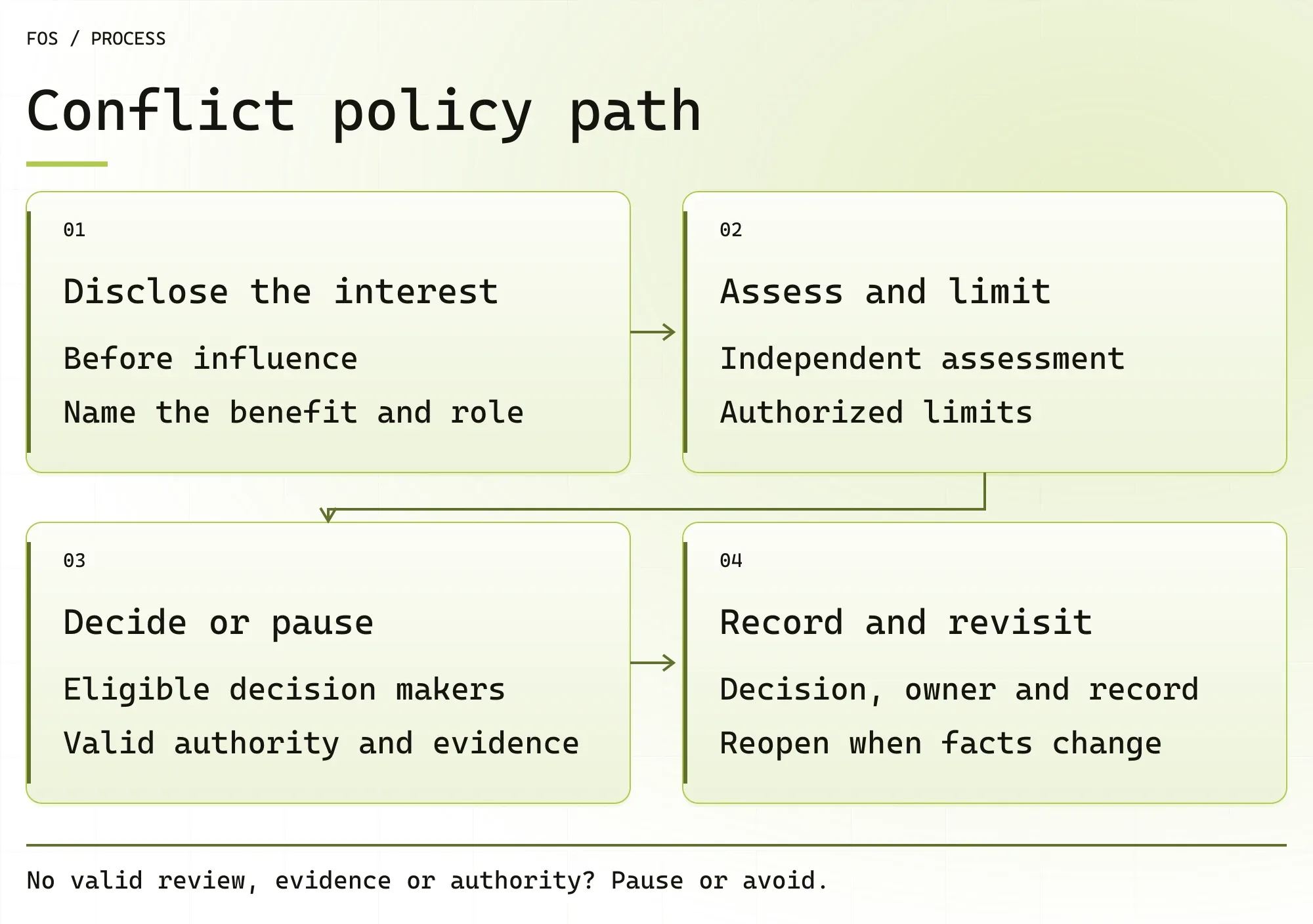
Suggested decision path, subject to the office's governing rules. View the full-width diagram.
Example
Illustrative decision record: a provider proposal
Interest and timing: A committee member owns part of a proposed reporting provider and helped put it on the shortlist. The member reports both facts before further evaluation.
Assessment: A non-interested reviewer records the ownership interest and earlier influence. The office checks who may set restrictions and whether the shortlist needs an independent retest or a fresh start.
Participation limit: The authorized person bars the member from evaluating bids, deliberating or voting. The member may answer documented factual questions through the same controlled channel as other bidders, without access to rival bids.
Authority and evidence: The office has not yet confirmed eligible decision makers, the governing approval rule or comparable provider scopes. No one signs on the strength of the disclosure.
Outcome and next check: Defer the appointment. In this illustration, the office CFO owns the follow-up. The proposal returns for a valid decision only when an independently checked shortlist, comparable scopes and the approval route are confirmed; otherwise the office declines it.
06What Should You Be Careful About When Crafting the Policy?
The policy is an operating tool, not a replacement for the office's legal documents or duties. Four checks keep it grounded in the decisions people actually make:
- Define the actual scope: Match covered roles, entities, services and approval rights to the office's arrangements. A shared surname alone does not make every person ineligible.
- Address influence before the vote: A person may affect a choice through recommendations, access to bids, negotiation or implementation. Restrict the stage that creates the risk, not just the final vote.
- Provide independent escalation: An interested reviewer cannot be the sole judge of their own case. Plan for an unavailable quorum, no eligible decision maker or signatory, and cases where the office should decline the proposal.
- Keep the process usable: Make reporting easy to find, teach relevant triggers, protect the register and assign someone to follow up when an interest changes. Do not copy another organization's numerical thresholds or approval body.
Foundation example: The Mellon Foundation's policy illustrates disclosure and recusal under its own rules. Its thresholds and approval body are not family-office defaults.
Regulated advice: In retail-investor relationships involving an investment adviser subject to the Advisers Act, SEC staff guidance discusses informed consent and conflicts that may need to be eliminated. These staff views create no new obligations and do not apply to every family office. Counsel should assess the actual entity and activity.
07Check Whether Your Policy Is Ready to Use
Take one pending decision and ask whether the people involved can perform each check without inventing an answer:
- Recognize: Can they identify the interest and the duty or choice it might affect? Have relevant family members, staff and committee participants learned and practiced the triggers?
- Report: Do they know when, to whom and by what alternate route to disclose it?
- Assess: Is there a non-interested assessor, or an authorized independent route if none is available internally? Who has the power to impose limits and request evidence?
- Decide: After recusals, is there a valid decision maker and signatory under the actual documents? If not, is the hold or escalation route clear?
- Maintain: Can the office find the record, owner and trigger for revisiting the decision, including a route for a conflict discovered late?
Put the policy to work
Use the next pending hire, provider appointment or investment decision as a rehearsal. Ask each participant to disclose a relevant interest before they shape the choice. Name the assessor, check who can set participation limits, and confirm who can decide and sign. Put the evidence, outcome and review date in one record. If a required answer is missing, give it an owner and hold the decision that depends on it.
If an interest surfaces after a decision, record when it was found and contain further affected action where possible. An authorized reviewer should assess the earlier decision and any remedial step, with advice where needed. Late disclosure does not erase earlier influence, but it gives the office a route to address it.
People, businesses and investment opportunities can overlap within a family office. The policy is useful when those overlaps are visible, the authority to act is clear, and a later reviewer can trace why the office proceeded, paused or declined.
 Knowledge & Decision · Analysis
How to Set Up a Family Office in India, From Mandate to First Report
Choose an India family-office model, map authority and asset owners, budget year one, and test the first report… Knowledge & Decision · Analysis
How Much Net Worth Do You Need for a Family Office, and When Should You Start?
What family office wealth figures mean, how location-specific rules differ, and how to test costs, cash and service… Knowledge & Decision · Analysis