How to Test a Family Office Investment Manager Against the Mandate
A manager can present an attractive return history and still be the wrong hire for a family office's account.

A manager can present an attractive return history and still be the wrong hire for a family office's account. The decisive question is whether that team can invest this family's assets within this family's written limits, with trading authority, custody, fees and reporting that the office can verify.
Consider a fictional US$25 million segregated equity mandate. The family's own rule caps a single issuer at 8% when a trade is made. The candidate proposes establishing an 11% position in one issuer through new trades at that account value. These would be new initial trades; there is no existing holding or price drift in this case. The mismatch is measurable, but it does not by itself prove the manager should be rejected. It creates a specific test: can the manager demonstrate an office-approved route and the controls that would govern it after appointment?
- Define the account, investment objective, office-set limits and decision owner before comparing managers. A fund track record or polished pitch is not a mandate-specific pass.
- Test the proposed holdings and operating workflow. In the case below, an initial 11% position exceeds the family's illustrative 8% trade-date limit by US$750,000 on a US$25 million account. Keep the result conditional until an acceptable model or authorized exception and its control process are observed.
- Separate three approvals: a demonstrated strategy, signed authority and fee terms, and a live account whose custody, permissions and first reconciliation match the agreement.
01What Is This Due Diligence Decision?
Family office investment manager due diligence begins with a precise object. Here the office is considering an external investment adviser to trade a client-owned, separately held account within a defined equity mandate. The family has decided to hire outside management; it has not yet approved this firm, its trading discretion or the movement of assets.
That differs from committing to a private fund. A fund investor underwrites a manager, vehicle, governing documents and investor rights; a segregated-account client can negotiate account-specific investment guidelines, custodian arrangements and reporting. The FOS family-office due-diligence checklist owns the fund and direct-deal path. This article follows the hiring decision for a discretionary manager and the controls that must survive into the family's own account.
The CFA Institute's manager-selection framework calls for more than historical returns. It considers how results were produced, the people and process behind them, and the firm's operations. That is a useful frame, but this office still needs a decision record tied to its own mandate.
02Define the Mandate Before Reading the Pitch
Write the proposed account brief in terms a manager can test. For the fictional case, the family proposes US$25 million in a liquid-equity account, an 8% single-issuer limit at trade date, a named family-side approver for policy exceptions and a separate custodian. The 8% ceiling is this office's illustrative choice; another office must set its own rule.
Complete the brief with the terms that affect this manager's proposed account:
- Investment objective or benchmark, permitted securities, restricted names, and liquidity needs.
- Leverage, derivatives, cash treatment and tax-lot instructions where relevant.
- The treatment of price-driven drift after a compliant trade. A trade-date rule and an ongoing exposure limit are different instructions; the office must choose which it means.
Name the people who own each decision:
- The investment committee or delegated CIO approves the mandate, exception policy and hiring decision under the office's charter.
- The external manager proposes and, only after authority is granted, executes trades within signed guidelines.
- The custodian holds the account assets under the custody agreement; its role and any manager permissions must be checked against the forms.
- The family-office controller or assigned reviewer independently reconciles positions, cash, fees and exceptions to custodian evidence.
The office may allocate these roles differently. Record the approved version before asking candidates to compete against it; otherwise each pitch changes the question.
03Run One Proposed Portfolio Through the Limit
Ask the manager for a dated sample portfolio it would propose for this mandate, with issuer look-through where the office's own rule requires it. In our case, the candidate proposes buying into an initial 11% issuer weight through new trades on the US$25 million account. There is no pre-existing position or market drift in this fictional test. The calculation is straightforward:
| Measure | Illustrative result | Source or rule |
|---|---|---|
| Proposed account value | US$25,000,000 | Family's fictional mandate brief |
| Maximum single issuer at 8% | US$2,000,000 | Office-set trade-date ceiling |
| Proposed initial issuer position at 11% | US$2,750,000 | Candidate's hypothetical trades at the stated account value |
| Amount above the stated ceiling | US$750,000 | US$2,750,000 less US$2,000,000 |
The sample fails the proposed portfolio test as submitted. The office can request a compliant model, resolve a genuinely unclear issuer or look-through rule, or consider an exception only if its approved policy permits one. An exception record needs the named approver, rationale, issuer, proposed weight or amount, effective period, expiry or review date, and monitoring owner. The current decision is a hold while the manager responds. At the committee's dated gate, an approved route may advance to separate document checks; a failed final response stops the hire. An unresolved response remains on hold only if the committee records a new evidence request and decision date. Otherwise, stop. The office must approve a policy change separately rather than quietly rewriting the 8% rule after the pitch.
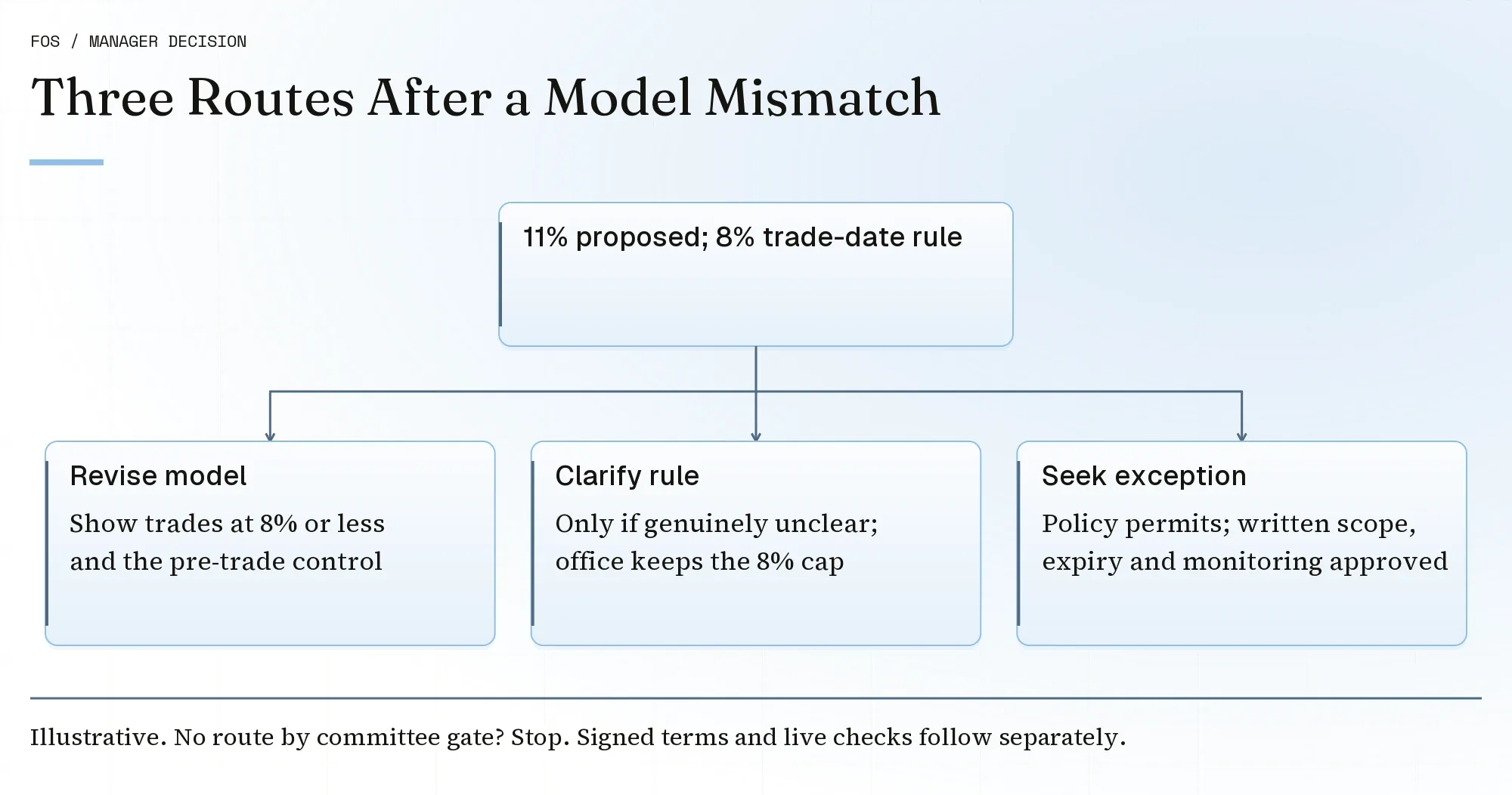
Three possible responses to the submitted model. No route has passed yet. View the wider desktop diagram. Signed terms and first-account checks remain separate.
A useful demonstration has the candidate show the proposed order, the pre-trade check, the blocked or escalated exception, the revised holdings and the dated record a family reviewer would receive. Mark a step unknown until it is seen. A spreadsheet promising a future control is not an observed control, and an observed demo is not a signed contractual obligation.
Historical performance needs its own fit test. Ask whether the cited returns came from the same strategy, account type, constraints, team and periods as this proposal; distinguish gross from net returns, account versus composite results, benchmark choice and material changes in assets or process. Do not treat an impressive number from a less constrained fund as the expected result of this segregated mandate. The manager should identify what is comparable and what remains unknown.
04Check the Firm, People, Process and Conflicts
Corroborate the legal firm, individual portfolio decision-makers, process, capacity, service providers and relevant disciplinary history. For a firm or individual in the SEC or state adviser disclosure system, Investor.gov explains how to search IAPD. Match the filing to the entity and people proposed for the account. Use the lookup to verify their identities and disclosures; assess control operation separately.
The SEC's Form ADV bulletin describes Part 1 public information and Part 2 narrative disclosures about business practices, fees, conflicts and disciplinary information. Read the current brochure and relevant supplements when they apply to this adviser, then reconcile the disclosures with the pitch and draft agreement. If the proposed firm is outside that filing regime, record the regulatory basis and obtain the relevant documents. An absent ADV alone settles neither fitness nor failure.
Interview the team against a real exception. Who changes the model when a risk limit blocks a trade? Who can override it? What happens if the named portfolio manager leaves? Request an example and its review trail, redacted as needed. References and process documents can help; the family-account control still needs demonstration and written scope.
For conflicts relevant to the proposed strategy, check affiliated products, proprietary positions, cross-trades, research arrangements, fee incentives and allocation policies. Request the disclosure and account-level mitigation for each applicable item. A material contradiction between a filing, pitch and draft agreement remains on hold until the manager explains it with evidence. The named family-side decision owner must accept any residual conflict and its monitoring terms; an unmitigated material conflict or unresolved contradiction stops the hire.
05Make Authority, Custody and Fees Agree in Writing
The model test establishes what the manager says it can do. The agreement and custodian paperwork establish what it will be allowed to do. Put the exact legal entity, account owner, approved guidelines and versions beside the contract before funding.
| Written item | Question to resolve before signature | Evidence to retain |
|---|---|---|
| Trading discretion | Which instruments, markets, derivatives, leverage and exceptions may the manager execute without further consent? | Signed management agreement and incorporated guidelines |
| Custody and cash movement | Who holds the assets, who can instruct transfers or withdrawals, and what confirmations reach the family? | Custodian agreement, account authority forms and tested permission map |
| Fees and expenses | Which assets are billed, at what rate and cadence, with what minimums, pass-through costs or fee-debit authority? | Final fee schedule, sample invoice and custodian instruction |
| Information and oversight | What holdings, trades, cash, tax-lot data and breach notices arrive, how often and in what usable format? | Reporting schedule, example export and escalation contact |
| Change and exit | Who can amend limits, terminate discretion and retrieve records or transfer assets, and how is an open trade handled? | Amendment, termination and transition clauses |
These are questions for the final documents; the office has not yet established these rights. A segregated account can still have poor visibility or broad authority if the agreement grants it. A contract clause must also be implemented by the custodian setup and reporting workflow.
The family-side approver should see every policy exception and any proposed expansion of discretion. Document who can approve, who can place a trade, who can instruct a withdrawal and who checks the evidence. Do not merge those permissions into one vague “manager access” line.
06Accept the First Account, Then Keep Watching
Appointment is not the end of diligence. After agreement and onboarding, check that the account name, custodian, authorized users, starting positions and fee instructions match the signed terms. Reconcile the first holdings and cash statement to the transfer record. Confirm that the manager's first reporting file can identify the sample issuer limit, trade-date exceptions and any drift under the office's chosen rule.
Keep three evidence states distinct:
- Demonstrated would mean the candidate showed how the approved route works: a compliant model, a resolved rule interpretation, or a documented policy-permitted exception, with the relevant pre-trade and escalation controls. This records an observed test. No acceptable route has been shown in the fictional case yet.
- Contracted: signed guidelines, authority, custody and fee terms define the approved scope. This does not prove a live account has been configured correctly.
- Live accepted: the family checks actual permissions, assets, first fees, reports and reconciliation. An unresolved difference has an owner and date; it is not silently treated as a passed migration.
Later oversight should test mandate drift, returns on a comparable basis, service quality, staffing changes, fee calculations and unresolved exceptions at a cadence the office approves. A manager may remain within the letter of the agreement while no longer fitting the family's objective; renewal or replacement is a separate authorized decision.
07Record a Conditional Hiring Decision
The fictional manager has not passed yet. The submitted model would breach the family's illustrative 8% trade-date ceiling if traded as proposed. No compliant revision, authorized exception, contract, custody setup or live-account test has been observed in this example. A decision record makes the next work precise:
The family-office CIO sends the evidence request to the manager's designated portfolio lead. The investment committee sets the response date and its own decision date before considering funding. A family-side risk reviewer, separate from the proposed manager's trading team, checks the artifacts. Both dates and the named people are to be set by this fictional office; no candidate response has been received.
| Possible route | Evidence that would close this test | Current status |
|---|---|---|
| Revise the model | Dated proposed holdings and orders at 8% or less at trade date, with the pre-trade block and escalation record demonstrated to the family-side reviewer. | Unknown; no revision shown. |
| Clarify a genuinely unclear issuer rule | Written interpretation approved by the office's authorized policy owner, with issuer look-through resolved and the 8% cap retained. A clear rule cannot be relaxed through interpretation. | Unknown; no ambiguity or approved interpretation shown. |
| Seek a policy-permitted exception | Existing policy allows the exception; the named family-side approver signs its issuer, weight or amount, rationale, effective period, expiry or review date and monitoring owner. | Unknown; no request or approval shown. |
At the dated gate, an approved demonstrated route advances to document checks; a failed response stops the hire. An unknown route stays on hold only with a recorded new evidence request and decision date; otherwise stop. Executed documents and first-account reconciliation require separate signoffs.
| Decision field | Case entry |
|---|---|
| Proposed hire | External manager for fictional US$25m client-owned equity account; firm and people to be verified. |
| Mandate constraint | 8% single-issuer cap at trade date, chosen by this office for the example; exception authority retained by named family-side approver. |
| Submitted model result | Proposed initial 11% position through new trades equals US$2.75m at the stated account value; US$750k over the illustrative US$2m trade-date ceiling. Proposal fails as submitted. |
| Required manager response | Evidence for one route in the table above; none received. Response and committee dates: to be set. |
| Other mandate terms | Objective/benchmark, leverage/derivatives, restricted names, liquidity, cash, relevant tax-lot instructions and drift treatment: open before candidate pass. |
| Disclosure and contract status | Applicable filings, adviser/people match, fees, trading discretion, custody and withdrawal powers: unknown until checked. A material disclosure contradiction or conflict stays on hold for evidence and named family-side acceptance; unresolved or unmitigated material issues stop the hire. |
| Hiring decision owner | Delegated CIO or investment committee under the office's charter records the route result, conflict review and draft terms at its dated gate. Conditional approval to hire does not release assets or trading authority. |
| Funding and authority release | Named family-side approver verifies executed agreement and incorporated guidelines or authorized exception, custodian instructions, withdrawal/fee permissions and account owner. Only then may the office release assets and trading discretion; controller checks first-account reconciliation afterward. |
| Present verdict | Conditional hold pending route evidence. Apply the dated gate rule above and the conflict stop rule. A route pass still requires signed funding release and separate live-account acceptance. |
The example records a conditional hiring decision. It makes no return prediction or recommendation to appoint this fictional firm. The family can reject, negotiate or test another manager. The output is a traceable answer to its approved mandate, with separate gates before custody and trading authority move.
 Investment & Portfolio · Analysis
What Is Family Office Private Fund Commitment Pacing, and Why Does It Matter?
Private fund commitment pacing sets the size and timing of new promises while older funds can still call… Investment & Portfolio · Analysis
Family Office Private Asset Valuation Policy: Which Mark Belongs in the Report?
A December family report can contain a fund value dated September and a direct-company mark proposed from a… Investment & Portfolio · Analysis