What Is a Single-Family Office? Services, Costs and Fit
A single-family office serves one family through a dedicated organization. See its services, staffing, costs and when another arrangement may fit.

A single-family office (SFO) is an organization dedicated to one family's financial, administrative and related affairs. It may employ a core team, engage outside specialists and coordinate work across several households, generations and legal entities. “Single-family” describes whom it serves; it does not require one shared asset pool or every professional on its payroll.
The practical question is what work the family needs done repeatedly, who will own each decision, and whether a dedicated organization is worth sustaining. An SFO can offer direct control and continuity, but the family also takes on the cost and responsibility of running it. A family office can instead be shared among families or assembled from existing advisers.
- One family can mean many households and generations. The office's agreed mandate defines whom and what it serves; ownership and legal authority remain with the relevant people and entities.
- The work can be broad, but the team need not be. Investment oversight, financial operations, specialist coordination and family matters can combine internal accountability with outside expertise.
- Choose the operating model by work and responsibility. Compare a dedicated office with shared or adviser-led arrangements on equivalent scope, ongoing cost, retained family effort and who will supervise the result.
01What Does “One Family” Mean?
One family may span parents, adult children, later generations and separate households. An SFO can serve several branches with different reporting needs. Its mandate should say which people, entities and activities are in scope, who may request a service, and who approves a decision.
That does not make every relative a client under every legal rule. In the United States, the SEC family office rule uses defined “family clients” and other conditions for an exclusion from the Investment Advisers Act's investment-adviser definition. The everyday SFO label alone does not establish eligibility; counsel must assess a particular structure.
02What Does a Single-Family Office Do?
Its work depends on the family's written mandate. Some offices concentrate on investments and reporting; others also run administration, governance or personal services. The useful test is the output and accountable owner, not whether a service appears on a generic menu.
| Possible service | Recognizable work and output | Who remains accountable |
|---|---|---|
| Investment oversight | Maintain an investment policy, review liquidity and managers, and prepare portfolio decision papers. | The family decision-maker or delegated investment lead; external managers may execute mandates. |
| Finance and operations | Reconcile accounts, forecast cash, administer approved bills and deliver consolidated reports with dated source records. | An office finance or operations owner, even when accountants and software providers do the processing. |
| Tax, legal and estate coordination | Collect entity information, track deadlines and follow through on approved planning or documents. | A named coordinator; qualified tax and legal professionals provide the specialist advice and filings. |
| Governance and succession | Prepare meetings, record decisions and maintain an authority map and transition tasks. | Family governing bodies and office leadership, with advisers supporting the legal work. |
| Education and knowledge transfer | Explain holdings, reports and decision processes to members taking on responsibilities. | An agreed family or education lead; the office can organize the materials and sessions. |
| Philanthropy and personal administration | Administer approved grants, property matters, travel or household tasks if included in the mandate. | The assigned office function and the relevant family approver; specialist providers may perform the work. |
These are options, not a required package. A family could fund investment reporting but leave household services outside scope. The Citi Private Bank guide and J.P. Morgan's SFO/MFO comparison both describe service models shaped around family needs. An office coordinating a tax return does not thereby become the tax adviser; an office preparing papers does not replace a trustee's or director's legal duty.
03Who Runs It, and Which Specialists Can Be External?
No, an SFO does not need every specialist on payroll. A smaller core team can commission, check and follow up on work done by outside professionals. The office still needs a named person to receive the output, challenge exceptions and bring decisions to the authorized family or entity body.
These are possible roles, not a required hiring chart. One person may cover more than one office role, and the family can retain an external provider for a function if the handoff and oversight are clear.
| Position or role | What this role owns | What can remain external, and where authority stays |
|---|---|---|
| Family or entity decision-maker | Sets the mandate, reserves major decisions and approves actions within the relevant entity's rules. | Advisers can prepare recommendations; the authorized person or body makes decisions reserved to it. |
| Head of office or operations lead | Coordinates the agreed scope, staff and providers; makes sure exceptions reach the right approver. | Administrative work can be outsourced, but someone must own the handoff and follow-up. |
| Investment lead | Monitors policy, liquidity, managers and breaches against delegated limits. | External managers can invest within their mandates; the authorized family or entity body retains reserved decisions and oversight. |
| Finance lead or controller | Owns reporting definitions, reconciliation exceptions and the release check for family reports. | An outside accountant can prepare books or returns; qualified specialists own their professional work, while the office checks the information it uses. |
| Tax, legal or estate coordinator | Gathers records, tracks requests and deadlines, and routes advice to the correct decision-maker. | Qualified counsel and tax advisers give advice and handle assigned filings; legal instructions and approvals follow the relevant authority documents. |
In practice: an external manager invests within an approved mandate while the investment lead checks limits and escalates a breach. An outside accountant prepares entity records while the controller resolves a reconciliation break before the family report is released. A coordinator assembles facts for counsel, then sends the advice to the person authorized to give instructions. Each handoff needs a recipient, a check on the deliverable and an escalation route.
There is no compulsory C-suite or universal first hire. The staffing guide and organization chart guide take those role choices further.
04Does One Office Mean One Pool of Assets?
No. The service organization, the people it serves and the owners of assets are separate questions. A consolidated report can show holdings across personal accounts, companies and trusts while the underlying ownership and authority remain where the governing documents put them.
Hypothetical example: one office, separate holdings
Parents and adult children use one dedicated office. The parents hold personal accounts; a trust and a family company hold other assets. Assume the office has agreed access to relevant records and no assets are transferred to it.
The finance team gathers dated balances for a family report. An outside accountant prepares tax returns under a separate engagement. Neither arrangement transfers ownership or signing power. The office checks who can instruct each bank, sign each return and approve each transaction.
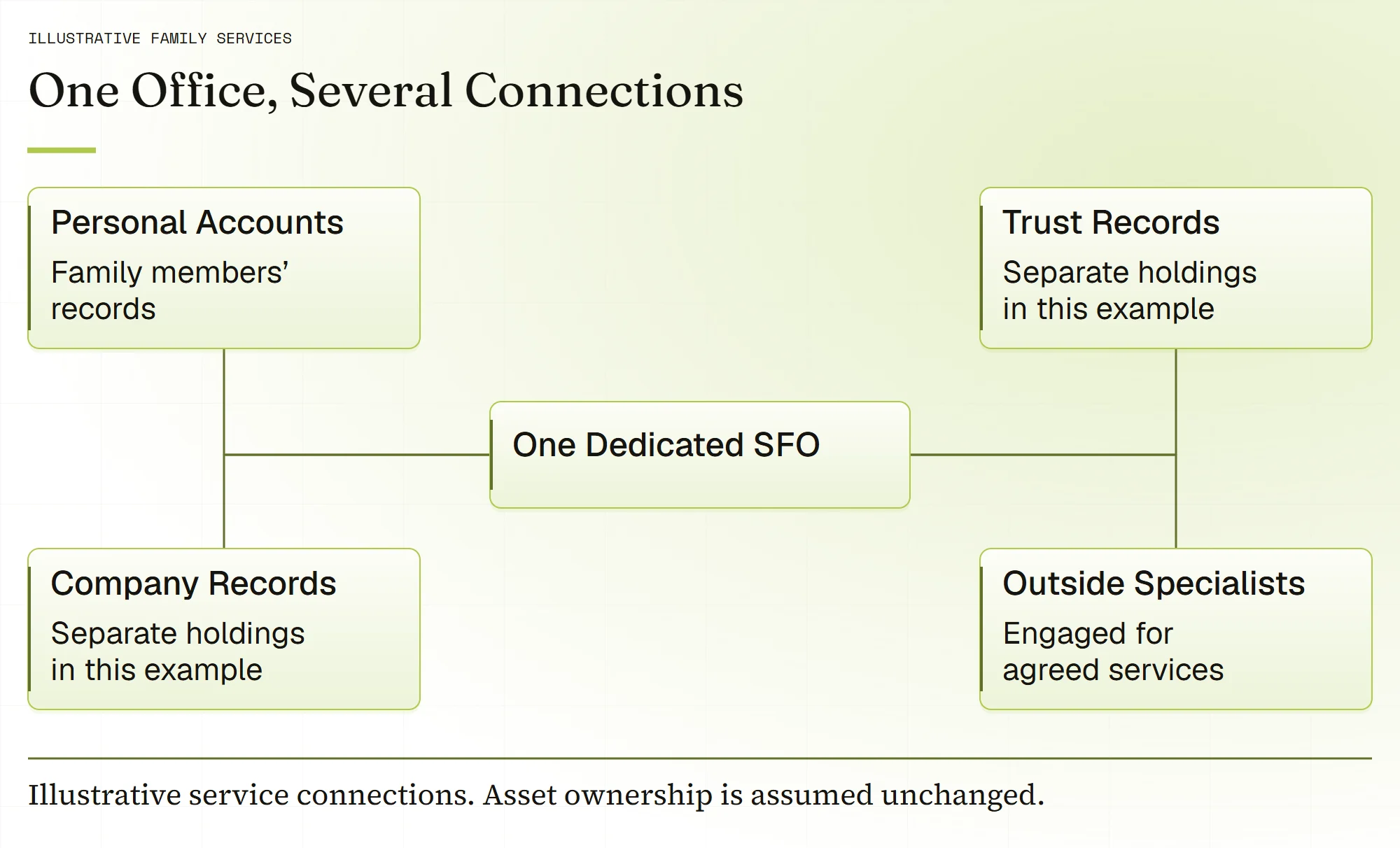
Diagram: one office coordinates records across separate holdings. Lines show possible service connections, not automatic access, ownership or signing authority. Open the full-width diagram.
05What Are the Benefits and Burdens?
A family may want a dedicated organization to set its own priorities, retain institutional knowledge and assign ongoing responsibility across complicated affairs. Each potential benefit brings an operating obligation:
- Family-defined work requires a written mandate, a funded scope and a way to resolve competing requests.
- Continuity across years requires recruiting, records, succession planning and absence cover.
- Direct oversight requires supervision of staff, providers, security, conflicts and handovers.
An SFO can be expensive before it is efficient. Payroll, systems, premises, cybersecurity, audit and outside advice can continue through quiet investment years. Concentrating knowledge in a few employees also creates handover risk. Dedicated service does not guarantee better returns, privacy, tax savings or family agreement.
06How Does an SFO Compare With Other Arrangements?
These are ways to organize responsibility, not rigid product tiers. “Virtual” or “outsourced” describes how work is delivered and may form part of an SFO, an MFO or an adviser-led arrangement.
| Arrangement | Potential advantage | Burden to test and reason to investigate |
|---|---|---|
| Dedicated SFO | A continuing one-family team with a tailored mandate and direct process oversight; outside specialists can still contribute. | Fixed cost, hiring and leadership. Investigate when repeated cross-entity work and control needs justify a sustainable dedicated team. |
| Multi-family office | Shared people and infrastructure can provide coordinated expertise without building every function internally. | Scope, fees, customization, capacity, conflicts and exit terms vary. Investigate when the family needs continuing breadth and can accept defined shared-service limits. |
| Existing advisers with a coordinator | A named internal or external coordinator can connect retained advisers and decisions without establishing a full dedicated office. | Reporting and exceptions need explicit ownership. Investigate when current specialists can meet the work with limited added support. |
An MFO is not automatically cheaper, more expensive, more or less private than an SFO for the same family. Compare actual contracts, security practices, scope and the work retained by the family. The SFO versus MFO guide examines that choice in more detail.
07What Does a Single-Family Office Cost?
There is no one price for the label. Separate one-time setup and transition from recurring operations such as staff, systems and security. Then identify provider retainers or asset-based charges, underlying investment and custody fees, and the time family members still contribute. J.P. Morgan's surveyed operating-cost totals include some external-provider spending; check the perimeter before adding any adviser or manager fee again.
The reviewed evidence as of October 2026 offers scale context, not five comparable national averages. Use these unlike sources only as background while obtaining local proposals for the same scope.
| Location | Cost evidence and its limit |
|---|---|
| United States | No US national average established. A J.P. Morgan global SFO subgroup averaged US$0.9 million in annual operating cost. Use this as scale context, then obtain a US scope-matched budget. |
| India | No consistent national range established. One provider's published estimates conflict between summary and detail. Request a scoped local budget. |
| United Kingdom | No measured UK national SFO average established in the inspected sources. Price staff, premises, systems, advisers and transition for the planned mandate. |
| Singapore | No measured national average established. A provider estimates S$300,000–S$1 million in annual running costs. Obtain a scope-matched proposal with setup priced separately. |
| Dubai | No Dubai-only comparable number established. An inspected provider estimate groups DIFC with Abu Dhabi's ADGM. Obtain a Dubai-specific scoped quote. |
The J.P. Morgan figure comes from its assets-under-supervision group of US$250 million or less, not from a US-only sample. Its whole global survey has 333 SFO respondents; the group's respondent count is not established here. Campden's 2025 North America results include mixed office types. These sources do not supply a comparable US setup quote. The Singapore figure is a provider estimate, not a measured national mean or an all-in quote.
No comparable annual averages for MFO services or outsourced/virtual delivery in these five locations were established in this reviewed source set. Providers can charge fixed annual, asset-based, hourly or mixed fees, and some services cost extra; Creative Planning describes these fee forms.
For each proposal, ask for the same work and outputs, responsible owner, currency, first-year and recurring cash, included and excluded provider charges, and work the family retains. Unquoted means unknown, not zero.
The setup-cost guide and operating-budget guide show how to build that comparison. Wealth and investable assets are different from cash available to run an office; the minimum-net-worth guide explains why no quoted cutoff makes the decision by itself.
08When Does an SFO Make Sense? A Quick Decision Guide
An SFO deserves investigation when the family has persistent work across entities or households, wants a dedicated owner for it, can fund the operating organization through quiet years and handovers, and is willing to govern employees and providers. It need not build one merely because its assets cross a published threshold.
- List the recurring work and gaps. Record entities, households, reporting, payments, investment decisions, deadlines and where current advisers leave an unresolved handoff.
- Name control and oversight needs. Identify which decisions demand dedicated family attention and who will supervise the people doing the work.
- Price equivalent scopes. Compare a dedicated operating plan with shared-office or coordinated-adviser proposals. Include transition, recurring cash, exclusions and retained family hours.
- Test durability. Ask whether the family can fund and govern the arrangement through a quiet year, a leader's departure and a change in family priorities.
- Choose the next investigation. Match the evidence to one route:
Keep current advisers and monitor the arrangement if their outputs and handoffs already work. If specialists cover their own tasks but nobody owns the handoffs, test a named coordinator.
Test an MFO or outsourced coordinator if continuing breadth is needed without a dedicated team.
Develop an SFO feasibility plan if sustained work, control needs, funding and oversight support one.
Illustrative decision: Suppose a family has timely investment reports but no one reconciles figures across its trusts and company. The next move is to map that reporting gap and ask current advisers or a coordinator to quote the missing work. It is too early to build a permanent office until the family establishes who will supervise that work and how it will be funded through ordinary and quiet years.
For a practical start, make a one-page map of work, outputs, approvers and current owners. Obtain proposals against that same map before committing. The setup guide and country-choice guide can then deepen the relevant route.
 Knowledge & Decision · Analysis
How Much Net Worth Do You Need for a Family Office, and When Should You Start?
What family office wealth figures mean, how location-specific rules differ, and how to test costs, cash and service… Knowledge & Decision · Analysis
What Is a Family Office, and What Does It Do?
What is a family office? Understand its purposes, services and staffing arrangements, plus five questions to ask before… Knowledge & Decision · Analysis