What Does It Cost to Set Up a Single-Family Office in Year One?
A first-year family-office budget fails when setup bills, the old provider's final months and the new team's annual cost are all called “startup cost.” Separate them before approving a figure.

There is no single US price to set up a single-family office. A family buying a few coordinated services faces a different project from one hiring its own team, migrating years of records and taking over payment authority. The useful answer is a first-year cash requirement tied to a defined scope, with the ongoing cost shown separately.
Build that requirement in three ledgers: one-time design and implementation; the incumbent arrangement's cost during transition, including any months of actual overlap; and the new office's annual operating run rate. Hold a separately authorized reserve for uncertain one-time work. If a quote cannot be placed in one of those ledgers, the family cannot yet tell whether it is buying a launch or an ongoing service.
- Price the work before the structure. Name the services, recipients, entity books, decision rights and data that must move. Get quotes against the same written scope.
- Keep four amounts visible. One-time build, incumbent cost through transition, recurring run rate and unspent contingency are not interchangeable.
- Release the launch budget in stages. Fund design and build, allow a bounded new-office parallel run, then approve the ongoing operating budget after the first decision, payment and report can be traced.
01What is included in the setup cost?
The setup bill is the cost of making a specified operating model ready. It may include legal and tax design, family and entity service agreements, recruitment or search fees, systems configuration, data conversion, cybersecurity controls and the testing needed before the office takes responsibility. These are project activities with a completion date, even if a vendor bills some of them monthly.
The recurring bill is different: salaries and benefits, retained advisers, software subscriptions, security monitoring, premises, insurance and administration after the office is running. A technology contract can have both an implementation charge and an annual licence. Put each in its proper ledger.
The incumbent's transition-period cost is easy to miss. The family may pay a reporting provider or outsourced accountant before and during the new team's parallel close. Ending that contract on the new office's incorporation date could leave no verified books or report. The old arrangement ends when a documented handoff passes, not when the new logo is printed.
| Cost line | What is being bought? | Where it belongs |
|---|---|---|
| Legal and tax structure advice | Documents and decisions needed to establish this operating model | One-time build; later advice is recurring or a separate project |
| Recruiting and onboarding | Search, hiring and initial training | Search and onboarding in build; salary from employment start in operating cash |
| Data and system migration | Mapping, conversion, security setup and reconciliation | One-time build; subscriptions in recurring run rate |
| Existing provider during handoff | Continued service before and during the parallel run | Transition-period cost, with an exit date and actual overlap months |
| Reserved amount | Approved capacity for scoped surprises | Authorization ceiling, not expense until used |
The general single-family-office setup guide explains how to define the work and authority. The operating-budget guide addresses how to control ongoing changes after launch. Here the decision is what cash to authorize to get from the current arrangement to the first working office.
02Why an annual cost benchmark does not answer the setup question
J.P. Morgan's 2026 Global Family Office Report reports average annual operating cost by assets-under-supervision tier: US$0.9 million for offices at US$250 million or less, US$1.7 million for US$250–500 million, US$3.3 million for US$501–999 million and US$6.6 million for US$1 billion plus. These are global survey averages for existing offices, not bids for a new office and not estimates of legal formation or migration cost. The public page does not break out a one-time setup bill by tier.
The same asset level can support different service scopes. One family may retain an outside investment manager and employ a controller; another may hire an investment team and run direct deals. Brown Brothers Harriman's comparison asks what services the family wants and how much it is willing to spend, rather than treating an asset threshold as an instruction to hire. Use a benchmark to challenge an estimate, not to replace quotations and a staffing plan.
A reported cost as a percentage of assets needs the same caution. It describes a ratio after selecting the numerator and denominator. It does not say who pays a recruiting invoice, whether investment-manager fees sit outside the office budget, or how many months of dual reporting are required.
03Write one scope before asking for prices
The family CFO can send a short request to each adviser and provider with four parts:
- Recipients and entities: which family members, trusts, companies and partnerships receive work; which entity will contract and pay. Listing assets alone does not establish the service recipient.
- Services and authority: investment research, legal-entity bookkeeping, consolidated reporting, tax coordination, bill payment, philanthropy or household administration; name who may approve each decision and bank instruction.
- Starting condition: current providers, data formats, account and entity count, unreconciled items, contracts, licences and access rights. Ask what the new team can receive, transform and use.
- Acceptance and exclusions: the first report, close, payment test and exception record that constitute delivery. Request a dated price for data remediation, interfaces, extra entities, change requests, taxes on the provider's bill and exit assistance.
J.P. Morgan's guide to starting a family office identifies staffing, operations, technology and cybersecurity, tax and accounting as cost considerations. Anchin's setup analysis likewise connects scope, structure, personnel, technology and external advice. Neither source establishes a universal all-in US setup price. The written scope is what turns those categories into a budget a family can approve.
Ask each bidder to return one-time fee, recurring fee, expense assumptions, payer, start date, cancellation or renewal terms, deliverables and exclusions. A low headline implementation fee may shift the work to hourly data cleanup or a separate integration contractor. A low annual platform fee may omit the people needed to reconcile its feeds. Treat “included” as a contractual claim with a named deliverable, not a brochure adjective.
04A worked first-year cash decision
Imagine a fictional family with US$300 million of supervised assets. It wants a small dedicated office to coordinate investments, control legal-entity books and release a consolidated family report. The budget horizon is the next twelve months.
The existing reporting provider remains in months 1–4. The new office's recurring contracts and full team start in month 3, so the arrangements overlap in months 3–4 for a parallel close.
In this scenario, months 1–2 have no new-office salaries, rent or subscriptions; all preparation then is covered by the one-time build estimates below. If a real contract starts earlier, add its dated cash cost. These figures are illustrative planning assumptions, not market prices or quotes from the cited firms.
The family obtains scoped estimates for the one-time build:
| One-time item | Illustrative amount | Delivery evidence |
|---|---|---|
| Legal, tax and governance design | US$95,000 | Approved service/entity map and documents |
| One-time systems configuration and data migration | US$75,000 | Reconciled opening balances and access test; excludes subscriptions |
| Search and initial onboarding | US$60,000 | Filled roles and assigned responsibilities |
| Control design and security setup | US$40,000 | Tested payment, approval and recovery controls |
| One-time build subtotal | US$270,000 | All four deliverables accepted |
The incumbent provider costs four months × US$25,000 = US$100,000 in this twelve-month horizon. Months 1–2 are incumbent-only; months 3–4 are the actual two-month overlap. Do not bury the old provider in the new office's software budget; its exit waits for the parallel close to pass.
The proposed steady-state annual run rate is US$1,200,000, or US$100,000 per month:
- US$780,000 staff and benefits;
- US$210,000 new-office external advisers and providers;
- US$120,000 ongoing systems and security; and
- US$90,000 premises and administration.
The US$210,000 excludes the incumbent reporting provider's US$100,000 transition-period bill. The recurring US$120,000 excludes the one-time US$75,000 configuration and migration work. These annual amounts are a scenario, not a J.P. Morgan tier prediction.
The CFO must check whether investment-manager, custodian and deal costs sit outside this office budget, and show them separately if the family wants a total wealth-management cost view.
The timing is easier to inspect as a cash strip. These figures exclude the one-time build and unspent reserve:
| Months | Arrangements paid | Monthly cash | Period cash |
|---|---|---|---|
| 1–2 | Incumbent only | US$25,000 | US$50,000 |
| 3–4 | Incumbent and new office | US$125,000 | US$250,000 |
| 5–12 | New office only | US$100,000 | US$800,000 |
| Transition and operating cash | US$1,100,000 |
Add the US$270,000 one-time build to reach US$1,370,000 of planned first-year cash. The month 3–4 line shows exactly where the two-month parallel close is funded.
First-year authorization record — illustrative
Planned cash in this twelve-month horizon: US$270,000 one-time build + US$100,000 incumbent provider through month 4 + ten months × US$100,000 new-office operation from month 3 = US$1,370,000. The new team's annualized run rate remains US$1,200,000; only ten months fall within this first cash budget. This example assumes no new-office recurring charge starts before month 3.
Unspent one-time reserve: 15% × US$270,000 = US$40,500. The principal may authorize a US$1,410,500 ceiling, but the reserve is not recorded as spent on day one. Release it only against a documented scope change or remediation decision.
Timing rule: first-year cash = one-time build + incumbent monthly charge × actual months retained + new-office monthly cost × actual active months. If hires start later or the incumbent leaves earlier, change those months and the dated cash forecast; keep the annualized run-rate comparison separate.
Owner and next gate: the family CFO owns quote reconciliation and cash forecast. The principal approves the ceiling and any reserve release. The incumbent-provider exit waits for a signed parallel-close result.
At US$300 million of supervised assets, the illustrated US$1.2 million annual office run rate equals 0.4% of that denominator. That arithmetic does not make the first-year US$1.37 million cash plan “a 0.4% setup cost.” The one-time build, transition period, reserve and investment fees have different meanings and timelines. The family's asset definition must also match any survey comparison before interpreting the percentage.
05Compare quotes without hiding work or paying twice
Put every proposal on one comparison sheet. Compare an in-house, hybrid or outsourced route against each question below, recording “unknown” where a bidder has not priced an item rather than entering zero.
| Question | Proof to request before approval |
|---|---|
| Who does the work? | Named office role or provider, capacity and start date |
| Who pays? | Contracting entity, allocation method and approval owner |
| What is one-time? | Deliverables, milestones, acceptance tests and change-order rate |
| What continues? | Annual commitments, renewal dates, variable usage and exit charges |
| What overlaps? | Incumbent contract, parallel-run months and release condition |
| What is excluded? | Data repair, new entities, extra reports, specialist advice and investment fees |
Quote comparison record
Copy this card for each in-house, hybrid or outsourced proposal:
- Route; quote source and date: [name and dated document]
- One-time build; monthly/annual commitments: [amounts, start dates and deliverables]
- Incumbent service retained: [monthly charge, months and exit test]
- Contracting payer; decision owner: [entity and named approver]
- Excluded or variable work: [scope, pricing method and who owns it]
- Acceptance proof; next review date: [test record and date]
Mark any unpriced field unknown, not zero. Compare cards only after every field uses the same service scope and time basis.
Two common errors change the answer materially. First, counting a person's loaded annual salary and also adding the same role as a full-year retained-provider fee exaggerates cost unless both genuinely run in parallel. Second, counting a provider's data-migration line and then adding the same work under the technology implementer's line creates a second copy of the same deliverable. Compare contractual scope and acceptance evidence, not just labels.
The reverse error is just as costly: pricing a reporting platform but omitting the accountant who decides how a disputed transaction posts to the entity books. A software subscription is not a close owner. Similarly, an investment manager's portfolio fee does not necessarily pay for the family's bill control, trust reporting or legal-entity accounting.
06When should the family release the money?
Approve the build in gates rather than one vague “family-office setup” line:
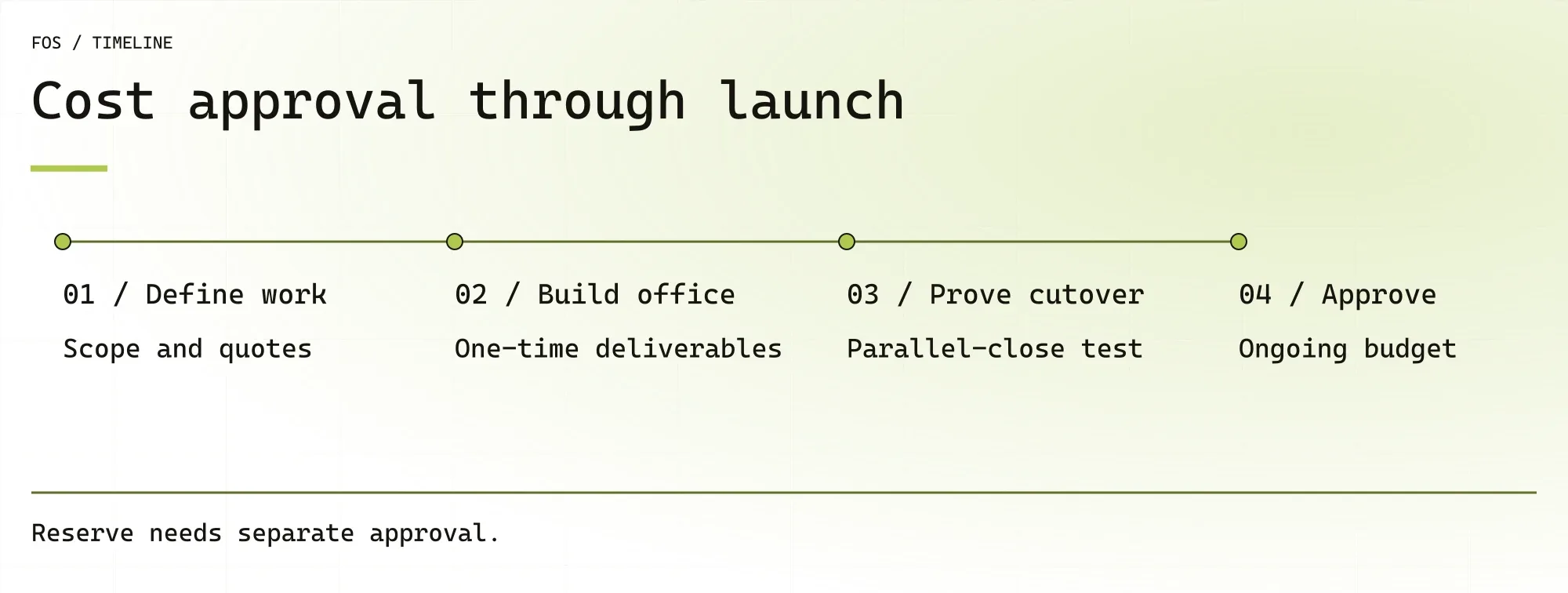
The fictional case uses two months of parallel operation before the incumbent exits. The reserve stays unspent unless separately released. Open the full-width cost approval diagram.
- Design release: approve the service charter, legal and tax questions, asset/entity inventory and quote scope. Stop if the family cannot say who receives or pays for the work.
- Build release: contract the team, providers and systems only after the one-time and annual obligations, migration rights and exclusions are visible. Set a ceiling for change orders.
- Cutover release: fund the bounded parallel close and security/payment test. In the worked case, the approved first-year cash plan already pays the new office US$100,000 per month in months 3–4 while the incumbent remains; cutover proof is not a prerequisite to that temporary funding. Keep the incumbent's exit conditional on reconciled opening records and assigned exception owners.
- Ongoing-budget release: after the office demonstrates a decision, authorized payment and reliable family report, move to the annual operating-budget process. Reforecast actual costs and service volumes rather than treating the launch estimate as a permanent entitlement. This gate approves continuing operation after cutover; it does not retroactively fund months 3–4.
The family can also decide not to build the proposed office. If quotations and retained family effort exceed the value of owning those responsibilities, compare a smaller internal team plus outsourced work against the same acceptance tests. The decision is whether the chosen arrangement performs the work with clear authority and evidence at a cost the family accepts—not whether a published asset threshold says it may call itself a family office.
 Knowledge & Decision · Analysis
How Much Net Worth Do You Need for a Family Office, and When Should You Start?
What family office wealth figures mean, how location-specific rules differ, and how to test costs, cash and service… Knowledge & Decision · Analysis
What Is a Single-Family Office? Services, Costs and Fit
A single-family office serves one family through a dedicated organization. See its services, staffing, costs and when another… Knowledge & Decision · Analysis