How to Staff a Single-Family Office and Choose the First Hire
Choose the first family-office hire by testing the work no one owns, the capacity needed at deadlines, and who can review and approve the result.

A single-family office needs someone accountable for each piece of work the family expects it to perform. That does not mean hiring a CIO, CFO, COO and full investment team at once. The first hire depends on what the family already has, what it wants to bring inside, and which decisions it will continue to make itself.
Start with the principal's intent and the first-year mandate. Map the investment, finance and operations work the office must cover, including what providers already do. Then name who prepares, challenges and approves each important result. Hire for the uncovered responsibility; use providers where specialist or variable work does not yet justify a permanent role. The office is staffed when its first close, investment decision and payment can be completed and reviewed without relying on an undocumented hero.
- Set the mandate. Name the principal's intended outcomes, first-year outputs and existing work across finance, investments and operations.
- Hire the missing owner first. An investment-led office may need a CIO; an office with unreliable books may need a controller or CFO. The title follows the work.
- Test the team, not the chart. Show who prepares, approves, reconciles and steps in when someone is absent. Price retained providers and family time beside salaries.
01Seven Steps from Mandate to First Staffing Decision
The first role is the last decision in a short design process. The principal can lead it with a family representative and existing advisers; it does not require a fully staffed office to begin.
- Write the principal's intent. Define what the office should achieve over the next several years: investment oversight, entity reporting, family governance, property and personal service, philanthropy, or some combination. Name what the family wants to decide itself. The output is a service charter, not a list of titles. The single-family-office setup guide covers the wider operating design.
- Set the first-year mandate. Choose the outputs that must work in the next 12 months, with dates and recipients. They may include a reliable entity close, an investment review, a payment control, tax-data delivery or a family service desk. Separate launch work from permanent monthly work; a one-off migration may need an interim lead, not a permanent executive.
- Cover three functional pillars. Finance and accounting covers entity records, cash control, tax-data coordination and family reporting. Investments covers policy support, portfolio and manager oversight, and decision preparation. Operations and support coordinates providers, documents, property or personal requests, access and continuity. Legal, tax, security and valuation specialists may serve more than one pillar. Each pillar needs named accountable coverage; the family or committee may retain policy and release decisions, and a pillar does not automatically need its own employee.
- Decide what to build and what to buy. Inventory the people and providers already doing the work. For each outsourced service, write its deliverable, deadline, evidence, access, first-line check, family-side sponsor and exit handoff. No fixed outsourcing percentage determines the right mix. The first employee may manage a provider and challenge its output instead of performing every technical task.
- Set authority before recruiting. Record who may hire, sign a provider contract, instruct an investment manager, verify and release a payment, resolve an accounting exception and approve a family report. Split preparation, independent challenge and release where the risk requires it. Use the delegation-of-authority matrix to document limits and substitutes.
- Choose the first missing capability. Compare the uncovered work with four possible routes below: investment lead, finance lead, operations lead, or interim specialist. Test monthly volume and the peak deadline, the build-versus-maintain skills required, and whether a fractional role or provider covers the work more sensibly than a full-time salary.
- Price and prove the arrangement. Obtain like-for-like first-year and ongoing scopes, including transition, independent review and absence cover. The cost guide separates setup and recurring cash. Do not issue an offer until the principal has set the cash ceiling and open control gates have owners. Test the arrangement through its first operating cycles; add capacity sooner if an urgent control gap is exposed rather than waiting for day 90.
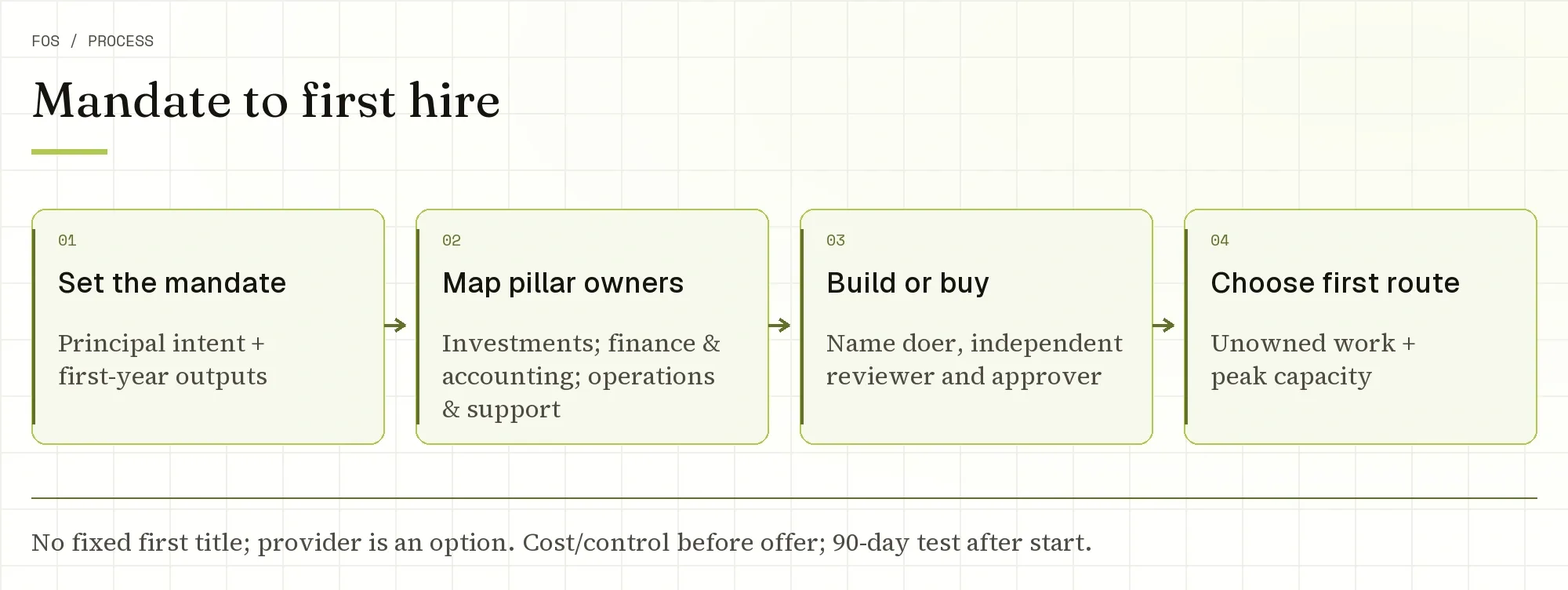
The diagram groups the steps above; each pillar needs an owner, not necessarily an employee. The worked record below tests peak capacity and comparable cost. View the full-width desktop diagram.
02Which Role Should Be Hired First?
There is no universal sequence. Brown Brothers Harriman observes that a CIO is often the first hire in an investment-focused family office and may also run day-to-day operations in a smaller one. That is a description of one common model, not a rule for every family. A CIO-first office can still fail its monthly books or bill controls if nobody owns them.
Use the family’s existing arrangement to select the first accountable lead:
| Work that lacks an owner | Candidate first capability | What remains to arrange |
|---|---|---|
| Investment policy, manager oversight and portfolio decisions | CIO or investment lead | Accounting, cash controls, provider management and independent review |
| Entity books, tax data and family reporting | Controller or CFO | Investment decision owner, payment approvals and specialist tax advice |
| Multiple providers, property work, security and service delivery | Head of office, chief of staff or COO/operations lead | Financial control, investment oversight and authority limits |
| Primarily one temporary migration or project | Named interim lead or specialist provider | Family-side approver, knowledge transfer and a permanent owner decision |
The family may keep portfolio management with an outside firm while hiring a finance lead first. Another family with sound accounting but fragmented investment decisions may make a CIO its first senior hire. A single person can hold more than one remit, but combining preparation, payment release and review in one unchecked role creates a control gap. The family-office org chart maps decision authority; this staffing decision asks who has the capacity and skill to do the work behind each box.
Within the finance route, a controller may be the right first technical owner when the uncovered job is entity books, close and reports. A CFO-level mandate is broader: financing, capital planning, accounting policy and decisions across entities. The family should write that scope before choosing the seniority or pay band.
03Calculate Workload Before Counting Heads
An org chart says where a role sits. It does not tell the family whether the role has 20 hours or 200 hours of work in a month, or whether all 200 hours arrive during close week. Build a service inventory with the next three months of actual or forecast activity.
For each workstream, record the volume, deadline, estimated preparation time, review time, exception rate, systems used, owner and substitute. Distinguish a predictable monthly close from a capital call that must be checked within two days. A role may look lightly loaded on average yet still miss an investment or tax deadline during a peak.
The estimate is a planning device, not a payroll benchmark. Review it against real time logs after launch. Add time for supervision, learning, meetings, leave, security training and rework; do not assume every paid hour is available for production.
Then identify review and approval work that cannot sit with the preparer, even when the preparation hours fit within one job.
04Decide What the Office Owns and What Providers Perform
“Outsource accounting” is too broad to staff against. A provider might process transactions, maintain legal-entity books, prepare tax schedules or produce a consolidated report. The family office might still own source-document collection, accounting policy, exception decisions and approval to release a family report. Put those obligations in the service agreement and the internal role description.
The same distinction applies to investments and payments. An external manager can research and execute within an agreed mandate; the family or committee may retain policy, allocation and exception approval. A bank can process an instruction, but the office must know who verifies the payee and who is authorized to sign. The delegation-of-authority matrix can document those limits.
Consider a compact ownership record:
| Work | Prepares | Reviews exceptions | Approves release | Backup |
|---|---|---|---|---|
| Entity close | Controller or accounting provider | Provider first-line QA; separate qualified reviewer for material entries | Named family-side report approver | Trained second preparer |
| Investment memo | Investment lead or adviser | Committee or independent reviewer | Authorized investment decision maker | Mandated delegate |
| Payment | Operations preparer | Finance controller verifies invoice and payee | Bank signatory under written limit | Alternate signatory |
| Family report | Reporting preparer | Finance lead, or a different qualified reviewer if the lead prepared it | Designated family-side approver | Named alternate reviewer |
These are illustrative assignments, not a legal delegation. If “controller” and “finance lead” are the same person, the two labels do not create an independent review. A provider supervisor can check its own team's work, but that is first-line provider review. Assign material entries and report exceptions to a different qualified family-side reviewer or a qualified external reviewer appointed by the family. Keep the family-side release decision separate. Adapt assignments to the entities, account mandates and governing documents.
Some functions should stay with outside legal, tax, security or valuation specialists even when an internal lead coordinates them. Outsourcing work does not remove the need for a family-side owner who can obtain qualified challenge, act on the findings, and renew or exit the contract.
05Worked Case: Finance Is the Missing Capability
Imagine a family with 14 legal entities, 120 invoices and eight private-fund notices in an ordinary month. Its fictional first-year mandate calls for a reconciled close and family report within 10 business days, fund notices triaged within one business day, and invoices acknowledged within two. An earlier payment cutoff overrides those intake targets. It already has outside investment advice and an investment committee, but no one owns that close or report. The principal wants a family-appointed finance lead who can challenge the books directly if the cost and coverage work; a fully provided technical close is still under consideration. The principal is prepared to approve material payments but cannot prepare them.
The three-pillar map makes the gap visible: investment decisions have an adviser and committee; finance lacks an accountable owner for the 10-day close and report; operations intake still needs scoped cover. The case therefore compares a family-appointed finance lead with a provider-led technical close, while keeping independent review and family approval separate.
The family estimates the following illustrative productive workload before allowing for leave, peaks or independent review. The exception/quality line includes first-line checks, not a second person's challenge:
| Work in a typical month | Illustrative calculation | Preparation and QA hours |
|---|---|---|
| Entity close | 14 entities × 4 hours | 56 |
| Invoice intake and checks | 120 invoices × 0.2 hours | 24 |
| Fund notices and movements | 8 notices × 1.5 hours | 12 |
| Consolidated family report | Monthly package | 16 |
| Exceptions and quality review | Named allowance | 20 |
| Total estimated work | 128 hours |
The current split would put 92 hours of entity close, report preparation and first-line exception work (56 + 16 + 20) with a finance lead. Invoice and fund-notice intake account for 36 hours (24 + 12), which the family could quote as part-time operations support rather than assume it needs a full-time hire. A separate qualified reviewer must still challenge material entries and exceptions; that review time is additional to 128 hours and needs its own priced scope.
The estimate does not establish headcount. Close-week peaks and backup cover may require more capacity. It points to financial control as the current gap because investment advice already has an owner.
A first-hire decision record the family can use
The ordinary-month total is only the starting point. The family needs to know whether qualified people are available when the close and report are due, and whether each proposed arrangement includes the same review, backup and transition work.
Assume a 10-business-day close and reporting window contains all 56 close hours, all 16 report hours, and 10 of the 20 first-line exception hours. That is 82 productive finance hours due in the window. A candidate finance lead has 60 productive hours available after other duties. The minimum gap is 22 hours.
To avoid scheduling every available hour, the family asks a qualified provider to commit 26 close-preparation hours in that window. The lead then has 30 close hours, 16 report hours and 10 first-line exception and provider-check hours: 56 scheduled hours, with four hours of the assumed capacity uncommitted. The provider's own first-line QA must be scoped and timed: if it is additional to the 26 hours, the monthly 128-hour estimate increases. The lead's 10-hour QA allowance must also be checked against actual supervision and rework; the four hours are a buffer assumption, not proven capacity.
Outside the window, the lead handles the remaining 10 exception hours. Monthly work remains 66 finance-lead + 26 provider + 36 intake = 128 hours. An independent challenge and absence cover are additional.
For a like-for-like comparison, the family also assumes 18 of the 36 intake hours fall in that window. Either route must show who can handle those time-sensitive notices and invoices, including a changed payee and an absent preparer. The assumptions are fictional planning inputs, not a general productivity target.
Fictional Staffing Decision Record: First Hire and Operating Cover
Decision at a glance: pursue Route A for further diligence because this principal wants family-appointed technical ownership. Do not issue an offer until peak cover, independent review, backup and comparable cost pass their gates. Route B remains a provider-led alternative.
Decision and sponsor: the principal appoints a family representative to gather scopes, manage contracts and escalate accounting challenges raised by an independent reviewer. The representative needs access to the source records, authority to require correction and to hold the release packet, and a path to the principal if a provider disputes the finding. If the representative lacks the accounting competence to act on review findings, the principal appoints a qualified family-side finance adviser before Route B proceeds. The principal retains hiring and report-release decisions unless written delegation names someone else.
Base and deadline: 128 productive hours in an ordinary month = 92 finance + 36 intake, before independent review, leave or transition. In the 10-business-day window, 82 finance and 18 intake hours are due.
Route A — finance lead first
- Monthly work: the lead performs 66 finance hours; a provider performs 26 close hours; an operations service handles 36 intake hours.
- Peak proof: the lead has 56 of 60 available hours scheduled; the provider commits 26 close hours; the service covers 18 intake hours.
- Technical owner and backup: the family-appointed lead owns close decisions. A trained substitute covers absence. The provider's 26 scheduled hours are not that backup.
- Employment check: establish other duties or consider a fractional appointment before pricing a full-time lead.
Route B — operations coordinator first
- Monthly work: a qualified provider performs all 92 technical hours; the coordinator handles 36 intake hours.
- Peak proof: the provider names staff for 82 technical hours; the coordinator covers 18 intake hours.
- Technical owner and backup: the provider controller leads the technical close under the family-side sponsor. A qualified provider substitute and a coordinator substitute cover absence.
- Employment check: establish other service duties or consider a fractional coordinator. The coordinator is not the accounting owner, and the 36 intake hours are not an additional provider fee.
Independent review and release
- A separate qualified reviewer challenges material entries and report exceptions, beyond the 128 preparation hours and provider first-line QA. For each route, name the reviewer, estimate their hours, secure their availability in the 10-day window and set a due time before report approval.
- The principal or written delegate approves report release and payments within limits. The family-side sponsor can access records, require corrections and hold release. Review hours cannot silently use the lead's four-hour buffer or the provider's preparation allocation.
- Route A's finance lead verifies changed payee details independently of the operations preparer. Route B uses a qualified family-appointed reviewer or finance adviser independent of the coordinator and provider. Name an alternate. In both routes, the bank signer is separate from preparation.
Comparable cost
Ask for first-year cash = loaded employee or fractional cost + provider fees + independent review + technical and intake absence cover + systems + recruiting + transition + priced exclusions. Ask for the ongoing-year total without one-time recruiting and transition.
Route A provider scope must cover 26 monthly peak close hours and 36 monthly intake-service hours. Route B provider scope must cover 92 monthly technical hours, including 82 due at peak; its coordinator cost covers intake. If Route B needs a family-side finance adviser, price that person separately from independent review.
For every quote line, mark included in a bundled fee, additional or unknown and count it once. Compare the same service deadlines and exclusions. Record family-retained hours separately. The principal has not yet set a cash ceiling; both route totals remain unknown, never zero.
Open gates and choice
The assumed workload arithmetic reconciles. Peak capacity, supervision time, independent-review hours and turnaround, source access, correction and hold authority, payee-verifier alternate, absence cover and comparable cost remain open. The family representative gathers written evidence before an offer; the principal sets the ceiling and signs the decision.
Prefer Route A for further diligence because this fictional principal wants family-appointed technical finance ownership. Hold the offer until every open gate passes. Route B remains an alternative if the provider proves deadline cover, family-side challenge and acceptable cost. Neither route is approved on this record.
90-day acceptance
In each monthly cycle, meet the 10-business-day close/report deadline, one-business-day fund-notice triage and two-business-day invoice acknowledgment targets, accelerating any item with an earlier payment cutoff. Reconcile all 14 entities, trace a fund notice and verified payment, obtain independent review before release, and label dated or provisional report values.
If no natural material exception arises, use a controlled work sample outside live books as a supplemental challenge test. Complete technical and intake absence handoffs. The family representative logs defects; owners close them; the principal signs acceptance after reviewing that evidence.
Copyable First-Hire Decision Form
Outcome and deadline: [unowned result, due date]
Route A — [first employee or fractional role]
- Monthly work and technical owner: [hours; name]
- Peak work and qualified capacity: [hours; named cover; intake response targets; evidence]
- Independent challenge and release: [reviewer; hours; written peak availability; due time; approver]
- Payment verifier and alternate: [names; access test]
- Absence cover, technical work and intake: [names; test]
- First-year and ongoing cash, included scope and exclusions: [quotes; open items]
Route B — [first employee or fractional role]
- Monthly work and technical owner: [hours; name]
- Peak work and qualified capacity: [hours; named cover; intake response targets; evidence]
- Independent challenge and release: [reviewer; hours; written peak availability; due time; approver]
- Payment verifier and alternate: [names; access test]
- Absence cover, technical work and intake: [names; test]
- First-year and ongoing cash, included scope and exclusions: [quotes; open items]
Approved ceiling: [amount]
Open gate — copy this line for each condition: [peak / challenge / source access / hold authority / verifier / backup / cost] · Status: [pass/open] · Owner: [name] · Evidence and due date: [proof; date]
Conditional choice or hold: [route and reason] · Final decision authorized by: [name/date]
90-day proof: [close deadline, peak intake, notice, payment, report and absence tests]
If the second month shows a backlog, hire or contract for the bottleneck actually measured. That may be operations intake rather than another senior title. If the outside investment mandate changes, revisit investment capacity then; the current choice is not a permanent veto on a CIO.
06What Should a Role Brief and Interview Prove?
Write the job brief around deliverables and limits. A “family office generalist” advertisement often hides three separate jobs: technical books, family service and money movement. Be explicit about the entities and assets handled, software and source systems, close calendar, reporting recipient, decision rights, travel or on-call expectations, confidentiality and who supervises the role.
Test the profile against the family's actual stage. A founding hire may need to build workflows, choose systems and manage co-sourced specialists; a later hire may need to maintain and improve a working model. Ask for examples of candid advice, discretion with sensitive information and a disagreement the candidate handled well. Interview the principal, the person supervising the role and any family decision makers whose expectations could conflict. Agree the decision boundary before the offer rather than assuming that a trusted generalist may approve everything.
Use a work sample that resembles the office's actual problem:
- Investment lead: ask for a short manager or allocation memo that identifies decision rights, concentration and what would change the recommendation.
- Controller or finance lead: use a fictional fund statement with a stale valuation and an entity cash mismatch; ask for reconciliation, provisional report treatment and release approval.
- Head of office or operations lead: present competing provider deadlines and a changed supplier bank account; ask for escalation and independent verification.
- Interim specialist: ask for a migration plan with source access, defect log, handoff evidence and the condition that ends the temporary assignment.
These exercises test judgment and escalation, not knowledge of the family's private records.
Before offering the role, check references for work the candidate actually owned. Decide who can access accounts, instruct providers and approve payments, then grant only the permissions needed. Establish a backup and handover file so continuity does not depend on a single inbox or relationship. Use the same standards when a provider supplies the person.
Price the role after defining it. A generic pay table cannot tell the family what this mix of responsibility, location, seniority and incentive design will cost. Morgan Stanley's 2025 family-office compensation page summarizes a report on investment-focused offices; it does not price the fictional controller or coordinator in this article. Use an actual role-specific report passage only when its job, respondent group and geography match the hiring brief. Give local recruiters and providers that same brief and request base pay, incentive, employer costs, recruiting and transition costs alongside a fractional or provider quote. The fictional 66- and 36-hour allocations above do not establish full-time salaries.
07From First Offer to the Next Role
Put the first person and retained providers through a parallel operating cycle while the previous arrangement remains available for comparison. Require a decision record, entity close, payment and family report. Record each defect, its owner and the evidence that closes it.
After acceptance, add a second role only for a measured service or control gap. Review workload, provider service levels, leave cover and retained family hours quarterly until the model is stable.
The staffing plan should let a principal answer a simple question: if the technical close owner is absent next month, who can keep the books, verify a payment and tell the family which report figures remain provisional? If the answer is a name, a permission and a tested handoff, the office has more than an attractive org chart.
 Knowledge & Decision · Analysis
How Much Net Worth Do You Need for a Family Office, and When Should You Start?
What family office wealth figures mean, how location-specific rules differ, and how to test costs, cash and service… Knowledge & Decision · Analysis
What Is a Single-Family Office? Services, Costs and Fit
A single-family office serves one family through a dedicated organization. See its services, staffing, costs and when another… Knowledge & Decision · Analysis