How to Set Up a Single-Family Office in Singapore
A practical guide to choosing a Singapore family-office model, mapping entities, testing MAS rules, budgeting the operation and completing the setup steps.

A single-family office (SFO) coordinates work for one family. It may oversee investments, consolidate records and cash flows, coordinate tax and legal advisers, administer entities, and support governance, succession or philanthropy. Setting one up in Singapore starts by deciding which of those jobs needs a dedicated team there. Registering a company is one possible part of that decision, not the goal.
For families that will manage investments through a Singapore office, there are three further questions: does the office meet the current Monetary Authority of Singapore (MAS) fund-management licensing exemption; should a separate fund apply for an optional tax incentive; and can the people, budget and controls deliver the promised work? The answers belong to different entities and should not be collapsed into a single “family-office licence.”
- Choose the work before the form. Compare a dedicated office with existing advisers, a multi-family office and a small family-side team that buys specialist services.
- Test Singapore against the family's real footprint. Identify which recurring decisions and services need people there, alongside banking, hiring, cross-border tax and continuing cost.
- Keep the office, assets and family authority separate. A Singapore company can employ the team while existing companies or trusts own investments; a fund award, if sought, belongs to an eligible vehicle.
- Check each legal route on its own facts. The MAS class exemption covers qualifying SFO fund management. A section 13O, 13OA or 13U fund tax award adds distinct assets, people, spending, deployment and account conditions.
- Budget and launch an operation, not a filing. Price initial cash and annual work, follow the seven setup steps below, and test who may instruct, pay, reconcile and report before routine use.
01First Decide What the Office Must Do
The name “single-family office” describes whom an organisation serves, not a fixed list of services or a requirement to employ every specialist. One family may need a controller to reconcile several entities. Another may need daily investment research, manager oversight and a committee secretariat. A third may be well served by existing advisers with one person accountable for bringing their work together.
Write the mandate in verbs and outputs:
- Investment work: Who sets policy, researches opportunities, recommends or executes trades, supervises managers and reviews risk? Keep any regulated activity within its assessed legal route.
- Finance and records: Who obtains bank and fund statements, maintains entity books, reconciles a consolidated view, forecasts cash needs and approves the report sent to the family?
- Specialist coordination: Who gathers inputs for Singapore and home-country tax, legal, estate, insurance and valuation advisers, follows up on advice and records the decision maker's instructions?
- Family work: Who prepares governance meetings, informs branches, educates successors or administers philanthropy, property and household matters where the family expressly wants them included?
- Boundaries: Which people and entities receive each service, which tasks remain with an external provider, and which decisions are reserved to principals, trustees or boards?
The arrangement should match that workload. A wealth manager may already provide investments and planning; its actual contract may not include entity accounting, bill approval or family governance. A multi-family office (MFO) shares people and systems across families. A dedicated SFO gives the family its own operating design while making it responsible for an employer, contracts, records and continuity. Compare the actual service scope rather than the label.
| Arrangement to compare | Useful when | What the family remains accountable for |
|---|---|---|
| Existing advisers and a named coordinator | The work is intermittent or already covered by competent providers | Joining outputs, resolving gaps and approving decisions |
| Multi-family office or shared provider | Several functions recur, but exclusive staff would be hard to sustain | Mandate, conflicts, data access, fees and provider oversight |
| Small internal team plus specialists | Daily coordination needs a family-side owner but not every expert on payroll | Employment, handoffs, quality control and backup authority |
| Dedicated Singapore SFO | Persistent work and control needs justify a tailored team | Full operating budget, entity duties, hiring, systems and succession |
There is no universal family-wealth number that decides between these rows. Price the necessary work, identify a sponsor who can supervise it, and compare the quotes with the family's accessible funding. The SFO definition and minimum-net-worth guide provide wider context; the decision above must still be made for this family's actual work.
02Why Put the Work in Singapore?
Singapore may be useful when principals, investments, advisers or a continuing family team are already connected to the region. Its financial and professional-services ecosystem can make it practical to hire investment and operational people, access banks and providers, and coordinate Asian assets. The MAS wealth-management overview and EDB's setup guide describe that ecosystem; neither proves that every family should relocate its office or receive a particular tax result.
Ask what recurring work actually needs a Singapore team. If a family elsewhere needs occasional Singapore legal advice or manager access, contracting for that service may be more proportionate than forming an employer. A local office earns its place when sustained work, available people, provider access, decision location and a funded budget support it together.
Compare the same outputs, people, authority, cross-border consequences and annual cost for a Singapore team, the family's current location and a Singapore provider-only route. If a principal or family member may relocate, identify who would move, their individual residence and work-permission questions, the home-country tax consequences and the adviser who will resolve each question before signing a lease or employment contract. Incorporation itself grants no individual residence status.
Illustrative location choice: A family with daily oversight of Asian managers and several Singapore-based decision makers may justify a local investment and operations team. If the same family needs only occasional Singapore advice, a provider and its current home-base team may cover the work with less fixed cost. The decision reverses when the frequency, authority or quality of local work changes; advisers still need to assess residence, regulated activity and tax for the actual people and entities.
- People and place: Where do the principals, trustees, directors and intended staff work? Can the necessary people be hired and, if foreign, obtain the right permission to work?
- Assets and providers: Will banks, custodians, administrators and advisers serve the proposed owners and vehicles? An incorporation certificate does not assure account acceptance.
- Decision location: Where will strategic company decisions genuinely be made? A Singapore registered address or resident director does not alone determine corporate tax residence; IRAS assesses control and management.
- Cross-border consequences: Company, fund, trust and individual residence are separate. Existing home-country tax, reporting and succession obligations may continue after a Singapore office is formed.
- Trade-off: Compare access and control with payroll, premises, adviser, compliance, banking and continuity costs. Neither an incentive application nor Singapore incorporation guarantees a pass, permanent residence, privacy outcome or investment return.
Our location comparison helps frame a multi-country choice. It is no substitute for showing the work and cost that makes Singapore useful here.
03Draw the Office, Asset and Authority Map
“Set up a Singapore family office” can mean employing a team, contracting with a provider, creating an investment vehicle, applying for a fund tax award or moving family decision makers. These acts do not happen automatically together. Draw the structure before choosing forms.
| Layer | Question to answer | Evidence to prepare |
|---|---|---|
| Family decision structure | Who sets policy, reserves decisions and may instruct each entity? | Family mandate, delegation and signatory schedule |
| Singapore operating company | Who employs staff, contracts with providers and pays bills? | Ownership, officer, service and employment records |
| Existing or new asset vehicles | Which company, trust, partnership or person owns each asset and account? | Ownership chart, tax analysis and custody map |
| Fund applicant, if any | Which eligible vehicle seeks a 13O, 13OA or 13U award? | Vehicle form, administrator, manager, assets and award-condition schedule |
| Data and records | Who holds source documents, books, access rights and the exit copy? | Data map, permissions, retention and export plan |
For a dedicated employing office, the practical default to evaluate is a Singapore-incorporated entity with real directors, employer duties and a documented service mandate. A family can retain overseas asset vehicles or use different structures for different assets. A fund award may require a particular applicant form; it does not require every family asset to move into one fund. A Singapore investment company, trust or limited partnership needs its own legal, tax and governance reasons.
Do not treat a variable capital company (VCC) as a universal shortcut. ACRA's VCC manager rules require a permissible fund manager; the SFO class exemption by itself is not an automatic VCC-manager route. Have advisers verify the intended manager, vehicle and continuing duties before including one in the shortlist.
Where the operating company serves several family entities, document the recipient, scope, charging method and approval rights for each. The family should know which body can commit an asset vehicle, which employee may prepare an instruction and who may release a family report. The family-office structures guide explains the broader ownership-versus-operation distinction.
04Check the MAS Fund-Management Exemption
Route gate: Will the family's own Singapore entity manage qualifying family investments? If yes, assess the exemption below for that office. If an external manager does the work or the office only coordinates non-investment services, assess those actual activities and contracts instead. Only after the management route is clear should the family ask whether an eligible fund's incremental tax benefit justifies a separate award application.
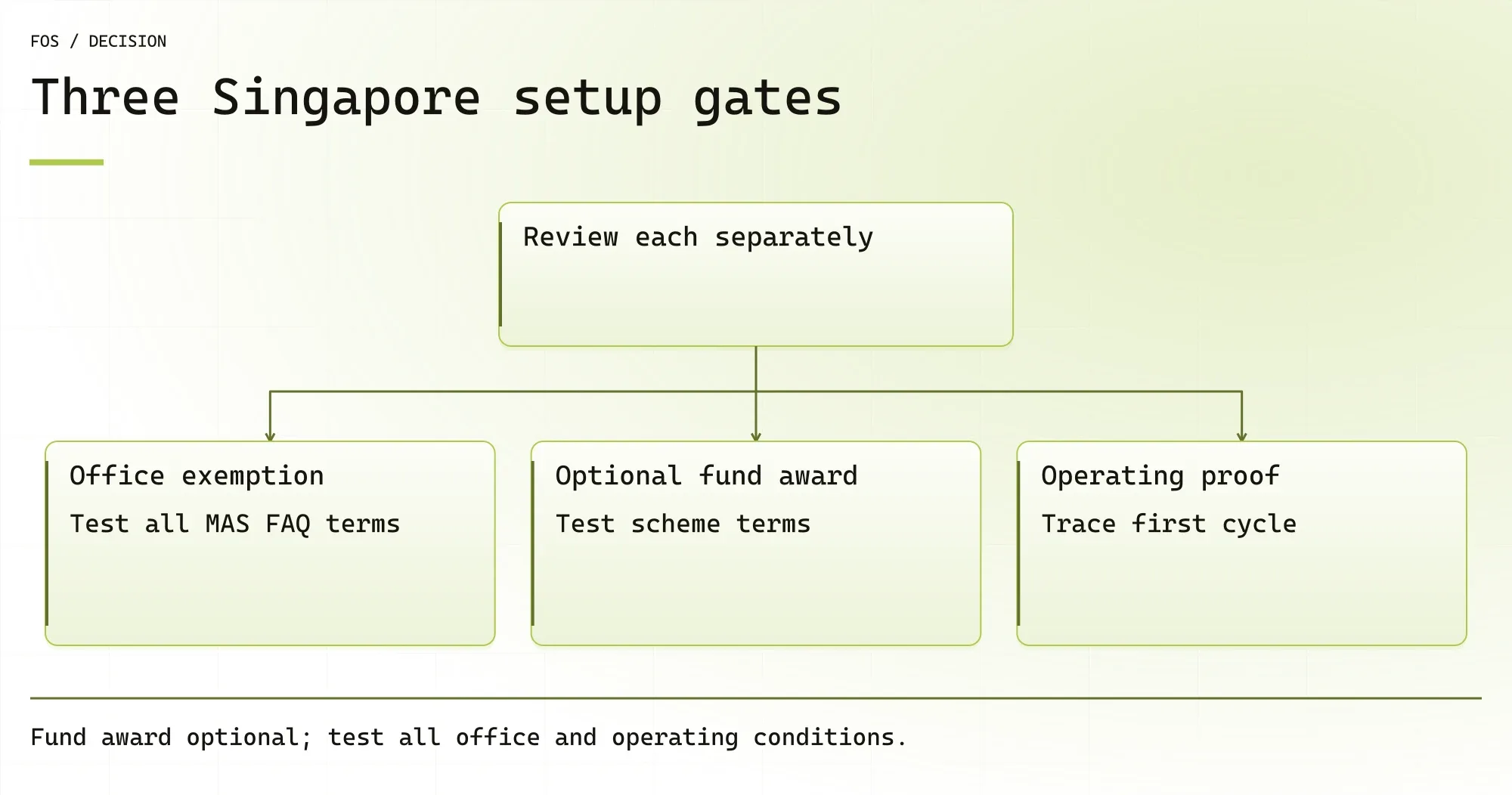
DIAGRAM · THREE SINGAPORE SETUP GATES Open the full-width diagram. The MAS exemption applies to the office, an optional tax award applies to an eligible fund, and operating proof applies to the service as a whole.
MAS's revised framework took effect on 15 June 2026. It provides a class exemption for qualifying SFO fund management, with notification and an annual return. It is not a universal exemption for any company using the family-office name, nor does it decide whether other advice, arranging or dealing activities need a different permission. Ask Singapore counsel to map the actual activity, entity and recipient before the team undertakes it.
The MAS FAQ updated in July 2026 supplies the working tests for the office:
- Recipients and ownership: The office may manage for qualifying family members, family trusts and corporations wholly owned by and for the sole benefit of the family; exclusively family-funded charities; and specified key employees within conditions. MAS defines family through its common-ancestor and relationship rules. Beneficial purpose alone does not make a mixed-ownership corporation eligible.
- Non-family key employees: Three separate checks need separate records:
Managed assets: Their assets are capped in aggregate at 10% of the SFO's assets under management.
Office stake and funding: The office's funding must originate from the family and permitted non-family key employees; their SFO stake is non-controlling and capped at 10%.
Departure: If a qualifying employee leaves, the FAQ requires divestment of all relevant SFO shareholdings and/or investments managed by the SFO within one year after employment ends. - Singapore office and bank accounts: The SFO must be incorporated in Singapore. It and each Singapore-incorporated managed investment vehicle must maintain an account with a MAS-licensed bank. A foreign-incorporated vehicle may instead use an appropriately regulated bank in a jurisdiction meeting the FAQ's anti-money-laundering and counter-terrorism-financing standards. Record each account's legal owner; one general office account does not replace vehicle evidence.
- Notice and return: A new qualifying office notifies MAS within 14 days after commencing operations, with account information in the notice. Its first annual return is due within four months after the end of its current financial year. The notice is not a bespoke licence or a fund tax-award letter. The FAQ does not require a legal opinion with the notice, although counsel review is prudent for a complex structure.
A provider may submit through Corppass, but the FAQ still requires a declaration signed by the contributing family member and an SFO director; a provider's signature cannot replace it. Offices already operating before 15 June 2026 under the earlier qualifying routes have until 15 June 2027 to meet the revised conditions and notify. A family launching now should use the current framework, not assume the transition is its setup window.
Keep an owner for changes in family recipients, key employees, funding, accounts or activities. The FAQ does not create a blanket MAS update filing for every office change, but a material change may alter whether the exemption still fits. Review before accepting new work, and keep the office's annual-return calendar distinct from any optional fund-award reporting.
05Decide Separately Whether a Fund Tax Award Is Worth Seeking
Sections 13O, 13OA and 13U concern eligible fund vehicles and specified income from designated investments, subject to scheme conditions. They are not an automatic exemption for the SFO's own service income, all family income or every asset. A family can operate an office under an appropriate legal route without applying for a fund award. The MAS circular of 31 July 2026 sets the conditions below for new SFO-fund awards approved from 1 August 2026; earlier awards have their own applicable terms and transition rules.
First identify an eligible applicant and its award. For the new 13O route, the circular describes a Singapore-incorporated and Singapore-tax-resident company; 13OA concerns a Singapore-registered limited partnership. Required administration, management and other conditions need separate review. Do not open a new fund merely because an office has been formed. In the table, assets under management (AUM) and designated investments (DI) follow the circular's definitions. A year of assessment (YA) basis period is the accounting period whose income is assessed in that YA.
On a phone, swipe across the table to compare each scheme and its conditions.
| Condition for a new SFO-fund award | 13O / 13OA | 13U | What the family must check |
|---|---|---|---|
| Minimum assets under management in designated investments (DI) | S$20 million | S$50 million | Test at application and relevant basis-period ends; exclude investments in family operating businesses from this minimum even if otherwise designated investments |
| Qualifying Singapore-tax-resident investment professionals (IPs) | One at application; two including one non-family by the end of the first YA basis period | Two at application; three including one non-family by that deadline | Verify role, substantial fund-management work, residence, pay and the actual first-period end; maintain the full count thereafter |
| Annual spending test | S$200,000 below S$250 million DI AUM; S$500,000 from S$250 million to below S$2 billion; S$1 million at S$2 billion or more | Same tier schedule | The first tier is local business spending (LBS). Higher tiers require at least S$300,000 or S$500,000 of LBS respectively; eligible donations or blended-finance grants may count toward the balance. Test definitions and possible initial-period proration. |
| Capital deployment | Lower of 10% of DI AUM or S$10 million in specified eligible investments | Same test | First tested at the end of the first full YA basis period after commencement, then at later period ends |
| Private banking | Applicable applicant fund account with a MAS-licensed financial institution | At least one approved entity must meet the route's account condition | Account in place at application and continuing through relevant periods; separate from exemption accounts |
DI AUM is not total family net worth. Have advisers calculate the eligible-investment numerator, AUM denominator and first due date from the actual vehicle and award. The deployment rule is not an instruction to put 10% of all family assets into Singapore stocks, and total office expense is not automatically qualifying fund spending.
The timing can be surprising. Under the circular's example, an award commencing 1 August 2026 for a 31 December year-end can require the additional qualifying hire by 31 December 2026, while the first full-year capital-deployment test falls on 31 December 2027. Missing the first staffing deadline can revoke the award from its commencement date. The full IP count then has to be maintained through subsequent basis periods; later shortfalls and economic-condition failures require their own consequence analysis. Do not assume a general twelve-month hiring grace.
The fund's private-banking account is an application and continuing award condition. It does not replace the office and vehicle accounts required for the fund-management exemption.
The fund also has its own annual declaration for each year of assessment. The circular's Annex 12 Q4 sets a deadline within four months after that year's corresponding basis-period end; missing it can deny that year's exemption and MAS may terminate the award. Incentive-related changes to owners, key people or intermediate entities can have reporting requirements that differ from the exemption FAQ's no-blanket-update rule. Keep the award letter and advisers' calendar beside the office calendar.
Put the office's financial-year end (FYE), the fund's basis-period end and the award commencement date on separate calendar rows. Ask advisers to calculate and confirm the first staffing, deployment, office-return and fund-declaration dates from those actual inputs. The August/December example is not a universal filing schedule.
06Budget Initial Cash and the Annual Operation
The public fees below help price particular transactions, not a complete SFO. ACRA lists S$15 for a company-name application, S$300 for registration and S$60 for an annual return. Those transactions exclude structure advice, provider work, banking, staff, premises and systems. No defensible Singapore-wide all-in SFO price or universal investable-asset floor was established for this guide.
Build three views for each shortlisted model: one-time setup spending, annual operating expense and first-year cash needed. The last includes bills actually payable in year one plus refundable deposits or account funding. Do not add annual run rate to first-year cash: many of the same bills appear in both views. Ask for dated quotes with the same services, entity count, people and outputs.
| Cost line | Initial item and treatment | Recurring cost to quote | Evidence or owner |
|---|---|---|---|
| Formation and advice | ACRA transactions; legal/tax design, constitution, controller records and any fund application | Secretary, accounts, tax, legal, administration and conditional audit | ACRA fees and adviser scope; company secretary |
| People | Recruitment, verification, relocation and work-pass applications | Salaries, benefits, conditional employer CPF, supervision and training | Role plan, payroll calculation and MOM route |
| Premises | Fit-out and equipment: spending; refundable deposit: cash funding | Rent, services, insurance, security and utilities | Lease terms and office manager |
| Bank, custody and investments | Quoted onboarding fees: spending; deposits and invested capital: funding/assets | Bank, FX, custody, transaction and manager fees | Bank tariff, account owner and finance lead |
| Technology and data | Migration, access design and cyber setup | Licences, feeds, backup, support and recovery | Provider quote, volumes, exit test and data owner |
| Outside services | Initial MFO, corporate-service provider (CSP) or specialist setup | Agreed retainers and priced exclusions | Comparable scopes, responsibility and renewal terms |
For an Employment Pass, MOM currently lists S$105 for an online application and S$225 for issuance, with an additional visa fee where applicable. These are per-pass government fees, not the cost of hiring. For Singapore citizens and permanent residents, Central Provident Fund (CPF) employer contributions vary by age, wage and PR year; do not apply one rate to every employee or add employee deductions as a second employer expense.
The fund-award spending test is separate from the office budget. For each fund and basis period, track qualifying local business spending and, where the higher-tier rules permit, any eligible donations or blended-finance grants separately. Reconcile amounts already in the operating plan without double counting or treating every payment as an office operating cost. Keep invested assets, restricted reserves, account funding and refundable deposits out of the expense subtotal. If a critical provider fee or role is unquoted, mark it unknown, not zero.
Fictional cost comparison, not a Singapore market quote. Suppose two proposals cover the same reporting scope. First-year operating bills exclude setup in both cases. No bank-account funding, invested capital or unquoted line is included in this example.
| Illustrative line | Provider-led service | Small internal team |
|---|---|---|
| One-time setup expense | S$25,000 | S$40,000 |
| First-year operating bills, excluding setup | S$180,000 | S$270,000 |
| Refundable deposit, a cash use rather than expense | S$10,000 | S$20,000 |
| Illustrative cash for these listed service costs: all three lines | S$215,000 | S$330,000 |
| First-year expense: setup plus operating bills | S$205,000 | S$310,000 |
The internal route needs S$115,000 more cash and has S$105,000 more expense under these invented assumptions. Neither proposal is shown to satisfy a fund-award spending test. Compare retained work, authority, service quality, exclusions, resilience and the approved funding ceiling before choosing.
07Set Up the Chosen Route Step by Step
These steps are dependencies, not a promise that every family needs a new company or a fund. A provider-led arrangement may begin under existing family entities and contracts. A dedicated SFO needs company, employment and continuing-control work. ACRA says most company registrations are approved soon after payment, while complex applications may take up to 15 working days and referrals about 14–60 days. Those are registration processing estimates only; banking, hiring and any fund award have separate, case-dependent schedules.
- Approve the mandate and operating model. Name family recipients, services, exclusions, asset owners, reserved decisions, family sponsor, proposed staff and annual funding ceiling. Compare a dedicated team with a priced MFO or co-sourced offer. Output: approved mandate and owner for each open question.
- Map entities, activities and tax before filing. Singapore counsel assesses any fund-management exemption and other regulated activities; Singapore and home-country tax advisers assess company, fund, trust and individual positions. Decide whether any fund-award application is actually wanted. Output: entity/authority chart and a written list of unresolved facts, not an assumed tax result.
- Prepare incorporation and officer records. For a new local company, assemble name, registered office, financial-year end, constitution, shareholders, controllers and director information. ACRA requires at least one director meeting local-residency rules, a company secretary within six months, and an auditor within three months unless exempt. A sole director cannot also serve as secretary. Maintain applicable controller and nominee registers; a nominee director still has real duties. Output: accepted filing, valid officers and governance records.
- Pre-screen banks and prepare accounts. Take ownership, beneficial-owner, source-of-wealth/funds, tax classification, constitutional and signatory evidence to candidate institutions. Set up the office and each managed vehicle's qualifying account under the actual MAS route. Bank due diligence and acceptance are separate from company registration or fund eligibility. Output: account-owner register, bank mandates and payment controls.
- Hire, contract and equip the service. Verify each worker's duties, right to work, pay, supervision and security access. A foreign worker's Employment Pass salary and COMPASS tests are separate from MAS's definition of a qualifying investment professional for a fund award. Install payroll, applicable CPF, accounting, reporting, cybersecurity, provider contracts and data access. Output: people and service readiness evidenced for the actual mandate.
- Notify and apply on the correct clocks. A new qualifying fund-management office files its MAS commencement notice within 14 days after starting operations, with the required account details and signed declaration. If a separate fund seeks an award, complete its application and first-period conditions as another workstream. Record ACRA, IRAS and MAS due dates independently. Output: notice evidence, application status where relevant and named calendar owners.
- Prove the first authorised cycle. Trace one investment instruction, one bank payment and one report figure from source to permitted preparer, approver and record. Reconcile the actual full family report before release; label provisional valuations and unresolved exceptions. A sample proves only the controls it tested, not every service or future compliance. Assign an owner and deadline for gaps and the next cycle.
Work on legal structure, bank evidence, people and technology can proceed in parallel after their common facts are known. Do not allow a later notification deadline to be mistaken for permission to undertake activities outside the supported route.
08Keep Separate Calendars After Launch
One “annual family-office filing” is not enough. The office company, an awarded fund, employees and the family may have different duties. The table is an assessment map; applicability and dates depend on the entity, activity and financial year.
| Trigger and entity | Continuing work and timing | Evidence owner |
|---|---|---|
| Qualifying fund-management SFO | MAS annual return: first within four months after the current financial-year end; monitor exemption conditions and key-employee departures | Office compliance lead and Singapore counsel |
| Fund with 13O/13OA/13U award | Annual declaration for each YA within four months after its basis-period end; monitor DI AUM, IPs, spending, deployment, private banking and reportable changes | Fund administrator, manager and tax adviser |
| Live Singapore company | ACRA annual return, usually within seven months after FYE for an ordinary non-listed company; maintain officers, registers, accounts and applicable audit | Directors and company secretary; ACRA guidance |
| Singapore company, including a dormant or loss-making company unless a filing waiver applies | IRAS estimated chargeable income (ECI) generally within three months after FYE unless waived or not required; annual corporate return generally by 30 November, using the applicable form or dormant-company route. Test goods and services tax (GST) registration separately on actual taxable supplies and turnover. | Company tax adviser and finance lead; IRAS filing guidance |
| Employees and foreign hires | Payroll, applicable CPF, employment duties and individual pass validity; review people changes before assigning regulated or scheme-critical work | HR/payroll owner and immigration adviser |
| Organisation handling personal family data | If the Personal Data Protection Act (PDPA) applies, appoint a data protection officer (DPO) and make business contact information public; control access, security, retention and overseas transfers; assess breach-notification triggers | Named data-protection owner; PDPC DPO guidance |
IRAS lists the general corporate income tax rate as 17% of chargeable income, subject to applicable reliefs and the company's actual tax position. A fund award does not automatically exempt the operating company's service income. Singapore GST is currently 9%; compulsory registration generally tests taxable turnover above S$1 million, not assets under management. Classification of supplies and recovery of input GST need advice.
The PDPC's data-protection duties matter when an office handles passports, beneficiary records, health or household information and investment data across providers or countries. Appoint an owner, restrict access by role, document processors and recovery, and have a breach-assessment route. Not every incident triggers the same notification; the PDPC explains when notification is required. A company secretary, tax adviser and data lead should each know what they own; a single generic “compliance” label hides missed work.
09Plan for Changing People, Providers and Family Needs
An office can remain registered while becoming unable to serve the family. The sponsor should review mandate, authority, costs and provider fit when a principal relocates, a branch is added, a key employee leaves, an investment vehicle changes or an important provider exits. These are operating triggers, not automatic statutory filing events.
These are planning lenses, not waiting periods. Assign an owner and deputy for absence, data access and provider exit at launch; revisit the design as the family changes.
- Near-term continuity: Can a valid substitute approve a capital call or payment if the usual principal or executive is unavailable? Rehearse access to records and bank mandates without sharing credentials informally.
- Next-generation readiness: Which successors understand the assets, risk policy and reserved decisions? Review branch representation, education, confidentiality and how new households affect service and cost allocation.
- Longer-term change or exit: Can the family move books, source records, data and custody relationships to a different provider or jurisdiction? Test export rights, retention, cyber recovery and the approvals needed to change or close the office.
Avoid the familiar failure modes: an impressive legal chart with no operating owner; an award budget that cannot fund the whole service; a single executive who holds every provider relationship; a bank account whose signatories do not match the family's approvals; or a consolidated report that cannot be reconciled to dated source records. Put a prevention check and named deputy beside each risk. No one first-cycle test certifies the future operation.
10Make the Family's Decision and Adviser Brief
Before paying for an entity or hiring a permanent team, give Singapore and home-country advisers the same brief and request scoped, dated replies. It should be short enough to compare routes without hiding material unknowns.
| Field to fill | Family's entry |
|---|---|
| Purpose and operating route | Services, beneficiaries/entities, dedicated/MFO/co-sourced choice, excluded work |
| Singapore reason | Recurring work that needs local people; provider-only alternative and why it is insufficient or sufficient |
| Ownership and authority | Office owners, asset vehicles, fund applicant if any, reserved decisions, signatories and sponsor |
| Money | First-year cash ceiling, sustainable annual budget, quoted scope, funding source and unknown lines |
| Legal and people gates | Actual MAS activities/recipients, optional award, bank account, tax residence and work-pass questions |
| Continuing owner | MAS, ACRA, IRAS, payroll and data calendars; backup person and next review trigger |
| Open question | Adviser responsible, evidence needed, decision date and condition for proceeding |
Ask each adviser or provider to return a recommended route, the assumptions behind it, conditions and dependencies, scoped setup and recurring fees, and any explicit reason not to proceed. Compare those responses against the same mandate and budget.
Build when recurring work, family control, qualified people and a funded operating plan justify a Singapore team. Buy or co-source when a provider can deliver the outputs with acceptable authority, records and exit terms. Defer a permanent office when the mandate, sponsor, funding or a material legal boundary remains unresolved; assign the preparatory work an owner and date. Approve the mandate first, then commission comparable route and budget responses before committing to the structure.
 Knowledge & Decision · Analysis
How to Set Up a Family Office in India, From Mandate to First Report
Choose an India family-office model, map authority and asset owners, budget year one, and test the first report… Knowledge & Decision · Analysis
How Much Net Worth Do You Need for a Family Office, and When Should You Start?
What family office wealth figures mean, how location-specific rules differ, and how to test costs, cash and service… Knowledge & Decision · Analysis