Family Office Liquidity Stress Testing: When Does the Paying Entity Breach Its Cash Floor?
A fictional entity-level stress test shows when coupled liquidity shocks first breach a cash floor, which remedy could arrive in time, and why a four-week cure may fail the next month.

A family office can appear liquid on a consolidated report, pay the calls that arrive, and still push the paying entity below its operating cash floor. A stress test puts usable cash and several possible obligations on the same dated, entity-level path.
This guide works through a fictional office facing an accelerated capital call, a delayed fund distribution and a fall in the proceeds it could raise from securities. It shows the first point of failure, the size and timing of the remedy and the evidence an approver needs before relying on it. Every amount, date and policy floor below is illustrative.
- Start with verified cash, obligations and authority by paying entity, not consolidated wealth or reported NAV.
- Apply related shocks to the same dated register. Keep unissued calls and expected distributions conditional; haircut sale proceeds and allow for settlement.
- Locate the first breach and work backward from it. A different entity's surplus, an undrawn credit line or an unsold security is a candidate remedy, not cash already available.
01What Should a Family Office Liquidity Stress Test Answer?
A forecast describes expected receipts and payments. A liquidity stress test deliberately changes assumptions that may fail together, then asks whether the office can still meet obligations without an unauthorized transfer, a missed payment or a forced sale. The cash flow projection guide explains how to build the dated baseline and test one delayed distribution. Here the job is to combine shocks, expose the first entity-level breach and decide what action can be taken in time.
The decision has four parts:
- Where is the obligation? Name its legal payer, bank account, currency, notice and due date.
- What remains usable after stress? Separate cleared cash from restricted cash, securities, unconfirmed receipts and credit capacity.
- When does headroom first fall below policy? Calculate it after each material event, not only at month-end.
- Which remedy is executable? Name an owner, approval, cost, lead time, fallback and evidence of arrival.
The office sets its own liquidity floor and scenario severity for the decision at hand. Cambridge Associates' work on family liquidity recommends examining stressed liquid assets against cash demands and challenges assumptions about private-fund flows, spending and currency. Its suggested coverage level belongs to its own scenario; it is not a mandatory threshold for every family.
02Build the Baseline Without Counting the Same Money Twice
Begin with bank-reconciled, unrestricted cash for each entity as of a stated date and time. Put payments and receipts on their actual or modeled settlement dates. Preserve the source notice, contract or assumption next to each event.
For private funds, keep noticed calls separate from remaining unfunded commitments. A noticed call has an amount and due date; the remainder is potential future demand. Do not pay the noticed amount in the weekly register and then subtract the whole unfunded balance again. Likewise, an expected distribution may sit in the baseline, but it is not cleared cash until it arrives.
Add resources only in the form the entity can use. A security's market value may need a haircut and a sale/settlement period. A credit facility requires current availability, conditions, draw authority and funding time. Another entity's bank balance needs a lawful, approved transfer path. NEPC notes that slower distributions can disrupt spending and anticipated commitments; it recommends revisiting assumptions and applying liquidity stress models rather than treating portfolio value as immediate funding.
03A Worked Test: Three Shocks, One Paying Entity
Assume Entity A has US$4.0 million of cleared, unrestricted cash and an approved US$1.0 million operating floor. Its baseline has these events:
- Week 1: US$0.8 million in approved tax and operating payments.
- Week 2: A valid, noticed US$1.4 million private-fund call.
- Week 3: US$0.3 million operating payment and a modeled, not confirmed, US$1.0 million fund distribution.
- Week 4: US$0.6 million property payment.
The baseline ends weeks 1–4 at US$3.2m, US$1.8m, US$2.5m and US$1.9m. The last figure sits US$0.9m above the floor. It is tempting to stop there.
Now run three related changes without editing verified starting cash:
- Cash path — early call: Assume a manager issues an early notice under an existing unfunded commitment, with an additional US$0.8m due in week 2. This accelerates timing; it does not create a new commitment. The actual notice period and payment date must follow that fund's documents.
- Cash path — delayed receipt: Move the modeled US$1.0m distribution beyond week 4. It has not been confirmed or lost.
- Remedy capacity — lower sale proceeds: Apply a 20% haircut to the value of Entity A's liquid securities. This limits a possible sale remedy; it does not change starting bank cash.
Stressed cash path for Entity A
- Week 1 — US$3.2m: The same US$0.8m payment as baseline.
- Week 2 — US$1.0m: Pay the US$1.4m noticed call and the hypothetical US$0.8m accelerated call. Cash meets the floor exactly.
- Week 3 — US$0.7m: Pay US$0.3m; the modeled US$1.0m distribution does not arrive. This is the first breach, US$0.3m below the floor.
- Week 4 — US$0.1m: Pay US$0.6m. The cumulative gap to the floor is US$0.9m.
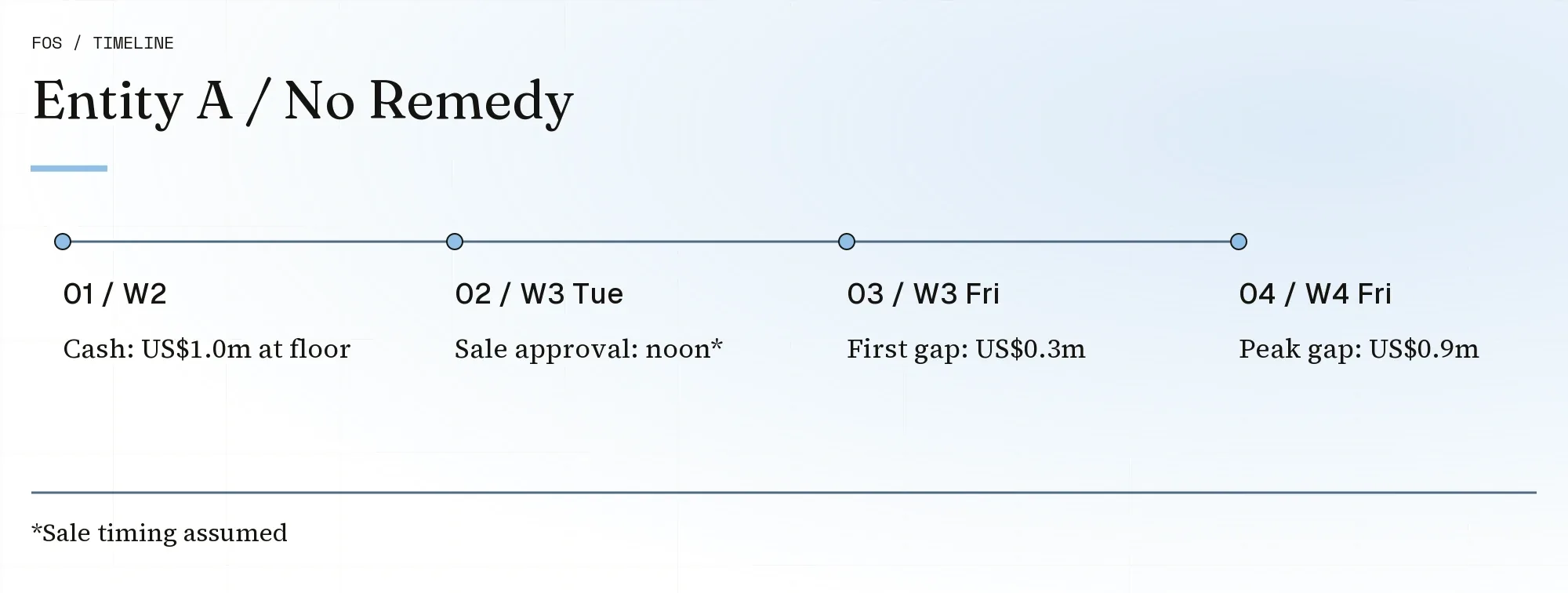
Entity A's fictional US$1.0m operating floor. Tuesday noon is an illustrative approval cutoff for the assumed sale, settlement and transfer sequence, before any office safety buffer. View the full-width desktop diagram. The gaps show the unremedied path.
Entity A's stressed cash remains positive, but its path fails the chosen operating floor. To preserve that floor through week 4 without changing outflows, the office needs at least US$0.9m of additional usable cash in Entity A: US$0.3m before the first week-3 payment and a further US$0.6m before the week-4 payment. One indivisible US$0.9m remedy must arrive by week 3; staged remedies may use those separate deadlines. Exact payment times belong in the office's register.
The family's Entity B also holds US$2.0m cash, with its own US$0.5m floor. Its apparent US$1.5m surplus is not automatically Entity A's resource. The treasury and legal teams would first need to identify the permitted transfer mechanism, approvals, bank signatories and timing. The stress test should show Entity B separately until that path is documented.
04Compare Remedies Against the First Payment Deadline
Assume Entity A also holds liquid securities marked at US$1.2m. The test applies the 20% illustrative sale-proceeds haircut, leaving US$0.96m in stressed gross proceeds before actual transaction costs or tax effects. If that whole amount can reach Entity A's paying account before the week-3 payment, it would lift stressed week-4 cash from US$0.1m to US$1.06m. That clears the illustrative US$1.0m floor by only US$0.06m. Actual net usable proceeds must be at least US$0.9m; costs or price slippage above US$0.06m would make this single remedy insufficient.
But the sale is not yet a passed remedy. Record the instrument, realizable quantity, stressed price, dealing window, settlement cycle, account restrictions and authority to sell. The owner must verify the receiving account and cutoff. If settlement is after the week-3 payment, the sale fails the first-breach test even if its proceeds are enough by week 4.
For this fictional case, place the first week-3 operating payment on Friday at 16:00. Work backward using only these assumed times:
- Friday, 16:00: Entity A must make the payment without falling below its floor.
- Friday, noon: The sale proceeds must reach Entity A's paying account, leaving four modeled hours before payment. Assume the transfer takes up to 24 hours after settlement.
- Thursday, noon: The chosen securities settle under this example's dealing terms. A Tuesday 15:00 trade is assumed to settle by then; this is not a universal settlement rule.
- Tuesday, 15:00: The office must release the order. Assume three hours from signed approval to release, making Tuesday noon of week 3 the latest illustrative approval cutoff under these zero-slippage assumptions.
A Wednesday approval misses the modeled receipt sequence. Four hours between receipt and payment is not an office-approved safety buffer. The approver must set an additional buffer and verify the real order, trade, settlement, transfer and bank cutoffs before acting. The week-4 payment is assumed due the following Friday; proceeds must remain sufficient through it.
Compare remedies on the same amount, arrival, authority and cost test:
| Candidate route | Potential stressed amount | Proof needed before reliance | Present result |
|---|---|---|---|
| Entity A securities sale | US$0.96m after scenario haircut, before costs | Executable net price, authority and arrival in Entity A's account before week-3 Friday 16:00, with office buffer | Proposed remedy, conditional; only US$0.06m cost/slippage margin |
| Credit-line draw | Unknown | Signed undrawn limit, conditions, draw approval, funding time and repayment path | Unverified; cannot pass yet |
| Entity B to A transfer | Up to US$1.5m above B's floor, before B's own future demands | Lawful inter-entity route, entity approvals, bank signatories and timing | Unverified; cannot pass yet |
| Defer a payment | Only an amount shown to be discretionary | Decision authority, revised obligation date and effects on counterparty | Not available for mandatory payments or valid calls |
The candidate amounts cannot be summed as independently usable cash. The same securities may secure a line; Entity B needs its own stress test; a deferred expense may reappear later.
Provisional decision record
- Trigger: Entity A first falls US$0.3m below its floor in week 3; its peak four-week shortfall is US$0.9m.
- Candidate: Sell specified Entity A securities with illustrative gross proceeds of US$0.96m after the scenario haircut. Fees, taxes and executable price remain open.
- Owner: Treasury documents sale, settlement, receipt and a backup; the authorized approver decides whether that remedy and its costs are acceptable.
- Illustrative approval cutoff: Tuesday noon of week 3 under the stated zero-slippage sequence; the office must verify real cutoffs and add its own buffer.
- Unremedied scenario — FAIL: Entity A breaches its floor by US$0.3m in week 3 and US$0.9m in week 4.
- Sale remedy — PROPOSED / CONDITIONAL: An approver may authorize execution, but executable net proceeds of at least US$0.9m must reach Entity A's paying account before the first payment.
- Remediated four-week path — PASS only after proof: Bank evidence must show the receipt and a recalculated path that retains the floor through both payments. The month-2 onward path still fails without another remedy.
If the evidence fails, the family can consider postponing a discretionary payment, adjusting a proposed commitment, using an authorized line or moving cash through a permitted inter-entity route. The unchanged cash calculation will then show whether the revised action works. Mandatory payments and valid calls cannot simply be relabeled discretionary.
05Look Beyond Four Weeks to Find the Next Breach
Passing four weeks leaves the rest of the year to test. Assume for illustration that the full US$0.96m stressed gross sale amount arrives without further costs. Entity A then begins the later view at US$1.06m after its week-4 payment. The continuation below is deliberately provisional: its receipts are forecast, not bank-verified, and it gives no credit for the delayed fund distribution.
- Month 2: A US$0.25m operating payment on day 10 takes cash from US$1.06m to US$0.81m: the next floor breach, US$0.19m, begins then. A modeled US$0.15m receipt on day 20 would lift month-end cash to US$0.96m, still US$0.04m below the floor.
- Month 3: A possible future US$0.55m call on day 10 takes cash to US$0.41m if the modeled month-2 receipt occurred. A further modeled US$0.10m receipt on day 20 would leave US$0.51m at month-end. That call remains hypothetical until notice; its due date must follow the fund documents.
- Months 4–6: A further US$0.45m of receipts and US$0.60m of payments leave US$0.36m.
- Months 7–12: US$1.00m of receipts and US$1.20m of payments leave US$0.16m, or US$0.84m below the floor.
Even a perfect four-week sale does not fund the full stressed year. The second breach begins with the month-2 day-10 payment under these sample dates. The office must work backward from that payment to set a second funding decision deadline. The further month-3 call makes the shortfall deeper even if modeled receipts arrive.
Do not approve new discretionary commitments on the four-week result alone. Sale fees would increase the later shortfall. A subsequently confirmed distribution may be added to a separately labeled scenario when its amount and date are evidenced.
The grouped months 4–12 above are selected checkpoints, not a replacement for the office's full dated register. For every month, show the lowest projected headroom for each legal entity and currency. If the office must convert currency, transfer between entities or sell assets, model the time and approvals before calling that resource available. Do not assume a fund's distributions will offset calls merely because they have done so in an earlier vintage. NEPC's private-markets guidance places calls, distributions and family spending together in a longer-horizon plan; decisions about the size and timing of new commitments belong in a separate pacing review.
Rerun the short and long views after a new call notice, material distribution change, family spending decision, market move, credit-facility change or failed funding remedy. Keep each version and its input dates. A useful test shows which assumption changed and which previously approved response still works.
06Copyable Stress-Test and Approval Register
The office does not need a new software platform to run its first defensible test. A controlled workbook can hold four linked tabs or exports:
- Source register:
entity | account | currency | event | amount | due/settlement date and time | actual/confirmed/modeled | source | owner | last checked. - Scenario assumptions:
shock | affected event | old assumption | stressed assumption | rationale | owner | approval date. Change only named inputs between baseline and stress. - Entity cash path: opening cash + receipts − payments = ending cash; ending cash − policy floor = headroom. Flag the first negative headroom and the largest gap.
- Remedy and decision log:
breach date/time | gap | source | stressed gross proceeds | estimated costs | verified net usable cash | approval | execution lead time | arrival proof | fallback | decision. Mark a remedy proposed, approved, executed and bank-verified separately.
Before signing, the approver should see source records for the largest demands, the scenario's coupled assumptions and the earliest failure. Ask whether a resource remains available after a simultaneous market decline, whether the paying entity can access it, and whether the proposed action settles before that failure.
Record the unremedied path as pass or fail. Record each remedy separately as proposed, approved, executed or bank-verified. Only call a remediated path passed after its cash and floor arithmetic work on verified arrivals. A test that merely shows total family wealth does not answer the payment question.
07Frequently Asked Questions
How Often Should a Family Office Rerun a Liquidity Stress Test?
Set a periodic review tied to the office's cash and investment calendar, and rerun it when a material notice, distribution, market or funding assumption changes. Frequency should match how quickly the office's obligations and available resources can move; it is not a universal legal interval.
Should Every Unfunded Private-Fund Commitment Be Treated as Cash Due Now?
No. Track the entire remaining contractual exposure, but place only noticed amounts on actual due dates. Use documented assumptions to stress the timing and size of future unissued calls. Do not count a noticed amount twice.
Can a Credit Line Make a Failed Test Pass?
Only if the office verifies available borrowing capacity, conditions, authority, draw timing and the later repayment path. A proposed facility or a line that cannot fund before the first breach does not cure the test.
Is a Consolidated Liquidity Ratio Enough?
It can flag a portfolio-level concern, but it cannot prove that an entity has cash in the right account on the required date. The entity cash path and executable transfer or funding route provide that answer.
 Investment & Portfolio · Analysis
What Is Family Office Private Fund Commitment Pacing, and Why Does It Matter?
Private fund commitment pacing sets the size and timing of new promises while older funds can still call… Investment & Portfolio · Analysis
Family Office Private Asset Valuation Policy: Which Mark Belongs in the Report?
A December family report can contain a fund value dated September and a direct-company mark proposed from a… Investment & Portfolio · Analysis