Family Office Co-Investment Due Diligence Begins With the Sponsor's Allocation
A sponsor offers a family office US$5 million beside its private-equity fund and asks for an answer by Thursday noon.
A sponsor offers a family office US$5 million beside its private-equity fund and asks for an answer by Thursday noon. The presentation says there is no separate management fee or carried interest. Those facts do not yet tell the family why the fund is taking only part of the deal, which rights the family would hold, or how much cash it may need after closing.
Start with the allocation. Ask what the fund could have bought, why a side vehicle exists, who else receives an interest and whether all participants pay the same price and expenses. Then inspect the actual vehicle documents. The family can make a decision only when its own investment authority, available cash and evidence arrive before the offer expires.
This article uses a fictional sponsor-led transaction to show that diligence route. The amounts, costs and deadlines are teaching assumptions. Sponsor policies, signed documents, tax and entity rules, and the family's own delegation control a real investment.
- Map the fund, sponsor, side vehicle and family to the actual security and cash flows. A look-through percentage does not grant a direct company vote or board seat.
- Check the allocation rationale, complete economics, information and exit rights, and any future capital request in written evidence. “No management fee” does not answer the full-cost question.
- Record what remains unknown before the acceptance deadline. For this case, the recommended family policy is to make no binding commitment while a material term remains open. The authorized decision-maker can seek more time; if the offer expires first, decline it. A sponsor's informal assurance cannot replace the governing document.
01What Is the Family Being Offered Alongside the Fund?
A co-investment lets an investor participate in a transaction alongside a sponsor's fund. The family may invest directly into a company or holding vehicle, or through a sponsor-controlled special purpose vehicle. The latter is the route in this example. It can simplify the sponsor's cap table while placing a layer of documents and decisions between the family and the company.
The American Bar Association's co-investment structuring analysis distinguishes direct participation from a sponsor-controlled SPV and describes information, pre-emptive, exit and minority rights as deal terms to negotiate. It is a practitioner account of possible structures. The vehicle agreement and company documents must establish which rights this family would actually have.
In the fictional offer, the sponsor plans US$80 million of equity for one acquisition. Its fund would invest US$60 million; a side vehicle would invest US$20 million. The family is invited to contribute US$5 million to that side vehicle.
| Layer in the fictional offer | Equity amount | Share of US$80m transaction equity | What the family can infer |
|---|---|---|---|
| Sponsor's fund | US$60m | 75% | The fund is the largest planned investor; its rights require its documents. |
| Sponsor-controlled side vehicle | US$20m | 25% | The vehicle holds the company security; each participant's rights depend on its documents. |
| Of the side vehicle: family's subset | US$5m, included in the US$20m above | 6.25% of the proposed US$80m equity cheque; not an additional cheque or company ownership percentage | The family supplies 25% of the side vehicle's equity cheque, subject to final units and terms. |
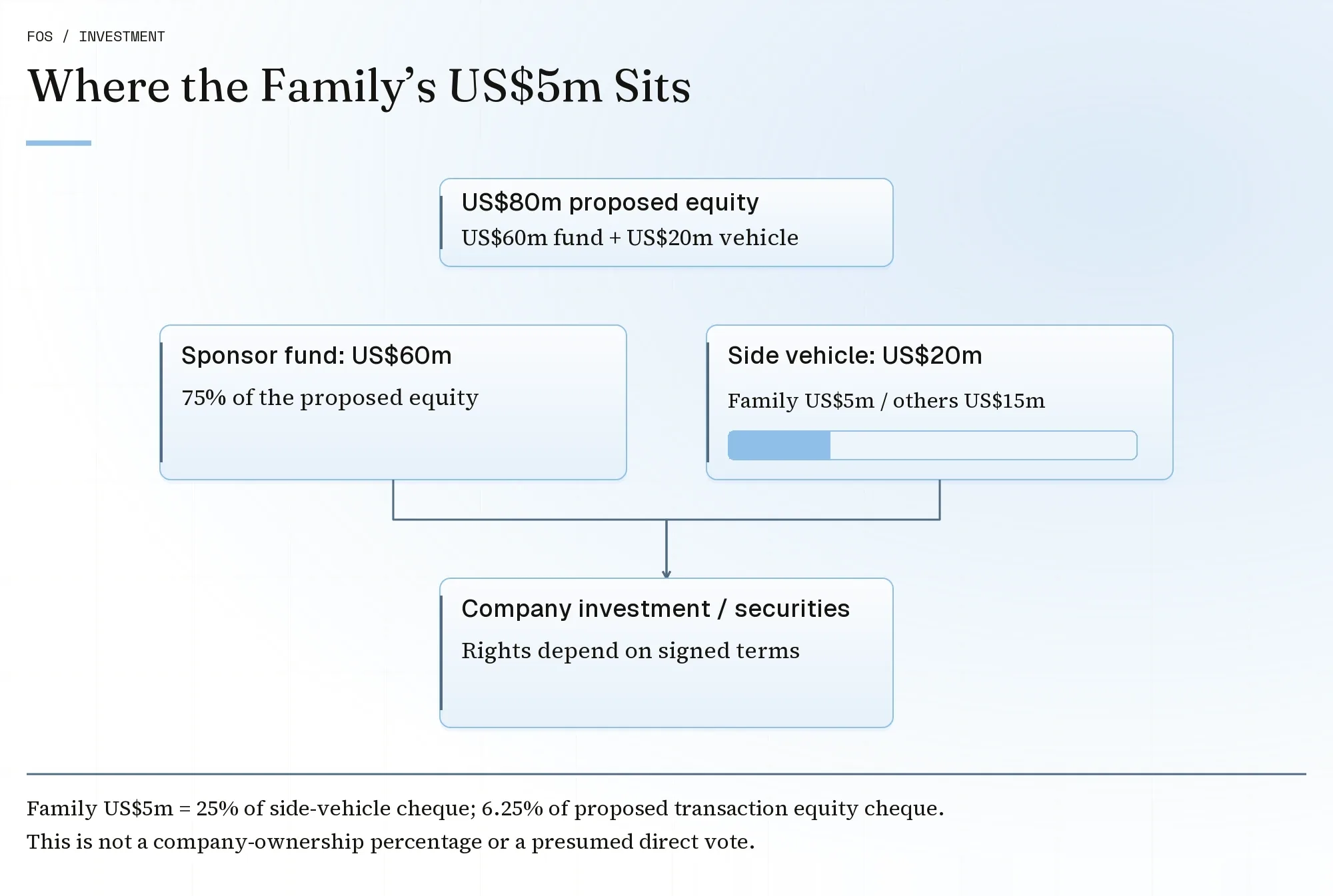
Diagram: The blue quarter of the side-vehicle bar represents the family's proposed US$5m within the US$20m cheque. Open the full-width desktop diagram.
The family's US$5 million is 25% of the US$20 million side vehicle. On a simple proportional calculation it represents 6.25% of the US$80 million equity cheque. The transaction may also have debt, other securities or later dilution; the figure is not a percentage of the whole company's enterprise value. It does not establish direct shareholder, voting or board rights for the family.
Before underwriting returns, obtain a chart showing the portfolio company, holding companies, fund, side vehicle, sponsor affiliates and the family's subscribing entity. Put the proposed investment amount and class of security at each connection. Then ask counsel to compare the chart with the subscription, vehicle and company agreements. A slide that says “alongside the fund” is too imprecise for a commitment decision.
The broader family-office due-diligence checklist covers company and fund underwriting, source records and conflicting evidence. A side-by-side offer still needs that work. This article concentrates on the additional question created by the sponsor's allocation and the family's indirect rights.
02Why Did the Sponsor Allocate Part of the Deal Outside Its Fund?
The family should ask the sponsor for a written explanation of the US$60 million fund position and US$20 million side allocation. Possibilities might include the fund's concentration limit, available commitments, investment period, portfolio construction or a negotiated syndication plan. None has been established for this fictional offer. Request the applicable fund policy, relevant governing terms and a deal-specific allocation memo before accepting any answer.
The ILPA Principles 3.0 recommend that GPs disclose an advance framework for allocating co-investment opportunities, interests and expenses, describe conflict handling, and explain why a co-investment tranche is offered instead of the fund taking the whole opportunity. ILPA's document is industry guidance published in 2019. It does not itself give this family a legal right to the sponsor's internal files, but it gives the investment team precise questions to raise.
Those questions have a practical basis. A 2020 SEC examination risk alert reported instances of private-fund advisers inadequately disclosing allocation conflicts among clients, including different prices or amounts allocated and investments at different capital-structure levels. The historical observation concerns examined advisers; it does not specifically address this fictional side vehicle. It says nothing about this sponsor and creates no new rule for the offer.
For this US$80 million transaction, ask for one reconciled allocation schedule: fund, side vehicle, GP/employee and other investor amounts; security class; entry price; transaction expenses; any syndication fee and its recipient; and any discretion to change the split before closing. Ask how a later equity round would be allocated between fund and side vehicle. If the participants enter at different prices, pay different charges or occupy different levels of the capital structure, the family needs the reason and the resulting risk. Calling both tranches the “same deal” cannot answer that. Ask who reviews conflicts and how a change will be notified.
The first decision gate is documentary. If the sponsor cannot explain the fund/side split and provide the terms on which the family would participate, the family cannot conclude the allocation is fair simply because it likes the company.
03What Will the Family Pay and Control Through the Side Vehicle?
The fictional teaser says “no separate management fee or carried interest.” That may be valuable, but it leaves vehicle formation, administration, broken-deal, transaction, monitoring, refinancing and exit expenses open. Some charges may arise at a portfolio company or holding company rather than appear on the family's subscription invoice.
The ILPA fee guidance notes that GPs may charge fees on co-investments unless the LPA prohibits them and recommends clear disclosure of fee allocation and offsets. The ABA analysis likewise describes possible indirect fees and expenses. Neither source supplies this sponsor's fee schedule. The family needs the draft vehicle budget, company-level fee agreements and the final governing terms.
Suppose that draft budget contains US$60,000 of side-vehicle setup costs in addition to the US$20 million equity cheque, separately funded by the vehicle's participants. On that assumption, the vehicle invests the full US$20 million while its participants supply US$20.06 million in total. If the setup costs are permitted and split strictly in proportion to subscriptions, the family's 25% share would be US$15,000. Its modeled upfront cash requirement would be US$5.015 million, of which US$5 million buys the proposed vehicle interest and US$15,000 pays an expense.
This is a possible charge under an explicit funding assumption; no invoice has been issued. Request a gross-to-net sources-and-uses schedule to check whether the real documents instead deduct costs from subscribed capital. Check whether the US$60,000 is a cap or estimate, who may increase it, whether broken-deal costs are included, and whether the family bears expenses even if the transaction does not close. A zero management-fee line cannot settle those questions.
Control is similarly layered. The vehicle may receive company financials, a board observer seat or consent rights while the family receives only periodic vehicle reports. Ask which document requires the sponsor to pass information through, how quickly, and whether the family can inspect material changes before a vote or sale. Identify who can amend the vehicle agreement, approve a related-party transaction, waive rights or transfer the family's interest. The answer may be different for each decision.
Use the same four questions when reading the sponsor's presentation and operative terms:
| Decision question | What the fictional offer shows | Evidence still needed before a yes | Action if missing by deadline |
|---|---|---|---|
| Why does the fund take US$60m and the vehicle US$20m? | Amounts are shown; rationale is not. | Fund allocation framework, deal memo, other investor/affiliate interests. | Hold the fairness judgment and seek an extension. |
| What does the family's US$5m buy and cost? | A 25% proposed vehicle interest and “no management fee/carry” claim. | Security/units, entry price, full sources and uses, complete vehicle and company-level expense schedule. | Seek the cost schedule and more time; decline if still material and unavailable at expiry. |
| Which information and decisions reach the family? | A sponsor-controlled vehicle is named. | Complete execution-form reporting, consent, amendment and transfer provisions for counsel to review. | Seek the clauses and more time; decline if rights remain material and unverified at expiry. |
| What happens if more equity is needed or the fund exits? | No follow-on or exit terms are provided. | Notice, participation, opt-out or dilution, drag/tag, sale, transfer, distribution and expense terms. | Seek the terms and more time; decline if future exposure or exit control remains materially unknown at expiry. |
Send the evidence-needed column to the sponsor as a document request. An absent clause stays unknown; a presentation alone cannot turn it into approval. If execution copies change after review, counsel must compare them with the approved forms before closing.
04What If the Deal Needs More Cash or the Fund Exits?
The investment team should model a later cash call before using the term “US$5 million opportunity.” The ability to participate pro rata, the price, notice period, consequences of not funding and possible dilution all depend on the executed documents and future financing. A reserve is a family planning choice; it creates no automatic right to invest later.
In the fictional case, assume a later US$24 million equity request and, only for the stress test, the original investors are offered the same proportional participation. The side vehicle would take 25%, or US$6 million; the family would take 25% of that vehicle amount, or US$1.5 million. If it set aside US$1 million, its additional reserve gap is US$500,000. The sponsor could propose different terms or a different allocation. The calculation gives the investment committee a cash question; it predicts neither an actual call, a direct family subscription right nor a binding obligation.
For the entry decision, the investment committee or other person named in the family's actual delegation should decide whether a further US$500,000 could be reserved or sourced under this stress case, whether to seek a smaller entry allocation, and whether any documented opt-out or dilution consequence is acceptable. This is a present capacity test, not authorization for a future payment. If a real call arrives, its documents, price, notice and the family's then-current delegation determine whether and how to participate.
The family should test whether it could fund that scenario without selling a position under pressure or breaching its own concentration limit. It should ask whether it can decline, transfer or be diluted, and what notice it receives. Its fund stake, if any, must be counted with the side-vehicle economic exposure when assessing concentration; the same underlying company should not appear as two unrelated positions simply because two vehicles hold it.
Exit is another linked test. If the sponsor sells the fund's stake, can it compel the side vehicle to sell, and on which price and expense terms? If the family wants to sell early, who can approve a transfer and what market is realistically available? The ABA discussion describes negotiated co-sale, information and pre-emptive rights; those rights are not presumed in this offer. Counsel should mark the exact clauses and exceptions.
Post-close monitoring also needs an owner. The investment lead should name a records owner to log each vehicle capital notice and distribution and obtain the periodic company and valuation reports required by the final agreement. A late notice, changed leverage or related-party arrangement goes to the authorized reviewer before the next funding or report decision.
The exact reporting cadence and remedy for a missed sponsor notice belong in the vehicle terms, not in an assumed standard. The direct-investing guide addresses the wider choice of route and operating capacity. Here, the extra task is making the sponsor-controlled vehicle's information and decision pathway usable for this specific family.
05What Must Be in the Decision Record Before the Offer Expires?
In the fictional timeline, the sponsor sends the offer Tuesday at 3 p.m. and asks for a response Thursday at noon. The family may ask for an extension. It should not turn an incomplete deck into a binding commitment solely because the clock is short. The investment lead can keep this one dated record for the family's authorized decision-maker. The internal cutoffs below are illustrative; a real office would set its own and obtain any extension in writing.
| Decision item | Current status | Sponsor evidence and delivery owner | Family reviewer and internal cutoff | Decision rule |
|---|---|---|---|---|
| Fund/side allocation | Unknown | Sponsor deal lead: allocation memo, relevant fund policy or provision, participants, prices and classes | Investment lead, Wednesday 3 p.m. | Explain material differences and conflict handling; otherwise seek extension or decline at expiry. |
| All-in entry cash | US$5m proposed; US$15k modeled expense unconfirmed | Sponsor finance contact: execution-form sources and uses, vehicle budget, expense cap, syndication fees and allocation clause | Family finance lead, Wednesday 3 p.m. | Verify whether the family needs US$5.015m under the separate-cost assumption or a different documented amount; no binding yes on an unknown cheque. |
| Family rights and exit | Unknown | Sponsor counsel: complete execution-form vehicle/company clauses for notices, voting, amendments, conflicts, transfers, sale, distributions and expenses | Family counsel, Thursday 9 a.m. | Identify exact rights and any remedy if sponsor notices fail; seek extension or decline if a material right or restriction is unverified. |
| Follow-on capacity and family authority | US$1.5m stress, US$1m reserve, US$0.5m planning gap; terms unknown | Sponsor deal lead: fund/vehicle future allocation, participation, opt-out/dilution and notice clauses | Investment lead and authorized approver, Thursday 9 a.m. | Approver checks whether an extra US$0.5m can be reserved or sourced now and whether documented alternatives are acceptable. A future call needs its own decision under then-current terms and delegation. |
| Company/deal underwriting | Unknown in this offer record | Sponsor deal lead: operating, leverage, valuation and downside evidence requested under the linked broader due-diligence packet | Investment reviewer, Thursday 9 a.m. | Record pass, hold or adverse finding with source and reviewer; missing or unreviewed material evidence keeps this offer on hold. |
| Final response | Hold; no binding instruction sent | Sponsor deal lead: written extension confirmation if evidence misses an internal cutoff | Family counsel confirms final execution forms and sources/uses match approved terms; authorized approver decides Thursday 10 a.m.; investment lead communicates by noon | Go only after all evidence, company underwriting, cash and delegated authority pass. A material final-form change returns to approver. Otherwise seek written extension, or decline at expiry. |
If evidence arrives after its internal cutoff, the reviewer tells the approver what remains unexamined and seeks a written extension; late delivery is not a pass. For this case the current response is hold while the allocation, complete economics, operative rights and future-cash decision remain open. A later go requires review of the final documents and confirmation that the execution copies have not changed adversely.
Common questions
Does a co-investment replace fund due diligence? No. The fund/sponsor record matters because it controls allocation, conflicts and often the side vehicle. The company and deal still need their own underwriting, as does the legal route for the family's money.
Is a co-investment with no management fee cheaper? It may be, but the comparison needs every direct and indirect fee and expense, the way costs are allocated, and any different entry or exit economics. In the fictional case, a possible US$15,000 setup share remains unresolved despite the headline fee claim.
Does 6.25% look-through mean the family owns 6.25% of the company? The arithmetic describes its proportional share of the proposed US$80 million equity cheque. The vehicle and company documents determine legal ownership, voting, information, transfer and proceeds rights.
Must the family fund later rounds? That depends on the signed participation and default terms. The US$1.5 million stress case tests preparedness; it is not a forecast call or an assertion of a legal obligation.
Who follows the investment after closing? Name a family records owner for notices, reports, valuations and distributions and an authorized reviewer for late notices, policy exceptions or a new funding request. The agreement must supply the actual reporting cadence and rights.
For this fictional Thursday offer, approve only if the documented allocation, complete cost, rights, company underwriting and authorized cash decision pass. Otherwise seek a written extension while the offer is open; if a material condition remains unresolved at expiry, decline.
 Investment & Portfolio · Analysis
What Is Family Office Private Fund Commitment Pacing, and Why Does It Matter?
Private fund commitment pacing sets the size and timing of new promises while older funds can still call… Investment & Portfolio · Analysis
Family Office Private Asset Valuation Policy: Which Mark Belongs in the Report?
A December family report can contain a fund value dated September and a direct-company mark proposed from a… Investment & Portfolio · Analysis