How a Cash Deadline Changes Family Office Portfolio Rebalancing
A family office can face a cash deadline and an allocation breach at once. A worked US$105m case separates the funding trade from a valuation-sensitive band trade.

A family office can see an allocation breach and a cash deadline on the same day. The two signals do not necessarily justify the same trade. One may require funding now; the other may depend on a private-asset value that has not arrived.
This guide shows how to separate them. A fictional US$105 million portfolio faces a US$4 million outgoing payment and an apparent public-equity breach. The worked decision identifies what the office must fund, what it can trade conditionally, and what should stay open until better evidence arrives.
- Treat an allocation band as a review trigger, then check the valuation dates and assets actually available to trade.
- Fund a committed payment and the required cash reserve before considering an optional move toward target weights.
- Approve the specific lots and orders only after checking tax, cost, mandate and settlement. Record why any separate drift trade was deferred.
01What rebalancing changes—and what it does not
Portfolio rebalancing changes holdings to bring exposures closer to the family’s approved policy. It can use a scheduled review, a tolerance-band breach, cash flows, or a combination. The trigger starts a decision; it is not an instruction to sell a particular security.
The choice has a measurable trade-off. Tighter control of target weights usually means more turnover. Wellington’s multi-asset analysis frames the policy choice around deviation from target and the trading required to contain it. It also notes that illiquid assets may need an acceptable range rather than a point target. Those findings inform the questions to ask; they do not set a band for this family.
Rebalancing also does not guarantee a higher return. A trade can reduce an unwanted exposure while creating tax, spread or implementation costs. The family’s investment policy should say whose weights count, which valuations are accepted, how much drift prompts review, and who may authorize an exception.
02First, establish the portfolio and cash deadline
Assume the following fictional family-wide reporting perimeter. Values are in US$ millions. The private-fund value is the last approved figure from 31 December 2025; the other values are from a 31 March 2026 report used for the 10 April 2026 decision. The policy’s public-equity upper review band is 43% of this perimeter. It also requires at least US$3 million cash after scheduled payments. These thresholds are invented for the example, not recommended defaults.
| Holding | Value used | Value date | Liquidity for this decision |
|---|---|---|---|
| Public equities | 46 | 31 March | Tradable, subject to account, lot and settlement checks |
| Bonds | 24 | 31 March | Potentially tradable, subject to cost and settlement checks |
| Private fund interests | 30 | 31 December | Not assumed saleable before this deadline |
| Cash | 5 | 31 March | Available, but the policy floor still applies |
| Reported total | 105 | Mixed dates | Not all US$105m can be spent or rebalanced |
The paying entity must send US$4 million outside the portfolio on 15 April. Assume the office decides on 10 April using the positions above and that any chosen sale settles by 14 April; actual prices and balances must be refreshed before trading. For this example, US$5 million cash is already in the paying account and can settle the payment; the US$3 million floor applies to that same account. Paying from cash alone would leave US$1 million, below the floor. The minimum is US$2 million in net settled proceeds after execution costs, before any optional cushion. In a real structure, the office must verify entity-level account access and payment instructions rather than treating family-wide cash as freely transferable.
On the mixed-date US$105 million report, public equities appear to be 46 ÷ 105 = 43.81%, above the 43% review band. It is a provisional signal. The private-fund denominator is dated three months earlier, so the office should not call 43.81% a precise 31 March exposure without that qualification.
03Which trade funds the payment?
The office can first look for confirmed incoming cash or a distribution whose timing, amount and legal owner match the payment. Predictable flows can reduce unnecessary turnover; Wellington warns against making the whole rebalancing policy depend on uncertain flows.
Assume there is no usable incoming cash before 15 April. The office's initial funding test is US$2 million net proceeds: US$4 million payment + US$3 million cash floor − US$5 million starting cash. A gross US$2 million sale would miss the floor if execution costs were positive.
Suppose the desk estimates US$0.03 million in spreads, fees and other execution costs, and the treasurer wants US$0.07 million of cash above the floor. A US$2.10 million public-equity sale from an eligible account is one illustrative candidate, provided its US$2.07 million expected net proceeds reach the paying entity by 14 April. After the sale and payment, and before market movement or other flows, the balances would be:
| Holding | After payment and illustrative sale (US$m) |
|---|---|
| Public equities | 43.90 |
| Bonds | 24 |
| Private fund, last approved value | 30 |
| Cash | 3.07 |
| Total | 100.97 |
The US$2.10 million sale moves money between equity and cash; US$0.03 million in assumed costs and the US$4 million payment leave the perimeter. Hence 105 − 4 − 0.03 = 100.97. Cash ends at 5 + 2.10 − 0.03 − 4 = 3.07. If actual costs, settlement or another obligation would take cash below US$3 million by the due date, this candidate fails and needs a different size, source or timing.
Selling US$2.10 million of bonds under the same cost assumption could fund the payment but leave public equities at 46 ÷ 100.97 = 45.56% on the stale private value. The equity sale would leave them at 43.48%. This is an exposure comparison, not a complete trade ranking: the bond may settle differently or carry a lower tax cost. The investment and tax teams must compare eligible accounts, expected net proceeds, settlement and lot-level effects before selecting a security.
In a US taxable account, a sale can realize a gain or loss measured against adjusted basis; holding period also affects the tax treatment. The IRS capital-gains guidance and stock-basis FAQ support checking the actual lots and properly identifying selected shares with the broker where that method is used. Our tax-lot method guide explains that recordkeeping choice in more detail. None of these sources establishes that the illustrative equity sale is tax-efficient for this family. Account ownership and legal restrictions must be checked as well.
The funding decision
- Obligation: US$4m payment due 15 April from the named entity.
- Cash test: US$5m in the payer account; US$3m minimum after payment; US$2m minimum net proceeds.
- Illustrative candidate: Sell US$2.10m of eligible public-equity lots for US$2.07m expected net proceeds after US$0.03m estimated costs, leaving US$3.07m cash. This remains a proposal until lots, costs and settlement are checked.
- Authority: Treasurer confirms payment instructions and cash timing; investment decision-maker approves the eligible lots and order; controller verifies actual proceeds and the cash floor after settlement.
04Does the allocation breach still require a trade?
After the illustrative funding sale, the mixed-date report shows public equities at 43.90 ÷ 100.97 = 43.48%. A mechanical application of the 43% band would suggest reducing equity by about US$0.48 million: 43.90 − (0.43 × 100.97) = 0.4829. That pre-cost calculation assumes the private-fund value remains US$30 million. It does not select a destination for the proceeds or approve an order.
About US$31.12 million is the decision boundary in this simplified case. Holding all other post-payment values fixed, an accepted private-fund NAV of approximately US$31.123 million puts the equity weight at 43%: 43.90 ÷ 0.43 − (43.90 + 24 + 3.07). Below it, the breach persists; above it, this upper-band signal clears. The table tests valuation uncertainty in both directions. It is sensitivity analysis, not a substitute for an approved valuation.
| Accepted private NAV scenario (US$m) | Post-payment total (US$m) | Equity weight | 43% band signal |
|---|---|---|---|
| 27.00 | 97.97 | 44.81% | Breach widens |
| 30.00 (last approved, dated 31 December) | 100.97 | 43.48% | Provisional breach |
| 31.123 | 102.093 | Approximately 43.00% | Approximately at boundary |
| 34.00 | 104.97 | 41.82% | No upper-band breach |
The cash-funding trade has a separate purpose in every row. The optional drift trade changes with the accepted valuation; a lower mark would make it more urgent, while a US$34 million mark would remove this particular breach.
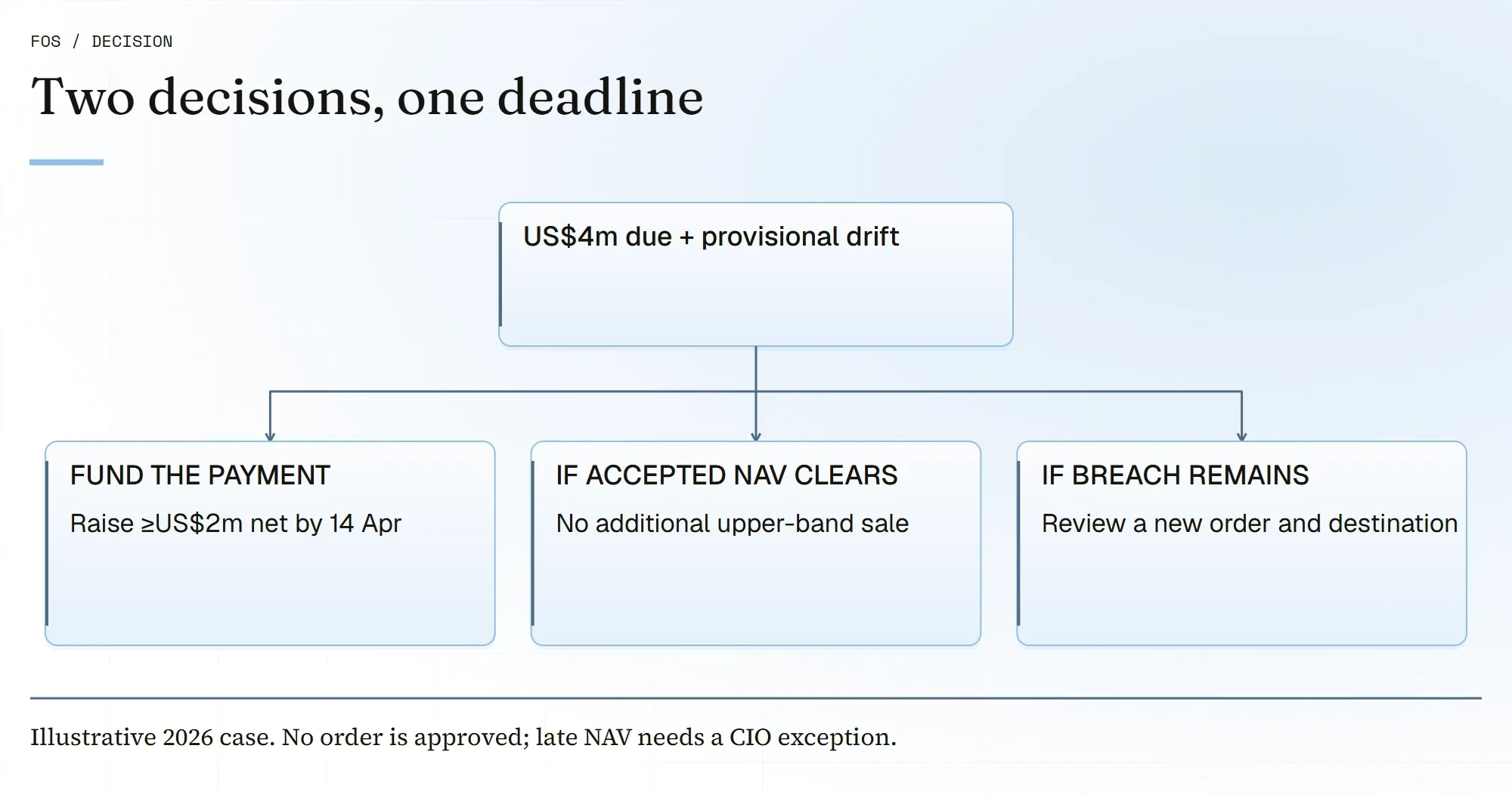
The funding order and any drift order need separate approval. The diagram uses the simplified 2026 case and a NAV boundary of about US$31.123 million. View the full-width desktop diagram.
The office must not simply replace an approved US$30 million December value with a guessed US$34 million March value. Keep the old number, its date and any approved provisional treatment visible. Request the administrator’s current statement or an approved valuation bridge. Calculate sensitivity to plausible values for decision support, then decide whether the policy allows a trade before the current value is accepted.
Russell Investments’ discussion of private-market rebalancing explains the practical constraint: an illiquid allocation cannot usually be resized like an exchange-traded sleeve. The liquid portfolio often bears the adjustment. We infer that forcing public holdings to absorb every stale-mark movement could create unwanted exposure elsewhere.
The illustrative proposal is therefore seek approval for a costed funding trade now and seek a separate, time-limited exception for the optional band trade. Assume this fictional policy lets the CIO authorize a deferral requested on Friday 10 April 2026, running for the five following business days under the assumed office calendar and expiring at the close of Friday 17 April 2026. The named governance officer sends investment-committee notice on 10 April if the CIO approves it. The funding sale must still settle by 14 April for the 15 April payment.
During the exception, the controller checks both mixed-date reported weights from refreshed public positions and cash and pro forma weights after the planned sale, estimated costs and US$4 million payment. Each calculation shows the last approved private NAV and a documented downside NAV sensitivity supplied by the fund-data owner. Neither is passed off as a fully current total-portfolio weight. The CIO reviews either estimate at or above a separate 45% escalation limit immediately; if the downside cannot be bounded credibly, the committee reviews immediately rather than waiting for an apparent 45% print. If the March fund value has not arrived by 17 April, the committee must renew or end the exception explicitly. These time and exposure limits are invented for the example.
If an accepted value still breaches the 43% band, calculate a fresh trade and approved destination rather than recycling the US$0.48 million figure. A lower NAV may increase the required adjustment; a higher one may remove it.
05Compare calendar, band and cash-flow rules
These rules answer different operational questions. They can work together, but none substitutes for asset-level data and authority.
| Rule | What starts review | Where it helps | What to test |
|---|---|---|---|
| Calendar | A fixed review date | Ensures drift is revisited | Could a large breach arise between reviews? |
| Tolerance band | Weight crosses an approved range | Links action to exposure | Are values dated and comparable? Is the breach material after costs? |
| Cash-flow aware | Known contributions, spending, calls or distributions | May reduce turnover | Is the flow firm, in the right entity and before the trade deadline? |
The office can schedule a monthly monitoring run, escalate a band breach when it occurs, and use confirmed cash flows when they fit. A private interest may have a wider review range than liquid assets because its mark arrives later and its units cannot easily be traded. This is a policy design choice, not a universal percentage.
New commitments and capital calls are separate from mark-to-market drift. A commitment is not immediately an invested value or spendable cash. A call may consume liquidity even when the reported private NAV has not changed. Maintain a cash calendar and a commitment register alongside the allocation report.
06Turn the decision into an approved order
The investment committee or its delegated authority should approve the reason, asset, account, quantity or value limit, time window and fallback for each order. The trader or custodian then executes within that mandate. The controller reconciles proceeds, costs and settlement to the cash forecast. The report owner updates weights only from accepted post-trade positions and valuation dates.
Before releasing the order, confirm:
- The signal: Which policy version and perimeter produced the breach? Were source values accepted, provisional or stale?
- The cash need: Which entity pays, when, and through which account? What cash must remain after estimated costs?
- The candidate trade: Which account and lots are eligible, and what are their estimated gains, spreads, fees and settlement dates?
- The mandate: Who can approve a funding trade versus a discretionary drift trade? What happens if prices or values change?
- The stop condition: Which missing statement, restriction or tax issue requires a pause or a smaller order?
A proposed authorization to sell up to US$2.10 million gross targets US$2.07 million net and the US$0.07 million cushion above the cash floor. US$2 million net is the hard floor requirement; if proceeds miss the cushion but meet the floor, the treasurer must approve the smaller margin or revise the order. Below US$2 million net, the proposed funding route fails. This funding authority would not authorize a separate trade to return public equities to a 40% target. If the office has such a target, it should specify whether a breach calls for a move to the band boundary, a partial move, or the target itself.
07What to record and review next time
A short decision record should let another reviewer reproduce the result: policy version; legal entities and accounts; position and valuation sources with dates; calculation before and after cash flows; accepted assumptions; trade alternatives; tax and cost review; approver; order details; settlement; and the date for rechecking deferred drift.
Before execution, this fictional case's 10 April record could say: “Proposed US$2.10m equity sale targeting US$2.07m net proceeds for the 15 April payment; lot, cost and 14 April settlement checks open. Treasurer owns cash timing; CIO owns order approval. Private NAV remains dated 31 December. Separate band-trade deferral requested from CIO through 17 April, with daily public-mark and downside-NAV monitoring; committee notice and CIO decision pending.”
The same record should state the settlement outcomes: at least US$2.07m net meets the illustrated cushion; US$2.00m to below US$2.07m protects the floor only if the treasurer accepts the smaller margin or revises the order; below US$2.00m fails this funding route. Name the officer who sends committee notice. After settlement, the controller adds actual net proceeds, payment confirmation and verified cash. This is a conditional proposal, not proof of execution or a better return.
At the next policy review, ask whether the cash floor, 43% band, private-asset valuation rule and authority limits worked under stress. Revise the policy only through the designated decision process. A bad or late valuation should not quietly rewrite it through an ad hoc trade.
 Investment & Portfolio · Analysis
What Is Family Office Private Fund Commitment Pacing, and Why Does It Matter?
Private fund commitment pacing sets the size and timing of new promises while older funds can still call… Investment & Portfolio · Analysis
Family Office Private Asset Valuation Policy: Which Mark Belongs in the Report?
A December family report can contain a fund value dated September and a direct-company mark proposed from a… Investment & Portfolio · Analysis