Family Office Direct Investing: Underwrite the Deal and the Work It Creates
A direct investment gives a family a claim on a specific company or asset. It also gives someone a continuing job: verify the opportunity…

A direct investment gives a family a claim on a specific company or asset. It also gives someone a continuing job: verify the opportunity, negotiate rights, monitor performance, fund possible follow-ons and decide when to exit. The question is whether the office can do that work at the proposed size and on the proposed terms.
- A direct deal or co-investment can target an identified company. A pooled fund pursues a mandate and may never own that company.
- Test committed exposure against the policy limit, then model plausible follow-ons under the policy's capacity rule.
- Do not approve a deal until a named person owns diligence, conflicts, funding authority, valuation, monitoring and the route to an exit.
01What Counts as Direct Investing?
In this article, a direct investment means the family selects and holds an interest in an identifiable private company or asset, rather than delegating underlying asset selection to a pooled fund manager. A family can take a controlling stake or a minority stake. Selection does not itself give the family control, a board seat or an exit right.
The term is sometimes used more broadly for co-investments beside a sponsor or club deals with other families. Those arrangements deserve separate treatment: the family may select the specific exposure while another party leads the transaction and post-close work. The signed documents, not the label, determine its rights.
Private placements can be hard to resell and may have limited disclosure. The SEC's private-placement bulletin explains the illiquidity and information risks. A family office should also obtain US legal and tax advice on the proposed entity, security, investor eligibility and transaction. The SEC family-office rule conditionally addresses an office's investment-adviser status; it does not establish eligibility for a private offering.
The choice matters because the family's exposure and workload need not move together. A minority investor may have little influence but still have to evaluate capital calls, monitor covenants and explain a stale valuation to the family's reporting team.
02Compare Three Routes Into Private Companies
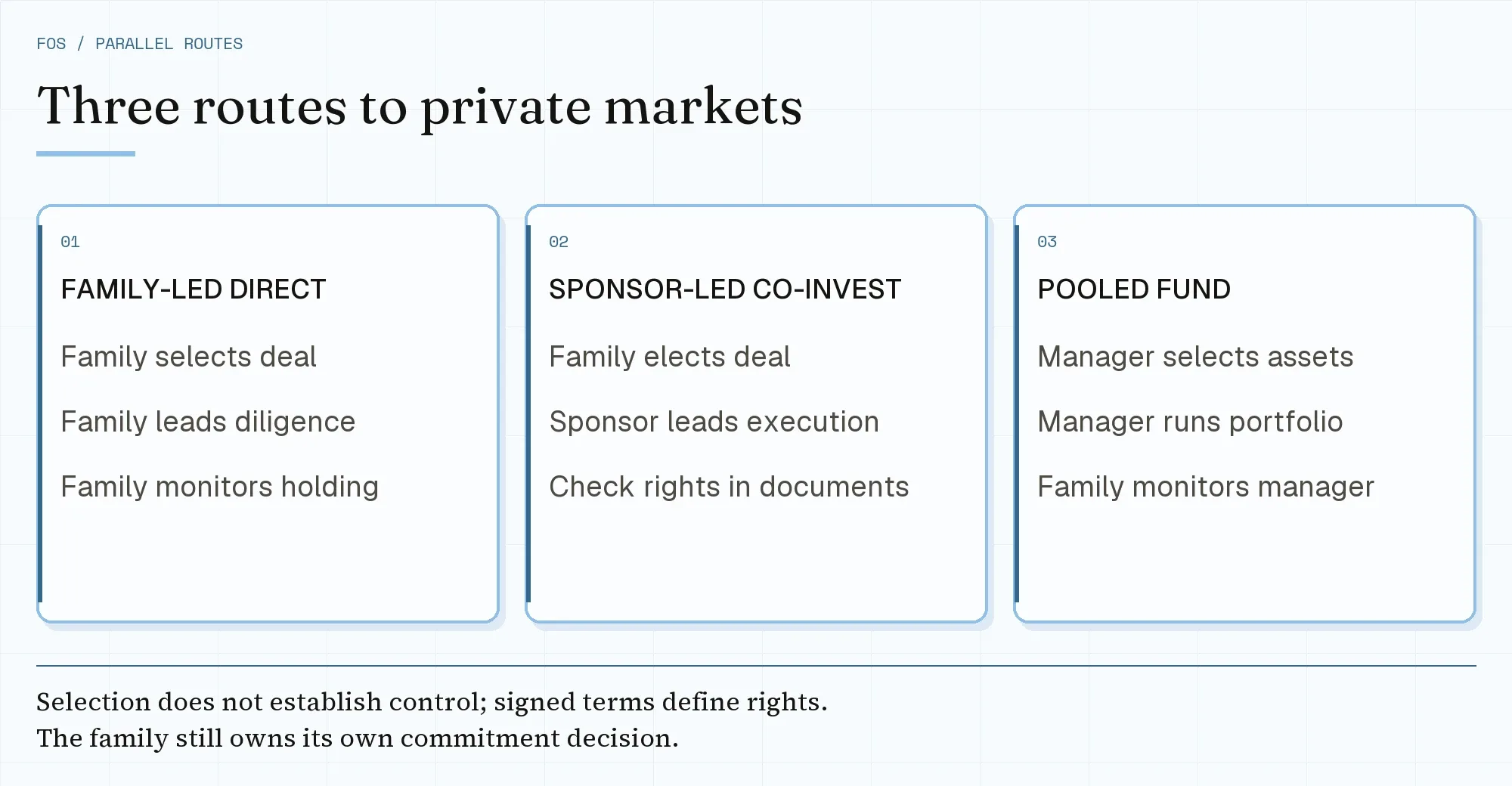
Suppose the family is interested in a private manufacturer it understands. A family-led direct deal or sponsor-led co-investment could provide an interest in that identified company. A pooled fund may pursue a similar thesis, but its manager may never buy the manufacturer. These are not three ways to secure the same asset.
| Route | Who selects the assets? | Who leads diligence and negotiation? | What the family must verify |
|---|---|---|---|
| Family-led direct deal | The family office | The office and its retained advisers | Governance rights, transaction documents, management oversight, funding plan and exit options |
| Sponsor-led co-investment | The family elects this identified deal alongside a sponsor | Usually the sponsor, subject to the actual documents | Sponsor diligence access, allocation terms, fees, information rights, follow-on obligations and sponsor conflicts |
| Pooled fund commitment | The manager selects assets within a mandate; this company may never be bought | The manager | Manager mandate, fees, reporting, capital-call terms, conflicts and liquidity |
A co-investment can reduce some sourcing or execution work; it does not relieve the family of its own decision to commit. A fund may provide manager capacity and diversification across holdings, depending on its mandate and concentration, but the family generally does not choose this single company. None of the three routes is inherently the cheapest or safest.
Ask to see the exact security and holding entity for each route. A family-owned minority share, an interest in a sponsor vehicle and a limited-partner interest in a fund are not interchangeable. Compare both the economic exposure and the right to receive information, vote, block certain actions or sell.
03The Follow-On That Tests a Portfolio Limit
Consider an illustrative US family with a US$100 million investment portfolio and an internal policy ceiling of US$12 million for direct private-company exposure. For this example, policy measures exposure as invested cost plus any legally binding unfunded commitments. The existing US$7 million is invested cost, with no other binding commitments assumed. A new deal requests US$4 million to be funded at closing and could invite a further US$2 million to support a planned expansion. The follow-on is discretionary here, not a binding obligation.
| Policy exposure and discretionary planning scenario | US$ million |
|---|---|
| Existing direct investments | 7 |
| Proposed closing investment | 4 |
| Policy exposure at closing | 11 |
| Discretionary follow-on scenario | 2 |
| Exposure if the follow-on is funded | 13 |
| Internal ceiling | 12 |
| Potential excess if funded | 1 |
At closing, US$7 million plus US$4 million equals US$11 million, below the US$12 million ceiling. If the family later elects to fund the full US$2 million follow-on, exposure reaches US$13 million. The office must distinguish a binding commitment, a likely support need and a discretionary scenario. Under this example's policy, the discretionary reserve is a planning need, not present policy exposure.
Keep the US$2 million visible in the funding plan. The committee could reduce its opening stake, negotiate participation terms, decline the deal or reserve capacity. If it makes a legally binding unfunded commitment, or later funds an amount that takes policy exposure above US$12 million, it must resize or obtain an authorized exception before proceeding. A different family's policy may count prospective reserves; inspect that policy separately. The committee must also check concentration by company, sector and family enterprise exposure. The US$12 million ceiling is an example, not a recommended market threshold.
The potential US$1 million excess is only one gate. The family may need cash for taxes, distributions, other capital calls and existing obligations. A private holding cannot be assumed saleable when those needs arise.
04What Diligence Must Establish Before a Binding Commitment
A polished investment memo is a starting point. A non-binding term sheet may come before full diligence. Before a binding commitment or wire instruction, the office needs source records, independent challenge and a decision on what remains unknown.
For the illustrative manufacturer, the investment lead would request audited or reviewed statements where available, management accounts tied to the same period, a customer-concentration schedule, debt and covenant documents, ownership records, litigation and regulatory disclosures, a cash forecast, and a use-of-proceeds bridge. The office should define who reconciles inconsistencies and who can accept a residual risk.
A practical decision packet separates four questions:
- Business: What must happen for the company to earn the proposed return, and which customer, operating or financing assumptions could break it?
- Price and terms: What does the family receive for US$4 million? Model dilution, preference rights, debt priority, fees and a downside case before relying on a valuation headline.
- Authority and conflicts: Who represents the family, who has a side interest, what information can each party see, and who can sign or waive a right?
- Liquidity and follow-on: What funding can be required, when could the family refuse it, and what happens to its stake if it does?
The committee should record missing documents as open conditions, not turn them into a pass because the investment narrative is attractive. Commercial, legal, tax and valuation specialists may each own a different diligence question. Their involvement does not transfer the family's approval authority unless its governance documents explicitly do so.
A Dentons survey of family offices describes operational risk, deal flow, exit control and limited diligence time among respondents' challenges. Those are survey findings, not an estimate of what this particular office will experience. They help identify which tests to perform.
05Decide Who Will Own the Work After Closing
Before approval, ask for a one-page operating map with a person, record and escalation path for each obligation.
| Work after closing | Evidence the office should require | Decision owner to name |
|---|---|---|
| Capital call or follow-on notice | Notice, obligation under signed documents, cash forecast and policy-limit refresh | Authorized funding approver |
| Company performance | Dated management pack, covenant status and variance explanation | Investment lead or named external manager |
| Valuation for family reporting | Approved method, source date, adjustments and reviewer sign-off | Valuation policy owner and report approver |
| Governance rights | Board papers, votes, waivers and conflict register | Appointed representative within delegated authority |
| Exit or recapitalization | Consent thresholds, transfer restrictions, expected proceeds and tax analysis | Investment committee or other authorized body |
The names may differ in a sponsor-led co-investment or fund. The family still needs to know who supplies the evidence and what it can challenge. A monthly dashboard is not proof that the underlying private value is current; label an older valuation date in the family report and document the bridge to any new figure.
Set reporting triggers before closing. A covenant breach, missed forecast, follow-on request or proposed sale should arrive with an owner and deadline. If no one has capacity to read the information and act, the investment plan has an operating gap.
06Price the Opportunity and the Capacity It Requires
Fund fee categories can be found in the fund documents, while total cost still depends on terms and expenses. The cost of leading a direct deal can be scattered among legal work, tax structuring, diligence, travel, specialist retainers and ongoing staff time. A co-investment may add sponsor fees or carried interest. Compare written terms and a common expected holding period; do not assume a direct deal “saves fees” overall.
Build a scope ledger before comparing routes:
| Cost or demand | Family-led direct | Sponsor-led co-investment | Fund |
|---|---|---|---|
| Transaction diligence and legal work | Family-led; quote externally | Sponsor-led work plus family's own review | Manager diligence and fund-document review |
| Ongoing monitoring and valuation review | Family capacity required | Split by documents and information rights | Manager reports, with family oversight |
| Fees, carry and expenses | Deal and adviser terms | Sponsor/vehicle terms | Fund terms |
| Follow-on decisions | Family must plan and approve | Family rights and obligations depend on vehicle | Manager selects underlying deals; family budgets LP calls under its signed commitment |
| Exit control | Depends on stake and agreements | Depends on sponsor and vehicle terms | Typically manager-led |
Unknown means request the term sheet or quote, not zero. For the US$4 million case, the office might pay for independent diligence and still decline the deal. That spending is a cost of disciplined selection. The relevant question is whether the family can sustain both the capital at risk and the work required across several holdings.
Run the same capacity and authority test across routes
The US$4 million manufacturer opportunity is available only through the first two routes in this example. The fund is a way to pursue a broader private-company mandate; it does not secure the manufacturer. The family's policy must say whether a sponsor-vehicle interest counts toward its direct-exposure ceiling. The fund's LP commitment needs a separate cash schedule even if the policy classifies it outside that ceiling.
| Route | Policy and cash test for this family | Who makes the next investment decision? | Conditional result |
|---|---|---|---|
| Family-led direct | US$7m existing plus US$4m funded = US$11m at closing. A discretionary US$2m later would reach US$13m if funded. | Family committee approves the stake and any later follow-on. | Defer until diligence and post-close owners are ready; reserve capacity or resize before a follow-on that would breach policy. |
| Sponsor-led co-invest | If the family's policy looks through the vehicle and the same US$4m / possible US$2m terms apply, the capacity scenario is also US$11m / US$13m. Actual obligation, fees and cash dates depend on signed vehicle terms. | Family approves its vehicle commitment; sponsor leads the underlying deal within its mandate. | Request vehicle documents, policy classification, capital-call terms, rights and sponsor conflict disclosures before deciding. |
| Pooled fund | The fund may never buy this company. The family's direct-exposure ceiling may classify the LP interest separately; any unfunded LP commitment still belongs in liquidity planning. Amount and call schedule are unknown until the fund terms are reviewed. | Family approves the LP commitment; manager selects underlying assets. | Consider only for the broader mandate after manager diligence, policy classification and a funded-call schedule. |
The table does not assume the sponsor offers the same check size or that a fund holds the manufacturer. It shows what to recalculate when actual terms arrive. A cheaper apparent fee or lighter sourcing workload cannot replace the cash and authority tests.
07The Investment Committee's Decision Record
A useful decision record for the example could say:
- Proposed route: family-led minority investment in an identified manufacturer, US$4 million at closing.
- Policy test: existing US$7 million exposure plus proposed US$4 million reaches US$11 million at closing, below the family's US$12 million ceiling. A discretionary US$2 million follow-on would raise exposure to US$13 million, US$1 million above it. Confirm how policy treats prospective reserves.
- Diligence status: three illustrative open conditions remain: the deal lead and an independent accountant reconcile the top-customer schedule to revenue records; counsel and a credit specialist test the signed debt terms against the downside cash forecast; counsel verifies signed governance and follow-on rights. Each reviewer records the evidence, unresolved exceptions and recommendation. These are proposed tests for a fictional deal, not discovered defects in a real company.
- Work owner: investment lead monitors the company; valuation policy owner controls the reporting method; authorized committee decides follow-on funding and policy exceptions.
- Decision: defer the family-led commitment pending a funding plan for the potential follow-on, final documents, closure of the three recorded diligence conditions and named post-close capacity. The authorized committee, not the preparers alone, accepts or rejects the evidence and releases the final decision. Under this example's policy, the discretionary reserve alone needs no present exception; a binding unfunded commitment or funded follow-on above US$12 million would require compliant sizing or an authorized exception before proceeding. A sponsor-led offer requires its own vehicle and cash-duty review; a fund can serve only the broader mandate. No wire instruction follows a conditional approval.
This example does not say direct investing is wrong. It shows what the family must be able to decide before signing. A family with relevant industry expertise and people to govern the asset may reasonably choose a direct stake. Another may prefer a sponsor-led role or a fund when it wants exposure without taking on the same transaction and monitoring work. The route should follow the rights, obligations and operating capacity the family is willing to own.
If the open question is how this investment fits the broader portfolio, see investment and portfolio decisions in a family office. If the office has not defined who may approve investments and exceptions, first settle its family office structure and decision authority.
 Investment & Portfolio · Analysis
What Is Family Office Private Fund Commitment Pacing, and Why Does It Matter?
Private fund commitment pacing sets the size and timing of new promises while older funds can still call… Investment & Portfolio · Analysis
Family Office Private Asset Valuation Policy: Which Mark Belongs in the Report?
A December family report can contain a fund value dated September and a direct-company mark proposed from a… Investment & Portfolio · Analysis