Family Office Investment Fund: Pool, Separate or Deal by Deal?
Should a family office pool capital? Compare a common fund, separate holdings and a deal vehicle through one branch opt-out decision.

A family can share an investment team without putting every branch's capital into one fund. The useful question is whether investors need the same assets, entry dates, liquidity rights and decision rules. If they do, a common vehicle may simplify ownership and reporting. If one branch can decline a deal or needs a different exit date, the structure has to preserve that choice.
- A family office is the organization making or coordinating decisions. A family investment fund is a vehicle that pools capital and owns investments. One does not automatically require the other.
- Compare three routes: common pool, separate holdings under shared oversight, and a vehicle for one transaction. Test who participates in each asset and who may approve a commitment, valuation and exit.
- Set the capital-account, liquidity and reporting rules before money moves. Ask US securities and tax counsel which rules apply to the actual owners, adviser and offering; the label “family fund” decides none of them.
01What a Family Office Investment Fund Actually Is
In this article, a family office investment fund means a vehicle through which family investors contribute capital, hold interests in the vehicle, and share in its investments under governing documents. A partnership or LLC might serve that job, but its legal form and tax classification require separate analysis. The SEC describes a fund as an entity that pools money from investors who purchase interests in it.
The family office can advise, administer or oversee investments held through that vehicle. It may also oversee assets held directly by trusts, companies or individuals. The office, the fund, and any deal company therefore need separate names on an ownership and authority chart. Our guide to family office structures compares the operating and service models; this article tests the investment ownership choice.
The SEC's family-office rule guide addresses when an adviser qualifies for the family-office exclusion. That rule does not turn every family-owned investment vehicle into a regulatory exemption.
Pooling organizes economic ownership. It does not itself establish a tax saving, improve returns or settle disagreements between branches.
02Three Ways to Hold the Same Investments
Suppose three family branches want one investment team and a combined report. They could still choose different ownership arrangements:
| Route | Who holds the investment? | When it may fit | Friction to test |
|---|---|---|---|
| Common pool | One vehicle holds assets; branches hold interests in that vehicle. | The investors want a shared portfolio and can agree on entry, allocations and exit rules. | Capital accounts, unequal contributions, opt-outs, redemptions and valuation policy. |
| Separate holdings | Each branch or its entities hold their own assets under a shared investment process. | Branches need distinct mandates, taxes or liquidity while retaining coordinated oversight. | Duplicated trades, custody and reporting; whether investment authority is actually aligned. |
| Deal vehicle | Participating investors own interests in a vehicle for a specified deal. | A subset wants exposure to one private investment. | Deal costs, governance, follow-on funding, exit rights and how it appears in the family report. |
One family may use all three: a shared liquid portfolio, separate branch holdings and a special-purpose vehicle for a direct investment. Separate holdings may be the better operational fit when branches require different sale dates or tax decisions, even if they make coordinated execution and reporting harder. An investment policy and reporting system can present the positions together while retaining their actual owners.
Ask the investment and accounting teams to draw the ownership path from each branch to each asset. If the chart cannot show who bears an expense or receives a distribution, the consolidated report will hide a decision the documents have not made.
03The $2 Million Deal That One Branch Declines
Consider an illustrative $10 million common portfolio. Branch A contributed $6 million, B $3 million and C $1 million. Assume, solely for this example, that these amounts equal current economic interests of 60%, 30% and 10%, with no intervening gains, losses, fees or withdrawals.
The investment team proposes a $2 million illiquid direct deal. If the existing pool makes the investment for every investor in those proportions, A has $1.2 million of look-through exposure, B $600,000 and C $200,000. C declines the deal. That objection cannot be cured by calling the exposure “family capital.”
One possible route is to leave the common pool out of this transaction and let A and B subscribe to a deal vehicle. For this illustration, each uses separately owned, available cash outside the $10 million pool. The pool supplies no investment, loan, guarantee or deal expense.
If A or B instead needs a pool distribution or redemption to fund a subscription, the family must establish that right, document the transaction and recalculate the pool's cash and interests before making the deal. No right to withdraw is assumed here.
Suppose A and B choose a two-to-one funding split: A contributes about $1.333 million and B about $667,000. Their former interests in the common pool do not dictate the new deal's economics. Participating investors must agree who bears formation, diligence, incremental staff work and later deal costs. Under this example, those deal-specific charges go to A and B, with none charged to a C-funded shared-office budget. The final interests, rounding and funding dates belong in the deal documents and ledger.
Another route may be possible within the existing pool, but counsel and the administrator would need to show how it protects C's economic interest and handles allocations, expenses and later exits.
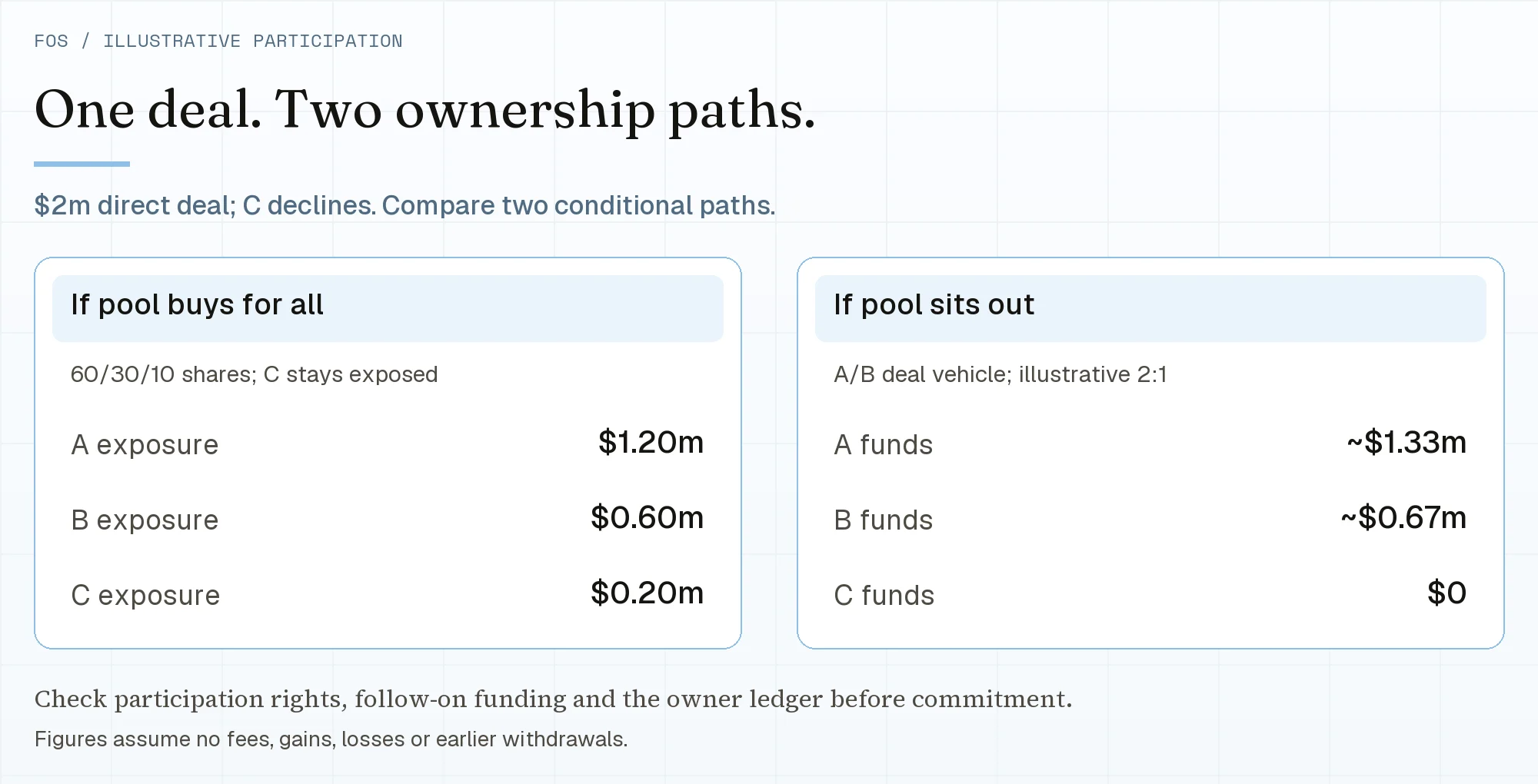
Illustrative participation only; view the full-width desktop diagram. Contributions, rights and expenses require agreement.
The same opt-out can be tested across all three routes:
| Route for this $2 million deal | What must be true for C to stay out | Reason to choose or reject it |
|---|---|---|
| Existing common pool | Documents and administration support a valid allocation or opt-out mechanism that removes C's economic participation, including expenses and future calls. | Use the existing pool as the sole subscriber only if those rights and records actually work. The current 60/30/10 split would expose C. |
| A and B hold directly | The target accepts separate subscribing owners, and A and B can coordinate approvals and later funding without a shared deal entity. | Avoid a new entity's costs when joint ownership machinery adds no needed benefit. |
| A/B deal vehicle | The common pool stays out; A and B fund and bear costs through their separately owned resources, with agreed governance. | Consider it if one subscribing entity or joint decision process is needed; confirm the target's terms and compare setup and running costs. |
A “branch” is convenient shorthand in this case. The actual subscribing owners may be individuals, trusts or companies with different tax and liquidity constraints inside the same branch. Name them before comparing the routes.
| Question at the first approval meeting | Evidence needed before the commitment |
|---|---|
| May C decline while the common vehicle invests? | Governing-document provisions and counsel's proposed mechanism, not a verbal assurance. |
| Who funds a follow-on call or an expense overrun? | Written commitment limits, capital-call terms and default treatment. |
| Who can approve the deal and a later sale? | Named decision body, conflict procedure, quorum and delegated authority. |
| What number reaches each branch report? | Ownership register, dated valuation basis, capital-account or equivalent allocation, and reconciliation to the asset record. |
The test forces the family to decide whether the common pool can support different participants. It may also show that A and B can hold directly. A new vehicle is justified by an identified ownership or governance need, subject to its cost and legal treatment.
04What the Governing Documents Must Settle
The family can give counsel a usable brief before choosing an entity form. It should identify the following decisions in ordinary language:
- Eligibility and participation. Which people, trusts or entities may invest? Can a branch decline an asset or join later, and at what value?
- Authority. Who proposes, approves and executes investments? Who resolves a conflict when the decision-maker or their branch has a separate interest?
- Capital and expenses. How are contributions, commitments, follow-on calls, fees and broken-deal costs allocated? What happens if a participant does not fund?
- Valuation and reporting. Who approves private-asset values, on which date, using what source? Can a branch trace a reported number to its interest and the underlying investment?
- Liquidity and exit. Are redemptions allowed, restricted or unavailable? How are transfers, distributions, death and branch separation handled?
These points change the daily operating burden. A common pool reduces the number of direct asset owners but creates a need to maintain investor interests and allocation records. Separate holdings preserve autonomy but can make execution and consolidated reporting harder. A deal vehicle narrows participation but requires its own formation, controls and ongoing records.
05US Legal and Tax Questions to Take to Counsel
Start with the actual people and entities involved. Give US counsel three separate questions:
- Who is the adviser? The SEC family-office exclusion requires the office to provide investment advice about securities only to family clients as defined by the rule, be wholly owned by family clients, be exclusively controlled by family members or family entities, and not hold itself out publicly as an adviser.
- What is the vehicle and how are interests offered? The SEC's private-fund guide describes specific Investment Company Act exclusions and exempt securities offerings. Adviser registration or an applicable exemption is a separate analysis. A family-only pool should not assume its name, participant count or relationship answers these questions. Review any proposed non-family investor before an invitation or subscription.
- How is the vehicle taxed? If treated as a partnership for US federal tax purposes, the IRS explains that it generally reports income, deductions and credits through an information return while partners account for their shares. Ask how contributions, allocations, basis, distributions, state taxes and any cross-border participants would work for this family's owners.
These are issue spots, not legal or tax advice. Counsel must assess the current rules and documents before formation, fundraising or a change in adviser activity.
06A Decision Record Before Capital Moves
Use one page to record the proposed arrangement and what remains unknown. For the $2 million example, the entry might read:
Decision: A and B may compare direct subscriptions with a separate deal vehicle. No commitment is approved under either route, and the common pool makes no commitment. C's participation in future common-pool deals remains a separate policy question.
Economic case: If A and B select the illustrative 2:1 vehicle route, A proposes about $1.333 million and B about $667,000 from resources outside the common pool. C has no investment position under the stated ownership, funding and guarantee arrangements. A claim that C bears no deal-specific financial cost also requires proof that the pool and C-funded office budget pay none of the formation, diligence, incremental staff or later charges. Forming a new entity alone establishes neither result.
Open conditions: Written authority and conflict review; legal and tax classification; target subscription terms; evidence of available outside-pool cash and no pool support; assignment of deal-specific staff and other costs; follow-on funding and expense limits; valuation and reporting design; custody and cash-control instructions. Track each condition as open or satisfied with its evidence reference.
Owner and evidence: A named family-office coordinator collects the closure evidence. The investment committee makes the investment decision, counsel clears the structure, and the administrator tests the ownership and reporting entries. The authorized signatory releases funds only after required conditions are satisfied, evidence is retained, and the designated approver authorizes commitment and payment.
Before the first wire, test the proposed records with three events:
- A capital call: can the team identify who owes each amount and who authorizes payment?
- A distribution: can it trace cash to the participating owners and their recorded interests?
- A changed valuation: can it reproduce each branch's reported amount and the approver's dated source?
This three-event test is one operational gate, not the entire approval. It passes only when each branch's owner, amount and approver reconcile to the documents and ledger, including the claimed zero exposure for C. Book capital, tax capital and outside tax basis may differ; ask the administrator and tax adviser which record supports each figure. Take the ownership chart and decision record to the investment team, accountant and US counsel before committing capital.
 Investment & Portfolio · Analysis
What Is Family Office Private Fund Commitment Pacing, and Why Does It Matter?
Private fund commitment pacing sets the size and timing of new promises while older funds can still call… Investment & Portfolio · Analysis
Family Office Private Asset Valuation Policy: Which Mark Belongs in the Report?
A December family report can contain a fund value dated September and a direct-company mark proposed from a… Investment & Portfolio · Analysis