A Missed Report Puts Family Office Vendor Oversight on the Clock
A late report and an unresolved provider account force a renewal decision before another service cycle can be checked. Follow the evidence, notice and exit handoff.

A family office may choose a capable provider and still lose control of the relationship a year later. The monthly report arrives late. A named provider employee leaves, but their account remains on the portal roster. The contract renews automatically unless the office gives notice before it can observe another full month of service. None of these facts alone proves a breach or a failed provider. Together they demand an owner, evidence and a decision before the deadline passes.
Family office vendor oversight is the work between procurement and exit: check what the provider delivered, who can reach family information, what the contract requires, and what the office will do when the evidence is incomplete. The provider performs a service. The office still decides whether to accept its output, approve its access and continue the relationship.
This article uses one fictional non-investment administration and reporting provider. The contract terms and dates are illustrative. Actual duties and remedies depend on the signed agreement, the systems involved and applicable advice.
- Keep a small living record for each material provider: service and data scope, named office owner, deliverable and evidence, access roster, contract notice date and exit dependencies.
- Test delivery and access separately. A late report needs source and quality proof; a lingering account needs authorization and revocation proof. Record what is known, what is not and who may close each issue.
- Decide before the contractual deadline. If proof is incomplete, document an authorized, bounded risk acceptance or use the actual notice or signed-extension options. A provider promise is not verified performance.
01Oversight Begins Where Selection Ends
Initial due diligence asks whether a provider can do the job. Ongoing oversight asks whether this provider is doing the agreed job now, with the permissions and evidence the office approved. A strong proposal, certificate or reference call does not answer what happened to this month's work.
The office should name a person who accepts the deliverable and a person who controls access; one individual may hold both roles in a small office, but each decision must be explicit. The provider should name a service lead and an escalation contact. If the contract covers several family entities, mark which services and data belong to each. A single vendor name is not enough to know who may see a trust document or approve a payment instruction.
Morgan Stanley's family-office structure report describes hybrid models that retain strategic oversight internally while using external specialists. It is a provider perspective, not proof that every office needs the same organizational chart. The useful boundary is practical: delegating production does not remove the office's need to accept work, manage permissions and decide exceptions.
Make the Vendor Register Small Enough to Maintain
For each significant non-investment provider, keep six fields current:
- Service and output: what the provider actually produces, for whom, at what interval, and in which system.
- Office and provider owners: who answers a routine question, who escalates an issue, and who can accept a correction.
- Data and access: what family or entity information the provider can reach, which named users or integrations have access, and who authorizes changes.
- Proof of service: the dated report, reconciled source, completed task or other artifact that shows the promised output was delivered and usable.
- Contract clock: renewal, notice, pricing and service-change dates as stated in the signed agreement, with an office reminder before the decision date.
- Exit dependency: the data export, credentials, work-in-progress record and replacement capacity needed to continue service if the relationship ends.
The register is an index, not a substitute for the contract, access log or work product. A payroll processor with sensitive records and a provider operating the reporting portal need a closer look than a supplier with no system or family-data access. Set review frequency from the service's consequence, not a universal calendar.
02Work a Delivery and Access Exception Before Renewal
In this fictional case, an outside administration provider prepares a consolidated monthly family report and hosts the portal used to share it. The assumed service schedule calls for the report on Day 0. By Day 2, the report is missing. The provider says a bank feed is stale and promises a corrected package, but has not supplied a dated exception record or a new delivery time.
The office also sees a portal account for a provider analyst who left the provider on Day −5. The roster alone does not show whether the account was used after departure, what it could reach or whether the identity was already disabled elsewhere. The provider has not yet supplied a revocation confirmation and activity log.
The assumed agreement renews automatically on Day 60 unless written notice is given by Day 30. The next monthly report may be due around Day 30, but it cannot be delivered, checked and accepted before the notice deadline. The office must therefore make a contractual decision with an incomplete performance record, rather than quietly waiting for the next cycle.
Treat the two problems as separate workstreams. The report may be late because of an upstream feed, but the office still needs a reliable family-facing package. The account may be inactive, but the office still needs to know whether access is authorized and closed. Neither a late report nor a listed account is evidence of a data breach. Neither should be waved away by an unsupported assurance.
Record the First Two Issues
R-01 · Monthly report — open on Day 2. The report due on Day 0 has not been accepted. On Day 2, the office reporting owner asks the provider service lead for a dated feed exception, a revised delivery time by Day 5 and a source-to-report check for affected figures. The office's next review is Day 7. Close R-01 only after the corrected package is delivered and reconciled, or after a formal exception is accepted under the actual agreement. If the office authorizes and labels a provisional family-facing version, record that release decision separately and keep the unresolved feed or figure in R-01. Save the request, package version, source check and approver together.
A-01 · Provider portal account — open on Day 2. A departed analyst remains on the roster; post-departure use has not been established. On Day 2, the office access owner asks the provider security lead for the named-account permissions, revocation record and relevant activity log by Day 4. The office's next check is Day 5. Close A-01 only when the account and any dependent access are verified closed and unexplained activity has been escalated. Save the roster, log, revocation proof and office verifier.
If the Day 4 proof does not arrive, the office access owner escalates on Day 5. Where the office controls the account, suspend the identified identity while preserving the relevant logs. Where only the provider controls it, require immediate disablement and evidence; until verified, keep sensitive new material out of that portal or use an approved controlled route. Record the remaining exposure and any service effect rather than treating a request to disable as proof it happened.
The Day 5 and Day 7 checkpoints are example management dates, not contractual cure periods. A dashboard marked “green” is not a closure record if its evidence or approver is missing. If the bank feed remains unavailable, the office can decide whether to release a report with a clearly identified provisional figure; the provider cannot make that family-disclosure decision by merely supplying a draft.
The NIST Cybersecurity Supply Chain Risk Management quick-start guide describes defining supplier requirements, specifying how compliance can be verified, and monitoring security performance across the supplier relationship. It is a useful model for a technology-enabled service, not a universal legal rule for family offices. CISA's guidance for managed-service customers calls for regularly reevaluating provider access, disabling accounts when they are not actively used, and retaining activity logs. These sources support asking for verifiable access evidence; they do not establish that this fictional account was misused.
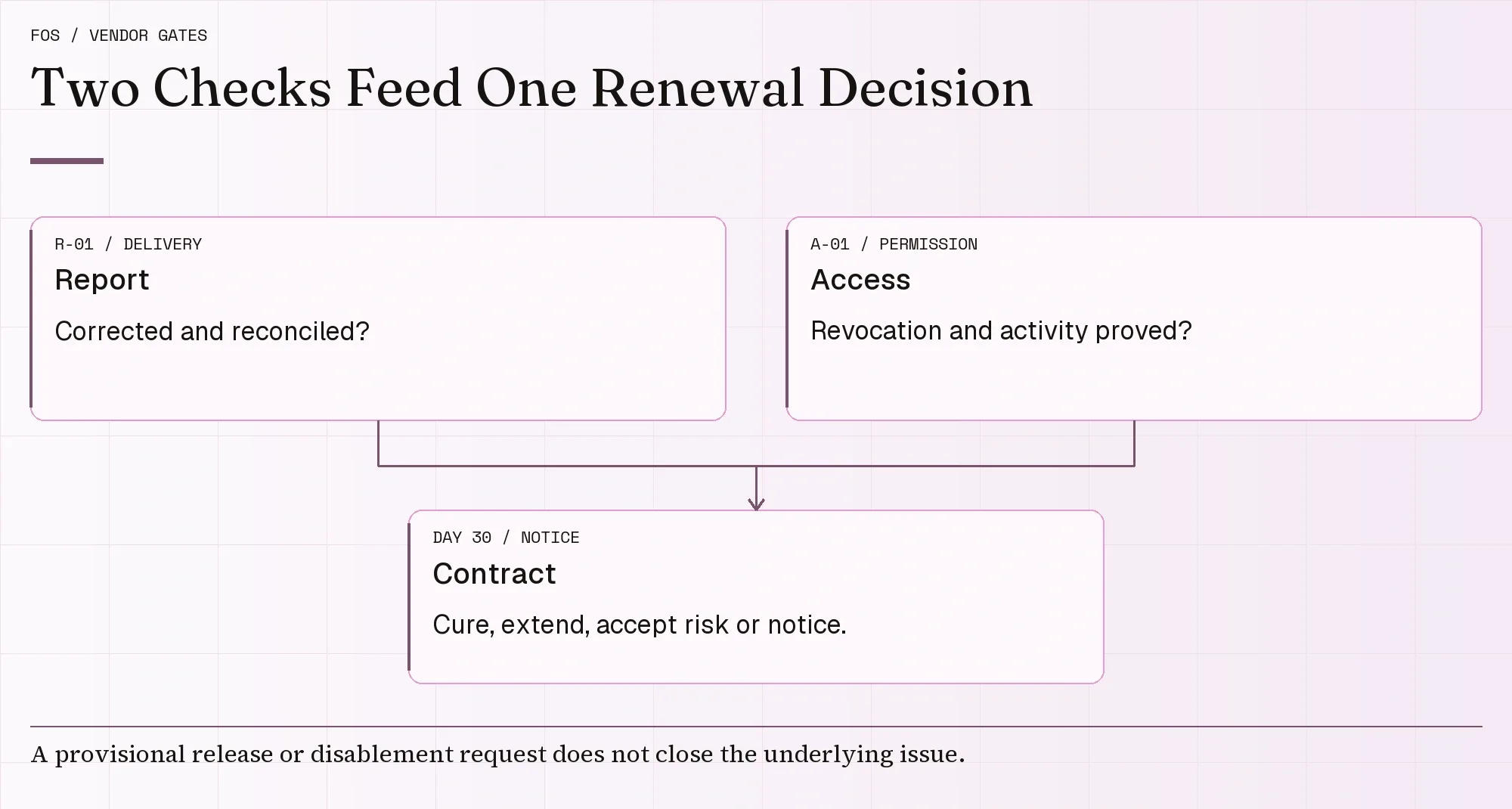
See the full-width desktop diagram. A provisional report release or a request to disable an account does not close the underlying issue.
03Make the Renewal Decision Before More Evidence Arrives
The service owner should put the actual notice deadline beside the two open issues. Before Day 30, ask whether the contract permits cure, termination, a different scope or a written extension. Confirm who must send notice and how delivery is proved. Do not assume a meeting, verbal promise or unacknowledged email changes the signed terms.
The family office has several conditional paths:
- Continue with a documented cure: if the report and access evidence arrive, the office tests both and records who accepted each. A new service checkpoint can then be set under the existing agreement.
- Negotiate more time in writing: if a further report cycle would help but the notice date comes first, seek a written amendment or extension with the authorized counterparty. Until signed, treat the original deadline as operative.
- Give timely notice or prepare a controlled exit: if the office cannot accept the open risk or obtain a documented extension, act under its contract rather than let the renewal happen by default. Counsel can confirm the actual notice and termination language where needed.
- Accept bounded residual risk explicitly: if the contract permits continuation and the authorized office decision-maker judges an open issue tolerable, record the missing proof, likely consequence, temporary controls, owner and next checkpoint. This is an explicit acceptance decision, not a silent auto-renewal or a claim that the issue was cured.
Illustrative Day 25 decision. Suppose the corrected and reconciled report was accepted on Day 7, but the provider still has not supplied the access revocation record or relevant log for A-01. The office access owner keeps A-01 open; since Day 5, new sensitive material has used a controlled alternative to the portal while the provider has been asked to disable the account. This limits new exposure but does not prove that old material was unreachable. The family-office executive authorized for vendor contracts records that uncertainty and asks the provider security lead for proof by Day 27.
In this fictional office, proof is still absent on Day 28 and no written extension has been signed. The executive approves nonrenewal under the assumed agreement. The office contract owner checks the signed notice clause: for this example, it names a recipient email address, permits notice by email and requires delivery by Day 30. The authorized executive sends notice to that address on Day 29. The office saves the signed clause, approved notice, sent message and recipient's dated acknowledgment; the contract owner records notice delivered. Without evidence of timely delivery, the status would remain approved, notice unconfirmed, requiring immediate contract-specific escalation before Day 30.
That is an office choice under the assumed agreement, not an automatic remedy for every family. Another office might accept bounded residual risk under its actual terms, but its authorized decision-maker would need to record the open exposure, temporary control and next checkpoint. An unsupported provider assurance is not a verified cure in either path.
This is not a claim that one late report automatically justifies termination, or that a lingering account triggers a particular remedy. The decision depends on the service's importance, the provider's explanation, the contract, proof of cure and the family's tolerance for interruption. A service credit, penalty or audit right exists only if the applicable terms provide it.
Preserve Service While Testing an Exit
Before any switch, list what the office needs to keep the work running: a current data export in an agreed format, a map from source files to report fields, open exceptions, provider-owned credentials or integrations, a named replacement owner and dates for overlap. Revoke former-provider access in coordination with a safe transition; turning off a feed before retrieving the data could create a second problem.
In the worked case, the service owner leads the transition and schedules the first replacement-export and report test for Day 35, before the assumed Day 60 contract end. The office access owner keeps A-01 open across the handoff. Nonrenewal does not revoke a login: that owner records the alternate route's limits and closes A-01 only after checking the former analyst's account and dependent access are disabled, reviewing relevant activity, and escalating anything unexplained.
The office should test one exported report or record with the replacement workflow before declaring continuity. If a family member still needs the report during transition, say who will prepare it, which numbers are provisional and who authorizes release. Exit readiness is part of renewal leverage, but it is also a direct protection against a service gap.
04Set a Cadence That Matches the Provider's Consequence
There is no useful rule that every supplier needs the same monthly scorecard. The office can maintain a compact rhythm for a material reporting or technology provider:
- Each delivery: compare due date, completeness and material exceptions with the agreed output. Note the office approver and the version released to the family.
- At access changes: reconcile named provider users and integrations with approvals, departures and role changes. Record revocation evidence; investigate any activity that does not fit the approved scope.
- At a periodic service review: inspect recurring misses, open actions, changes in staff or subcontractors, data-handling issues and whether the provider still serves the intended family entities. Set the interval from risk and contract terms.
- Before the notice date: compare the evidence against the service decision, not just last year's invoice. Confirm renewal economics, changed scope, unresolved issues, exit capacity and the notice method while there is still time to act.
PKF O'Connor Davies' family-office controls discussion emphasizes operational controls and separation of duties in a family-office setting. The office should adapt that principle to its staff and providers; the article does not establish a mandatory checklist or review frequency.
The best oversight record is not the longest. It is the one that lets a successor answer: What did this provider promise? What was delivered and accepted? Who can reach the data now? What remains open? What choice must we make before the next contract date? When those answers are current, the office can keep a good provider without blind trust and change a weak relationship without losing the work it depends on.
 Operations & Governance · Analysis
A Family Office Reporting Calendar That Survives Late Data
A family office can promise a report by the 14th and still leave the most important dates unstated.… Operations & Governance · Analysis
What Should Family Office Investment Committee Minutes Include—and Why?
Investment committee minutes record what was considered and decided, who could vote, and what remains open. Clear authority… Operations & Governance · Analysis