Ultra-High-Net-Worth Family Office: Who Owns the Work?
Should a US UHNW family build an office? Test decision ownership after a liquidity event across an adviser-led team, MFO and dedicated office.

At a certain scale, a family may have excellent advisers and still be unsure who is carrying a decision from start to finish. The investment manager can recommend where to place cash. Tax counsel can advise on the sale. A trustee can protect trust interests. None of those assignments necessarily names the person who checks that the proceeds, reserve, approvals and family report agree.
An ultra-high-net-worth family office earns its place when it takes responsibility for that coordination and leaves a record the family can inspect. The first decision is therefore a scope question: which work needs one owner, and who has authority to approve the result?
- “Ultra-high-net-worth” often describes a wealth band. It does not set a US legal threshold for creating a family office or prove that a dedicated staff is economical.
- Use the same sale record to assess three routes: test the incumbent team live; request an MFO walkthrough against a proposed written scope and a staffed dedicated-office plan. Name who would own each handoff, record and exception.
- Hold the proposed investment transfer of sale proceeds until each legal owner’s available amount, reserve decision and approval authority are documented. Use the later family report to test reconciliation and follow-up.
01What UHNW Means and What It Does Not Decide
In its 2022 World Wealth Report taxonomy, Capgemini calls individuals with US$30 million or more of investable assets ultra-HNWIs. It excludes primary homes and certain personal assets from that measure. The figure describes a population for research; it is not a legal qualification for a family office, nor a minimum at which one becomes necessary.
A family office is a coordinated set of people and services for a family's financial affairs. It may be a dedicated internal team, a multi-family office, or a smaller retained coordinator working with specialist firms. Its service design should follow the number of owners, entities, decisions and deadlines it must manage.
Our family office structures guide compares broader operating patterns. Here the question is narrower: who actually owns the work when several advisers must act on the same facts? For the staffing and scale question, see large family offices.
The SEC's family-office exclusion is a separate regulatory question. For an office seeking that exclusion from Investment Advisers Act regulation, its securities advice must be only to family clients as defined by the rule. The office must be wholly owned by family clients and exclusively controlled by family members and/or family entities, as defined by the rule, and cannot hold itself out to the public as an investment adviser. Wealth size alone neither grants nor removes the exclusion. US counsel should assess the actual office and client relationships.
02The Coordination Work a Family Office Should Own
A family office need not give every piece of advice itself. It does need to assign an owner who makes related advice usable together. For a US family, the recurring work may include:
- Cash and investment authority: identify the legal owner of each account, the cash available after known obligations, the approved mandate and who may instruct a transfer.
- Tax and legal coordination: route questions to the relevant professionals, capture their dated advice and make sure an investment instruction does not outrun an unresolved tax or entity decision.
- Records and reporting: reconcile custody, private assets, liabilities and entity ownership so that a family report can be traced back to its source date and approver.
- Family decisions: distinguish information rights, recommendation rights and final approval, especially when branches or generations have different interests.
- Exceptions and continuity: put a named person and due date on missing documents, unexpected cash needs, adviser changes and a successor's access to records.
The person coordinating these items might sit inside the family, an MFO or a dedicated office. The test is whether the mandate gives them access to the records, authority to chase exceptions and a clear escalation path. A glossy consolidated report is not evidence that the source decisions were coordinated.
03One Liquidity Event, Three Operating Models
Consider a fictional US family with US$90 million of investable assets across three trusts and two generations. The figure describes the family collectively, not any individual's research classification. A business sale is expected to bring US$25 million in gross proceeds in 45 days. The sale asset's treatment within the existing US$90 million has not been specified, so the figures cannot be added to produce a post-sale total. The net amount available for investing is also unknown: tax counsel has not finished the reserve advice, transaction costs remain open, and the sale documents determine which legal owners receive the cash.
The family wants to invest part of the proceeds, keep money for near-term obligations and produce one report. Its current roster includes an investment adviser, tax counsel, an estate lawyer, a private bank and trustees. They are all capable within their mandates. The test is whether anyone owns the chain between them.
| Route to test | Who coordinates this sale? | Proof the family should demand | Main trade-off |
|---|---|---|---|
| Adviser-led with a retained coordinator | A named family CFO or lead adviser owns the action log and convenes specialists; each professional retains their assigned advice and approval role. | One dated proceeds-to-reserve-to-investment bridge, owner list, escalation path and signed release rule. | Lower dedicated infrastructure, but coordination depends on a role that must actually be staffed, paid and empowered. |
| Multi-family office | A proposed service lead would coordinate within a written scope while outside lawyers, tax advisers and trustees keep their professional responsibilities. | Before selection: named lead, draft scope, exclusions, proposed access and a sample report by legal owner. Before handover: signed scope and demonstrated access and controls. | Shared infrastructure may reduce internal staffing, while the family still needs to govern provider scope and retained decisions. |
| Dedicated single-family office | An employed executive and team would maintain the action record and coordinate specialists under family governance. | Before selection: named hiring and systems plan, proposed money-movement controls, close-test plan and absence-cover design. Test them after staffing and before handover. | More direct control and customization, with payroll, systems, supervision and continuity costs that persist after the sale. |
This table sets assignments to test; it records no provider's actual performance. Brown Brothers Harriman advises families to consider services, spending, involvement and long-term sustainability.
Goldman Sachs identifies liquidity events, adviser changes and intergenerational continuity as possible triggers. These are reasons to investigate a model, not evidence that one has passed this family's test.
04Who Signs Off Before Proceeds Move?
The sale creates decisions that should not collapse into one vague “family office approval.” The family can use a short authority map:
| Decision or record | Prepares the evidence | Advises or reviews | Approves the action |
|---|---|---|---|
| Closing allocation and receipt of sale proceeds | Transaction counsel or the closing agent documents the seller, amount and allocation under the actual transaction instructions; the bank receipt is matched to each legal owner | Coordinator and entity accountant check the receipt against closing documents | The persons empowered by the sale documents, entity or trust powers and account or escrow instructions approve the relevant allocation and movement; names must be verified for this transaction |
| Estimated tax reserve | Tax adviser, using actual sale facts and owner positions | Counsel and accountant as needed | Each legal owner or authorized fiduciary retains the reserve decision under its mandate |
| Cash available to invest | Coordinator reconciles gross receipts, expenses, reserve and near-term obligations | Tax adviser and investment adviser review their inputs | The legal owner or delegated investment authority approves the investable amount |
| Investment of available cash | Investment adviser proposes within the approved mandate | Risk and tax professionals review relevant constraints | Named decision-maker instructs the custodian; any separate release control follows the actual mandate and account authority |
| Family report | Accountant or reporting team reconciles accounts, dates and owner interests | Coordinator resolves exceptions | Delegated family-side reviewer approves circulation |
The roles are illustrative. Trust deeds, account authority and service contracts may assign them differently. A coordinator can collect the evidence without becoming the tax adviser, trustee or investment approver.
Before a transfer, insist on a written bridge: gross proceeds received → owner-level costs and reserves → cash available under each owner → approved investment instruction. Do not insert an assumed reserve percentage into a report while tax advice is pending. Label the investable amount provisional and restrict release until the responsible approvals are complete.
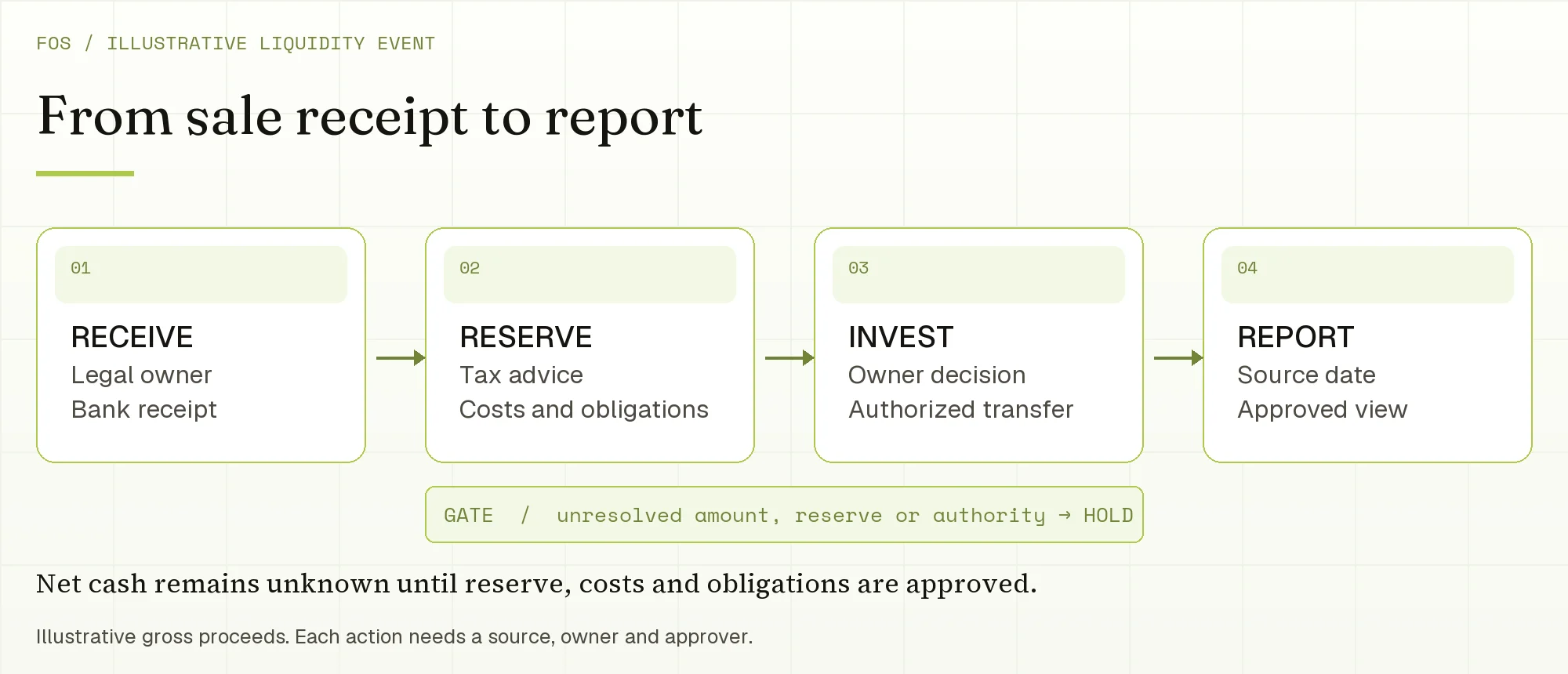
Illustrative handoff. Open the full-width diagram. The sequence concerns investment release after receipt; transaction-closing approval follows the governing sale documents.
05Compare Scope and Cost on the Same Terms
An MFO fee quote, an adviser fee and an in-house payroll estimate are not comparable until they cover the same work. Ask each route to price and identify the owner of these five outcomes:
- A complete owner-and-entity register, updated after the sale.
- A monthly cash and investment report reconciled to custody and transaction records.
- A dated exception log with response time and escalation owner.
- Coordination of tax, legal, trustee and investment decisions without implying that one provider supplies all regulated advice.
- Continuity when the lead person is absent or the provider contract ends.
For each route, use the same 12-month period. Show forecast first-year cash during the ramp, with start dates and any transition overlap; mark known incumbent payments as actual and proposed-route amounts as quoted or estimated. Beside it, show the next full year's recurring run rate. Count a fee once: add setup, transition and excluded work only when incremental to the quoted package. Record each amount's payer, timing and inclusion. Show retained family or CFO hours separately; value that time only if the same hourly assumption is used for every route. List unquoted work as unknown, not zero.
Ask who pays for additional entities, private assets, tax packages, cyber controls and a parallel reporting run. The broader structures comparison works through model cost; this scope test establishes what each quote must include.
The lower quoted price may simply leave the family with more coordination work. Conversely, a dedicated office can be costly without solving the handoff if its executive lacks authority to obtain records or escalate exceptions. Compare the deliverable and its accountable owner before comparing percentages of assets.
06A 90-Day Decision Before Building an Office
Use the coming sale as a live pilot for the incumbent team. A prospective MFO cannot claim it completed a sale it did not run. Ask it for a walkthrough using the same documents, a sample owner-level report and a written proposed scope that can later become a contract. Test a proposed dedicated office against named hires, delegated authority, system access, controls, timeline and cost.
Label each piece of evidence live, demonstrated or planned; they are not equivalent. Put all three routes on one decision sheet: owner-level proceeds bridge, accountable coordinator, exclusions, access and escalation, first-year cash cost, retained family hours and continuity cover. A proposed route must state who will produce each record and by when.
Use this sheet as a meeting record. For every cell, attach a document or demonstration date and mark the remaining action; a product description is not a pass.
| Decision evidence | Current adviser-led team | Proposed MFO | Proposed dedicated office |
|---|---|---|---|
| Accountable coordinator and authority | Name the person who ran the live sale; link the mandate and escalation log. | Name the proposed lead, access rights, exclusions and escalation path; confirm them in the signed scope before handover. | Name the role, hiring owner, delegated powers and interim cover. |
| Owner-level proceeds bridge | Attach the dated live closing-to-investment record and open exceptions. | Demonstrate the same record using the family's sample documents; label sample outputs. | Specify the ledger, preparer, reviewer and acceptance date for the same record. |
| Cost and family effort | Enter 12-month ramp cash, next-year run rate and retained hours. | Enter quoted inclusions, incremental exclusions, transition overlap and retained hours. | Enter payroll, systems, outside advisers, setup, ongoing run rate and retained hours. |
| Continuity and unresolved work | Show absence cover and one completed exception, with gaps recorded. | Review the proposed absence handoff and sample monthly report; test real delivery and access before handover. | Show staffing cover, system access, monthly close plan and unfilled roles; test after staffing. |
| Evidence status and next action | Live: attach source/date; name any remaining control. | Demonstrated or planned: attach sample and proposed scope/date; require signed contract and operating test before handover. | Planned until staffed and tested: attach approved build plan/date; name the next acceptance gate. |
The sheet supports two decisions. First, choose a preferred route for contracting or build planning from its scope, evidence and cost. Later, authorize it to take over live work only after the named handover owner confirms access, staffing, controls and records. Until then, the incumbent remains responsible for the current work under its existing mandates.
- Days 1 to 30: map ownership and authority. Name the legal owners, advisers, signatories and decision body. Identify missing records and who will obtain them.
- Before the expected day-45 closing: set the release gate. Confirm the proposed owner-level closing allocation and bank instructions under the governing documents; check final amounts against the signed closing statement. Where tax advice, reserve or authority remains provisional, hold the proposed investment transfer and record the open decision; a later report cannot cure an unauthorized earlier release.
- Days 31 to 60: run the sale bridge. After closing, trace actual proceeds, documented costs, tax advice, reserve decisions and cash available for each owner. If closing slips, keep the gate tied to the actual transfer date rather than the calendar day.
- Days 61 to 90: reconcile and report. Match bank and custody activity, demonstrate one exception from detection to resolution, and obtain approval of a dated family report. Also ask each prospective route for a continuity drill covering absence, turnover and recurring monthly reporting; one sale cannot prove those outcomes.
The incumbent route is viable if its live sale record shows named authority, complete handoffs and exception cover, and its fully scoped cost is acceptable. An MFO merits a written proposal when its proposed coordination, record access and escalation address repeated gaps; the contract and operating test come before handover. A dedicated office merits a staffing and governance plan when recurring volume, control or privacy needs justify continuing payroll and oversight.
No coordinator can compel an outside adviser or trustee beyond their contract and authority. Secure consent or contractual access, name an escalation owner and define a fallback when evidence does not arrive. Use the authority map and comparison sheet above to brief each route; keep the live-work handover separate from selecting a preferred model.
 Knowledge & Decision · Analysis
How Much Net Worth Do You Need for a Family Office, and When Should You Start?
What family office wealth figures mean, how location-specific rules differ, and how to test costs, cash and service… Knowledge & Decision · Analysis
What Is a Single-Family Office? Services, Costs and Fit
A single-family office serves one family through a dedicated organization. See its services, staffing, costs and when another… Knowledge & Decision · Analysis