Family Office Audit Readiness Begins With the Reporting Boundary
An orderly document room is useful only if each requested figure has the right entity, date, basis, approval and source behind it.

A family office can hand an auditor a neat folder and still be unprepared. A bank balance may reconcile to the wrong entity. A private-fund figure may be dated three months before the report. An approved journal entry may be absent from the final trial balance. The missing link is not another checklist item; it is a trace from the statement being examined to the record that supports it.
Family office audit readiness starts with scope. Which entity and period will be audited, under which accounting basis, by which independent firm, and for whose use? A family report, tax package, partnership statement and legal-entity financial statement can show different numbers for legitimate reasons. The office must state which one is the subject of the engagement before it builds the request list.
- Define the engagement and reporting boundary. An audit is not automatic for every family office; the entities, statement basis and users determine what the team must prepare.
- Tie every delivered schedule to the books. Keep source, reconciliation, reviewer, date and unresolved exceptions beside each material balance.
- Test the difficult numbers before fieldwork. Private valuations, inter-entity balances and cut-off items need an evidence trail, not a polished family dashboard.
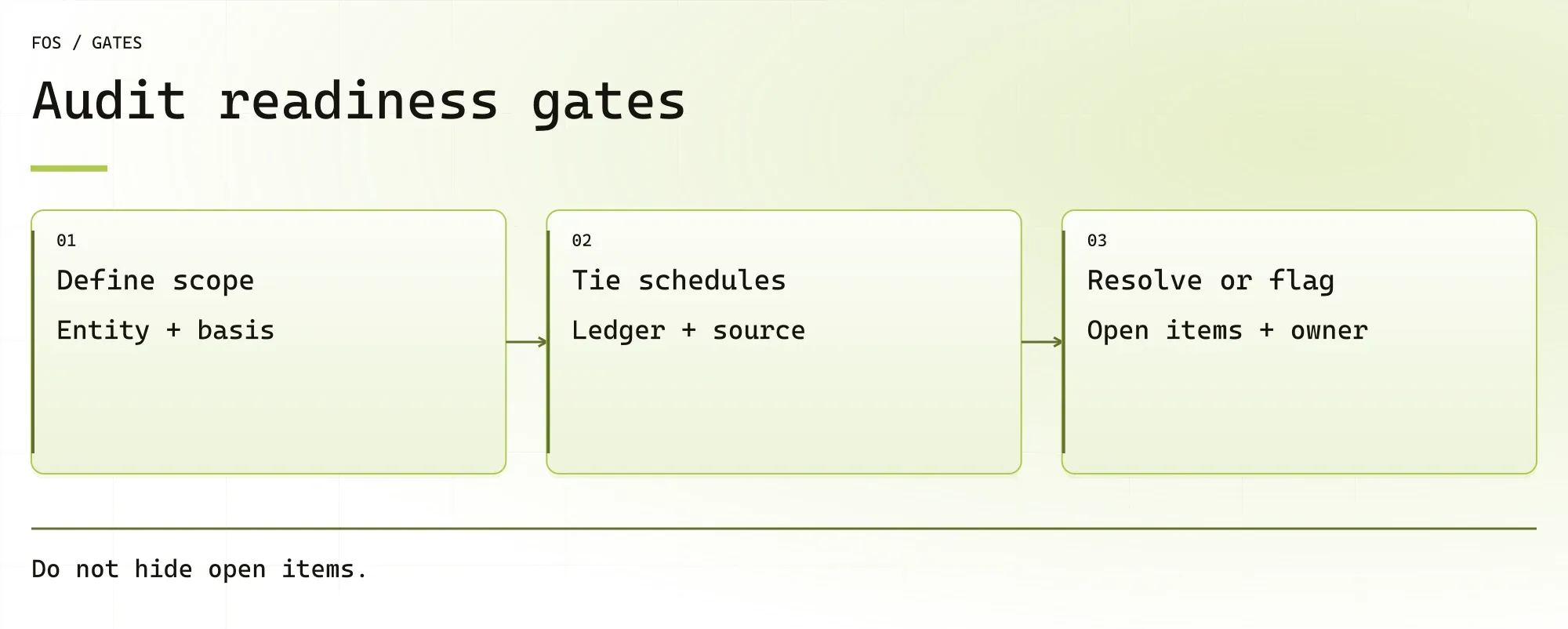
Open the full-width audit-readiness diagram. Flag open items for initial fieldwork; resolve material judgments before approving final statements.
01Decide what is actually being audited
Start with the engagement letter or the proposed auditor's scope discussion. List the legal entities, financial statements, period-end, accounting framework, reporting currency, comparative period and expected delivery date. Identify who in the office owns the books, drafts the statements, answers requests and approves management representations. If there is no audit engagement, distinguish an internal readiness exercise from a formal audit.
The AICPA's guide to financial-statement services distinguishes preparation, compilation, review and audit engagements. The service label matters because a family may need a lender package, an investor statement or a governance review rather than an audited set of financial statements. A family-office dashboard does not become an audited statement because it uses the same ledger data.
For each entity, record whether it is inside the proposed reporting boundary and how its balances appear in any family view. Map ownership, intercompany balances and material transactions separately. The newly published guide to related-party transactions shows why a transfer between family entities can be real in both legal ledgers yet require different treatment in a defined combined view.
02Build a request register that names the evidence owner
Ask the auditor for the engagement-specific prepared-by-client request list early. Do not assume a generic checklist is complete: the requested schedules depend on the statements, risk assessment and auditor's procedures. Creative Planning's audit-preparation guidance recommends assigning responsibilities and dates, keeping reconciliations current, and reviewing prior findings. Anchin's fund-audit guidance also stresses agreeing the request list early and tying delivered schedules to the trial balance; its fund-specific examples are useful analogies, not a universal family-office mandate.
Use one line per request, not one folder per person. The register should show the entity and period, request wording, owner, source file and version, ledger or statement line, preparer, reviewer, due date, delivery date, and open question. If an outside administrator prepares a schedule, a named office owner should still verify that it answers the request and ties to the office's final books. Outsourcing preparation does not transfer management's responsibility for its financial statements.
| Requested area | Minimum bridge to retain | Escalate if |
|---|---|---|
| Cash | Bank statement, reconciliation, outstanding items and ledger line by entity | A reconciling item lacks a dated explanation or later clearing evidence |
| Private investments | Ownership record, fund statement, capital activity, valuation basis and ledger/report bridge | A later contribution is being treated as a later valuation |
| Inter-entity balances | Counterparty schedule, both ledgers, approvals and settlement terms | Receivable and payable disagree or ownership differs across entities |
| Significant judgments | Policy, source inputs, calculation, reviewer and final journal entry | The report uses a figure whose source or approval cannot be reproduced |
This is a starting register, not a promise that an auditor will request only these four areas. A document-management process should preserve the version that supported the answer, rather than replacing it with a later file under the same name.
03Work one private-fund figure from source to report
Suppose a fictional family office is preparing Investment LLC X's 31 December financial statements for a proposed US GAAP audit. The office's separate draft family report shows US$15.4 million for a private fund held by X. Its latest approved fund statement is dated 30 September and shows US$14.8 million. The office paid a US$600,000 capital call in October. A spreadsheet added the payment to the September figure.
The addition is arithmetically correct: US$14.8 million + US$0.6 million = US$15.4 million. It does not establish the fund's 31 December value.
The office should first identify the legal owner of the interest and the entity ledger entry for the capital call. Then it should collect the call notice, bank settlement proof, fund statement, any later manager statement, and the applicable valuation policy. The preparer explains whether the US$600,000 is a contribution, how it was recorded, what other fund activity occurred, and which date the report's figure purports to represent. A reviewer checks the bridge to the final trial balance and report.
Illustrative readiness decision
Request: support X’s private-fund holding for its proposed 31 December statements, and bridge the chosen statement amount to the separate draft family report. The entity-statement amount and accounting conclusion are still to be determined; US$15.4 million is only the draft family-report figure.
In hand: 30 September fund statement, October call notice, bank payment, ownership record and ledger entry. These establish the dated prior balance and the cash contribution.
Still open: a supportable 31 December valuation or a documented reporting-basis conclusion on how the available evidence should be used. The fund manager's later statement and any intervening distributions or adjustments must be checked when available.
Status: the package may be organized for an initial auditor discussion with the valuation listed as open. Do not approve final statements or call the 31 December valuation resolved merely because US$15.4 million adds up. Name the valuation owner. Management documents its proposed accounting treatment and evidence; the auditor assesses the support and discusses additional requests under the engagement. If the family report uses a provisional estimate, label its date and basis plainly.
A filled request-register entry for this case would read:
| Request and scope | Source and ledger tie | Owner and status |
|---|---|---|
| Investment LLC X private-fund holding · 31 December · proposed US GAAP statements; bridge to separate family report | 30 September fund statement US$14.8m; October US$0.6m call and bank proof; final X trial-balance line to confirm; 31 December value open | Controller prepares; CFO reviews. Obtain later manager evidence and management valuation memo. Open for initial fieldwork discussion; not final. |
This case is illustrative, not a prescribed valuation method. Anchin notes that fund managers should prepare a year-end valuation package for private investments when a fund audit is in scope. A family-office entity's accounting treatment depends on its own reporting basis and facts. The article's test is narrower: can the office explain the movement from dated source evidence to the figure it proposes to report?
04Reconcile the whole package, not just isolated files
Before submission, tie each schedule to the final trial balance and draft statements. Identify journal entries posted after an earlier schedule was exported. Reconcile cash, investments, liabilities and intercompany balances by entity and period; investigate differences rather than forcing one family total. The family-office reconciliation process provides a way to keep an open item, owner and clearing evidence together.
Preserve the audit trail from source to report for corrections. An auditor may ask which version was available on the close date, who approved an estimate, and whether a later change reached the books and issued report. Record both the original and corrected figures with dates; do not overwrite the history to make the package appear cleaner.
Review prior-year adjustments and management-letter items, if any. For each unresolved matter, show the original finding, assigned owner, control change, evidence of operation and date tested. PKF O'Connor Davies' family-office control guidance emphasizes defined roles, periodic reconciliations and monitoring in a multi-entity office. A policy that was signed but never used is weak evidence of an operating control.
05Run a readiness gate before fieldwork
The CFO or designated owner can use a short gate before releasing the package:
- Scope is signed off. The audit entity, statements, basis, period and contact list agree with the engagement.
- Schedules tie. Each material requested schedule reconciles to the final ledger and draft statement, or carries a named exception and explanation.
- Judgments are tracked. Completed private valuations, allocations, estimates and related-party positions have source inputs, methods and approvals. Unresolved material judgments carry a documented gap, owner and next step; they cannot be presented as final.
- Open items are honest. Missing confirmations, stale statements and disputed balances have owners, next actions and dates; they are not labelled complete.
- Delivery is controlled. The request register records which version went to the auditor and what changed afterward.
Passing the fieldwork-start gate does not predict the auditor's conclusion, and open material judgments must be resolved before management approves final statements. The gate means management can answer initial requests with the right entity, date, basis and evidence, and show where its evidence ends. The annual compliance checklist is a separate exercise: it determines which obligations apply and who owns them. Audit readiness tests whether the financial reporting package can be examined without reconstructing its history from memory.
 Knowledge & Decision · Analysis
How Much Net Worth Do You Need for a Family Office, and When Should You Start?
What family office wealth figures mean, how location-specific rules differ, and how to test costs, cash and service… Knowledge & Decision · Analysis
What Is a Single-Family Office? Services, Costs and Fit
A single-family office serves one family through a dedicated organization. See its services, staffing, costs and when another… Knowledge & Decision · Analysis