Where Should You Set Up a Single-Family Office? Compare the US, UK, Singapore and UAE
A practical four-hub comparison that separates where a family lives, where its office works, and where its investment entities sit.

An office address alone cannot settle where a single-family office should be established. The people making decisions may live in one country, the team preparing recommendations may work in another, and the assets may be held through entities elsewhere. Each fact can raise a different legal, tax or operating question.
The useful choice is therefore which work belongs in which place. This guide compares the United States, United Kingdom, Singapore and United Arab Emirates as possible office bases. It gives a family a way to shortlist locations before commissioning country-specific advice or incorporating an entity.
- Map the family's residence, actual decision makers, office staff and investment vehicles separately. A company registration does not move all four.
- Test the activities first. An office serving one family may have a different regulatory position from an adviser serving outside clients, and tax incentives are separate from permission to operate.
- Choose the base that can run the work with real people, authority and records. Add a second location only for a defined service need, with clear control over decisions and data.
01What location decision are you actually making?
“Where should we set up the family office?” hides at least four questions:
- Family residence: Record where principals, beneficiaries and next-generation members actually live or expect to live. Personal tax, immigration and succession questions follow their facts, not the office's registered address.
- Office operations: Record where staff work and where investment and payment decisions are truly made. Employment, regulation and company-residence analysis may depend on real activity and control.
- Asset and vehicle locations: Separate custody and real-asset locations from the legal domicile of funds, trusts and holding companies. Neither automatically follows the office.
- Service delivery: Name each entity receiving investment advice, administration or concierge work, and where provider and recipient sit. The client set and activity can determine the permission route.
One city can serve all four roles. It does not have to. An offshore vehicle with a London investment committee and an Abu Dhabi administration team, for example, is not adequately described as “a UAE family office.” The documents, decisions and people would have to match the proposed model.
This article addresses location choice. The operational steps to form and launch an office are covered in our single-family-office setup guide; the broader family-office structures guide explains why the operating office and asset-owning entities are separate design choices.
02Compare four possible operating hubs through one test
There is no universal winner. Apply the same first filter to each hub: where are the decision makers, what work needs local staff, which client and activity are involved, and can the family support the required operating presence? A tax incentive is a separate inquiry. The routes below are conditional shortlists, not legal opinions.
A conditional shortlist
- Investigate the US when the principals, approval authority and core team are already there. Pause if the proposed office would advise outsiders or has family-client, ownership or control facts that may defeat the SEC exclusion. Obtain the client and control map before assuming a licence position.
- Investigate the UK when a real London team is needed to direct work or serve the family during European hours. Pause if the plan relies on a nominal UK address while decisions happen elsewhere, or assumes that every family-office activity is outside FCA authorisation. Obtain an activity-by-activity perimeter analysis and company-residence advice.
- Investigate Singapore when an Asian team, banking access and local investment work have a defined purpose. Pause if the plan cannot support local staff, accounts and ongoing obligations, or requires a fund incentive without meeting its separate conditions. Obtain a client/fund map and a costed operating plan.
- Investigate ADGM or DIFC in the UAE when Gulf-based people and services have a real job. For ADGM, pause if the family does not meet its stated USD 10 million minimum family net assets for the single-family-office route. For DIFC, pause if a proposed financial service has no clear DFSA permission analysis. Specify which jurisdiction, activity and entity are proposed before comparing costs.
Across all four, compare the same cost drivers: incorporation and advice, permanent staff, office and banking, systems, ongoing filings, and the cost of an eventual move. Seek written local quotes instead of treating an advertised setup fee as the total cost of running the office.
United States: who is the office serving?
The SEC's family-office rule excludes a qualifying company from the Investment Advisers Act's adviser definition only if it advises family clients about securities, is wholly owned by family clients, is exclusively controlled by family members or family entities, and does not hold itself out as an investment adviser. The exact client, ownership and control facts matter. A label on the door does not establish the exclusion. See the SEC guide and our SEC family-office rule explainer.
For a family already based in the US, this can be a reason to evaluate a domestic operating team first. It is not a reason to assume every US family vehicle, charitable entity or outside participant is automatically a permissible client.
United Kingdom: what does the team actually do?
The UK does not offer a blanket “family office” exemption for every activity. The FCA says a firm must be sure that a relevant exemption or exclusion applies; otherwise regulated activity can require authorisation. A family should identify who gives investment advice, manages assets, arranges transactions or performs only administration, then obtain a fact-specific FCA perimeter assessment.
Company residence is a distinct question. HMRC guidance explains why the place of central management and control can matter for a company formed abroad. A paper board meeting in one country cannot substitute for evidence about where real control sits.
Singapore: separate office permission from fund incentives
MAS explains that a single-family office managing only one family's assets, without third-party customers or money, is exempt from certain Securities and Futures Act licensing and business-conduct requirements. A multi-family office serving outside families has a different regulatory position.
MAS describes maintaining accounts with a MAS-licensed bank for both the SFO and its Singapore fund vehicles, alongside notice and annual-return obligations. Singapore's Sections 13O, 13OA and 13U fund tax schemes impose their own investment, staffing, spending and other conditions. Registering an office is not the same as qualifying a fund vehicle for a tax incentive. The family should price the people and ongoing commitments needed to meet any scheme it actually seeks.
UAE: choose the jurisdiction and activity, not just the city
ADGM describes a single-family-office route for families with at least USD 10 million in net assets as a controlled licence activity that does not itself require financial-services permission. Its multi-family-office offering is different. ADGM also distinguishes an operating office from a foundation, special-purpose vehicle or trust used for structuring. The family's actual activities still need to fit the chosen permission route.
In Dubai International Financial Centre, the DFSA states that conducting financial services in or from DIFC requires its authorisation. This does not mean every DIFC family-office function is a regulated financial service. The proposed activity, provider, client and location need to be tested before choosing a licence route. Neither a free-zone registration nor a claimed tax benefit resolves the family's residence and cross-border obligations.
03When is one headquarters the wrong model?
A single base is simpler when the principals, investment decision makers and core records already sit together. Test a second location only when the family can name an indispensable local function, the people who will perform it, and a cost or service advantage that an outside provider cannot deliver as well. An Asian private-investment research team may pass that test; a second address chosen for prestige does not.
The second office should have an assigned job. Before approving it, write down:
- Which work the new team may perform, and which decisions remain with the first office or family committee.
- Which entities receive its services, who may sign or instruct a bank, and how inter-office costs will be charged.
- Where original records, accounting books and access logs are held, and how each office gets a reliable view.
- What local employment, immigration, data, regulatory and tax questions arise from actual activity.
- How the family will prove the model still works if a principal or key employee changes residence.
Without these answers, two addresses can create duplicate work and uncertain accountability. The operating design matters more than the prestige of the location. Our org-chart guide is a useful companion when assigning people and reporting lines.
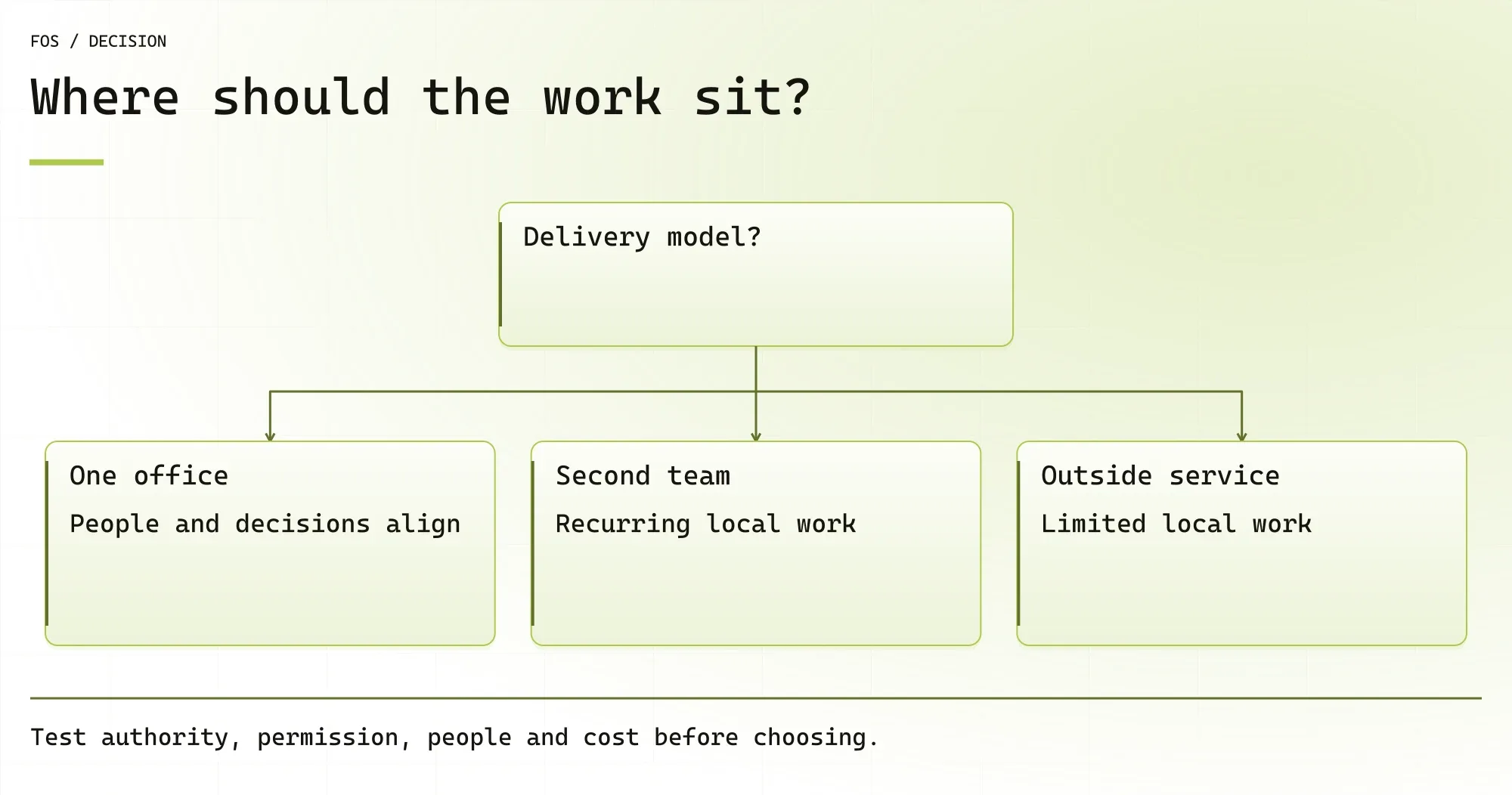
Delivery model for the work, before selecting the jurisdiction. View the full-width desktop diagram. Test authority, permission, staffing and cost for the chosen route.
04An illustrative decision: a family, two operating centres
Consider a fictional family whose principal and two adult children live in the US, with a long-held US investment team. Another family member moves to Singapore and wants dedicated research on Asian private investments. Existing fund interests are held through several entities in different places. No outside client money is managed.
The family initially asks whether to “move the family office to Singapore.” It compares three practical options: keep research in the US despite the time-zone and local-network gap; commission a Singapore specialist for a defined mandate; or hire a Singapore team. Moving the whole office would disrupt an operating US approval chain without solving a demonstrated problem.
The test is one real Asian investment proposal. If a specialist can provide timely local diligence and the US committee can review it with reliable records, an outside mandate may suffice—subject to the specialist's own permission and cross-border assessment. A Singapore team becomes a stronger option only if recurring work needs in-house people and the family can support local hiring, data access, any applicable account and reporting duties, and a clear permission analysis. This is an operating hypothesis, not a conclusion that either office or any fund qualifies for a particular exemption or incentive.
The first proposal must answer five questions, each with an owner:
- Who approves the investment? The existing family investment committee needs a mandate and meeting record showing who may bind the investing entity and where the decision was made.
- What may the Singapore team do? A named office executive must define research, administration, advice and any execution authority in writing.
- Who employs and pays the team? The family CFO and local advisers need employment, service and cost-allocation agreements that match the work.
- Are permissions or incentives available? Qualified local counsel and tax advisers must examine the US, Singapore and relevant asset-jurisdiction facts separately. No tax result is assumed.
- When does the model pass? The principal or delegated family board signs off only after a complete proposal and reporting cycle preserves authority, records and reconciled charges.
If Singapore research is valuable but the proposed team cannot hire, access records or operate under a clear permission analysis, the family may postpone an office and buy a defined service instead. If the second team can operate with real substance and clean authority, the family can launch it without pretending every asset or family member has moved.
The same research function compared across all four hubs
This is a worked shortlist for the fictional family, not a ranking of countries for other families. For each candidate, the six fields have the same meaning: work and people; receiving entity/client; permission; residence/tax; annual cost; and the next evidence gate.
United States — retain the current team as the baseline
- Work and people: Existing US staff prepare research; the US committee keeps approval.
- Entity and client: Existing office serves named family investing entities; verify the exact client set.
- Permission: Confirm the existing office's SEC exclusion and any activity-specific obligations still fit.
- Residence and tax: Record where decisions really occur and review affected entities; do not infer the answer from the office address.
- Annual cost: Measure incremental research time and travel against the existing budget.
- Next gate: CFO tests whether one real Asian proposal can be researched and approved adequately from the US.
United Kingdom — defer unless a London function emerges
- Work and people: No London-specific research need or prospective hire has been identified in these example facts.
- Entity and client: Any UK provider or office entity and service recipient would need naming.
- Permission: FCA activity classification is unknown until the work and provider are specified.
- Residence and tax: A UK office or decision maker would require a separate company and personal-position review.
- Annual cost: No meaningful quote can be made until the proposed work and staffing exist.
- Next gate: Do not create an office for this proposal; reconsider only if recurring UK-based work becomes necessary.
Singapore — test a provider before hiring a team
- Work and people: Commission a defined local diligence mandate; compare its output with the recurring work needed for an in-house team.
- Entity and client: Name the outside provider and the family investing entity receiving the work.
- Permission: Check the provider's own status and cross-border delivery; assess an SFO route separately if hiring a family-owned team.
- Residence and tax: Review where any new staff, management and fund vehicles would actually sit; no incentive is assumed.
- Annual cost: Obtain comparable provider and in-house quotes, including local staff and ongoing duties.
- Next gate: Complete one proposal and reporting cycle, then decide whether repeat volume justifies a permanent team.
UAE — defer without a Gulf function
- Work and people: No Gulf-based research or administration task is evidenced in the example.
- Entity and client: The family has not named an ADGM or DIFC operating entity or recipient.
- Permission: An ADGM SFO route and DIFC financial-services question cannot be resolved without the proposed activity; ADGM's stated asset threshold is route-specific.
- Residence and tax: Examine actual people and control only if a Gulf operating function is proposed.
- Annual cost: Request a route-specific quote if that function becomes real; an incorporation fee alone is insufficient.
- Next gate: Keep out of this proposal's operating shortlist until an accountable Gulf service need exists.
For this family, the provisional order is to test the current US team against a Singapore provider mandate, then decide whether a Singapore team has enough recurring work. UK and UAE offices remain unproven by the example facts. This is a choice about service delivery, not a country-wide judgement.
05Build a jurisdiction-by-function brief before filing
Ask each candidate location to answer the same questions, with written sources and an accountable adviser. This makes proposals comparable and exposes where a claimed advantage depends on a missing fact.
- Purpose and people. What work must the office own, who receives it, and where will the principals, decision makers and staff actually be?
- Activities and permissions. For each proposed service, is it regulated, excluded, exempt or outside the relevant regime? Which assumptions make that answer true?
- Entity map. Which operating company employs people and contracts for services? Which entities own investments? Who controls each one?
- Tax and residence. What are the personal, entity, fund and cross-border questions, each considered separately? What changes if people or decision-making move?
- Banking and operations. Can the location support custody, payment controls, data access, hiring and reliable books for the family's actual work?
- Cost and reversibility. What are setup and annual commitments, including people, advice, systems and any incentive conditions? What happens if the family exits or adds a branch?
Prepare a one-page shortlist summary for the family, with a short supporting record for each essential function—investment approval, administration, banking/payments and reporting—in every candidate location. Leave unknown where a question has not been resolved; an empty field must not be treated as approval. Use the same fields for each record:
Worked location record: Asian investment research
Proposed place and receiving entity: Singapore; named family investing entity.
Decision owner: US investment committee; authority remains under its mandate.
Permission status: Unknown. Local counsel must classify the research/advice boundary and any cross-border delivery.
Tax and residence status: Unknown. Tax advisers must assess the people, office and relevant entities separately.
Evidence owner and open condition: Office executive to obtain written scope, adviser analyses and the first completed proposal record.
For the next function, copy those five fields and replace the example facts. This format keeps permission and tax/residence as separate decisions without requiring a wide mobile table.
For active candidate routes, the shortlist is ready for targeted adviser review when no essential function lacks an owner, each proposed activity has an evidenced permission route or a named adviser question, and cost and staffing commitments have a credible quote.
In the worked case, that test applies to the US baseline and Singapore provider mandate. The UK and UAE remain screened-out comparison rows; they need a defined local function, owner and quote only if the family reconsiders them. Selection or incorporation waits until essential permissions and other material conditions are resolved.
For the underlying office build, use the setup guide; for the recurring run rate, see the family-office operating budget.
06What should be verified before incorporation or hiring?
A route is ready for selection when its function, operating owner and material permissions are documented. A screened-out location can remain in the comparison without meeting that test. A low tax rate or fast company registration is not enough.
Before signing an office lease, hiring staff or moving decision rights, obtain current local advice on the actual activity and client set. Then test the chosen model through a real reporting and approval cycle. A location earns its place in the structure when the people there can perform the work, the authorised person can make the decision, and the family can trace the result back to reliable records.
 Knowledge & Decision · Analysis
How Much Net Worth Do You Need for a Family Office, and When Should You Start?
What family office wealth figures mean, how location-specific rules differ, and how to test costs, cash and service… Knowledge & Decision · Analysis
What Is a Single-Family Office? Services, Costs and Fit
A single-family office serves one family through a dedicated organization. See its services, staffing, costs and when another… Knowledge & Decision · Analysis