An Unplanned Security Fix Tests the Family Office Operating Budget
A family office can approve a sensible annual budget and still be unable to answer a simple question in June: who pays for proposed new work, and…

A family office can approve a sensible annual budget and still be unable to answer a simple question in June: who pays for proposed new work, and what must change before it is ordered? A security fix may serve several trusts and companies, while the office's budget lists only one technology total. Without a payer, owner and forecast effect, the team cannot use that estimate to control the purchase.
In the worked case below, the fix would raise the full-year forecast by US$36,000 if it is approved and optional work is deferred. The proposed July payment also faces a US$14,000 cash gap. The current forecast stays at the approved US$1 million under this case's assumptions; the ordinary order stays on hold while the office checks funding, payer and approval authority.
This article builds a fictional US$1 million annual office budget and tests it against a proposed US$48,000 security remediation. The amounts and allocation shares teach the method; they are not market prices, recommended staffing levels or advice to charge a particular legal entity. Actual entity documents, trust terms, contracts and professional advice govern whether an expense may be incurred, paid or recharged.
- Budget the work the office will perform. Separate office running costs from investment fees, household costs and one-off projects before comparing any benchmark.
- For each line, record the service, cost owner, contracting party, proposed payer, allocation basis, timing and approval route. A management allocation does not itself authorize a trust or company to pay.
- At each review, reconcile incurred cost, signed future work and a realistic estimate to complete. Check cash timing separately. Reforecast the whole year when a decision changes; a proposal is not an actual expense or signed commitment.
01What Belongs in the Family Office Operating Budget?
The operating budget is a prospective plan for the work the office delivers or coordinates: people, systems, professional support, premises, security and administration. It should be set for a named period, normally a year, and a defined service scope.
This article's fictional consolidated management plan includes both pure office running costs and US$250,000 of direct services for specific entities. Those categories stay separate in the detail. The plan is not the family's investment allocation, the fees embedded in a fund, household spending or any one entity's general ledger. Where costs cross these boundaries, the office must state its classification instead of hiding them in “miscellaneous.”
The answer to “How much does a family office cost?” depends on its services, staff and provider mix, locations, complexity and the source's definition of operating cost.
The UBS 2026 global family-office survey distinguishes pure office running costs from other expenditure; it reports that 58% of its respondents had an annual budgeting process for the office. The J.P. Morgan 2026 global survey reports that average annual operating costs exceed US$6.6 million among responding offices with more than US$1 billion in assets. Those are global survey observations for particular respondents and definitions. They do not set a target budget for this office or a US minimum.
A useful budget starts with the services to be delivered. A small office that outsources tax preparation still needs to plan for the office time required to gather records and review advice. An office with an internal investment team has a different staff and systems base. The single-family versus multi-family office comparison owns that service-model choice. The separate fee-structure guide explains what a provider quote includes and excludes; this budget must place every retained task and excluded charge somewhere visible.
Build each line from its work and approval route
For a first pass, list these columns: service or deliverable; annual base amount and basis; one-time or recurring; month of likely cash payment; direct or shared benefit; contract signer and legal payer; management-allocation driver; owner; approval threshold and evidence. Flag missing quotes as unknown instead of entering zero.
| Illustrative annual line | Amount | Planning basis | Budget owner |
|---|---|---|---|
| Staff and benefits | US$600,000 | Named roles and expected employment cost | Office leader |
| Systems and security | US$90,000 | Licenses, support and planned security work | Technology lead |
| Premises and administration | US$60,000 | Lease, facilities and common administration | Office manager |
| Direct entity advice and services | US$250,000 | Specific tax, legal and fiduciary scopes | Assigned entity owner |
| Consolidated office-managed plan | US$1,000,000 | Running costs plus direct entity services; not a market benchmark | Office CFO |
The US$250,000 direct line is a roll-up of US$140,000 of entity-specific tax and legal work and US$110,000 of fiduciary and records services in this invented plan. Each underlying scope needs its own owner and permitted payer; the combined figure cannot be spread automatically. The office might include a contingency if its approvers authorize one. It still needs a separate decision on whether the proposal is proper and the contract may be approved.
Filled systems line (fictional). The annual baseline is US$90,000. The technology lead owns scope. Office Services LLC is the proposed contracting and paying entity, subject to its service agreement and authority check. Shared use would be measured by protected users or systems; no trust recharge is authorized by this planning line.
Its working cost schedule shows US$45,000 incurred through June, US$33,000 of signed future work due under July through December contracts, and US$12,000 of uncommitted work tentatively planned for November. The cash schedule separately shows when each received service was or will be paid.
Under this fictional office's assumed written delegation, two managers must approve a new project above US$25,000. That threshold is invented for the case. Other offices must use their own delegations.
02Who Benefits, Who Contracts and Who Pays?
An office may serve a holding company, two trusts and several family members. Its internal cost report can allocate work across them to show consumption. That allocation should not be confused with an authority to make a trust pay an invoice or to deduct the charge for tax purposes. The governing documents, service agreements and applicable professional advice decide the latter.
Start by distinguishing direct work from genuinely shared work. A tax opinion for one entity belongs in that entity's direct planning line. Shared office staff time can be estimated using contemporaneous service hours or another supportable measure. Shared software may be better allocated by users, covered accounts or another measure of use. A universal assets-under-management percentage is not a causal explanation for every service.
Suppose the fictional office's US$600,000 staff plan is expected to support three service groups in a 50% / 30% / 20% hours split. For management reporting, the planned shares are US$300,000, US$180,000 and US$120,000. At year-end, actual service hours may change. The office records the method and reviews material changes before making any charge between legal vehicles.
| Question | Record needed before payment or recharge |
|---|---|
| Who receives the service? | Deliverable, entity or family beneficiary and evidence of use |
| Who ordered and contracted it? | Agreement, signatory and scope |
| Who is legally permitted to pay? | Governing document, agreement, approval and any needed advice |
| How is a shared charge measured? | Stated allocation driver, period and supporting data |
| Who checks the result? | Independent review where appropriate, exception and correction record |
The distinction between a budget allocation and a legal payer belongs in the decision record. If the payer or reimbursement route is unclear, the office can still model the proposed work in a separate consolidated scenario while it resolves that question. It should not silently assume that the entity with the most assets bears the cost.
03Test the Budget With a US$48,000 Security Proposal
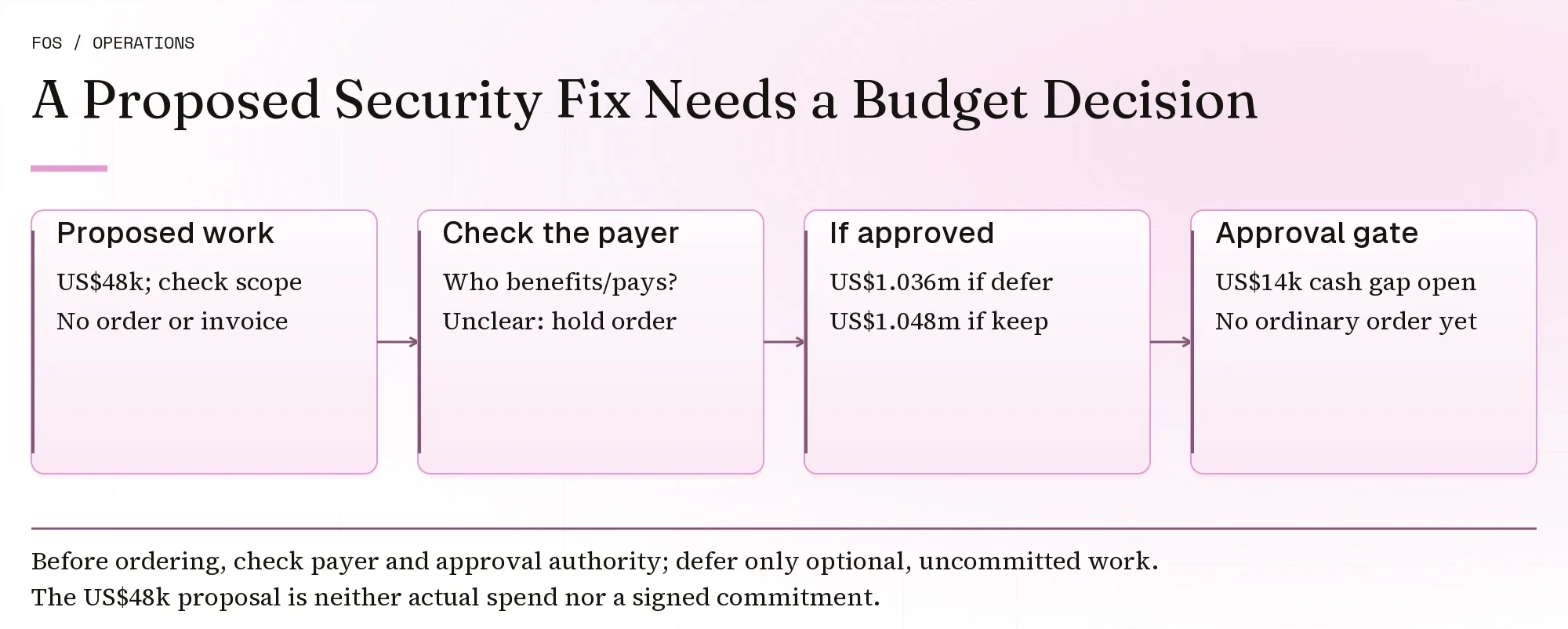
The diagram shows the decision route before an order. Its two annual totals depend on whether the office may defer US$12,000 of still-uncommitted systems work; the case and arithmetic follow below.
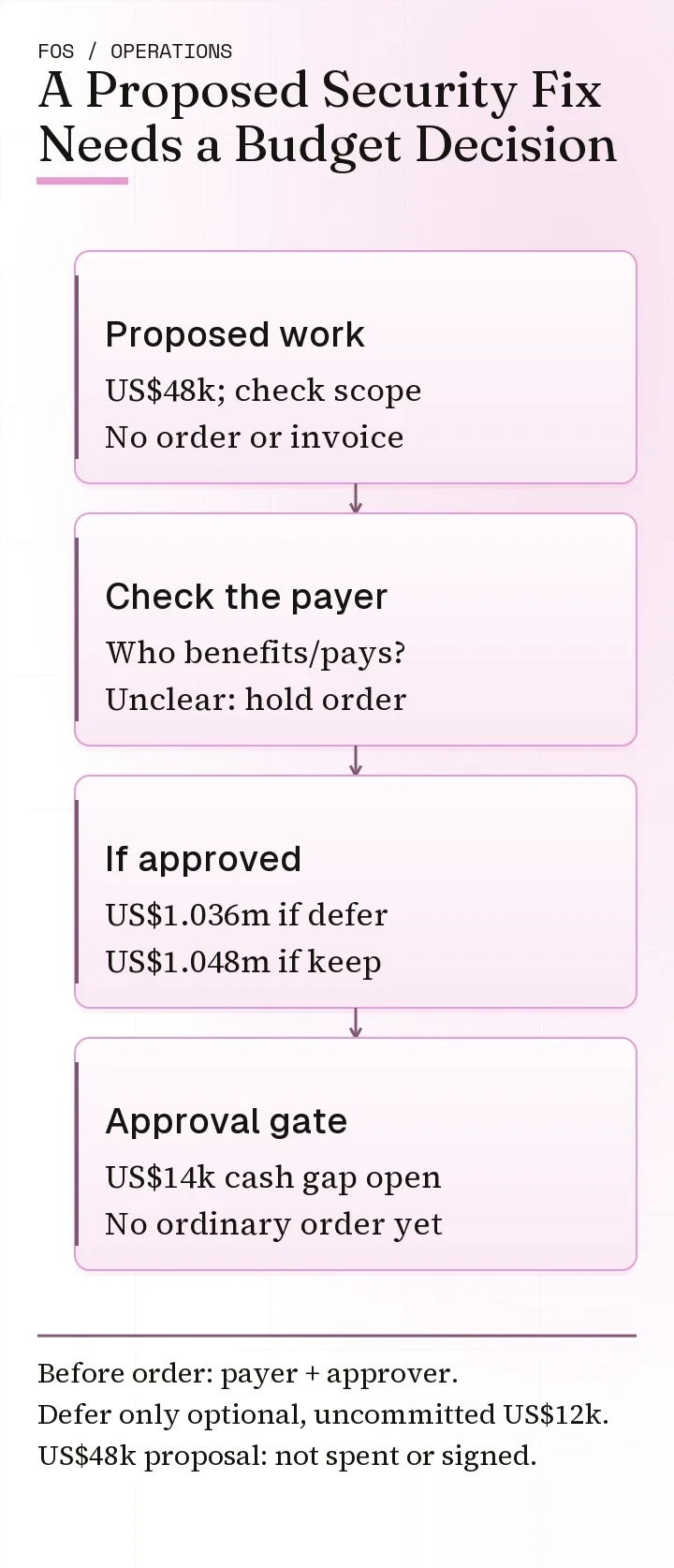
Diagram: The security proposal is not booked as paid or approved. Open the full-width desktop diagram.
On 30 June, the fictional office has a US$90,000 annual systems-and-security budget. It has incurred US$45,000 for work received through June, counted once whether already paid or still accrued. It also has US$33,000 of signed commitments for future work, excluding any amount already accrued. A further US$12,000 was planned but has not been contracted. The technology lead receives a US$48,000 proposal for urgent remediation across the office's systems.
The first question is operational: what risk does the work address, what must happen now, and can the office verify the proposed scope and provider? The second is financial: which legal vehicle will contract and pay, and who may approve the purchase? Those questions cannot be answered by moving a number from one spreadsheet cell to another.
The CFO models two cases before approval. The first US$45,000 is incurred cost, the US$33,000 covers signed future work, and the US$12,000 is still optional and uncommitted:
| Annual systems case | Components (US$000) | Full-year estimate | Variance to US$90,000 budget |
|---|---|---|---|
| Existing plan | 45 incurred + 33 signed future + 12 uncommitted | US$90,000 | No variance |
| Fix proposed; defer eligible US$12,000 work | 45 incurred + 33 signed future + 48 proposed | US$126,000 | +US$36,000 |
| Fix proposed; keep all planned work | 45 incurred + 33 signed future + 12 planned + 48 proposed | US$138,000 | +US$48,000 |
With no other changes in this fictional office, the approved baseline and current authorized forecast remain US$1 million. If the project is approved and every other line stays unchanged, the full-year forecast would become US$1.036 million when the optional work is deferred, or US$1.048 million when that work remains. Those conditional scenarios are increases of 3.6% and 4.8% against the baseline. The office would adopt a revised forecast only after deciding the project, deferral, payer and funding route. Neither scenario is actual spend or permission to order the work.
The signed US$33,000 cannot be cancelled merely because the budget is tight; contract terms control any change. The US$12,000 can be removed only if the office confirms that work is genuinely optional and uncommitted.
A forecast is not available cash
Assume the fictional supplier proposes US$24,000 at order in July and US$24,000 after accepted work in August. At 30 June, Office Services LLC has US$80,000 of unrestricted cash, with US$50,000 reserved for payroll and US$20,000 for existing signed bills before its next verified receipt. The available balance for a new July order is US$10,000. The first installment would therefore have a US$14,000 cash gap. The payroll and signed bills are already in the annual cost plan; this cash bridge does not add them to annual expense again.
The office has not identified a verified July receipt or an authorized source for that gap. Dropping the optional US$12,000 of later systems work would lower the post-approval annual forecast but would not automatically create US$12,000 of cash before the first installment. The CFO must confirm the actual payment dates and permitted funding route. A transfer or contribution, if proposed, needs its own legal and approval check; no trust reimbursement has been authorized.
The outcome at this point is hold the ordinary order. The team can continue investigating the security risk and the documented emergency authority route, but it cannot call the project funded merely because the full-year increase is 3.6%.
The technology lead owns the unresolved security risk while the order is held and documents urgency, scope and provider checks. In this fictional case, the office leader sets 1 July at noon for a decision on the risk and any interim protective measure. That deadline belongs to the example; an actual office must use its own incident process.
The CFO documents who benefits, why Office Services LLC would contract and pay, whether its agreement allows that role, and how the US$14,000 July cash gap would be filled. Two managers must approve a US$48,000 new project under the fictional delegation once the evidence is complete. If the remediation protects several vehicles, any later allocation proposal needs a suitable driver and entity-specific authority. The supplier's immediate payer is a separate decision.
Before the managers decide, the CFO compares the final scoped quote, full amount payable and July/August payment dates with the modeled case. A material change sends the annual and cash calculations back for review. The office records approve, modify or decline, with an owner and date.
If ordinary approval is withheld but immediate protective work is needed, the technology lead raises the risk to the office leader by the stated deadline. The responsible person then checks an actual documented emergency authority, if one exists, rather than inventing a budget exception. That route still needs a lawful payer and cash source; it does not erase the US$14,000 July gap or the later US$24,000 installment.
Make the forecast change visible
A full-year forecast estimates the cost of authorized work, using incurred cost, future commitments and expected remaining work. Keep open proposals in a separate scenario column until the office decides. For this case, the current authorized forecast remains US$1 million; US$1.036 million and US$1.048 million are post-approval scenarios. Show cash-payment timing in its own view. A proposal becomes a commitment only when the office enters a binding arrangement; payment and expense recognition follow their own timing and accounting rules. The budget report should point back to the underlying contract and accounting record. Its forecast does not replace the books.
04Review Variances Without Hiding the Decision
For this fictional office, a monthly review is a useful starting cadence; an actual office should follow its own policy and decision deadlines. The CFO shows the original approved budget beside year-to-date incurred costs, signed future commitments and the estimate to complete. Discuss the authorized full-year forecast minus the approved annual budget, then show any open proposal as a separate conditional variance. Explain timing and scope separately. A late invoice can move cash into another month without changing annual cost. New work can change annual cost before an invoice arrives.
For each material movement, write one sentence about the cause and one about the required decision. “Security +US$36,000” is incomplete. “Conditional security scenario +US$36,000 if remediation is approved and uncommitted work is deferred; funding and payer review due before contract” lets a reviewer act. Set escalation thresholds in the office's actual delegation and budget policy; there is no reliable universal percentage at which every family office must reapprove a line.
A practical variance register needs only six fields:
- Baseline budget and last approved revision, with dates.
- Incurred cost, paid or accrued once, reconciled to the relevant books; cash paid in a separate column.
- Signed commitments and realistic estimate to complete.
- Forecast variance, separated into timing, rate, volume or new scope.
- Named owner, proposed action and approval route.
- Decision, supporting record and next review date.
Keep the baseline visible after a revision. Otherwise the office may gradually absorb cost growth and lose the ability to say what changed. Do not double-count an external investment manager fee in both the office budget and portfolio cost report. Conversely, do not omit the office's retained oversight work simply because a provider quote includes execution.
05Put the Annual Plan on One Decision Page
The annual budget should be something the principal, office leader and entity decision-makers can challenge. Its front page states the service scope, base plan, major assumptions, direct and shared categories, cash-heavy months, known exclusions, approval map and review cadence. Attach the detail behind it. An office may approve a consolidated management plan while separate entities still need their own valid budgets, contracts and payment authorities.
For the fictional office, the June decision record could read:
Status: hold. Security remediation proposed at US$48,000; no contract or invoice.
Annual plan: US$1.000 million approved baseline and current authorized forecast. The post-approval scenario would be US$1.036 million if optional US$12,000 systems work is deferred, or US$1.048 million if that work remains. Neither scenario is approved or adopted.
Cash: US$24,000 proposed July installment; US$10,000 available after near-term reserves; US$14,000 gap. A second US$24,000 is proposed after accepted work in August. Verified funding for both installments remains open. Solving July alone would not establish August liquidity.
Payer and authority: Office Services LLC is the candidate contracting and paying entity. Its service agreement and two-manager approval route must be checked; no trust reimbursement is assumed.
Owners and next decision: Technology lead owns and monitors the security risk during the hold, verifies scope and provider, and raises any need for interim protection to the office leader. The fictional decision deadline is 1 July at noon. CFO verifies final quote and July/August dates against the model, cash, and payer. The managers decide under the assumed written delegation after receiving the packet. No ordinary purchase order or payment before that decision; any urgent protective action needs a documented emergency authority that actually applies.
That record tells the reader what is known, what is proposed and what remains unresolved. It is also the handoff for the next monthly review: was the project approved, did the work happen, which entity paid, was the allocation approved, and was a revised forecast formally adopted?
Common questions
Is there a normal family office operating budget? Survey figures can give context, but service scope and cost definitions differ. The UBS and J.P. Morgan reports above describe their respondents; neither supplies a correct annual budget for a particular family. Build the plan from roles, providers, systems and deliverables first, then compare like-for-like definitions.
Should investment fees be included? Show them in the family's complete cost view, but distinguish the office's own running cost from asset-management, fund, banking and external-structure fees. Use one consistent boundary so a fee is neither hidden nor counted twice.
Can a trust pay part of a shared office bill? A management allocation may describe benefit; it does not settle whether the trust instrument, agreement, fiduciary duty, accounting or tax treatment permits payment or reimbursement. Have the responsible trustee and advisers review the actual arrangement.
When should the office reforecast or seek a new approval? Update the forecast when new facts change the full-year estimate. Seek approval when the actual delegation requires it, then record the authorized decision and dated revision. Preserve the original baseline. A timing difference alone may need explanation without a new annual spending authorization.
An operating budget earns its place when it can survive a real proposal. It shows the office what it has already spent, what it has promised, what it now expects to spend and who must decide before the next dollar moves.
 Operations & Governance · Analysis
A Family Office Reporting Calendar That Survives Late Data
A family office can promise a report by the 14th and still leave the most important dates unstated.… Operations & Governance · Analysis
What Should Family Office Investment Committee Minutes Include—and Why?
Investment committee minutes record what was considered and decided, who could vote, and what remains open. Clear authority… Operations & Governance · Analysis