What a Family Office Fee Covers—and What It Leaves Out
Compare family office fee structures using one asset and service schedule. See how billed assets, included work and separate charges change the known first-year and ongoing cost.

A family office fee is not comparable until the family knows which assets are billed, which work is included, and who pays for work outside the contract. An asset-based quote can look smaller than a retainer yet cost more as private-asset values rise. A fixed fee can look predictable while leaving document processing, tax coordination or investment oversight to separate providers.
For a US family, the useful comparison is a written annual bill for the same work and the same period, followed by a test of who will actually deliver it. The numbers below are illustrative proposals, not quoted market rates.
- Ask for the fee formula, billing base, valuation date, minimum, cap, tier and payment schedule. “Assets under management” and “assets reported” may be different pools.
- Put the scope beside the price. Name who handles investments, books, private-fund notices, consolidated reporting, tax coordination and family approvals. Price any missing work separately.
- Compare known first-year and ongoing cash cost on the same asset schedule, listing unquoted work separately. Then test the first bill, one report and an exception before treating a proposal as an operating solution.
01Start With the Service, Not the Percentage
“Family office” may describe a multi-family office, an adviser coordinating outside firms, or a dedicated single-family office. Their bills measure different things. A provider's fee buys an agreed service; an internal office incurs payroll, technology, insurance and outside-adviser expenses even when it charges the family no fee.
Write the proposed service in deliverables. For example, “consolidated reporting” should say which entities and accounts enter the report, how often it arrives, who checks stale values and who resolves a difference. “Tax support” should distinguish preparing a return from coordinating records for an outside tax preparer. A fee that includes one but not the other is not a comparable quote.
Creative Planning's explanation of multi-family offices describes asset-based, fixed, hourly, performance-based and hybrid arrangements. Those are possible charging methods, not a common definition of what every provider delivers. The contract and service schedule supply that definition for a particular family.
02Read the Formula Behind Each Fee Model
| Model | What to calculate | Main question for the family |
|---|---|---|
| Asset-based | Rate × the defined billed assets, with any tiers, minimums or caps. | Does the base include assets the office reports but does not manage, private holdings, cash, or values already counted through an entity? |
| Fixed retainer | Annual or monthly amount for a named service volume and term. | Which events, entities, hours or reports trigger an extra charge? |
| Hourly or project | Rate × authorized time, or a priced deliverable. | Who approves work outside scope, and what is the estimate before it begins? |
| Hybrid | Each component above, calculated separately. | Are two components charging for the same assets or activity? |
| Performance-based | The contract's defined measure, period and calculation method. | What incentive and additional cost would the arrangement create, and does it apply to this mandate? |
There is no universal family-office fee or reliable answer to whether “1% is high” without the billed assets and contracted service. An annual 0.50% applied to US$50 million is US$250,000; applied to US$80 million it is US$400,000. The difference is the base, not a change in the quoted rate. For private holdings, ask which valuation is used, when it changes, and whether entity look-through counts an asset twice. Published percentage ranges alone cannot settle the price of a particular US office.
For a registered investment adviser, the SEC's Form ADV brochure guidance says the brochure must describe compensation, its fee schedule, whether fees are negotiable, how and when they are charged, and other expenses clients may pay. Read that disclosure with the proposal and agreement. It does not replace a service schedule, and not every family-office provider is acting in the same regulatory capacity.
03Put Two Proposals on One Asset and Service Schedule
Consider a hypothetical family with US$80 million on a non-duplicated asset schedule: US$50 million of marketable assets under the proposed investment mandate, US$20 million of private funds and US$10 million of property. For this comparison, both providers receive the same valuation dated 1 January and quote a full 12-month year, with no mid-year proration or tier change. These dates and values are assumptions, not a forecast.
The family has six legal entities. It asks for management of the marketable assets, 12 monthly consolidated reports across all three asset groups, four quarterly entity packs, processing for up to 24 private-fund notices, and records for an outside tax preparer. The deliverable counts make scope comparable on paper; they do not prove equal service quality.
Proposal A: 0.40% annually on all US$80 million of reported assets, billed in equal quarters on the stated base if it does not change. The written scope includes the stated investment work, reporting, quarterly packs, up to 24 notices and delivery of records to the outside tax preparer. One-time setup is US$40,000, billed with the first quarterly invoice.
Proposal B: 0.50% on the US$50 million managed portfolio plus a US$90,000 annual administration retainer. Its base scope includes the same investment work, reporting, quarterly packs and tax-preparer records. Processing up to 24 notices requires a separate US$40,000 annual quote. One-time setup is US$20,000.
Neither proposal includes the outside tax preparer's US$30,000 annual quote. Both assume the same 12-month service volume and no other priced exclusion in the arithmetic below. Unquoted legal, custody, transaction or underlying-investment costs remain unresolved; the calculated totals are known cash costs for the stated scope, not every economic cost of the family's investments.
These are invented quote terms used to show the method. Before using real proposals, confirm that service volumes, entity lists, valuation rules, exclusions and tax-provider responsibilities actually match.
| Annual cost on this schedule | Proposal A | Proposal B |
|---|---|---|
| Main asset-based fee | 0.40% × US$80m = US$320,000 | 0.50% × US$50m = US$250,000 |
| Administration retainer | Included | US$90,000 |
| Private-fund notice service needed for equal scope | Included | US$40,000 |
| Outside tax preparer, same scope for both | US$30,000 | US$30,000 |
| Known ongoing annual cash cost for stated scope | US$350,000 | US$410,000 |
| One-time setup | US$40,000 | US$20,000 |
| Known first-year cash cost for stated scope | US$390,000 | US$430,000 |
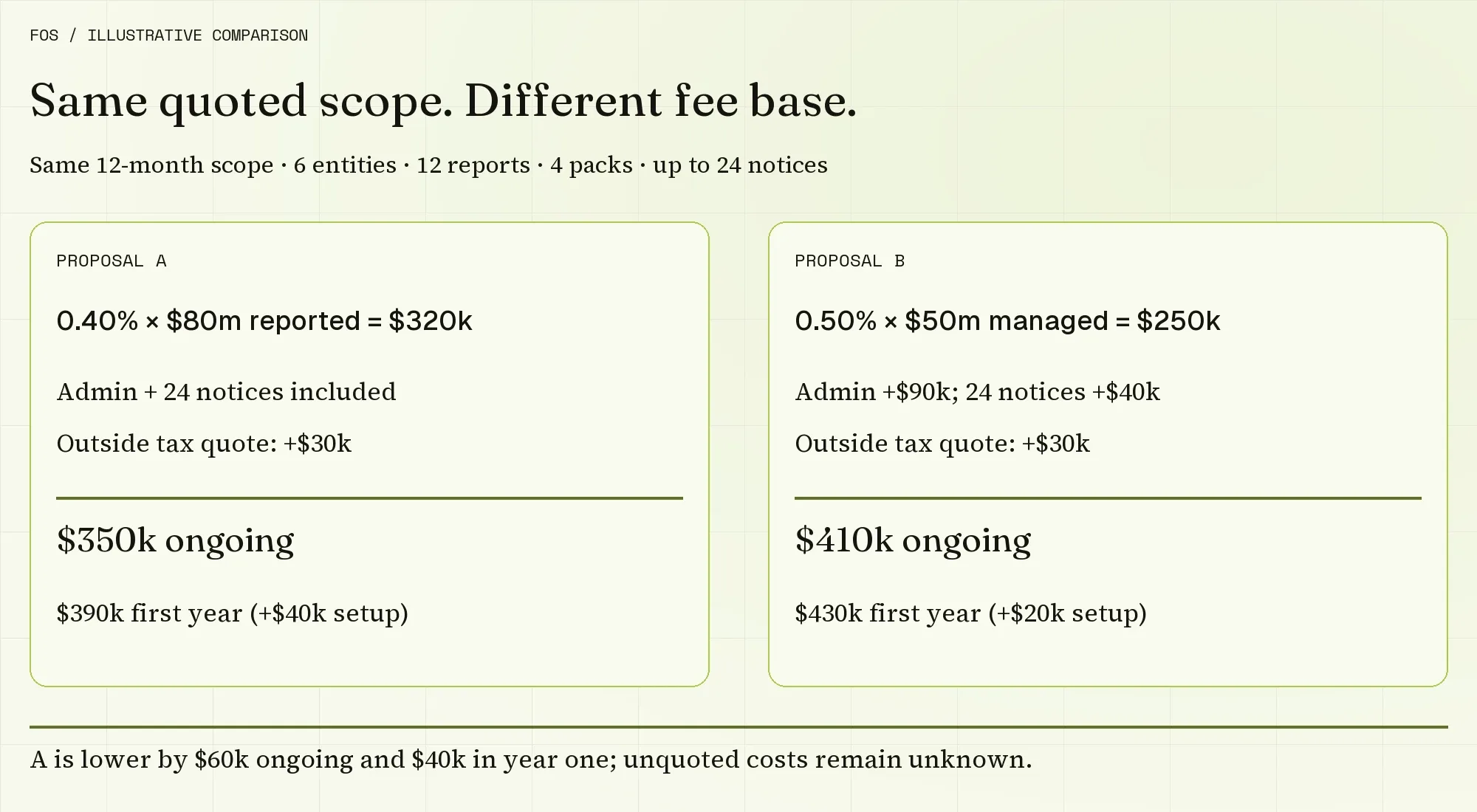
View the full-width desktop version. The fee bridge shows both the ongoing and first-year totals, including the same US$30,000 outside tax quote. Unquoted costs remain unknown; the full service and valuation assumptions are in the table above.
On these assumptions, A is US$40,000 lower in year one and US$60,000 lower in an ongoing year. That is a known-cost comparison, not a verdict that A's service is better.
A may have more exposure to changes in reported private-asset or property values. If those assets rise by US$10 million while other inputs remain unchanged, A's 0.40% formula adds US$40,000 annually. Its known ongoing amount rises to US$390,000, narrowing the gap with B's unchanged US$410,000 to US$20,000. A real agreement may reprice a retainer, change scope or apply a tier, so do not extend this sensitivity beyond its assumptions.
Do not add the same expense twice. If a fund's own expenses are already reflected in its reported return, they remain economically relevant but are not another invoice from the family-office provider. If an adviser rebates a manager fee or offsets a retainer, show the credit in the same period and under the same conditions. Mark any unquoted tax, legal, custody or transaction work unknown, not zero.
04Ask What Happens Outside the Quoted Scope
The gap between fee and full bill often appears at handoffs. A reporting team may collect statements but leave the family to chase a private-fund capital call. An investment team may approve a manager while a different provider maintains the entity books. The office could still be a good choice, but the quote needs to say who owns those seams.
Use a one-page schedule when requesting revised proposals:
| Record to complete | Proposal A | Proposal B |
|---|---|---|
| Billed asset list, exclusions and valuation date | [US$ base, included/excluded assets, date] | [US$ base, included/excluded assets, date] |
| Rate, tier, minimum, cap and billing period | [Formula and 12-month result] | [Formula and 12-month result] |
| Included deliverables, entity count, frequency and named owner | [Written service schedule] | [Written service schedule] |
| Extra work: scope status, written price or unquoted, payer, authorization owner | [Included / excluded / unresolved; amount or unknown; names] | [Included / excluded / unresolved; amount or unknown; names] |
| Family-retained work and third-party charges | [Task, named payer, amount or unknown] | [Task, named payer, amount or unknown] |
| Rebates or offsets | [Amount, condition and period] | [Amount, condition and period] |
| Setup, migration, termination and data-export cost | [Written amount or unquoted; payer and trigger] | [Written amount or unquoted; payer and trigger] |
| Known first-year / ongoing total | [Add priced rows; list unknowns below] | [Add priced rows; list unknowns below] |
| Unquoted item, owner and next quote date | [Item, owner, date; no zero default] | [Item, owner, date; no zero default] |
| Before signing: sample bill, report and exception exercise | [Evidence, decision and owner] | [Evidence, decision and owner] |
| After signing: actual first bill and report | [Acceptance / hold / correction; owner] | [Acceptance / hold / correction; owner] |
For an in-house single-family office, make a separate operating-cost schedule for salaries and benefits, systems, facilities, security, insurance and retained specialists. Do not compare an MFO fee with SFO payroll alone. Forge Community's 2020 survey, published in 2021, of 187 invited single-family offices reported wide variation in operating expense across office types and asset bands. It is historical, invitation-based evidence of variation, not a current quote or a rule for this family's budget.
05Choose a Scope, Then Test the First Bill and Report
Before signing, compare written commitments. Use the same entity list, asset date and service volume in both proposals. Have each provider state which assets enter each charge, who approves out-of-scope work, who pays third parties, and what happens to records on exit. For an advisory relationship where Form ADV applies, reconcile the proposal with its brochure and proposed agreement.
Calculate a sample first invoice from each proposed formula. If A bills one quarter on the assumed US$80 million base with no change or proration, 0.40% × US$80 million ÷ 4 = US$80,000. Add its US$40,000 setup due at that point: the proposed first provider bill is US$120,000. The outside tax preparer would bill separately. Ask A to identify any data-integration charge in writing; an unapproved US$6,000 extra must be resolved in the contract and sample bill before the family relies on the US$120,000 figure.
Also ask each finalist to work through a representative dated statement set with one private-fund notice and one valuation difference, if a pre-contract exercise is available. Observe who would log the exception, obtain the source, decide the treatment and carry the resolution into a family report. The exercise is evidence of a proposed workflow, not proof that the contracted team has delivered it.
Record a provisional selection as pass, hold or decline. Pass requires a written formula and scope, first-year and ongoing known-cost calculations, named owners and prices or quote dates for missing work, and sufficient pre-sign evidence for the family's required workflow. Hold an unresolved billed asset, exclusion, rebate, price or owner. Decline if a provider cannot price or own work the family requires. Selection remains conditional on final contract terms.
After signing, verify what arrives. Match the actual first invoice to the agreed asset snapshot, period, tier or minimum, retainer, setup, authorized extras, rebates and third-party charges. Hold a disputed line for correction or escalation. Compare the first contracted report and its exception record with the service schedule; record who resolved the notice and valuation issue and whether the promised report was delivered. A signed contract and sample demonstration do not substitute for this operating acceptance check.
 Knowledge & Decision · Analysis
How Much Net Worth Do You Need for a Family Office, and When Should You Start?
What family office wealth figures mean, how location-specific rules differ, and how to test costs, cash and service… Knowledge & Decision · Analysis
What Is a Single-Family Office? Services, Costs and Fit
A single-family office serves one family through a dedicated organization. See its services, staffing, costs and when another… Knowledge & Decision · Analysis