A Family Office Org Chart That Shows Who Decides
Build a family office org chart that separates reporting, legal-owner approval and outside advice. Test lean and staffed models against one investment decision.

A family office org chart should tell a new employee who manages their work. It should also answer a different question: who may commit a family entity's money? A line from a chief investment officer to the head of the office does not, by itself, give either person authority over a trust account.
Draw three relationships separately: staff reporting, approval rights and outside advice. Then test the chart against a decision that crosses them. The examples below show a lean office and a staffed office for a US family; their titles and approval paths are illustrative, not a prescribed legal structure.
- Put the family decision body and each legal asset owner on the chart before adding job titles. A trustee or company manager may have powers that a family council or office employee does not.
- Use a solid line for management, a clearly labelled approval connection for a delegated decision, and a separate advisory connection for outside counsel, tax and investment specialists. Write down the mandate behind each approval.
- Run one proposed transaction across the chart. If nobody can name who recommends, checks cash, approves for the owner, executes and reconciles it, the chart is decorative rather than operational.
01What a Family Office Org Chart Must Show
The chart has two layers. One is the family and ownership layer: family principals, any council or board, and the trusts, companies or other entities that own assets. The other is the service layer: the office staff or provider team that prepares advice, moves work between specialists and maintains records. A family council can set priorities without becoming the legal owner of every account.
Heidrick & Struggles describes several plausible leadership roles and cautions that not every office needs every one. Its sample structures vary with the family's purpose and operating businesses. The question is therefore which functions and reporting lines this family needs, rather than whether its chart contains a CEO, CIO and CFO in every box.
Mark each relationship with its meaning:
| Line on the chart | What it establishes | What it does not establish |
|---|---|---|
| Management | Who assigns work, reviews performance and provides cover for a staff role. | Authority to bind a trust, company or account merely because the manager is senior. |
| Decision authority | Who may approve a specified action for a specified legal owner, within a recorded mandate or governing document. | That the same person may approve every entity, amount or asset class. |
| Advice and service | Which outside professional supplies an opinion, recommendation or contracted task, and who receives it. | A vote, signature or money-movement power unless separately granted. |
Keep the broader family-office structures comparison for choosing an operating model. This page turns a chosen model into reporting lines and decision rights.
02A Lean Office Chart
A lean family office can have a family representative or small decision body, one retained coordinator and several outside firms. It still needs named owners for cash, records and exceptions. A coordinator who arranges meetings but cannot obtain source documents will struggle to make the model work.
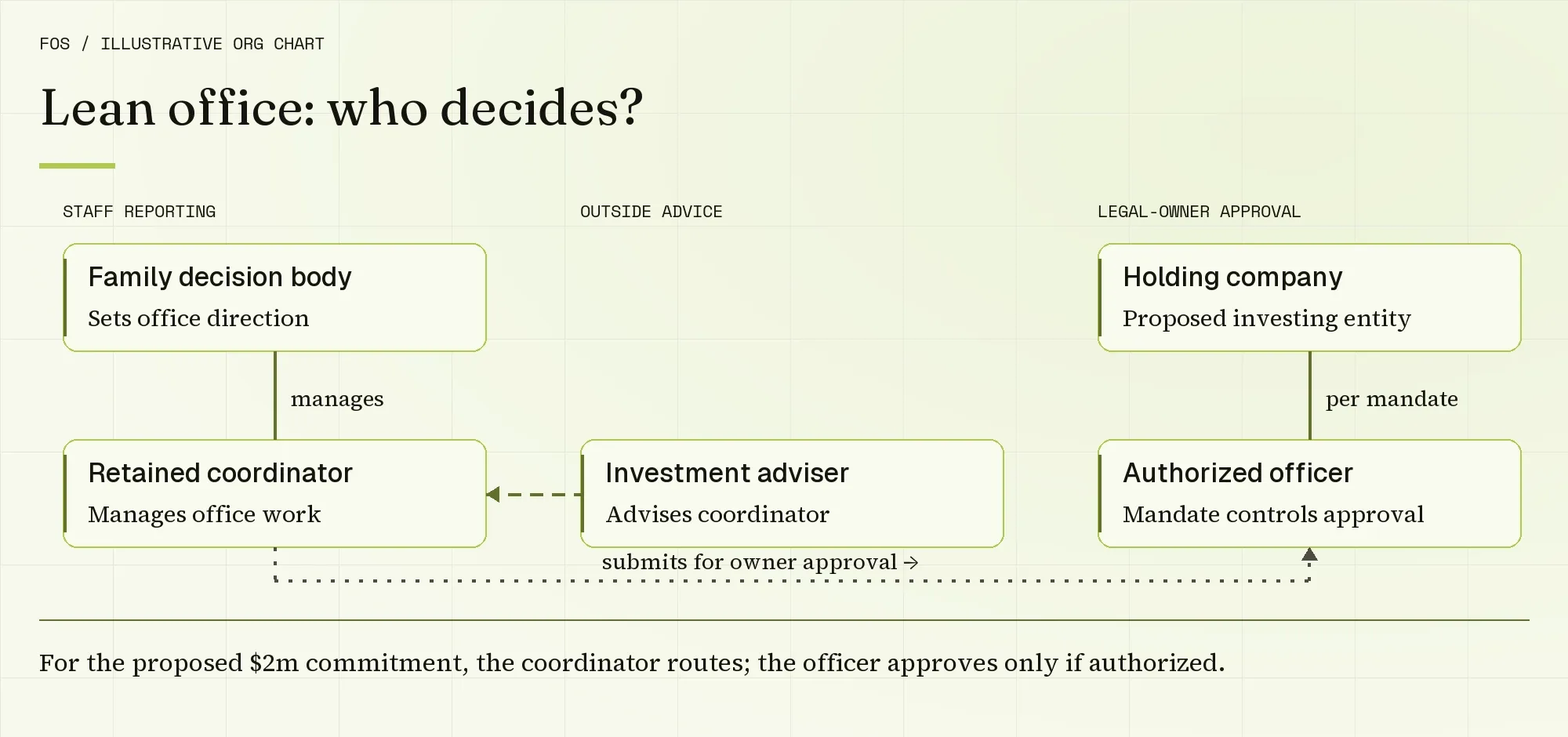
View the full-width desktop version. Read the labels as well as the lines: the solid staff link means manages; the solid owner link identifies an officer whose power exists only per mandate. The dashed link means outside advice. The dotted route submits a proposal to the officer; it does not delegate approval. Check actual powers against the holding company's documents.
An illustrative lean chart could read:
Family principals / decision body manage the retained coordinator. The coordinator contracts with an accounting and administration service and receives advice from an investment adviser. Trustees or entity officers act for the legal owners they represent. Those service and authority lines are separate from employment reporting.
For each service, add a contact, contract owner and substitute. Bank of America Private Bank treats outsourcing as a choice involving expertise, privacy, operating risk and backup capacity, not merely a lower-payroll shortcut. In a lean chart, the family must be able to see which work remains with it after outsourcing.
The chart is lean when the work is scoped and the retained coordinator can follow it through. It is fragile when a provider owns only its task and no one owns the handoff between providers.
03A Staffed Office Chart
A staffed office may have a family board or principal appoint a head of office, who manages investment, finance and operations leads. Legal, tax, technology, philanthropy and household work may be employed, outsourced or shared across roles. The diagram should reflect actual staffing, not aspirational titles.
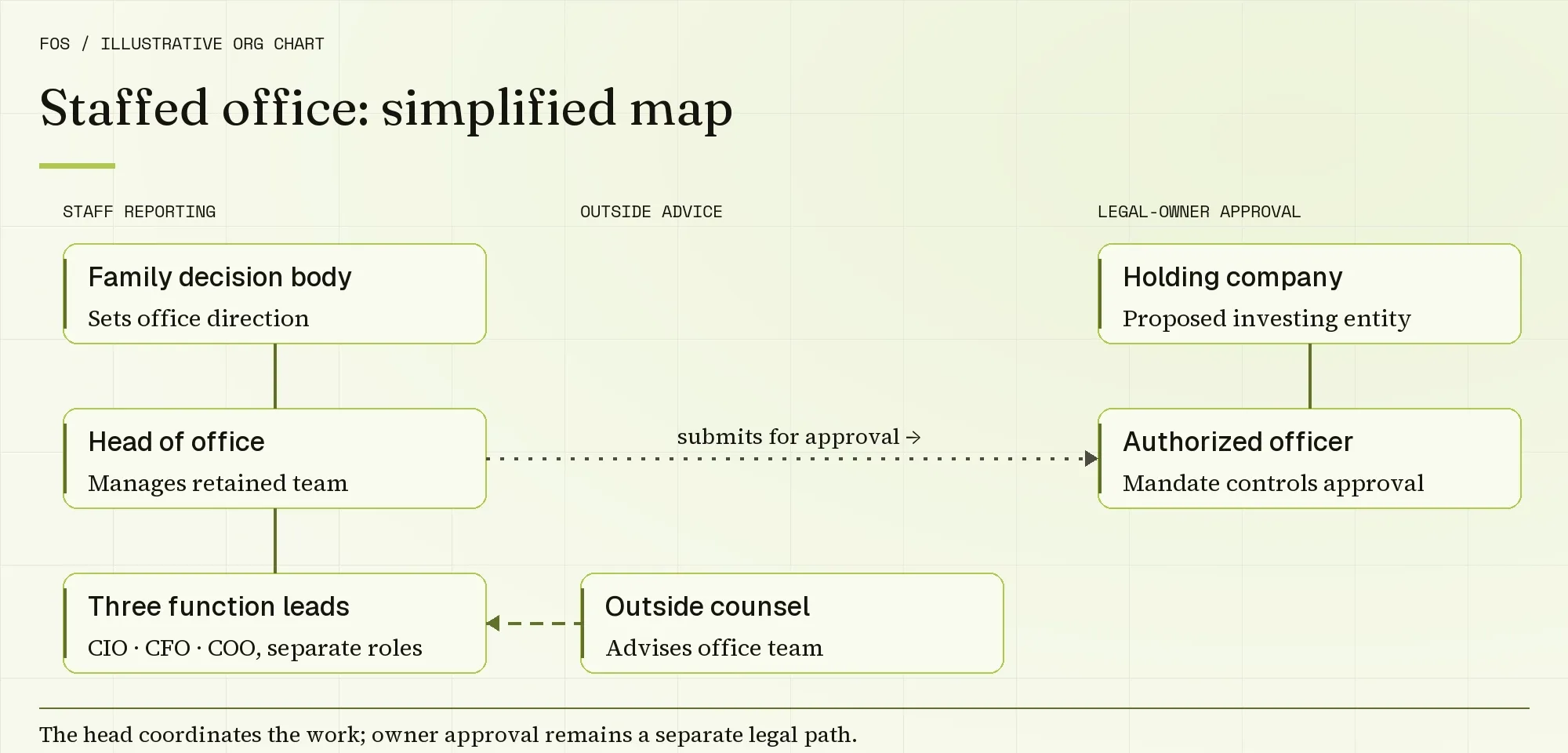
View the full-width desktop version. The CIO, CFO and COO are three separate roles grouped in one box for space. The solid staff links mean manages; the solid owner link means authority only per mandate. The dashed link means outside advice. The dotted route submits the head of office's proposal to the company officer; it does not grant approval. Replace each box with the actual owner, role and delegated limit.
The staffed counterpart keeps those relationships separate too:
- Management: the family decision body manages the head of office, who manages the CIO or investment lead, CFO or finance lead, and COO or operations lead. Analysts or external managers support the CIO; accountants and treasury staff support the CFO; administration and technology staff support the COO.
- Advice: a general counsel or outside law firm advises the relevant lead and legal owner under its actual engagement.
- Owner approval: trustees and company officers act for the trusts or companies whose governing documents empower them. They do not acquire that power from a staff reporting line.
Heidrick's leadership descriptions support this range of roles, but the firm also shows family enterprises that join investment, operations, business ownership and philanthropy in different ways. Hiring a CIO does not transfer a trustee's authority to the CIO. Hiring a CFO does not resolve who approves an investment or signs a bank instruction.
Give every internal role a manager and a backup. Give every approval a threshold, scope, substitute and documented source of authority. If one person prepares and releases the same material payment, write down the compensating review or change the workflow rather than hiding the overlap in an impressive-looking chart.
04Trace One Decision Through Both Charts
Suppose a family is considering a US$2 million direct-investment commitment from a holding company, with the entire amount due at an illustrative 30 October 2026 closing. There are no later capital calls in this example. The opportunity is hypothetical; the family has not approved it and the company documents have not been reviewed.
The holding company's illustrative 21 October 2026 bank balance is US$3.0 million. Subtract US$600,000 of obligations due before the next expected inflow and a US$300,000 minimum cash reserve: US$2.1 million remains available on those assumptions. A US$2 million closing payment would leave only US$100,000 before transaction costs.
That 21 October calculation is a planning check, not clearance for a 30 October payment. Before releasing an instruction, refresh the owner account's balance, due obligations, reserve, restrictions and known closing costs as of closing. Spendable cash after obligations and reserve must cover the US$2 million payment plus those costs. For example, if nothing else changes, US$80,000 of costs leaves US$20,000; US$120,000 of costs creates a US$20,000 shortfall. A shortfall or newly identified restriction means hold the instruction and re-plan funding.
Trace the same six steps through either office design:
| Step | Lean office: named role to confirm | Staffed office: named role to confirm | Evidence before the next step |
|---|---|---|---|
| Recommend | External investment adviser, with coordinator routing the proposal. | CIO or investment team. | Written thesis, risks, conflicts and fit with the owner's policy. |
| Check cash and owner | Outsourced accountant or bank contact, reviewed by the coordinator. | CFO or treasury lead. | 21 October plan: owner-level US$3.0m less US$0.6m obligations and US$0.3m reserve = US$2.1m before costs. Before release on 30 October: refresh owner-account cash, obligations, reserve, restrictions and all known costs; hold unless spendable cash covers US$2m plus costs. |
| Approve commitment | Authorized holding-company decision-maker under its governing documents and delegation. | The same legal-owner authority; a family investment committee may recommend or approve only if its mandate says so. | Minute, consent or other approval record showing the US$2m amount, owner and conditions. Record the named governing document, delegated limit, document owner and date checked; “to verify” means hold. |
| Sign the obligation | Named holding-company signatory, after the coordinator obtains documented legal and finance clearance. | Named holding-company signatory, after legal and finance checks. | Executed agreement, signatory authority and closing conditions; approval alone is not a signature. |
| Fund at closing | Authorized account user prepares; another authorized person reviews or releases as required by the account rules. | Treasury or operations prepares; authorized signatory releases under the account rules. | Dated US$2m instruction, verified payee, matched agreement and bank release record. |
| Record and report | Accounting provider posts and reconciles; family-side reviewer receives the report and any open exceptions. | Accounting team reconciles; delegated report reviewer signs off. | Owner-level entry, payment evidence and a dated report with open items. |
The titles differ; the transaction questions do not. A committee's recommendation can be useful without being the holding company's legal approval. Creative Planning distinguishes family direction from investment decision bodies; WE Family Offices discusses the tradeoff between committee deliberation and delegated speed. Neither source tells this family who has authority under its own documents.
Use this record to adapt the chart to a real decision. Fill it with actual people and documents, not job titles alone:
| Decision-rights field | Illustrative case | Your office |
|---|---|---|
| Owner, amount and due date | Holding company; US$2m due 30 October 2026. | [Entity, amount, date] |
| Recommender and cash checker | Investment adviser; accountant or CFO checks US$2.1m available before costs. | [Names and dated cash source] |
| Approver, limit and authority source | Authorized company decision-maker; governing mandate and threshold to verify—hold. | [Name, limit, governing document, document owner, date checked, verified/hold status] |
| Agreement signer and conditions | Company signatory; executed agreement and closing conditions to verify. | [Name and evidence] |
| Payment preparer, verifier and releaser | Named account users under bank rules; payee independently verified. | [Names, current bank mandate, document owner, date checked, verified/hold status] |
| Reconciler, report reviewer and backup | Accounting provider or team; family-side reviewer; named substitutes. | [Names and open-item record] |
Stop if the owner, close-day cash evidence, approval or signing mandate, or verified payment instruction is missing. A placeholder marked “to verify” is a hold, not an approval. The coordinator or head of office should record the exception and name who can resolve it.
05Where Outside Advisers and Trustees Sit
Put outside professionals beside the function they advise, with a dashed or otherwise labelled advisory connection. Do not draw them beneath the COO as though employment reporting and contracted advice were the same relationship. The chart should show who requests their work, who receives it, and whether advice is required before a decision.
Trustees require particular care. They may be family members, professional firms or officers of a private trust company. Before drawing an approval or bank-instruction line, ask counsel to check the relevant trust instrument and governing state law. Mark each trust and its fiduciary relationship separately where it affects account or asset decisions; one generic trustee box could otherwise appear to authorize every trust.
The same separation applies to outside managers and custodians. A manager may recommend or execute within a discretionary mandate; a custodian follows account instructions. The office should record which mandate applies to which owner, how a conflict is escalated and who can replace an unavailable contact. This is an operating map, not a substitute for legal review.
06Check the Chart Before Hiring
Use the draft chart as an acceptance test with the people who will actually perform the work. Start with a decision and trace it from request to approved report. Ask five concrete questions:
- Who is the legal owner and what document gives each approver authority? Do not assume family seniority, a committee title or an employment line supplies it.
- Who is accountable for each handoff? Name the person who receives advice, checks completeness and escalates delay.
- Who can prepare, review and release money movement? Record the actual bank and entity rules, plus an independent check where the risk requires one.
- Who takes over during absence or turnover? Test document access and a named substitute, not only a dotted line on a slide.
- What evidence closes the loop? Require source records, decision minutes, reconciled entries and a dated report with exceptions still visible.
If those answers fit on the chart and survive one real workflow, the next hire or provider scope becomes clearer. A lean office may need a stronger coordinator rather than a new C-suite layer. A staffed office may need a clean delegation and cover arrangement rather than another senior title. Redraw the chart whenever the legal owners, mandates or retained services change; the version in use should match the work people are authorized to do.
 Knowledge & Decision · Analysis
How Much Net Worth Do You Need for a Family Office, and When Should You Start?
What family office wealth figures mean, how location-specific rules differ, and how to test costs, cash and service… Knowledge & Decision · Analysis
What Is a Single-Family Office? Services, Costs and Fit
A single-family office serves one family through a dedicated organization. See its services, staffing, costs and when another… Knowledge & Decision · Analysis